

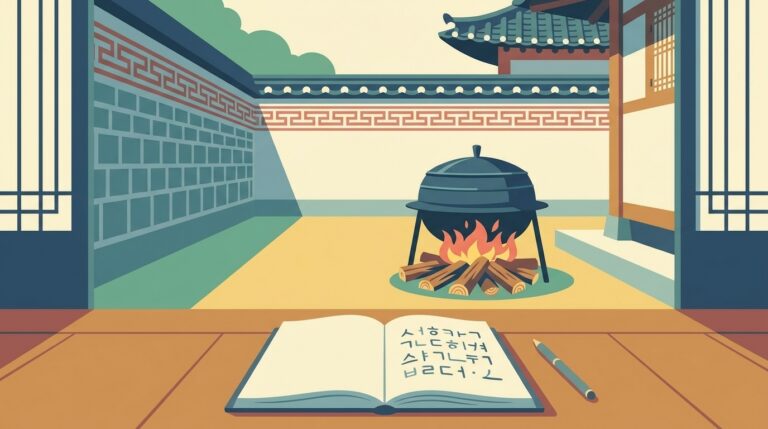
Phase 1: 공감 (Immersive Storytelling Opening)
안녕하세요! 매일한글 에디터입니다. (Annyeonghaseyo! It’s your Daily Hangul editor here.)
Picture this classic K-Drama corporate scene: the emergency conference room in a drama like Misaeng or Search: WWW is in total chaos. A critical system crash has frozen nationwide logistics. The anxious junior manager bursts in, announcing that they just issued a 10% coupon pop-up to pacify angry users. The seasoned Director sighs deeply, sets down his lukewarm espresso, and mutters: “그건 그냥 양탕지비(揚湯止沸)에 불과하잖아. 불을 끌 생각을 해야지!” (That is nothing more than stirring boiling water. You should think about putting out the fire!).
Have you ever found yourself in an advanced Korean discussion where you desperately wanted to say, “That’s just treating the symptom, not curing the disease,” but ended up stuck with basic vocabulary like “그건 진짜 해결이 아니에요” (Geugeon jinjja haegyeori anieyo)? At the C1 level, expressing the subtle tension between a superficial patch and a systemic, root-cause solution is an essential milestone. Today’s guide is built straight from real feedback gathered from our advanced learners navigating boardroom debates, graduate seminars, and editorial discussions in Seoul. By the end of this guide, you will wield the philosophical depth of classic four-character idioms (Sajaseong-eo) to dissect complex issues like an articulate cultural insider.
Phase 2: 핵심 표현 3선 심층 분석 (Core Expressions Deep Dive)
1. 양탕지비 (Yang-tang-ji-bi / 揚湯止沸)
- Pronunciation: [Yang-tang-ji-bi] (Sounds like “Yahm-tahng-jee-bee” with a sharp, crisp cadence on tang).
- Meaning: Literally “Scooping up and pouring back boiling water to stop it from boiling.” Nuance: A futile, cosmetic intervention that tackles immediate symptoms while ignoring the blazing heat source.
- K-Culture Moment: Seen in political and investigative thrillers (e.g., Stranger / Secret Forest) when detectives criticize politicians who merely replace a departmental spokesperson to hush a whistleblower scandal.
- Editor’s Insight: The character 揚 (yang) means to lift or stir, 湯 (tang) means hot soup/boiling liquid, 止 (ji) means stop, and 沸 (bi) means boil. It conveys mild intellectual frustration towards naive management decisions.
- Situation Spectrum: Casual 🚫 | Semi-formal ⚠️ | Formal/Editorial ✅
- 🤔 Think About It: Does your native tongue distinguish between a “band-aid fix” and the visual absurdity of stirring boiling water? How does the culinary metaphor reflect Korea’s traditional hearth culture?
2. 발본색원 (Bal-bon-saek-won / 拔本塞源)
- Pronunciation: [Bal-bon-saeg-won] (Think of “Bahl-bohn-saig-wuhn”; stress the decisive Bal).
- Meaning: Literally “Uprooting the tree trunk and plugging up the water’s source.” Nuance: Eradicating a problem completely down to its very origin so it can never resurrect.
- K-Culture Moment: Frequently headlined on Korean evening news broadcasts during special audits targeting systemic financial crimes or corrupt chaebol cartels.
- Editor’s Insight: This is the ultimate antonym to 양탕지비. While 양탕지비 scolds superficiality, 발본색원 demands surgical, uncompromising elimination of systemic flaws.
- Situation Spectrum: Casual 🚫 | Semi-formal ✅ | Formal/Professional ✅
- 🤔 Think About It: Why does Korean culture revere structural eradication (root and source) rather than incremental compromises during institutional reforms?
3. 하석상대 (Ha-seok-sang-dae / 下石上臺)
- Pronunciation: [Ha-seok-sang-dae] (Pronounce like “Hah-suhk-sahng-deh”).
- Meaning: Literally “Taking the stone from the lower tier to shore up the upper tier.” Nuance: Robbing Peter to pay Paul; patching one temporary crisis by creating an even deadlier crisis elsewhere.
- K-Culture Moment: Heard in financial sitcoms or startup dramas like Start-Up when founders burn through employee pension reserves to pay off immediate vendor interest.
- Editor’s Insight: It emphasizes systemic decay. Unlike 양탕지비 (which is just useless stirring), 하석상대 actively destabilizes the entire foundation.
- Situation Spectrum: Casual ⚠️ | Semi-formal ✅ | Formal/Professional ✅
- 🤔 Think About It: In fast-paced urban environments, why do organizations so easily fall into the trap of Haseoksangdae despite knowing the eventual collapse?
Phase 3: 교과서 한국어 vs 진짜 한국어 (Textbook vs. Native Idiomatic)
Situation 1: Calling out a superficial sales patch in a strategy sync
- 📖 교과서 한국어 (Textbook):
- “이 방법은 임시적인 대책이라서 근본 문제를 해결하지 못합니다.” (I bangbeobeun imsijeogin daechaegiraseo geunbon munjereul haegyeolhaji mothamnida. – This method is a temporary measure, so it cannot solve the root problem.)
- 🗣️ 진짜 한국어 (Real Native C1):
- “이건 아랫돌 빼서 윗돌 괴는 격이라, 결국 양탕지비로 끝날 공산이 커요.” (Igeon araetdol ppaeseo witdol goeneun gyeogira, gyeolguk yangtangjibiro kkeutnal gongsani keoyo. – This is like robbing Peter to pay Paul; high chances are it will just end up treating the symptom while ignoring the cause.)
- 💡 왜 다를까? (Why the Difference?): Advanced native speakers rarely describe abstract concepts with flat adjectives like “임시적인” (temporary). Instead, they juxtapose vivid idioms (아랫돌 빼서 윗돌 괴다 + 양탕지비) with high-register prognostic markers like ~할 공산이 크다 (high probability).
Situation 2: Demanding structural reform during a crisis retrospection
- 📖 교과서 한국어 (Textbook):
- “우리는 다음부터 이런 일이 없도록 원인을 철저하게 찾아야 합니다.” (Urineun daeumbuteo ireon iri eopdorok wonineul cheoljeohage chajaya hamnida. – We must thoroughly find the cause so this doesn’t happen next time.)
- 🗣️ 진짜 한국어 (Real Native C1):
- “땜질식 처방은 접어두고, 이번 기회에 환부를 발본색원해야 합니다.” (Ttaemjilsik cheobangeun jeobeodugo, ibeon gihwoee hwanbureul balbonsaekwonhaeya hamnida. – Let’s set aside patch-up remedies and use this opportunity to excise the core rot at its source.)
- 💡 왜 다를까? (Why the Difference?): Sophisticated speakers frame stopgap fixes as “땜질식 처방” (tinkering/soldering prescription) and metaphorize systemic flaws as “환부” (infected flesh/affected area) paired with “발본색원”.
Phase 4: K-Culture 딥다이브 & 비언어적 매너 (Deep Dive & Non-Verbal Nuance)
4-1. 눈치 (Nunchi) & Crisis Decorum
When critiquing a superior’s or client’s proposed plan as “양탕지비”, direct confrontation violates Korean workplace harmony (Hwa). Instead of pointing a finger or leaning forward aggressively:
* The Cautious Head Tilt: Slightly tilt your head about 10 degrees, soften your gaze downward toward the meeting agenda sheet, and introduce your critique with a modest hedge: “외람된 말씀이지만…” (Oeramdoen malsseumijiman… – It may be presumptuous of me, but…).
* The Open-Hand Restraint: Avoid chopping the air. Rest both palms lightly facing down on the conference table. This non-verbal anchor communicates, “I am questioning the strategy, not your authority.”
4-2. Cultural Code: The Tension Between ‘빨리빨리’ and ‘발본색원’
Korea’s compressed economic modernization created an instinctive pride in Ppalli-ppalli (fast-paced execution). When a fire breaks out, the immediate instinct is to stir the cauldron or patch the leak within hours. However, contemporary K-society—from tech mega-unicorns in Pangyo to public policy debates—now experiences severe fatigue from repeated Injae (man-made systemic failures). Demonstrating the intellectual foresight to resist premature patches and advocate for foundational redesign (Balbonsaekwon) commands immense respect in Korean intellectual and corporate circles.
Phase 5: 실전 롤플레이 시나리오 (Real-Life Roleplay Scenario)
- Setting: Late evening in a glass-walled conference room at a Pangyo fintech enterprise. A critical database deadlock keeps crashing the checkout gateway on Black Friday.
- Characters:
- 팀장 박성현 (Team Leader Park Sung-hyun): Exhausted, under immense executive heat, seeking an immediate quick patch.
- 수석 엔지니어 민지 (Senior Engineer Minji): Methodical, protective of systemic integrity, aiming for root-cause resolution.
- 박 팀장 (Park Team Leader): 민지 씨, 일단 트래픽 리밋 걸고 캐시 서버 재부팅해서 넘깁시다. 고객 항의가 빗발쳐요! (Minji-ssi, ildan teuraepik rimit geolgo kaesi seobeo jaebuttinghaeseo neomgipsida. Gogaek hang-uiga bitbalchyeoyo! – Minji, let’s just throttle traffic, reboot the cache server, and push through. Customer complaints are pouring in!)
- 민지 (Minji): 🎭 안경을 고쳐 쓰며 차분하게 서류를 가리킨다 (Adjusts glasses calmly and points to the telemetry report) 팀장님, 그건 끓는 국물에 찬물 한 컵 붓는 양탕지비(揚湯止沸)일 뿐입니다. (Timjangnim, geugeon kkeulneun gungmure chanmul han keop bunneun yangtangjibi-il ppunimnida. – Team leader, that is merely pouring a cup of cold water into boiling soup—a temporary stir that doesn’t put out the flame.)
- 박 팀장 (Park Team Leader): 🎭 머리를 쥐어짜며 한숨을 쉰다 (Clutches his forehead and sighs heavily) 그럼 지금 이 상황에서 사이트를 셧다운이라도 하자는 겁니까? (Geureom jigeum i sanghwang-eseo saiteureul syeotdaun-irado hajaneun geomnikka? – Then are you suggesting we shut down the site altogether in this situation?)
- 민지 (Minji): 결제 락(lock) 로직의 인덱스 충돌을 발본색원(拔本塞源)하지 않으면 10분 뒤에 또 다운됩니다. (Gyeolje rak rojik-ui indekseu chungdoreul balbonsaekwon-haji aneumyeon sip-bun dwie tto daunjimnida. – Unless we eliminate the index collision in the transaction lock logic at its root, it will go down again in ten minutes.)
- 박 팀장 (Park Team Leader): 당장 임원진 보고는 어쩌고요? 아랫돌 빼서 윗돌 괴는 격이라도 일단 버텨야 해요! (Dangjang imwonjin bogoneun eojjeogoyo? Araetdol ppaeseo witdol goeneun gyeogirado ildan beotyeoya haeyo! – What about our report to the executives right now? Even if we have to rob Peter to pay Paul, we must endure right now!)
- 민지 (Minji): 🎭 단호하지만 나직한 목소리로 (In a firm yet low, respectful tone) 미봉책으로 덮었다가 자정에 데이터 무결성이 깨지면 전원 문책당합니다. (Mibongchaegeuro deopeotdaga jajeong-e deiteo mugyeolseong-i kkaejimyeon jeonwon munchaekdanghamnida. – If we cover it with a stopgap and data integrity collapses at midnight, our whole team will be reprimanded.)
- 박 팀장 (Park Team Leader): 🎭 벽면 모니터의 오류 로그를 응시한다 (Stares intently at the error logs on the wall monitor) …근본 작업에 얼마나 걸립니까? (…Geunbon jag-eobe eolmana geollimnikka? – …How long will the root-cause work take?)
- 민지 (Minji): 딱 20분 주십시오. 장작불부터 끄겠습니다. (Ttak isip-bun jusipsio. Jangjakbulbuteo kkeugessumnida. – Give me exactly twenty minutes. I’ll extinguish the firewood first.)
🔀 인터랙티브 분기점 (Interactive Fork)
How should Minji reply if Director Park insists on rebooting immediately?
- Option A: “팀장님 생각이 정 그렇다면 시키는 대로 리부팅하겠습니다.” (If that’s what you think, I’ll just reboot as told.)
- Outcome (Bad): Complete loss of professional authority. The site crashes again during prime shopping hours; Minji shares blame for passive compliance.
- Option B: “지금 양탕지비 식 대증요법을 강행하시면 전 이 사태에 대한 면책 합의서 써주셔야 합니다.” (If you enforce this symptomatic fix, you must sign an indemnity waiver for me.)
- Outcome (Risk): Extremely aggressive. Destroys the hierarchical trust (In-hwa) and alienates the team leader despite being technically right.
- Option C: “팀장님의 심정은 십분 이해합니다만, 5분만 격리 패치를 적용할 시간을 주시면 근본 리스크를 차단하겠습니다.” (I completely understand your urgency, but if you grant me just 5 minutes for an isolated patch, I will neutralize the systemic hazard.)
- Outcome (Best): Diplomatic perfection! Validates executive anxiety while defending structural rigor. Demonstrates top-tier Nunchi.
Phase 6: 10초 감정 섀도잉 드릴 (10-Second Emotional Shadowing Drill)
Practice these natural cadences. Follow the stress markers and pauses (/):
- [🧐 지적이면서도 정중하게 / Intellectual & Courteous]
- “국자를 / 아무리 저어봤자 / 밑에 불을 끄지 않으면 / 양탕지비일 뿐입니다.”
- (Gukjareul / amuri jeo-eobatja / mite bureul kkeuji aneumyeon / yangtangjibi-il ppunimnida.)
- Meaning: No matter how much you stir with a ladle, if you don’t douse the fire underneath, it’s merely Yangtangjibi.
- [😤 결연하고 확신에 차서 / Resolute & Convincing]
- “언 발에 오줌 누기 식 조치는 / 이제 그만두고 / 이번에야말로 / 발본색원합시다.”
- (Eon bare ojum nugi sik jochineun / ije geumandugo / ibeon-eyamallo / balbonsaekwon-hapsida.)
- Meaning: Let’s stop these pee-on-frozen-feet stopgaps, and root it out entirely once and for all.
- [😮💨 답답하지만 차분한 조언 / Frustrated yet Sober Advisory]
- “그건 / 아랫돌 빼서 윗돌 괴는 격이라 / 머지않아 / 더 큰 붕괴로 이어집니다.”
- (Geugeon / araetdol ppaeseo witdol goeneun gyeogira / meojian-a / deo keun bung-goero ieojimnida.)
- Meaning: That is like robbing Peter to pay Paul; before long, it will cause an even greater collapse.
Phase 7: K-Culture 미니 사전 (Mini Dictionary)
- 미봉책 (Mi-bong-chaek / 彌縫策)
- Translation: Stopgap measure / Patchwork policy.
- Usage: Widely used in news editorials and strategy meetings when criticizing short-sighted policies that merely sew over a tear temporarily.
- 대증요법 (Dae-jeung-yo-beop / 對症療法)
- Translation: Symptomatic therapy / Treating symptoms rather than root pathology.
- Usage: Originating from medicine, heavily adopted in startup operations to denote addressing client fallout rather than software bug origins.
- 발본색원 (Bal-bon-saek-won / 拔本塞源)
- Translation: Root-and-branch eradication.
- Usage: Used when announcing internal audits, complete rewrites of buggy legacy software, or organizational restructuring.
- 언 발에 오줌 누기 (Eon bar-e ojum nugi)
- Translation: Peeing on frozen feet (Native Korean proverb).
- Usage: The colorful, down-to-earth idiomatic counterpart of 양탕지비. It warms your frozen feet for ten seconds before freezing them into solid blocks of ice.
Phase 8: 여행자를 위한 생존 키트 (Survival Kit for Navigators)
Real-World Practical Expressions TOP 3
- “임시방편 말고 근본적인 해결책이 필요해요.”
- (Imsibangpyeon malgo geunbonjeogin haegyeolchaegi piryohaeyo.)
- Pro Tip: Use this at an Airbnb, hotel front desk, or electronics repair center in Yongsan when a staff member gives an intermittent workaround that keeps failing.
- “이러면 나중에 다시 문제 되지 않을까요?”
- (Ireomyeon najung-e dasi munje doeji aneulkkayo?)
- Pro Tip: A polite, indirect way to point out a superficial fix without sounding confrontational.
- “원인을 확실히 확인하고 조치해 주세요.”
- (Wonineul hwaksilhi hwaginhago jochihae juseyo.)
- Pro Tip: The golden sentence when dealing with car mechanics, repair technicians, or dental clinics in Korea.
Editor’s Travel & Life Note
When navigating technical repairs or booking customer inquiries during your Korean stay, avoid relying on automatic text translations that sound robotic. Check transit schedules or report issues accurately by consulting the 네이버 지도 앱 다운로드 platform for verified repair hubs and community-rated centers with English service.
Phase 9: “한 발 더 깊이” (Cultural Contemplation)
Korean architectural traditions construct wooden structures (Hanok) through sophisticated joinery without using a single nail; if a foundation stone shifts, the master carpenter does not simply drive a wedge into the beam—he disassembles the joint to rebalance the ground pillar. Yet, modern Korea’s blistering trajectory through the Miracle on the Han River forged a conflicting instinct: the pressure to produce instant visible outcomes (Seonggwa-juui). The idiom 양탕지비(揚湯止沸) captures the enduring philosophical critique of this modern rush. It reminds us that whether in personal life, software architecture, or romance, frantically stirring the broth only burns more energy; true wisdom lies in stepping back to douse the firewood.
💬 Your Turn: Have you ever used a temporary patch (Yangtangjibi) in your work or language study instead of solving the fundamental obstacle? Share your thoughts below in Korean or English!
Phase 10: FAQ & 오해 방지 (FAQ Schema)
Q: Can I use 양탕지비 directly to my Korean professor or corporate boss?
A: You should exercise caution. While it is a sophisticated literary idiom, applying it directly to a superior’s decision (e.g., “교수님 의견은 양탕지비입니다”) sounds accusatory. Instead, contextualize it objectively: “이 방안은 자칫 양탕지비에 그칠 우려가 있습니다” (This plan raises concerns of merely becoming a temporary measure).
Q: What is the core difference between 미봉책 (Mibongchaek) and 양탕지비 (Yangtangjibi)?
A: Mibongchaek (sewing up seams) focuses on sewing over an unsightly tear to hide it temporarily. Yangtangjibi (stirring boiling broth) specifically emphasizes the futility of high-energy intervention that ignores the thermal power source underneath.
Q: Is ‘언 발에 오줌 누기’ considered rude because it mentions urine?
A: Not at all! It is an ancient, standard folk proverb (Sokdam). However, in formal boardrooms or academic papers, people prefer the refined Sino-Korean four-character idioms like Yangtangjibi or Haseoksangdae.
🚨 흔한 실수 (Common Mistakes) Checklist
- ❌ Mistake 1: Using 양탕지비 to describe someone who is physically boiling food in a kitchen restaurant.
- 👉 Correction: It is exclusively a metaphorical critique of flawed problem-solving strategies, never a culinary instruction.
- ❌ Mistake 2: Confusing 하석상대 (robbing bottom stones to support top stones) with harmless multitasking.
- 👉 Correction: Haseoksangdae always carries a foreboding tone of imminent systemic disaster.
- ❌ Mistake 3: Pronouncing 발본색원 as Bal-bon-saek-won with a soft won without linking sounds.
- 👉 Correction: Pronounce it smoothly as [발본새권 / Bal-bon-sae-gwon].
Phase 11: 액션 미션 & 참여 유도 (Action Missions)
- 🥉 Bronze Level: Write down the 4 characters of 揚湯止沸 (양탕지비) in your notebook and repeat the Phase 6 Shadowing Drill 3 times with recorded audio.
- 🥈 Silver Level: Craft an original sentence on Instagram or Threads contrasting a superficial diet trend with sustainable health using “미봉책” or “양탕지비”. Tag
#DailyHangulC1. - 🥇 Gold Level: In your next advanced Korean conversation or essay, replace basic words like “임시 대책” with “양탕지비 식 대증요법” (Yangtangjibi-style symptomatic treatment) to defend a strategic decision.
- 🎮 K-Culture Mission: Watch an episode of a political/legal K-Drama (Vincenzo, Hyena, or Stranger). Spot the scene where an executive crisis meeting scrambles for a cover-up, and pinpoint whether they commit Yangtangjibi or Balbonsaekwon!
Phase 12: 인터랙티브 퀴즈 챌린지 (Interactive Quiz)
Quiz 1. 상황 판단 (Situational Judgment)
A company discovers that customers are abandoning their shopping carts because the checkout page takes 15 seconds to load. Management decides to place a humorous animated GIF on the loading screen to entertain users instead of optimizing server queries. What idiom best critiques this action?
(A) 발본색원 (Balbonsaekwon)
(B) 양탕지비 (Yangtangjibi)
(C) 유비무환 (Yubimuhwan)
🔍 정답 및 해설 보기 (Click to reveal answer)
정답: (B) 양탕지비
해설: Placing an animated cartoon on a sluggish checkout page is the textbook definition of stirring boiling water while leaving the heat on—distracting from the symptom while the core engineering failure remains untouched.
Quiz 2. 빈칸 채우기 (Fill in the Blank)
다음 문장의 빈칸에 가장 어울리는 사자성어를 고르세요:
“단기 대출로 기존 부채의 이자만 갚아나가는 것은 결국 _________________에 불과하여 파산을 늦출 뿐이다.”
(Paying off old debt interest solely with short-term loans is merely _______, only delaying bankruptcy.)
🔍 정답 및 해설 보기 (Click to reveal answer)
정답: 하석상대 (下石上臺 / Haseoksangdae)
해설: Pulling stones from the foundation to prop up the crumbling roof represents borrowing more money to plug current debt holes, ultimately ensuring full structural collapse.
Quiz 3. True / False 문화 퀴즈
True or False: In high-stakes Korean corporate governance, calling an executive’s initiative 발본색원 (Balbonsaekwon) is considered an insult.
🔍 정답 및 해설 보기 (Click to reveal answer)
정답: False
해설: Balbonsaekwon is a high compliment signifying radical, thorough, and principled courage to eradicate root problems once and for all.







