

안녕하세요! 매일한글 에디터입니다.
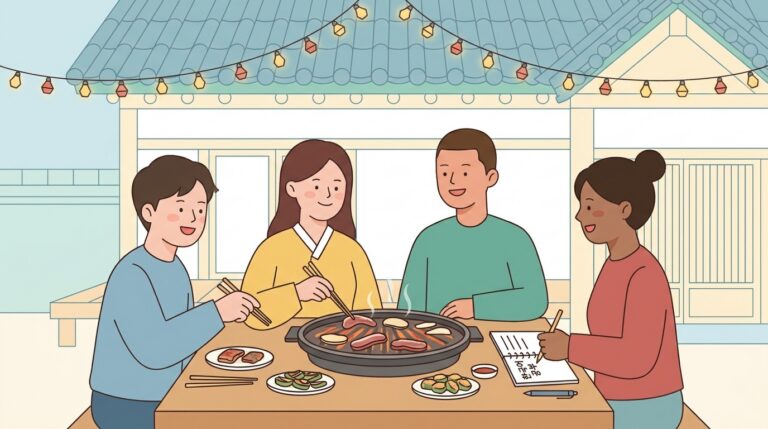
Imagine this: You have just checked into a vibrant seaside guesthouse in Gangneung or Jeju Island after a long day of solo exploring. The sun has dipped below the horizon, fairy lights flicker on over the outdoor patio, and the mouthwatering aroma of sizzling pork belly (samgyeopsal) fills the evening air. The guesthouse host announces, “Party is starting!” Everyone starts gathering around long wooden picnic benches in pairs and groups, laughing and opening chilled bottles of cider and beer. You step outside holding your plate, your heart pounding a little. You desperately want to join in, sit down, and make local Korean friends—yet your mind freezes. What do you say first? Do you use stiff textbook grammar like “Dangsin-eun eodi-eseo wassseumnikka?” (which sounds like an immigration officer interrogation!), or do you just smile awkwardly and stare at your phone?
If you have ever felt that cold sweat of social anxiety abroad, take a deep breath. Over the past decade of coaching foreign travelers, I have seen dozens of learners transform from wallflowers into the life of the guesthouse table with just three or four warm, natural, and polite A2-level phrases. Tonight, we are going to unlock the exact conversational keys that turn curious strangers at a Korean guesthouse party into lifelong travel buddies. Let’s dive in!
Phase 2: Core Expressions Deep Dive
1. 여기 앉아도 돼요? (Yeogi anjado dwaeyo?)
- Pronunciation: Yeo-gi ahn-jah-doh dway-yo? (Think: “Yo-gee” + “on-jah” + “dough” + “dway-yo”)
- Meaning: Literal: “Is it okay even if I sit here?” | Actual Nuance: “Do you mind if I sit here?” or “Is this seat taken?”
- K-Culture Moment: In popular youth dramas like Weightlifting Fairy Kim Bok-joo or travel reality shows like Youth Over Flowers, you will always hear a traveler approach a communal bench with a bright smile and this exact phrase.
- Editor’s Insight: The ending -도 돼요? (-do dwaeyo?) is the ultimate polite formula in Korean for asking permission. It sounds humble, relaxed, and extremely welcoming without being overly stiff.
- Situation Spectrum: Casual ⚠️ | Semi-formal/Polite ✅ | Formal ⚠️
- 🤔 Think About It: In English, we often ask “Is anyone sitting here?” focusing on the empty chair. Korean phrasing focuses directly on action and mutual comfort (“May I sit?”). How does asking permission directly change the friendliness of a first impression?
2. 어디서 오셨어요? (Eodiseo osyeosseoyo?)
- Pronunciation: Uh-dee-suh oh-shyeoss-uh-yo? (Sounds like “Uh-dee-saw” + “oh-shuss-uh-yo”)
- Meaning: Literal: “From where did you come?” | Actual Nuance: “Where are you visiting from?” or “Where is your hometown?”
- K-Culture Moment: At any Korean guesthouse (게하 – ge-ha) barbecue night, this is always question number one! Since travelers gather from Seoul, Busan, Daegu, and across the globe, it is the universal icebreaker.
- Editor’s Insight: Notice the honorific -셨- (-syeoss-). Even though guesthouse parties are informal, using this respectful past-tense marker shows immediate social intelligence and good manners toward new acquaintances.
- Situation Spectrum: Casual ⚠️ | Semi-formal/Polite ✅ | Formal ✅
- 🤔 Think About It: Koreans rarely start small talk with the weather. Instead, they ask about your origin, your travel path, and what delicious food you ate today. How does starting with origin build faster social bonds?
3. 우리 짠해요! (Uri jjanhaeyo!)
- Pronunciation: Oo-ree jjan-hae-yo! (Rhymes with “Ooh-ree” + crisp “Jjan” like a bell + “hae-yo”)
- Meaning: Literal: “Let’s do ‘jjan’!” | Actual Nuance: “Let’s clink glasses!” / “Cheers, everyone!”
- K-Culture Moment: You will hear this in every Korean variety show featuring dinner parties. When someone lifts their glass, shouting “Jjan!” instantly bridges any age or language gap at the table.
- Editor’s Insight: While the formal word for cheers is Geonbae (건배), younger crowds and guesthouse party-goers love the onomatopoeic word Jjan (짠), which mimics the ringing sound of glass cups touching.
- Situation Spectrum: Casual ✅ | Semi-formal/Polite ✅ | Formal 🚫
- 🤔 Think About It: “Jjan” is about synchronous connection—everyone must touch glasses at the exact same moment before taking a sip. Notice how it creates an instant team feeling!
Phase 3: Textbook Korean vs. Real Korean
Situation 1: Asking where someone traveled from
- 📖 교과서 한국어 (Textbook): 당신의 고향은 어디입니까? (Dangsin-ui gohyang-eun eodi-imnikka? – “Where is your hometown, thou?”)
- 🗣️ 진짜 한국어 (Real-life): 어디서 오셨어요? (Eodiseo osyeosseoyo? – “Where did you come from?”)
- 💡 왜 다를까? (Why the difference?): The word 당신 (dangsin) in textbook Korean translates to “you”, but in real everyday Korean, saying 당신 to a stranger can sound confrontational or like an interrogation dialogue from an old historical novel! Natural Korean drops “you” completely.
Situation 2: Suggesting a toast at the table
- 📖 교과서 한국어 (Textbook): 다 함께 건배를 합시다. (Da hamkke geonbaereul hapsida. – “Let us perform a toast together.”)
- 🗣️ 진짜 한국어 (Real-life): 우리 짠할까요? (Uri jjan-halkkayo? – “Shall we clink glasses together?”)
- 💡 왜 다를까? (Why the difference?): 건배를 합시다 sounds like a corporate director giving a speech at an end-of-year banquet. 짠할까요? is playful, energetic, and perfectly matches the sizzling barbecue grill vibe.
Phase 4: K-Culture Deep Dive & Non-Verbal Manners
4-1. 눈치 (Nunchi) & The Table Manners Checklist
At a Korean guesthouse party, table manners are not stiff, but observing small non-verbal gestures will earn you instant respect from Korean travelers:
1. The Two-Handed Pour: If someone offers to pour your beverage (whether water, soda, or beer), hold your cup with both hands (or hold the cup with your right hand while lightly supporting your right wrist with your left hand). Nod slightly and say, 감사합니다! (Gamsahamnida!)
2. The Clinking Etiquette: When you clink glasses (짠), if the person is visibly older or the party host, lightly tap the rim of your glass slightly lower than theirs. It is a subtle sign of politeness that local Koreans will instantly notice with a proud smile.
3. Turn Slightly Away: If you are drinking an alcoholic beverage with someone significantly older, it is polite to turn your head slightly to the side when taking a sip.
4-2. Culture Code: The “Ge-ha (게하) Party” Phenomenon
In Korea, guesthouses—especially in coastal hotspots like Jeju Island, Gangneung, and Yangyang—are not just cheap beds; they are vibrant social hubs. Known colloquially as 게하 파티 (Ge-ha Party), these evening barbecues allow solo travelers (혼행족 – hon-haeng-jok) to swap travel tips, share fresh grilled meat, and team up for rental cars or sunrise hikes the next morning. Food is placed in the center of the table and shared communally, so making a wrap (쌈 – ssam) and passing side dishes (반찬 – banchan) is the ultimate friendship currency!
Phase 5: Real-Life Roleplay Scenario
- Setting: An open-air barbecue terrace at a friendly guesthouse in Gangneung. Sizzling grills, ocean breeze, and retro indie music in the background.
- Characters:
- Alex (You): An adventurous solo traveler looking to make local friends.
- Minwoo (민우): A friendly Korean solo traveler from Seoul managing the meat tongs.
Alex: 저기요, 실례지만 여기 앉아도 돼요?
(Jeogiyo, sillyejiman yeogi anjado dwaeyo?)
“Excuse me, do you mind if I sit here?”
🎭 [Appears slightly hesitant, smiling politely, gesturing toward the empty stool]
Minwoo: 아, 네! 앉으세요. 자리 있어요!
(A, ne! Anjeuseyo. Jari isseoyo!)
“Ah, yes! Please sit down. There’s plenty of space!”
🎭 [Smiles warmly, pulling the wooden bench slightly back to make room]
Alex: 감사합니다! 고기 냄새가 진짜 좋아요.
(Gamsahamnida! Gogi naemsaega jinjja joayo.)
“Thank you! The barbecue smells incredible.”
🎭 [Takes a seat, taking off jacket and admiring the grill]
Minwoo: 방금 구웠어요. 먼저 드셔 보세요. 어디서 오셨어요?
(Banggeum gu-weosseoyo. Meonjeo deosyeo boseyo. Eodiseo osyeosseoyo?)
“I just grilled this piece. Try some first! Where did you travel from?”
🎭 [Uses tongs to place a piece of grilled meat onto Alex's side plate]
Alex: 미국에서 왔어요. 한국 여행 처음이에요! 민우 씨는 어디서 오셨어요?
(Miguk-eseo wasseoyo. Hanguk yeohaeng cheo-eum-ieyo! Minwoo ssineun eodiseo osyeosseoyo?)
“I came from the US. It’s my first trip to Korea! Where did you come from, Minwoo?”
🎭 [Holds chest in gratitude, speaking with bright, enthusiastic eyes]
Minwoo: 저는 서울에서 혼자 힐링하러 왔어요. 강릉 바다가 너무 좋더라고요.
(Jeoneun Seoul-eseo honja hilling-hareo wasseoyo. Gangneung badaga neomu joteoragoyo.)
“I came alone from Seoul to unwind. The Gangneung sea is just wonderful.”
🎭 [Pours a fresh glass of cold drink and raises it lightly]
Alex: 맞아요! 우리 시원하게 짠할까요?
(Majayo! Uri siwonhage jjan-halkkayo?)
“Totally agree! Shall we have a refreshing cheers?”
🎭 [Lifts glass with both hands, meeting Minwoo's eyes happily]
Minwoo: 좋아요! 만나서 반가워요, 짠!
(Joayo! Mannaseo bangawoyo, jjan!)
“Awesome! Great to meet you, cheers!”
🎭 [Lightly taps Alex's glass with a resonant clink]
🔀 Interactive Decision Point: What should Alex say next?
- Option A: “삼겹살 진짜 맛있네요! 쌈장 더 필요하세요?” (Samgyeopsal jinjja masinneyo! Ssamjang deo piryohaseyo? – “This pork belly is so delicious! Do you need more ssamjang dipping sauce?”)
- Option B: “나이가 어떻게 되세요? 말 편하게 놓으세요.” (Naiga eotteoke doeseyo? Mal pyeonhage no-euseyo. – “How old are you? Drop honorifics right now.”)
- Option C: “고기 제가 다 먹어도 돼요? 배고파요.” (Gogi jega da meogeodo dwaeyo? Baegopayo. – “Can I eat all this meat? I’m hungry.”)
Feedback:
* Option A is BEST! ⭐: Praising the food and offering to grab sauce from the self-bar shows natural Korean barbecue sharing etiquette. You will be crowned the table favorite in five seconds!
* Option B is RISKY ⚠️: While age determines social hierarchy in Korea, asking for someone’s age within the first two minutes and rushing to drop politeness can feel overly forward for a first impression. Let the conversation warm up first.
* Option C is BAD ❌: Korean BBQ is fundamentally a communal sharing feast. Claiming the meat for yourself ruins the shared Jeong vibe instantly.
Phase 6: 10-Second Emotion Shadowing Drill
Practice these lines out loud! Pay attention to the pauses (/) and the emotional cues:
[😊 Polite & Welcoming]
저기요, / 실례지만 / 여기 앉아도 돼요?
(Jeogiyo, / sillyejiman / yeogi anjado dwaeyo?)-
[🤝 Curious & Friendly]
어디서 / 오셨어요? / 여행 중이세요?
(Eodiseo / osyeosseoyo? / Yeohaeng jung-iseyo?) -
[🎉 Cheerful & Celebratory]
다 같이 / 시원하게 / 짠해요!
(Da gachi / siwonhage / jjanhaeyo!)
Phase 7: K-Culture Mini Dictionary
-
혼행 (Hon-haeng)
Meaning: Solo Travel (Combination of 혼자 [alone] + 여행 [travel]).
Usage: Koreans use this constantly on social media (#혼행) and in guesthouses. If you say, “저 혼행 왔어요” (I’m on a solo trip), people immediately welcome you with extra kindness. -
게하 (Ge-ha)
Meaning: Slang abbreviation for Guesthouse (게스트하우스).
Usage: Very common in everyday youth talk. E.g., “이 게하 파티 진짜 재밌다!” (The party at this guesthouse is so fun!). -
짠 (Jjan)
Meaning: The onomatopoeia for clinking glasses; equivalent to “Cheers!”.
Usage: Use it instead of long formal phrases whenever someone raises a glass. -
쌈 (Ssam)
Meaning: A lettuce or perilla leaf wrap loaded with grilled meat, garlic, and ssamjang paste.
Usage: Food bonding at its peak! Making a big wrap and eating it in one bite is the hallmark of Korean BBQ culture.
Phase 8: Traveler’s Survival Kit
TOP 3 Guesthouse Survival Phrases
- 불판 갈아주실 수 있나요? (Bulpan garajusil su innayo?)
Meaning: Can you please change the grill plate?
Pro Tip: Barbecue grills get charred quickly. Use this phrase with staff to keep your meat tasting clean. - 휴지 어디에 있어요? (Hyuji eodie isseoyo?)
Meaning: Where are the napkins/tissues?
Pro Tip: BBQ tables can get saucy. Finding the paper roll is your first survival skill. - 인스타 맞팔해요! (Inseuta matpal-haeyo!)
Meaning: Let’s follow each other back on Instagram!
Pro Tip: The smoothest way to exchange contacts with new travel friends without asking for private phone numbers.
Editor’s Travel Note 💡
- Navigation Essential: Google Maps is notoriously unreliable for walking routes in South Korea. Be sure to download Naver Map app before checking in so you can locate hidden seaside guesthouses and local grocery marts.
- Night Taxi Tip: Guesthouses are often situated along scenic beaches away from downtown hubs. If you stay out late with your new friends, install Kakao T for late night returns to call certified taxis safely with fixed card payments.
Phase 9: “한 발 더 깊이” (A Deeper Cultural Reflection)
In Western dining, food is frequently an individualized experience: your plate, your order, your bill. But around a Korean barbecue grill, individuality melts away. The shared grill plate (불판) requires everyone to pay attention to the same sizzling meat, turning slices over so they do not burn, and asking if a neighbor needs more water or sauce. This is the living manifestation of 정 (Jeong)—the warm, unspoken bond that emerges through shared physical care and shared meals (식구 – sikgu, literally “mouths that eat together”). When you join a guesthouse BBQ, you are not just a customer; you become part of that night’s temporary family.
💬 Your Turn: Have you ever attended a communal dinner while traveling abroad? What made you feel most welcomed? Share your story in the comments below!
Phase 10: FAQ & Avoiding Misunderstandings
Q: Can I join the barbecue party if I do not drink alcohol?
A: Absolutely! Guesthouse parties in Korea are centered around eating delicious grilled meat and making friends. It is completely normal to toast with cola, cider (Korean lemon-lime soda), or iced water. Simply raise your cup and shout “짠!” with everyone else.
Q: Is it rude if I cannot speak fluent Korean?
A: Not at all! Most local travelers at guesthouses are eager to practice English and are thrilled when international travelers make the effort to say basic phrases like 안녕하세요 (Hello) and 여기 앉아도 돼요? (May I sit here?). Sincerity and a warm smile speak louder than perfect grammar.
Q: Should I bring my own food or drinks to the party?
A: Guesthouse BBQ parties usually have an entry fee (typically 15,000 to 25,000 KRW) that covers the meat, vegetables, and basic drinks. However, bringing a small bag of local snacks, ice cream from the convenience store, or chips to share at the end of the night is a guaranteed way to win instant friends!
🚨 Common Mistakes (흔한 실수 TOP 3)
- Calling strangers ‘너’ (Neo): Foreigners often learn 너 as “you” from K-Pop lyrics. Calling a new acquaintance 너 sounds aggressive or disrespectful. Correct Action: Omit the word “you” entirely and say “어디서 오셨어요?”.
- Pouring your own drink while ignoring others: In Korean social drinking, pouring for yourself while nearby glasses are empty feels cold. Correct Action: Always keep an eye on your neighbor’s glass and offer to pour theirs first.
- Cutting meat with your mouth: Attempting to bite a giant piece of pork belly in half can get messy. Correct Action: Use the kitchen scissors (가위) provided at the grill to cut meat into single, bite-sized morsels before eating.
Phase 11: Action Missions
- 🥉 Bronze Mission (Solo Practice): Practice the shadowing drill in Phase 6 three times in front of a mirror until 여기 앉아도 돼요? flows naturally without stuttering.
- 🥈 Silver Mission (Social Sharing): Leave a comment below sharing what Korean barbecue side dish you are most excited to try at a guesthouse party!
- 🥇 Gold Mission (Real-world Challenge): Next time you visit Korea (or your local Korean restaurant), say “우리 짠해요!” when clinking glasses with your friends.
- 🎮 K-Culture Mission: Watch any travel vlog or K-Drama set outside Seoul (e.g., Hometown Cha-Cha-Cha). Count how many times people hand each other drinks with two hands!
Phase 12: Interactive Quiz Challenge
Test your guesthouse barbecue smarts! Solve the questions below:
- Situational Judgment: You arrive at the guesthouse barbecue patio and spot an empty space beside a group of Korean travelers. What is the most natural way to ask to join them?
- A) 당신의 자리는 어디입니까?
- B) 저기요, 여기 앉아도 돼요?
- C) 나 여기서 밥 먹을래.
- Fill-in-the-blank: When everyone raises their cups together at the grill table, you tap glasses and say: “우리 ______해요!” (Hint: Onomatopoeia for clinking glasses)
-
True or False: At a Korean guesthouse dinner, it is considered polite to tap your glass slightly higher than older people to show confidence. (True / False)
👉 Click to view answers and explanations
-
Answer: B) 저기요, 여기 앉아도 돼요?
Explanation: Option B is polite, natural A2 Korean. Option A uses the overly stiff and awkward word 당신, while Option C uses blunt banmal (informal speech) which would startle strangers! -
Answer: 짠 (Jjan)
Explanation: 우리 짠해요! means “Let’s clink glasses!” or “Cheers!”. -
Answer: False
Explanation: In Korean non-verbal etiquette, it is customary to tap the rim of your glass slightly lower than older people or hosts as a gesture of modesty and respect.







