

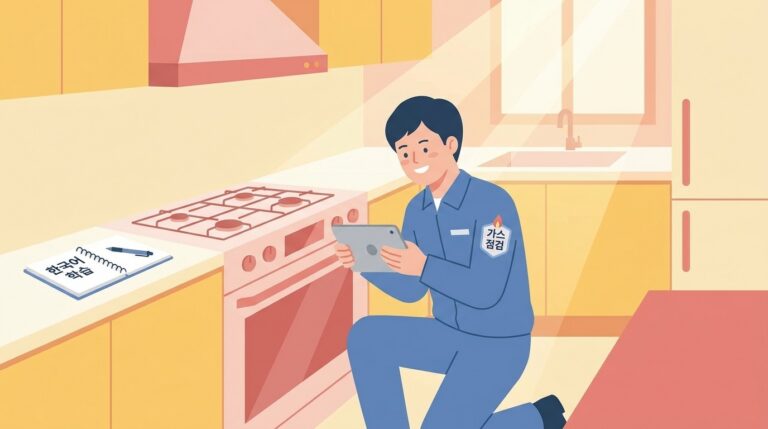
Phase 1: Empathy (Story-Driven Opening)
안녕하세요! 매일한글 에디터입니다. (Hello! This is your Daily Hangul editor.)
Picture this: You finally signed the lease on your new Seoul studio apartment (원룸 – wonrum). The moving boxes are stacked against the wall, your body aches, and all you want is to sit on the floor and boil a celebratory pot of spicy Shin Ramyun. You hook up your portable pot, turn the knob of your gas stove, and… nothing happens. Just an empty click-click-click.
Panic sets in. You look behind the stove and discover that the orange rubber hose is neatly unplugged, capped with a metal lock, and there is a bright yellow safety warning sticker staring back at you. In Korea, city gas (dosigaseu) is disconnected for safety every time a tenant moves out. You cannot simply plug the hose in yourself—doing so without certified leak inspection is illegal and dangerous!
Connecting your gas stove hose and getting a gas leak inspection (gaseu nuchul geomsa) is a rite of passage for every resident in Korea. It feels daunting when the technician arrives and speaks rapid-fire Korean with technical safety jargon. But take a deep breath! Our team has coached dozens of international residents through their first Korean moving days. By the end of this guide, you will master the exact conversational scripts, unspoken manners, and practical steps needed to turn on your gas without breaking a sweat.
Phase 2: Core Expressions Deep Dive
Here are three essential expressions you will need when dealing with the gas technician.
1. 가스레인지 호스 연결해 주세요 (Gaseu-reinji hoseu yeongyeol-hae juseyo)
- Pronunciation: [Ga-seu-re-in-ji ho-seu yeong-yeol-hae ju-se-yo] (Think: “Gas-range hose young-yull-hae joo-say-yo”)
- Meaning: “Please connect the gas stove hose.”
- K-Culture Moment: In realistic slice-of-life K-dramas like Because This Is My First Life (이번 생은 처음이라), moving into a rental always involves waiting by the bare kitchen counter for the technician to attach the signature orange hose before anything else can be cooked.
- Editor’s Insight: Adding 좀 (jom – a little/please) before yeongyeol-hae juseyo softens the request significantly. In Korean customer-service exchanges, softening requests shows warmth and politeness.
- Situation Spectrum: Casual 🚫 | Semi-formal ✅ | Formal ✅
- 🤔 Think About It: In English, you might say “I need my gas hooked up.” Korean tends to name the specific physical object (hoseu yeongyeol) rather than abstractly saying “activate the gas.”
2. 가스 누출 검사도 같이 해 주시나요? (Gaseu nuchul geomsa-do gachi hae jusinayo?)
- Pronunciation: [Ga-seu nu-chul geom-sa-do ga-chi hae ju-si-na-yo?] (Think: “Gas new-chool gum-sah-doh gah-chee hae joo-she-nah-yo?”)
- Meaning: “Do you inspect for gas leaks at the same time?”
- K-Culture Moment: Technicians carry a wand-like electronic detector or spray soapy bubble water (binutmul) over joints to verify safety. Seeing bubbles rise means there is a leak, a common trope in Korean public safety commercials!
- Editor’s Insight: The ending ~시나요? (~sinayo?) adds an honorific inquiry tone that sounds polished and respectful without being overly stiff.
- Situation Spectrum: Casual 🚫 | Semi-formal ✅ | Formal ✅
- 🤔 Think About It: Why ask this if it is mandatory? In Korean apartment culture, confirming safety procedures out loud demonstrates mutual awareness and civic responsibility (anjeon uisik).
3. 설치 비용은 어떻게 결제하면 되나요? (Seolchi biyong-eun eotteoke gyeolje-hamyeon doenayo?)
- Pronunciation: [Seol-chi bi-yong-eun eo-tteo-ke gyeol-je-ha-myeon doe-na-yo?] (Think: “Soul-chee bee-yong-un uh-ttoh-keh gyul-jeh-hah-myun dweh-nah-yo?”)
- Meaning: “How should I pay for the installation fee?”
- K-Culture Moment: Technicians often bring small mobile card terminals or show you an account number (gyejwa beonho) on their clipboard for a quick bank transfer right on the spot.
- Editor’s Insight: While monthly gas bills arrive via automated transfer or Kakao Pay, on-site service calls (installation of the fuse cock and hose) require immediate payment.
- Situation Spectrum: Casual 🚫 | Semi-formal ✅ | Formal ✅
- 🤔 Think About It: Asking “how” (eotteoke) instead of “can I use a card?” leaves room for the technician to provide their preferred payment method smoothly.
Phase 3: Textbook Korean vs. Real Korean
Situation 1: Confirming that the stove is safe to use right away
- 📖 교과서 한국어 (Textbook): 가스가 새지 않는 것이 확실합니까? (Gaseuga saeji anneun geosi hwaksilhamnikka? – Is it certain that gas is not leaking?)
- 🗣️ 진짜 한국어 (Real-life): 이제 바로 써도 괜찮은 거죠? (Ije baro sseodo gwaenchaneun geojyo? – It’s okay to use right away now, right?)
- 💡 Why it differs: Textbook phrasing sounds like an interrogation or a court trial! Real Koreans ask for warm confirmation using ~죠? (~jyo? – right?) to verify that cooking can start immediately.
Situation 2: Asking what to do with the safety valve
- 📖 교과서 한국어 (Textbook): 외출 시 중간 밸브를 차단해야 합니까? (Oechul si jungan baelbeureul chadanhaeya hamnikka? – Must I shut off the intermediate valve when going out?)
- 🗣️ 진짜 한국어 (Real-life): 안 쓸 때는 밸브 이쪽으로 잠그면 되죠? (An sseul ttaeneun baelbeu ijjogeuro jamgeumyeon doejyo? – When not in use, I just lock the valve this way, right?)
- 💡 Why it differs: Native speakers gesture directly toward the valve (ijjogeuro – towards this side) rather than using formal Sino-Korean nouns like chadanhada (to shut off).
Phase 4: K-Culture Deep Dive & Non-Verbal Manners
4-1. 눈치 (Nunchi) & Space Etiquette
When the city gas technician (gisanim) visits your home, keep these non-verbal cues in mind:
* The Welcome Drink (캔커피 매너): Technicians visit 10 to 15 homes a day, climbing stairs with heavy toolbags. Handing them a chilled canned coffee (let’s be/TOP) or a bottle of Bacchus (Bakkaseu) when they arrive creates instant rapport.
* Clear the Kitchen Counter: Make sure pots, dishes, and delivery boxes are cleared away from the stove area so the technician can kneel down and inspect the pipe effortlessly.
* Quiet during the Beep: When the technician turns on the digital gas detector, it produces high-pitched clicks or beeps. Maintain silence for a moment so they can listen to the sensor alarms.
4-2. Cultural Code: The First Meal & The Yellow Pipe
In Korea, moving day (isanal) has two eternal traditions: eating Jajangmyeon (black bean noodles) on packing boxes and looking out for the bright yellow gas pipes that climb up the exterior of brick villa buildings. Because most residential areas rely on piped LNG (Liquefied Natural Gas), safety compliance is communal. If one unit has a leak, the entire building is notified. Having your connection verified isn’t just about cooking ramyun; it is an unwritten civic promise to your Korean neighbors that your home is safe.
Phase 5: Real-World Roleplay Scenario
- Background: Mr. Park, a certified city gas technician (도시가스 기사님), arrives at your new studio apartment holding a tool kit and yellow rubber hoses.
- Characters:
- You (민우 – Minwoo): An international tenant who just moved in.
- 기사님 (Gisanim – Mr. Park): A friendly, brisk technician in his 50s wearing a blue utility vest.
— Dialogue Start —
- 기사님: 안녕하세요! 도시가스 호스 연결 예약하셨죠? (Annyeonghaseyo! Dosigaseu hoseu yeongyeol yeyakhasyeotjyo?)
- 🎭 행동 지문: 현관에서 덧신을 신으며 공구 가방을 내려놓는다.
- “Hello! You reserved a city gas hose connection, right?”
- 민우: 네, 기사님! 들어오세요. 여기 음료수 하나 드세요. (Ne, gisanim! Deureo-oseyo. Yeogi eumryosu hana deuseyo.)
- 🎭 행동 지문: 슬리퍼를 내어주며 시원한 캔커피를 건넨다.
- “Yes, technician! Please come in. Here is a cold drink for you.”
- 기사님: 아이고, 시원하네! 감사합니다. 가스레인지가 어디 있나요? (Aigo, siwonhane! Gamsahamnida. Gaseu-reinjiga eodi innayo?)
- 🎭 행동 지문: 캔커피를 받고 싱크대 쪽을 둘러본다.
- “Oh, that’s refreshing! Thank you. Where is your gas stove?”
- 민우: 싱크대 위에 뒀어요. 호스 연결하고 누출 검사도 부탁드려요. (Singkeudae wie dwosseoyo. Hoseu yeongyeolhago nuchul geomsado butakdeuryeoyo.)
- 🎭 행동 지문: 가스레인지와 가스 배관 밸브를 손으로 가리킨다.
- “I placed it on the sink counter. Please connect the hose and check for leaks too.”
- 기사님: 네, 퓨즈콕 밸브 연결하고 누출 탐지기로 꼼꼼히 봐 드릴게요. (Ne, pyujeukok baelbeu yeongyeolhago nuchul tamjigiro kkomkkomhi bwa deurilgeyo.)
- 🎭 행동 지문: 주황색 호스를 밸브에 끼우고 조임쇠를 단단히 조인다.
- “Sure, I’ll connect the fuse cock valve and inspect thoroughly with the leak detector.”
- 기사님: 자, 탐지기 삐 소리 안 나죠? 누출 전혀 없습니다! (Ja, tamjigi ppi sori an najyo? Nuchul jeonhyeo eopseumnida!)
- 🎭 행동 지문: 가스 밸브 주변에 탐지기를 대보며 끄덕인다.
- “See, the detector isn’t beeping, right? There is zero leak!”
- 민우: 다행이네요! 출장 연결 비용은 얼마인가요? (Dahaeng-ineyyo! Chuljang yeongyeol biyong-eun eolma-ingayo?)
- 🎭 행동 지문: 지갑과 스마트폰 뱅킹 앱을 준비한다.
- “What a relief! How much is the installation call-out fee?”
- 기사님: 부품비랑 출장비 합쳐서 25,000원입니다. 계좌이체나 카드 둘 다 돼요. (Bupumbi-rang chuljangbi hapchyeoseo iman-ocheon-won-imnida. Gyejwa-iche-na kadeu dul da dwaeyo.)
- 🎭 행동 지문: 휴대용 카드 단말기를 꺼내어 보여준다.
- “Parts and call-out fee come to 25,000 KRW in total. Both bank transfer and card are fine.”
— Dialogue End —
🔀 Interactive Choice Point
The technician packs his tools and says: “다 끝났으니 확인 서명 좀 해주세요!” (Da kkeun-nasseuni hwagin seomyeong jom hae-juseyo! – “We are all done, so please sign here!”) How do you respond?
- Option A: “바쁘니까 그냥 가세요.” (Bappeunikka geunyang gaseyo. – “I am busy, so just leave.”)
- ⚠️ Feedback (Bad): Highly impolite! Signing the safety checklist (jeomgeom seomyeong) is a legal requirement. Refusing to sign can invalidate insurance in case of an accident.
- Option B: “네, 여기에 서명하면 되나요? 정말 감사합니다, 기사님!” (Ne, yeogie seomyeonghamyeon doenayo? Jeongmal gamsahamnida, gisanim!)
- 🌟 Feedback (Best): Polite, cooperative, and shows gratitude. The technician leaves pleased, and your safety inspection is legally completed.
- Option C: “나중에 집주인한테 서명 받으세요.” (Najunge jipjuin-hante seomyeong badeuseyo. – “Get the signature from the landlord later.”)
- ⚠️ Feedback (Risk): As the current occupant who is physically present, the gas company requires the resident’s signature. Passing it to the landlord causes unnecessary delay and confusion.
Phase 6: 10-Second Emotion Shadowing Drill
Practice these natural rhythm pauses marked with / and mimic the emotion prompts:
[😊 환영하며 싹싹하게]- 기사님, / 더우신데 / 시원한 물 한 잔 / 드세요!
- (Gisanim, / deousinde / siwonhan mul han jan / deuseyo!)
- “Technician, it’s hot out, please have a glass of cold water!”
[🧐 꼼꼼하고 조심스럽게]- 호스 연결 부위에 / 가스 새는 곳은 / 없는 거죠?
- (Hoseu yeongyeol buwie / gaseu saeneun goseun / eomneun geojyo?)
- “Around the hose connection joint, there are no gas leaks, right?”
[😄 안도하고 상쾌하게]- 이제 / 안심하고 / 라면 끓여 먹을 수 / 있겠네요!
- (Ije / ansimhago / ramyeon kkeullyeo meogeul su / itgenneyo!)
- “Now I can finally boil and eat my ramyun with peace of mind!”
Phase 7: K-Culture Mini Dictionary
- 도시가스 기사님 (Dosi-gaseu gisa-nim)
- Translation: City gas technician / engineer.
- Usage: In Korea, service professionals (drivers, engineers, technicians) are respectfully addressed with the suffix ~기사님 (gisanim) instead of “저기요” (jeogiyo) or “선생님” (seonsaengnim).
- 중간 밸브 (Jungan baelbeu)
- Translation: Intermediate shut-off valve (Fuse cock).
- Usage: The small lever right above your stove. Whenever leaving for a trip or after cooking, Korean parents will remind you: “중간 밸브 잠갔니?” (Did you turn off the intermediate valve?).
- 비눗물 검사 (Binutmul geomsa)
- Translation: Soapy water leak test.
- Usage: The traditional method of dousing soapy foam on gas connectors to spot escaping bubbles. Even with digital sniffers, older technicians still swear by this visual test.
- 출장 점검비 (Chuljang jeomgeombi)
- Translation: On-site inspection / call-out fee.
- Usage: The standard labor fee (usually 15,000–30,000 KRW) charged for a technician to visit your home to connect or disconnect gas fixtures.
Phase 8: Expat Survival Kit
TOP 3 Survival Phrases
- 이사 와서 가스레인지 연결 신청하려고요. (Isa waseod dosigaseu yeongyeol sincheongharyeogoyo.)
- “I just moved in and would like to apply for a gas stove connection.”
- Pro Tip: Say this as soon as the call center operator picks up your regional gas hotline.
- 방문 시간대를 변경할 수 있을까요? (Bangmun sigandaereul byeongyeonghal su isseulkkayo?)
- “Could I change the appointment time slot?”
- Pro Tip: Use this if your moving truck is running late on moving day.
- 영수증 문자로 보내주세요. (Yeongsujeung munjaro bonaejuseyo.)
- “Please text me the receipt.”
- Pro Tip: Most technicians issue mobile digital receipts via SMS instead of paper slips.
Editor’s Travel & Living Note
- Utility Apps: Instead of making phone calls in Korean, manage everything through the official KakaoTalk City Gas Customer Center or download the comprehensive regional Gas App download guide (가스앱). You can book appointments, view technician profiles, and pay installation fees in a few taps!
- Timing: Book your gas connection at least 2 to 3 days before moving day. At the end of the month, technician schedules fill up rapidly!
Phase 9: A Step Deeper (한 발 더 깊이)
In Korea, calling a service worker 기사님 (gisanim – Master Craftsman) reflects a deep social appreciation for practical technical skill. Unlike Western cultures where domestic service providers are often greeted informally by their first name, Korean linguistic hierarchy honors functional expertise with formal respect. Furthermore, because millions live in high-density multi-family housing (빌라 and 아파트), private home maintenance is viewed as a civic duty. When the technician checks your stove, both parties treat it as a collaborative ritual that keeps the whole building safe.
- 💬 Your Turn: In your home country, do you connect your own gas appliances or is an authorized inspection strictly mandatory? How do you usually address domestic repair specialists? Share your stories in the comments below!
Phase 10: FAQ & Avoiding Misunderstandings
Q: Can I buy my own gas hose at a hardware store and connect it myself?
A: No! Under Korean safety laws, connecting piped city gas without certification is prohibited. You must have a registered city gas technician handle the fuse-cock attachment and submit the safety test log.
Q: Is the gas inspection free since I pay my monthly utility bills?
A: Regular bi-annual routine inspections are free, but new connection and reconnection requests incur a call-out and installation fee (usually between 20,000 to 35,000 KRW, including parts).
Q: What if my apartment has an induction cooktop instead of a gas stove?
A: If your home uses only electric induction (인덕션), you do not need to connect the stove hose, but you still need city gas connected for your floor heating (ondol) and hot water boiler!
🚨 Common Mistakes Warning Board
- Mistake: Forgetting to schedule an appointment beforehand and expecting same-day service.
- Correct Action: Call your district’s city gas provider (e.g., Seoul City Gas, Yesco, Samchully) at least 3 business days prior to moving.
- Mistake: Locking the intermediate valve perpendicular to the pipe and wondering why the stove won’t ignite.
- Correct Action: Turn the lever parallel to the pipe to open the gas flow; turn it perpendicular (crosswise) to shut it off.
- Mistake: Tipping the technician with cash.
- Correct Action: Tipping is not part of Korean culture and may cause embarrassment. Offer a canned coffee or cold juice drink instead!
Phase 11: Action Mission
- 🥉 Bronze Level: Stand in front of your kitchen stove and practice saying: “가스레인지 호스 연결해 주세요” three times with clear pronunciation.
- 🥈 Silver Level: Locate the yellow gas pipe in your kitchen or villa hallway, check whether the valve is open or closed, and take a photo to identify your regional city gas brand.
- 🥇 Gold Level: Open your mobile banking app or Kakao Pay and look up the utility bill section, or practice asking a Korean friend: “이사 갈 때 도시가스 예약 어떻게 해요?” (How do I book city gas when moving?).
- 🎮 K-Culture Mission: Watch a moving scene from any slice-of-life K-drama (like Hospital Playlist or My Liberation Notes) and spot the technician wearing the bright utility jacket visiting a new home!
Phase 12: Interactive Quiz Challenge
Question 1 (Scenario Judgment)
The gas technician has just installed your stove hose and holds an electronic wand near the pipe. What should you do?
* A) Test ignite the stove burner immediately to check the flame.
* B) Stay quiet and wait for the technician to verify there is no beeping alarm.
* C) Offer the technician a hot bowl of ramyun right away.
Question 2 (Fill-in-the-Blank)
When addressing the technician respectfully in Korean, you should say:
“안녕하세요, ________!” (Annyeonghaseyo, ________!)
* Choices: [사장님 / 기사님 / 아저씨]
Question 3 (True or False Cultural Trivia)
True or False: In Korea, it is considered polite to offer a modest cash tip (5,000 KRW) directly to the city gas technician.
👉 Click to reveal answers & explanations!
- Answer 1: B — Gas detection devices are sensitive to sound and air currents. Let the technician complete the leak test before turning on any switches or burners.
- Answer 2: 기사님 (Gisanim) — While 아저씨 (ajeossi) is common in casual speech, 기사님 is the standard, respectful professional term for technicians and drivers.
- Answer 3: False — Tipping is not practiced in Korea. The best way to show gratitude is offering a canned drink (eumryosu) and a warm verbal thank you: “수고하셨습니다, 감사합니다!”







