

Tech Shopping in Korea: How to Compare Gadgets and Get Free Gifts Like a Local
Phase 1: 공감 (Story-Driven Opening)
안녕하세요! 매일한글 에디터입니다. (Hello! It’s your Daily Hangul editor here!)
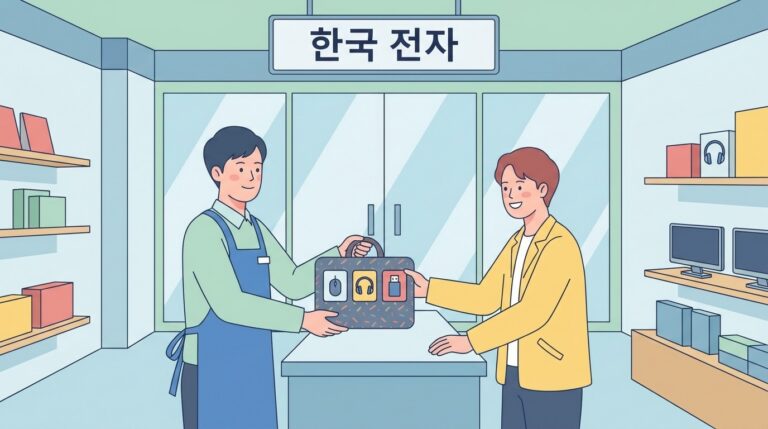
Picture this: You are standing in the middle of a glowing electronics market in Yongsan or an ultra-sleek tech flagship store in Gangnam. Towering displays of the latest smartphones and feather-light laptops surround you. You want to compare two sleek models—checking which battery lasts longer or which laptop weighs less—but suddenly, your mind freezes. Even more exciting, after you pick your favorite device, the smiling clerk slides a protective case, screen protector, and high-speed adapter into your bag, saying something warm with a polite bow.
Did you just get free stuff? How do you express polite gratitude, and how can you naturally ask if extra perks are included? In Korean retail, getting bonus gifts—known as 사은품 (sa-eun-pum)—is practically an art form. In this beginner-friendly guide, based on real feedback from international shoppers, you will learn the exact phrases needed to compare specs confidently and thank your clerk like a true Seoul local!
Phase 2: 핵심 표현 3선 심층 분석 (Top 3 Key Expressions)
1. 사은품도 챙겨 주셨어요 (They even packed free gifts for me)
- Pronunciation: [Sa-eun-pum-do chaeng-gyeo ju-syeo-sseo-yo] (Sound analogy: Think of “sah-eun-poom” like an ‘un-spooled’ thread, followed by “chank-yo jew-shyuh-yo”.)
- Meaning: Literal: “They thoughtfully took care of and gave me gift items too.” / Actual Nuance: “They were kind enough to bundle in awesome freebies!”
- K-Culture Moment: You will hear this in lifestyle K-Dramas whenever a character comes home from mobile phone shopping, eagerly unpacking phone grips, cases, and stickers generously gifted by the neighborhood vendor.
- Editor’s Insight: The verb 챙겨주다 (chaeng-gyeo-ju-da) goes far beyond the simple verb 주다 (to give). It carries emotional warmth, implying that someone looked after your needs with attentive care.
- Situation Spectrum: Casual: ✅ (사은품도 챙겨줬어) | Semi-formal: ✅ (사은품도 챙겨 주셨어요) | Formal: ✅ (사은품도 챙겨 주셨습니다)
- 🤔 Think About It: In your home country, do cashiers “give” bonuses or do they “take care of” you? What does this verb reveal about Korean hospitality?
2. 이게 배터리가 더 오래 가요 (This one has longer battery life)
- Pronunciation: [I-ge bae-teo-ri-ga deo o-rae ga-yo] (Sound analogy: “Ee-geh” + English “battery” with a punchy beat + “duh oh-ray gah-yo”.)
- Meaning: Literal: “This one, the battery goes longer.” / Actual Nuance: “This model has longer battery life.”
- K-Culture Moment: Korean tech YouTubers always repeat this key comparison phrase when testing the latest foldable smartphones against rival flagship models.
- Editor’s Insight: You do not need heavy technical jargon like 지속 시간 (duration). Everyday native speakers simply say that battery power 오래 가다 (goes a long time).
- Situation Spectrum: Casual: ✅ (이게 배터리 더 오래 가) | Semi-formal: ✅ (이게 배터리가 더 오래 가요) | Formal: ✅ (이 제품이 배터리가 더 오래 갑니다)
- 🤔 Think About It: Notice how the Korean language pictures battery endurance as a journey that “travels far” (오래 가다).
3. 케이스랑 충전기도 같이 주나요? (Are the case and charger also included?)
- Pronunciation: [Ke-i-seu-rang chung-jeon-gi-do ga-chi ju-na-yo?] (Sound analogy: “Kay-ee-seu-rahng choong-jeon-ghee-doh gah-chee jew-nah-yo?”)
- Meaning: Literal: “Do you give the case and charger together too?” / Actual Nuance: “Does this come with a case and charging adapter as perks?”
- K-Culture Moment: College freshmen at back-to-school campus tech fairs use this charming question to see what extra student accessories the vendor can throw in.
- Editor’s Insight: The connective particle ~랑 (rang) means “and” or “with”. It creates a smooth, conversational rhythm that sounds polite and casual rather than rigid.
- Situation Spectrum: Casual: ✅ (케이스랑 충전기도 같이 줘?) | Semi-formal: ✅ (케이스랑 충전기도 같이 주나요?) | Formal: ⚠️ (In high-end formal settings, use: “케이스와 충전기도 함께 제공되나요?”)
- 🤔 Think About It: How does phrasing a request as a simple inquiry make asking for extras feel polite instead of greedy?
Phase 3: 교과서 한국어 vs 진짜 한국어 (Textbook vs. Real Korean)
Situation 1: Asking if promotional gifts are available
- 📖 교과서 한국어: 무료 증정품이 포함되어 있습니까? (Mu-ryo jeung-jeong-pu-mi po-ham-doe-eo it-seum-ni-kka? / Are complimentary gift items included?)
- 🗣️ 진짜 한국어: 혹시 사은품도 나와요? (Hok-si sa-eun-pum-do na-wa-yo? / By any chance, do bonus gifts come with this?)
- 💡 왜 다를까?: The textbook phrase sounds like a formal clause from a corporate warranty contract. In real stores, native speakers naturally ask if free gifts 나오다 (come out / are released).
Situation 2: Comparing the weight of two laptops
- 📖 교과서 한국어: 이 모델이 저 모델보다 중량이 더 경량입니다. (I mo-de-ri jeo mo-del-bo-da jung-ryang-i deo gyeong-ryang-im-ni-da. / This model is lighter in weight than that model.)
- 🗣️ 진짜 한국어: 이게 훨씬 가벼워요! (I-ge hwol-ssin ga-byeo-wo-yo! / This one is way lighter!)
- 💡 왜 다를까?: Real shoppers rarely use Sino-Korean technical terms like 중량 (weight) or 경량 (lightweight) in spoken Korean. Simple descriptive verbs with intensifiers like 훨씬 (much/way) sound far more natural.
Phase 4: K-Culture 딥다이브 & 비언어적 매너 (Culture Deep Dive & Etiquette)
4-1. 눈치 (Nunchi) & Non-Verbal Gestures
When the clerk generously slips a protective case and adapter into your shopping bag, good manners turn a simple transaction into a heartwarming interaction:
* Two-Handed Acceptance: Receive the bag or freebies using both hands, or support your right wrist lightly with your left hand.
* The 15-Degree Polite Bow: A quick bow accompanied by a bright smile signals that you appreciate the extra care.
* Restraint: Avoid ripping open the gift boxes immediately at the checkout counter to check every accessory; it shows trust and grace to inspect them once you step away.
4-2. The Cultural Code of 덤 (Deom) and 사은품 (Sa-eun-pum)
In traditional Korean markets, vendors have long practiced 덤 (deom)—throwing in an extra scoop of fruit or side dish as a sign of affection (정, Jeong). Today’s massive electronics stores carry forward this exact DNA through 사은품 (sa-eun-pum). Even with tightly regulated gadget pricing, store managers have discretion over promotional bundles (cases, laptop sleeves, charging bricks, Bluetooth mice) to make customers feel truly valued.
Phase 5: 실전 롤플레이 시나리오 (Real Roleplay Scenario)
Setting: Alex is at an electronics flagship store in Seoul, comparing two laptops. Store clerk Min-ho approaches with a helpful smile.
- 직원 (Clerk): 🎭 (미소를 지으며 다가온다 / Smiles and approaches) 손님, 어떤 제품 보고 계세요? (Son-nim, eo-tteon je-pum bo-go gye-se-yo? / Customer, what kind of product are you looking for?)
- 알렉스 (Alex): 🎭 (두 노트북을 가리키며 / Pointing at two laptops) 이 두 모델 무게랑 배터리 비교해 보고 싶어요. (I du mo-del mu-ge-rang bae-teo-ri bi-gyo-hae bo-go si-peo-yo. / I’d like to compare the weight and battery of these two models.)
- 직원 (Clerk): 🎭 (흰색 노트북을 살짝 들어 보이며 / Lightly lifting the white laptop) 이건 1kg이라 가볍고, 배터리가 진짜 오래 가요. (I-geon il-ki-lo-geu-raem-i-ra ga-byeop-go, bae-teo-ri-ga jin-jja o-rae ga-yo. / This one is 1kg so it’s light, and the battery lasts really long.)
- 알렉스 (Alex): 🎭 (화면을 유심히 보며 / Looking closely at the screen) 와, 정말 가볍네요! 화면 크기는 둘이 같나요? (Wa, jeong-mal ga-byeom-ne-yo! Hwa-myeon keu-gi-neun dur-i gat-na-yo? / Wow, it really is light! Are the screen sizes the same?)
- 직원 (Clerk): 🎭 (스펙 표를 가리키며 / Pointing to the spec sheet) 네, 둘 다 15인치인데 이 모델 화질이 더 선명해요. (Ne, dul da sip-o-in-chi-in-de i mo-del hwa-ji-ri deo seon-myeong-hae-yo. / Yes, both are 15 inches, but this model has a crisper display.)
- 알렉스 (Alex): 🎭 (결정한 듯 고개를 끄덕인다 / Nodding decisively) 좋아요! 그럼 이 하얀색 모델로 할게요. (Jo-a-yo! Geu-reom i ha-yan-saek mo-del-lo hal-ge-yo. / Great! Then I’ll take this white model.)
- 직원 (Clerk): 🎭 (쇼핑백에 액세서리를 챙겨 넣으며 / Packing accessories into the shopping bag) 오늘 구매하시면 케이스랑 충전 어댑터도 사은품으로 챙겨 드릴게요! (O-neul gu-mae-ha-si-myeon ke-i-seu-rang chung-jeon eo-daep-teo-do sa-eun-pum-eu-ro chaeng-gyeo deu-ril-ge-yo! / If you buy today, I will also pack a case and charging adapter as free gifts!)
- 알렉스 (Alex): 🎭 (두 손으로 쇼핑백을 받으며 / Receiving the bag with both hands) 사은품까지 챙겨 주셔서 정말 감사합니다! (Sa-eun-pum-kka-ji chaeng-gyeo ju-syo-seo jeong-mal gam-sa-ham-ni-da! / Thank you so much for including the gifts as well!)
🔀 인터랙티브 분기점 (Interactive Decision Point)
Imagine the clerk forgot to mention accessories before checkout. What do you say?
* Option A: “케이스랑 충전 어댑터도 사은품으로 챙겨 주실 수 있나요?” (Can you also include a case and charging adapter as free gifts?)
* Outcome (Best): Polite, natural, and uses the magic word 챙겨 주시다. The clerk will happily check the back room for you!
* Option B: “공짜로 뭐 더 줄 수 있어요?” (Can you give me more free stuff?)
* Outcome (Bad): Using 공짜 (freebie) directly can sound demanding and slightly crude in a store setting.
* Option C: “너무 비싸니까 그냥 깎아 주세요.” (It’s too expensive, so just give me a discount.)
* Outcome (Risk): Retail device prices are strictly fixed by corporate systems in major department stores; asking for direct cash cuts creates awkwardness. Bundled gifts are the proper way to go!
Phase 6: 10초 감정 섀도잉 드릴 (10-Second Emotion Shadowing)
Practice these lines out loud. Pause briefly at the slashes (/) and match the emotion!
[😊 밝고 자신 있게 / Bright and confident]
“이게 / 배터리가 / 더 오래 가요!”
(I-ge / bae-teo-ri-ga / deo o-rae ga-yo!)
“This one / has a battery / that lasts longer!”-
[🤔 궁금하고 조심스럽게 / Curious and polite]
“혹시 / 케이스랑 충전기도 / 같이 주나요?”
(Hok-si / ke-i-seu-rang chung-jeon-gi-do / ga-chi ju-na-yo?)
“By any chance / the case and charger / are they included too?” -
[🥰 진심으로 감동하며 / Heartfelt gratitude]
“사은품까지 / 챙겨 주셔서 / 정말 감사합니다!”
(Sa-eun-pum-kka-ji / chaeng-gyeo ju-syo-seo / jeong-mal gam-sa-ham-ni-da!)
“Even the free gifts / packing them for me / thank you so very much!”
Phase 7: K-Culture 미니 사전 (Mini Dictionary)
- 사은품 (Sa-eun-pum): Complimentary gift / promotional bonus item provided to customers upon purchase.
- 가성비 (Ga-seong-bi): Short for 가격 대비 성능 (price-to-performance ratio). Used constantly when comparing budget laptops and phones.
- 스펙 (Seu-pek): Slang adaptation of “specification”. Refers to tech specs like RAM, camera megapixels, and battery capacity.
- 챙겨주다 (Chaeng-gyeo-ju-da): A compound verb combining “to pack/prepare attentively” and “to give”. Expresses caring generosity.
Phase 8: 여행자를 위한 생존 키트 (Traveler’s Survival Kit)
Survival Phrases TOP 3
- “이 둘 중에 어떤 게 더 인기 많아요?” (I dul jung-e eo-tteon ge deo in-gi man-a-yo? / Between these two, which one is more popular?)
- Pro Tip: Use this when specs feel overwhelming and you want the store’s honest bestseller recommendation.
- “사은품은 어떤 거 나와요?” (Sa-eun-pu-meun eo-tteon geo na-wa-yo? / What kind of free gifts come with this?)
- Pro Tip: Ask this before finalizing payment to see if you qualify for promotional accessories.
- “택스 리펀드(Tax Refund) 영수증 끊어 주세요.” (Taek-seu ri-peon-deu yeong-su-jeung kkeun-eo ju-se-yo. / Please issue a tax refund receipt.)
- Pro Tip: Always bring your passport! Most major electronics stores can process instant tax refunds on the spot.
Editor’s Travel Note
Before stepping into physical megastores in Yongsan or Gangnam, browse the Danawa online price comparison platform to check standard market rates. When navigating subway exits directly to major retail hubs like Electro Mart or Techno Mart, open the Naver Map navigation app for real-time indoor mall maps. Foreign credit cards are widely accepted everywhere in Korea with zero contactless fees!
Phase 9: “한 발 더 깊이” (Deep Cultural Reflection)
In many shopping cultures, transactions are purely cold and contractual: you pay the designated price, take your boxed item, and leave. But in Korea, commercial exchanges still preserve traces of community warmth known as 정 (Jeong). When a store clerk packs extra adapters or earbuds as 사은품, it is more than an inventory clearance tactic; it is an unspoken ritual that honors the customer for choosing their shop. It leaves both sides smiling with a warm connection.
💬 Your Turn: Have you ever received unexpected free gifts or extras while shopping? How would you react in Korean? Share your story in the comments below!
Phase 10: FAQ & 오해 방지 (FAQ & Common Mistakes)
Q: Can I choose the color of the free case or strap?
A: Yes! If they have multiple colors in stock, clerks will gladly let you choose. You can ask politely: “혹시 다른 색상도 있나요?” (Hok-si da-reun saek-sang-do it-na-yo? / Do you have other colors by any chance?).
Q: Is it rude to ask for 사은품 if the clerk doesn’t offer any?
A: Not at all! In tech retail, asking gently with “혹시 사은품도 있나요?” is completely normal. If there are none available, the clerk will simply explain with an apologetic smile.
Q: Are free gifts covered by warranties?
A: Generally, promotional accessories (cables, silicone cases) are complimentary perks and do not carry official brand warranty coverage, unlike the main smartphone or laptop device.
🚨 흔한 실수 (Common Mistakes)
| Mistake | Why It Happens | Correct Action |
|---|---|---|
| Saying “공짜 주세요” | Direct translation of “Give me free stuff.” | Say “사은품도 챙겨 주시나요?” to sound polite and respectful. |
| Taking items with one hand | Natural in Western casual retail. | Always hold the shopping bag or gift with two hands to show gratitude. |
| Demanding huge cash discounts | Expecting open-market haggling. | Chain store prices are system-locked; ask for bundled accessories (사은품) instead! |
Phase 11: 액션 미션 & 참여 유도 (Action Missions)
- 🥉 Bronze Mission: Read the 3 emotion shadowing drill sentences aloud three times until your tongue glides smoothly over 챙겨 주셨어요.
- 🥈 Silver Mission: Take a photo of your smartphone or laptop accessories and post on social media with the Korean caption: “케이스랑 충전기도 사은품으로 챙겨 주셨어요!”
- 🥇 Gold Mission: Walk into an electronics shop in Korea (or visit a Korean electronics retail website) and spot the promotional tag 사은품 증정 (Free Gift Event)!
- 🎮 K-Culture Mission: Watch a Korean tech unboxing vlog on YouTube. Listen closely for when the creator introduces the bonus accessories bundled inside the retail box.
Phase 12: 인터랙티브 퀴즈 챌린지 (Quiz Challenge)
Test your knowledge from today’s lesson!
- Situational Judgment: The clerk hands you your new smartphone along with a free wireless charger. What is the most natural, polite response?
- (A) 공짜 줘서 고마워. (Thanks for giving me free stuff.)
- (B) 사은품까지 챙겨 주셔서 감사합니다! (Thank you for packing the free gifts as well!)
- (C) 다른 가게는 더 주던데요? (Other stores give more.)
- Fill-in-the-Blank: Complete the sentence meaning “They also included a case AND charger”:
- “케이스____ 충전기도 사은품으로 챙겨 주셨어요.”
- True or False: True or False? The verb 챙겨주다 implies cold, mechanical distribution with no emotional care.
👉 Click here to reveal answers and explanations!
- Answer: (B)
- Explanation: Option B expresses warm, respectful gratitude using proper honorifics (챙겨 주셔서 감사합니다).
- Answer: 랑 (rang)
- Explanation: 케이스랑 (ke-i-seu-rang) connects the two nouns naturally in everyday spoken Korean.
- Answer: False
- Explanation: 챙겨주다 carries deep warmth, suggesting someone looked after you with thoughtful attention.
- Explanation: 챙겨주다 carries deep warmth, suggesting someone looked after you with thoughtful attention.






