

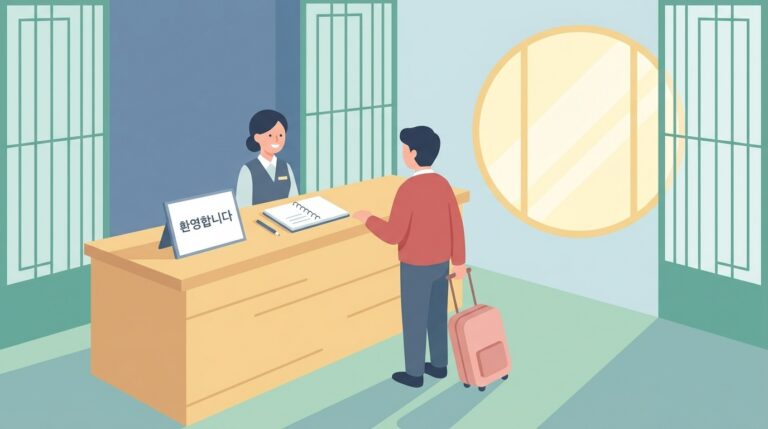
Master Hotel Check-Out in Korea: How to Ask for Late Check-Out Like a Local
Phase 1: 공감 (Story-Immersive Opening)
안녕하세요! 매일한글 에디터입니다. Picture this: It is 10:15 AM in a cozy boutique hotel in Seoul. Last night, you lived your best K-drama life—feasting on crispy Chimaek (fried chicken and beer) by the Han River and strolling through Hongdae until 2:00 AM. Suddenly, your alarm screeches. Check-out is strictly at 11:00 AM! Your luggage is exploded across the heated floor, sheet masks and K-pop albums are scattered everywhere, and your hair looks like a bird’s nest. You desperately need just one extra hour. But cold sweat breaks out: How do I ask for late check-out in Korean without sounding demanding or getting flatly rejected? Many A1 beginners freeze up because Korean honorifics seem like a maze. Take a deep breath! Over the past decade guiding international travelers, I have seen this exact hotel panic hundreds of times. With just three easy, polite phrases, you will walk up to the front desk with calm confidence and secure that golden extra hour.
Phase 2: 핵심 표현 3선 심층 분석 (Top 3 Core Expressions)
1. 레이트 체크아웃 돼요? (Leiteu chekeu-aut dwaeyo?)
- Pronunciation: [LAY-teu chek-eu-out DWEH-yo?] (Tip: “Dwaeyo” sounds like the English word “way” preceded by a soft “d”, meaning “is it okay / possible?”)
- Meaning: Literal: “Late check-out works?” | Real Nuance: “Is late check-out available?”
- K-Culture Moment: Just like when travelers in Korean reality travel shows ask the hotel manager for quick adjustments with a polite smile.
- Editor’s Insight: Konglish (Korean + English) is your superpower here! Hotels in Korea universally understand “레이트 체크아웃” (late check-out). Ending with “~돼요?” (~dwaeyo?) keeps it natural, casual yet respectful for an A1 learner.
- Situation Spectrum:
- Casual (Friends): 🚫
- Semi-formal (Front Desk / Staff): ✅
- Formal (Business Meeting): ⚠️
- 🤔 Think About It: In English, we often ask “Can I get…?” focusing on my action. In Korean, “돼요?” focuses on whether the situation permits it. Notice how Korean naturally minimizes the speaker’s ego!
2. 한 시간만 늦게 나가도 돼요? (Han sigan-man neutge nagado dwaeyo?)
- Pronunciation: [Hahn she-gahn-mahn NOOT-geh nah-gah-doh DWEH-yo?] (Tip: “Han” sounds like “ha” with an ‘n’, and “man” sounds like “mahn” meaning ‘only’)
- Meaning: Literal: “May I leave late by only one hour?” | Real Nuance: “Could I check out just one hour later?”
- K-Culture Moment: Think of romantic K-dramas where the lead character tries to buy time at a scenic pension in Jeju Island: “Just one hour more, please!”
- Editor’s Insight: The secret weapon here is ~만 (~man), meaning “only.” By asking for only one hour, you display empathy toward the housekeeping staff’s busy schedule, making staff much more willing to grant your request.
- Situation Spectrum:
- Casual (Friends): 🚫
- Semi-formal (Front Desk / Hospitality): ✅
- Formal (Official Inquiry): ⚠️
- 🤔 Think About It: Why do Koreans frequently add “only” (만) or “a little” (조금) when requesting favors? It softens the imposition on others.
3. 추가 요금 있어요? (Chuga yogeum isseoyo?)
- Pronunciation: [CHOO-gah yoh-geum EE-ssuh-yo?] (Tip: “Chuga” sounds like “chew-gah”, and “isseoyo” sounds like “ee-saw-yo”)
- Meaning: Literal: “Does an additional fee exist?” | Real Nuance: “Is there an extra charge for this?”
- K-Culture Moment: Often heard when ordering extra toppings at a Tteokbokki restaurant or extending time at a Korean Noraebang (karaoke room).
- Editor’s Insight: Many boutique hotels in Seoul grant 1 hour free if occupancy is low, but chain hotels charge between 10,000 to 20,000 KRW per hour. Asking this up front prevents any awkward surprise bills upon leaving!
- Situation Spectrum:
- Casual (Friends): 🚫
- Semi-formal (Clerk / Receptionist): ✅
- Formal (Written Notice): ⚠️
- 🤔 Think About It: Asking directly about money can feel blunt in some Western cultures, but in Korean service encounters, asking “추가 요금 있어요?” is viewed as polite, organized, and sensible.
Phase 3: 교과서 한국어 vs 진짜 한국어 (Textbook vs. Real-Life Korean)
Situation 1: Asking if extending check-out is possible
- 📖 교과서 한국어 (Textbook): 퇴실 시간을 연장하는 것이 가능합니까? (Toesil siganeul yeonjanghaneun geosi ganeunghamnikka? – “Is it possible to prolong the room exit time?”)
- 🗣️ 진짜 한국어 (Real-Life): 레이트 체크아웃 가능해요? (Leiteu chekeu-aut ganeunghaeyo? – “Is late check-out available?”)
- 💡 왜 다를까? (Why the difference?): Standard textbooks teach rigid Sino-Korean vocabulary (퇴실, 연장). In modern Korean hospitality, staff and guests routinely use the loanword “체크아웃” combined with the smooth polite ending “~가능해요?”.
Situation 2: Asking if you must pay extra
- 📖 교과서 한국어 (Textbook): 추가 비용이 발생합니까? (Chuga biyongi balsaenghamnikka? – “Does an additional expense occur?”)
- 🗣️ 진짜 한국어 (Real-Life): 추가 요금 내야 돼요? (Chuga yogeum naeya dwaeyo? – “Do I need to pay an extra fee?”)
- 💡 왜 다를까? (Why the difference?): Textbook phrasing sounds like a legal contract! Real humans use simple everyday verbs like “내다” (to pay) and grammar “~야 돼요” (have to).
Phase 4: K-Culture 딥다이브 & 비언어적 매너 (Culture Deep Dive & Etiquette)
4-1. 눈치 (Nunchi) & Front Desk Body Language
In Korea, hotel receptionists handle massive turnover between 11:00 AM and 2:00 PM due to Korea’s ultra-efficient Ppalli-ppalli (빨리빨리, fast-paced) culture. Housekeeping teams operate on razor-sharp schedules.
* The Golden Timing: Never wait until 10:59 AM to ask! The best time to ask for late check-out is around 9:30 AM to 10:00 AM.
* The Two-Handed Key Hold: When approaching the desk, hold your room card with both hands and give a gentle 15-degree bow. This subtle physical gesture signals humility and respect, activating the receptionist’s desire to help you (Jeong, 정).
4-2. Cultural Code: The Hotel “Service” Culture
Korean hotels pride themselves on customer service, often referred to as Service (서비스, free complimentary perks). If you ask politely and the hotel isn’t fully booked, desk staff will often say: “한 시간은 서비스로 해드릴게요!” (Han siganeun seobiseuro haedeurilgeyo! – “We’ll grant you one hour complimentary as a courtesy!”). Knowing basic Korean polite phrases unlocks this hospitality warmth instantly.
Phase 5: 실전 롤플레이 시나리오 (Real-World Roleplay Scenario)
- Setting: The front desk of Hotel Myeongdong Bloom. Soft jazz is playing.
- NPC: Receptionist Minji (민지), wearing a neat uniform, typing diligently on her terminal.
-
Turn 1 (Guest): 🎭 Approaching desk with hands gently folded, making polite eye contact
저기요, 안녕하세요! (Jeogiyo, annyeonghaseyo! – “Excuse me, hello!”) - Turn 2 (Minji): 🎭 Smiles warmly and bows lightly
안녕하세요! 무엇을 도와드릴까요? (Annyeonghaseyo! Mueoseul dowadeurilkkayo? – “Hello! How may I help you?”) - Turn 3 (Guest): 🎭 Presenting room card key gently
저, 혹시 레이트 체크아웃 돼요? (Jeo, hoksi leiteu chekeu-aut dwaeyo? – “Um, by any chance, is late check-out possible?”) - Turn 4 (Minji): 🎭 Checks room number on screen and types
몇 호실이세요? 아, 704호시네요. 몇 시 체크아웃을 원하세요? (Myeot hosiliseoyo? Ah, chil-baek-sa-hosineyo. Myeot si chekeu-a-useul wonhaseyo? – “Which room are you? Ah, room 704. What time check-out do you desire?”) - Turn 5 (Guest): 🎭 Shows one finger politely with a hopeful look
한 시간만 더 늦게 나가도 돼요? (Han sigan-man deo neutge nagado dwaeyo? – “Could I leave just one hour later?”) - Turn 6 (Minji): 🎭 Nods with a friendly expression
네, 12시까지는 괜찮습니다! (Ne, yeol-du-si-kkajineun gwaenchanseumnida! – “Yes, until 12:00 PM is fine!”) - Turn 7 (Guest): 🎭 Tilts head inquiringly
혹시 추가 요금 있어요? (Hoksi chuga yogeum isseoyo? – “By any chance, is there an extra fee?”) - Turn 8 (Minji): 🎭 Waves hand gently with a warm smile
아니요, 한 시간은 무료예요. 편하게 쉬세요! (Aniyo, han siganeun muryoyeyo. Pyeonhage swiseyo! – “No, one hour is free. Please rest comfortably!”)
🔀 Interactive Decision Point (What would you do?)
Imagine Minji told you: “죄송하지만 오늘은 방이 만실이라 어려워요.” (I’m sorry, but today we are fully booked so it is difficult.) What is your reply?
* Option A: “아, 알겠습니다! 짐 보관은 돼요?” (Ah, algetseumnida! Jim bogwaneun dwaeyo? – “Ah, I understand! Is luggage storage available?”)
* Option B: “안 돼요? 제발 그냥 한 시간만 더 주세요!” (An dwaeyo? Jebal geunyang han sigan-man deo juseyo! – “Not possible? Please just give me one more hour!”)
* Option C: “그럼 체크아웃 안 할래요.” (Geureom chekeu-aut an hallaeyo! – “Then I won’t check out.”)
- Feedback:
- Option A (Best): Perfect! You accepted the hotel’s constraint gracefully and pivoted to asking for luggage storage (짐 보관). Hotel staff will gladly hold your bags for free all day!
- Option B (Risk): Begging (제발) puts the staff in an uncomfortable spot because housekeeping rosters are fixed. It creates awkward tension.
- Option C (Bad): Refusing to check out can lead to heavy automatic penalty fees charged to your credit card on file.
Phase 6: 10초 감정 섀도잉 드릴 (10-Second Shadowing Drill)
Read these aloud, pausing at the slashes (/) and matching the emotional cues!
[🥺 Hesitant & super polite]
저기요, / 혹시 / 레이트 체크아웃 돼요?
(Jeogiyo, / hoksi / leiteu chekeu-aut dwaeyo?)-
[🙏 Modest & pleading slightly]
한 시간만 / 더 / 늦게 나가도 될까요?
(Han sigan-man / deo / neutge nagado doelkkayo?) -
[😊 Relieved & extremely grateful]
정말 감사합니다! / 12시에 키 반납할게요.
(Jeongmal gamsahamnida! / Yeol-du-sie ki bannap-halkeyo. – “Thank you so much! I’ll return the key at 12:00.”)
Phase 7: K-Culture 미니 사전 (Mini Dictionary)
- 체크아웃 (Chekeu-aut) | Check-out
- Real Usage: Used at hotels, motels, and pension guesthouses across Korea. Notice that Koreans pronounce it with crisp syllables: Che-keu-a-ut.
- 추가 요금 (Chuga yogeum) | Additional fee / Surcharge
- Real Usage: Crucial word everywhere in Korea—from adding extra noodles (사리 추가, sari chuga) to extending your stay at a hotel or rental car center.
- 짐 보관 (Jim bogwan) | Luggage storage
- Real Usage: If late check-out is denied, this phrase saves the day. Front desks, tourist centers, and subway stations across Korea offer luggage holding under this sign.
- 룸 카드키 (Rum kadeuki) | Room card key
- Real Usage: Used when returning or tapping access doors. In Korea, if you lose this, there is typically a 10,000 KRW replacement fee.
Phase 8: 여행자를 위한 생존 키트 (Traveler’s Survival Kit)
Top 3 Survival Phrases
- 짐 좀 맡겨도 될까요? (Jim jom matgyeodo doelkkayo?)
- Pronunciation: [Jeem jom maht-gyuh-doh doelkkayo?]
- Pro Tip: Use this if late check-out is impossible. You can drop your heavy bags and head out to explore lightweight!
- 몇 시까지 나가야 해요? (Myeot sikkaji nagaya haeyo?)
- Pronunciation: [Myut she-kkah-jee nah-gah-yah hae-yo?]
- Pro Tip: Ask this during check-in to verify whether standard check-out is 11:00 AM or 12:00 PM.
- 키 여기 있습니다. (Ki yeogi itseumnida.)
- Pronunciation: [Kee yuh-ghee eet-seum-nee-dah.]
- Pro Tip: Hand the room key back with two hands while saying this upon leaving.
Editor’s Travel Note
- When navigating hotels and subway routes in Seoul, Google Maps often lags or lacks walking routes. Make sure to download and utilize the Naver Map navigation application for real-time walking steps directly to your hotel lobby.
- Keep your hotel address written in both Hangul and English on your phone screen. If you get caught in heavy rain or rush hour, showing the address to taxi drivers or subway information attendants will save you hours.
Phase 9: 한 발 더 깊이 (Reflective Essay: Think Deeper)
Korean communication operates on mutual consideration (배려, Baeryeo). When you ask a hotel receptionist for late check-out, you are subtly requesting that housekeeping reorganize their workflow. That is why framing your request with soft modal words like 혹시 (by any chance) and ~만 (only) makes a world of difference. It acknowledges the other person’s effort and expresses gratitude before the favor is even granted.
💬 Your Turn: What is your usual morning routine when traveling abroad? Are you an early bird who checks out at 8 AM, or do you fight for every minute of sleep? Share your hotel stories in the comments below!
Phase 10: FAQ & 오해 방지 (FAQ & Common Mistakes)
Q: Can I just leave at 12:00 PM without telling the front desk if it’s only one hour late?
A: In Korea, please do not do this! Most digital keycard systems automatically deactivate at exactly 11:01 AM, locking you out of your room while your luggage is still inside. Furthermore, hotels may automatically charge late penalty fees directly to your card on file. Always ask first!
Q: Is late check-out usually free in Korea?
A: For boutique hotels and guesthouses, a 30 to 60-minute extension is frequently granted for free if requested politely before 10:00 AM. However, large business chain hotels (like Lotte City, Shilla Stay) usually have fixed policies charging 10,000 to 20,000 KRW per additional hour.
Q: How do I ask the front desk over the in-room telephone?
A: Dial ‘0’ or the ‘Front Desk’ button, and start with: “안녕하세요, 704호인데요…” (Annyeonghaseyo, chil-baek-sa-ho-indeyo… – Hello, this is room 704…) followed by “레이트 체크아웃 돼요?”.
🚨 Common Mistakes Warning Board
| Mistake | Why It Causes Trouble | Correct Action |
|---|---|---|
| Asking at 10:58 AM | Housekeeping is already knocking on your door. | Call or visit the desk around 9:30 AM. |
| Using 반말 (Informal speech): “늦게 갈래” | Highly disrespectful to service staff. | Always end your verbs with ~요 or ~습니다. |
| Handing the card key with one hand | Considered dismissive or rude in Korean etiquette. | Hand over items with both hands or support your right elbow. |
Phase 11: 액션 미션 & 참여 유도 (Action Missions)
- 🥉 Bronze Mission (Solo Practice): Stand in front of your bathroom mirror, hold an imaginary keycard with both hands, and say “혹시 레이트 체크아웃 돼요?” 5 times with a bright, friendly smile.
- 🥈 Silver Mission (Social Sharing): Screenshot your favorite phrase from this guide and share it on Instagram or X with the tag
#DailyHangulto teach fellow travelers! - 🥇 Gold Mission (Real Life Execution): On your next trip to Korea, use this exact phrase at the hotel desk instead of reverting to English! Notice how warmly the staff responds.
🎮 K-Culture Mission: Watch an episode of a modern travel or workplace drama (like King the Land). Observe how hotel staff and guests greet each other at the reception counter. Can you spot the two-handed handoff?
Phase 12: 인터랙티브 퀴즈 챌린지 (Interactive Quiz Challenge)
1. Situational Judgment: You want to ask for late check-out politely at 10:00 AM. Which phrase is the most natural for an A1 beginner?
* (A) 방 안 나갈 거야. (Bang an nagal geoya.)
* (B) 레이트 체크아웃 돼요? (Leiteu chekeu-aut dwaeyo?)
* (C) 돈 안 내고 더 잘래. (Don an naego deo jallae.)
2. Fill-in-the-blank: Fill in the particle that means “only” to soften your request:
* “한 시간(___) 더 늦게 나가도 돼요?” (Could I leave later by *only* one hour?)
3. True or False: In Korea, it is considered polite to hand your room keycard to the receptionist with just one hand while looking away.
* [True / False]
👉 Click here for Answers & Explanations
- Answer: (B)
- Explanation: (B) uses polite language suitable for front desk staff. (A) and (C) are aggressive, informal phrases (반말) that should never be used with hotel staff!
- Answer: 만 (man)
- Explanation: “한 시간만” translates to “only one hour.” It shows that you are conscious of their time.
- Answer: False
- Explanation: Always offer and receive items—especially cards, money, and keys—with both hands or your right hand supported by your left wrist to show respect!
- Explanation: Always offer and receive items—especially cards, money, and keys—with both hands or your right hand supported by your left wrist to show respect!







