

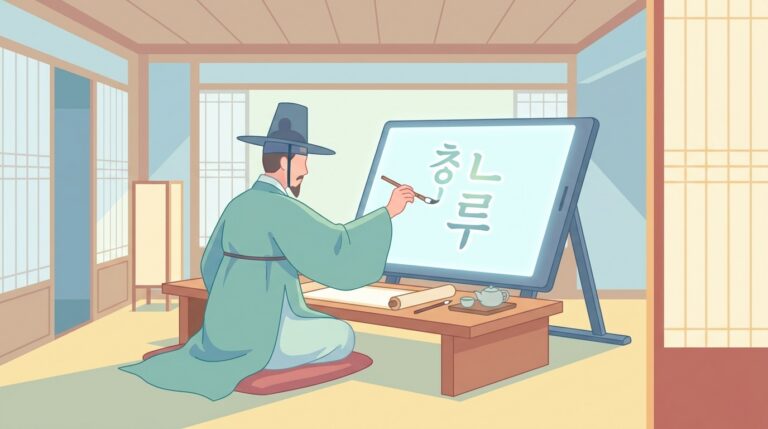
Phase 1: 공감 (스토리 몰입형 오프닝)
안녕하세요! 매일한글 에디터입니다.
Have you ever hit that elusive, invisible plateau where your Korean is technically flawless—you pass TOPIK VI with ease, comprehend news editorials, and debate socio-economic policies—yet your expression feels devoid of artistic pulse? Perhaps you were drafting a creative essay, pitching a screen treatment, or analyzing a classic novel in a graduate seminar, only to feel your words were trapped in rigid, sterile textbook formulations.
Picture this: You are sitting in an aesthetic café in Samcheong-dong with a Korean screenwriter friend. Over iced Americanos, she dissects the groundbreaking historical drama Mr. Queen (철인왕후) or the explosive cultural commentary of Agust D’s Daechwita (대취타). She leans forward and says: “결국 살아남는 창작은 옛것을 맹목적으로 베끼는 게 아니라, 그 뼈대를 쥐고 당대의 언어로 전복하는 법고창신(法古創新)에 있잖아.” (“Ultimately, enduring creation isn’t about blind imitation of antiquity; it lies in beopgochangsin—gripping tradition’s spine while radically subverting it in contemporary tongue.”)
In that single moment, classical Joseon rhetoric collides with cutting-edge 21st-century Hallyu storytelling. You realize that true linguistic mastery at the C2 level isn’t about using arcane vocabulary just to sound sophisticated; it is about wielding the rhetorical power of the classical masters to electrify modern thought. In 18th-century Joseon, Yeonam Pak Chi-won (박지원) shocked the Confucian establishment by daring to record the slang of market vendors, filthy town humor, and sharp sociopolitical critique within elite classical prose, braving King Jeongjo’s censorship in the infamous Munchebanjeong (Literary Purge). Drawing from over a decade of mentoring advanced scholars, diplomats, and creative writers, this guide will unlock the transformative rhetoric of Beopgochangsin (法古創新), empowering you to articulate cultural critique with the biting wit, elegance, and stylistic authority of Korea’s finest essayists.
Phase 2: 핵심 표현 3선 심층 분석
1. 법고창신 (法古創新)
- Pronunciation: [Beop-go-chang-sin] (Think: “Bup-go-chahng-sheen”—articulate the unvoiced stops cleanly without aspirating the ‘b’)
- Meaning: Literally “Modeling after the old to create the new.” Nuance: Grounding oneself rigorously in classical heritage, not out of nostalgic reverence, but as fuel for daring, avant-garde reinvention.
- K-Culture Moment: Used by acclaimed directors like Bong Joon-ho when explaining how Parasite (기생충) reinvents classic 1960s Korean cinema tropes into a razor-sharp modern class critique.
- Editor’s Insight: Do not confuse this with 온고지신 (溫故知新, Ongojisin). While Ongojisin emphasizes pedagogical reflection (“reviewing the old to gain new insights”), Yeonam’s Beopgochangsin is an aggressive creative manifesto: if you only imitate the old, your prose becomes a lifeless corpse; if you innovate without tradition, your writing becomes groundless babble.
- Situation Spectrum: Casual ⚠️ | Semi-formal ✅ | Formal ✅
- 🤔 Think About It: Does your native culture view classical canons as sacred relics to preserve unchanged, or as raw material meant to be dismantled and reinvented?
2. 진부함을 탈피하다 (Jinbuhameul talpihada)
- Pronunciation: [Jin-bu-ham-eul tal-pi-ha-da] (Pronounce ‘tal-pi’ crisply, evocative of molting a shell)
- Meaning: Literally “To molt/shed one’s triteness or cliché.” Nuance: To actively tear away predictable tropes and stale academic conventions to unleash genuine stylistic freshness.
- K-Culture Moment: Frequently employed in literary reviews, film criticism on Watcha, and cultural columns praising artists who refuse to fall into derivative storytelling.
- Editor’s Insight: Talpi (탈피) borrows the biological imagery of an insect or reptile shedding its old exoskeleton. When paired with jinbuham (진부함), it implies that breaking clichés is an uncomfortable, evolutionary necessity for any serious writer.
- Situation Spectrum: Casual ⚠️ | Semi-formal ✅ | Formal ✅
- 🤔 Think About It: When an artist reinterprets a historical event, where is the boundary between an inspired reinvention and an ungrounded distortion?
3. 파격을 꾀하다 (Pagyeogeul kkoehada)
- Pronunciation: [Pa-gyeo-geul kkoe-ha-da] (Crisp ‘pa’ exploding into the soft throat glide of ‘kkoe’)
- Meaning: Literally “To scheme or pursue the destruction of established rules.” Nuance: Deliberately breaking stylistic norms with calculated genius rather than amateur ignorance.
- K-Culture Moment: Music critics dissecting NewJeans’ unexpected song structures or BTS’s fusion of pansori cadences with modern trap beats.
- Editor’s Insight: Gyeok (격, 格) refers to formal decorum and social lattice. Pagyeok is not chaotic vandalism; it is a virtuoso’s conscious decision to violate the rules precisely because they have mastered them inside out.
- Situation Spectrum: Casual ⚠️ | Semi-formal ✅ | Formal ✅
- 🤔 Think About It: Can an apprentice attempt pagyeok, or does subverting rules require full mastery of classical convention first?
Phase 3: 교과서 한국어 vs 진짜 한국어
Situation 1: Critiquing a derivative, cliché creative project
- 📖 교과서 한국어:
이 작품은 과거의 형식을 그대로 모방하여 창의성이 다소 부족하다고 생각합니다.
(I think this work somewhat lacks creativity because it imitates past forms as they are.) - 🗣️ 진짜 한국어:
전통의 외피만 흉내 낸 전형적인 의고(擬古)에 그쳐서, 진부함을 전혀 탈피하지 못했어요.
(It barely scrapes by as sterile pseudo-classicism mimicking tradition’s outer husk, utterly failing to break free from cliché.) - 💡 왜 다를까? C2-level literary circles don’t rely on generic words like chang-uiseong (creativity). They invoke rhetorical concepts like Uigo (擬古, blind antiquity-mimicry) to diagnose why an artistic piece feels hollow.
Situation 2: Praising a radical reinterpretive work
- 📖 교과서 한국어:
고전을 현대적으로 잘 바꾸어서 아주 흥미롭고 새롭습니다.
(It changed the classics modernly, so it is very interesting and new.) - 🗣️ 진짜 한국어:
고전의 미학을 딛고 서서 당대의 날 선 언어로 과감한 파격을 꾀했더군요.
(Standing firmly upon classical aesthetics, it dared a razor-sharp subversion in contemporary vernacular.) - 💡 왜 다를까? Educated Koreans and critics use structural metaphors such as ~을 딛고 서서 (standing upon the stepping stones of) combined with kinetic nouns like pagyeok (radical rule-breaking) to confer high-register commendation.
Phase 4: K-Culture 딥다이브 & 비언어적 매너
4-1. 눈치(Nunchi) & Intellectual Restraint
When debating classical aesthetics or creative philosophy in Korea, intellectual confidence must be balanced with supreme philosophical humility. Classical scholars (seonbi) never shouted down an opponent. When deconstructing an outdated orthodoxy:
* Keep your posture composed, tilting your head slightly (약 15도) in deliberate contemplation before delivering a sharp intellectual critique.
* Modulate your speech cadence: slow down slightly when introducing classical idioms like Beopgochangsin, giving the weight of historical gravity to your diction.
* Use a quiet, steady tone of voice (담담한 어조) rather than passionate declamation; in elite Korean rhetorical traditions, understated calmness conveys formidable intellectual mastery.
4-2. Cultural Code: From Yeonam’s Satire to Modern K-Storytelling
In late Joseon, Yeonam Pak Chi-won penned Hojil (호질, The Tiger’s Reprimand) and Heosaengjeon (허생전), lampooning hypocritical aristocratic scholars who memorized ancient Chinese texts but were completely blind to the economic misery of their fellow citizens. King Jeongjo even launched the Munchebanjeong to suppress Yeonam’s colloquial, raw, vernacular style.
Fast forward 250 years: this exact tension defines modern Korean cultural success. When contemporary historical dramas rewrite stiff palace records into dynamic psychological thrillers, or when lyricists blend archaic court Korean with hip-hop rhyme schemes, they are enacting Yeonam’s ethos. True Korean cultural genius flourishes at the friction point between profound reverence for historical roots and the fearless urge to dismantle societal dogmas.
Phase 5: 실전 롤플레이 시나리오
Setting: A sunlit editorial office in Paju Book City (파주출판도시). You are presenting a concept paper for a high-concept literary adaptation to Chief Content Director Min (민 총괄 디렉터), renowned for her merciless aesthetic standards.
- 디렉터 민: 이번 기획안, 흥미롭긴 한데 자칫하면 그저 그런 퓨전 사극의 아류작으로 전락할 위험이 있어 보여요. 고전의 무게감과 현대적 감각 사이의 균형을 어떻게 잡으실 생각입니까?
(Ibeon gihoegan, heungmiropgin hande jachithamyeon geujeo geureon pyujeon sageuk-ui aryujak-euro jeonrakhal wiheom-i boyeoyo. Gojeon-ui mugegam-gwa hyeondaejeok gamgak sai-ui gyunhyeong-eul eotteoke japseil saenggak-imnikka?)
“This proposal is intriguing, but run the risk of degrading into a derivative knockoff of generic fusion period pieces. How do you intend to strike the balance between classical gravitas and modern sensibility?” -
나 (Learner):
🎭 (차분하게 시선을 맞추며 노트를 넘긴다)
단순한 시대 배경의 차용에 머물지 않고, 연암 박지원의 법고창신(法古創新) 정신을 서사의 핵심 동력으로 삼고자 합니다.
(Dansunhan sidae baegyeong-ui chayong-e meomulji anko, Yeonam Bak Chi-won-ui beopgochangsin jeongsin-eul seosa-ui haeksim dongryeok-euro samgoja hamnida.)
“Instead of merely borrowing the period backdrop, I intend to harness Yeonam Pak Chi-won’s spirit of Beopgochangsin as the narrative’s core engine.” -
디렉터 민: 법고창신이라… 개념은 훌륭하지만, 현장 연출에서 자칫 박제된 고전문학 강의처럼 보이면 대중은 외면할 텐데요?
(Beopgochangsin-ira… Gaenyeom-eun hullyunghajiman, hyeonjang yeonchul-eseo jachit bakjedoen gojeonmunhak gang-uicheoreom boimyeon daejung-eun oemyeonhal tendeyo?)
“Beopgochangsin… A fine concept, but if the actual staging appears like an embalmed lecture on classic literature, audiences will turn away.” -
나 (Learner):
🎭 (단호하면서도 절제된 어조로 미소를 띤다)
그렇기 때문에 전통의 외피만을 답습하는 의고(擬古)적 태도를 철저히 배제했습니다. 고전 한시의 함축적 리듬을 빌려오되, 인물들의 대사에는 오늘날 청년들이 체감하는 신랄한 속어와 파격을 담았습니다.
(Geureotgi ttaemune jeontong-ui oepimaneul dapseuphaneun uigo-jeok taedoreul cheoljeohi baejehaessseumnida. Gojeon hansi-ui hamchukjeok rideum-eul billyeoodoe, inmuldeur-ui daesa-eneun oneulnal cheongnyeondeur-i chegweomhaneun sinralhan sog-eowa pagyeog-eul damassseumnida.)
“That is precisely why we rigorously eliminated pseudo-classical mimicry that merely parrots tradition’s outer surface. While borrowing the implicit rhythms of Sino-Korean poetry, the dialogue channels the biting vernacular and rule-breaking wit felt by today’s youth.” -
디렉터 민: 흠, 고전의 뼈대를 쥐되 살과 피는 당대의 생생한 육성으로 채우겠다는 뜻이군요. 문체반정 당시 정조가 느꼈을 법한 아찔한 불온함이 느껴집니다.
(Heum, gojeon-ui ppyodaereul jwidoe sal-gwa pi-neun dangdae-ui saengsaenghan yukseong-euro chaeugessdaneun tteus-igunyo. Munchebanjeong dangsi Jeongjoga neukgyeosseul beobhan ajjilhan buronham-i neukkyeojimnida.)
“Hmm, so you mean to grasp the skeletal frame of the classics while filling the flesh and blood with the vibrant, living voice of our era. It emits the dizzying subversion that King Jeongjo must have felt during the Literary Purge.” -
나 (Learner):
🎭 (가볍게 고개를 끄덕이며 확신을 싣는다)
정확히 보셨습니다. 진부함을 탈피하지 못하는 고전은 박제일 뿐이지만, 오늘의 결핍과 충돌할 때 비로소 살아 움직이는 신화가 된다고 확신합니다.
(Jeonghwakhi bosyeossseumnida. Jinbuhameul talpihaji mothaneun gojeon-eun bakje-il ppun-ijiman, oneul-ui gyeolpip-gwa chungdolhal ttae biroso sara umjig-ineun sinhwaga doendago hwaksinhamnida.)
“You caught it precisely. Classics that fail to shed triteness are nothing more than museum specimens; I am convinced they become living mythology only when colliding with today’s existential hungers.” -
디렉터 민: 좋습니다. 그 서슬 퍼런 문제의식을 잃지 마세요. 이번 주 내로 1부 트리트먼트 완성해서 넘겨주시죠.
(Jotsseumnida. Geu seoseul peoreon munje-uisik-eul ilchi maseyo. Ibeon ju naero il-bu teuriteumeonteu wanseonghaeseo neomgyeojusijyo.)
“Agreed. Do not lose that razor-sharp critical consciousness. Finalize and submit the Episode 1 treatment within this week.” -
나 (Learner):
🎭 (깍듯하게 목례하며)
믿고 맡겨주신 만큼, 형식의 답습에 머물지 않는 서사를 증명해 보이겠습니다.
(Mitgo matgyeojusin mankeum, hyeongsik-ui dapseub-e meomulji anneun seosareul jeungmyeonghae boigessseumnida.)
“Given your trust, I will prove a narrative that never rests upon the sterile complacency of convention.”
🔀 인터랙티브 분기점 (What would you say next?)
Director Min asks: “만약 전통 한학자 그룹에서 역사 왜곡이나 고전 훼손이라는 비판을 제기한다면 어떻게 방어하시겠습니까?” (“If traditional classicists criticize the project for historical distortion or desecration of the classics, how will you defend it?”)
- Choice A (Best): “전통을 우상화하여 박제하는 것이야말로 고전을 고사시키는 일이며, 당대의 모순을 날카롭게 풍자했던 연암의 본령을 계승하는 것이 참된 계승임을 논리적으로 설득하겠습니다.”
Feedback: Best! Demonstrates flawless grasp of philosophical rhetoric, turning the opposition’s argument upside down by framing your innovation as the truest preservation. - Choice B (Risk): “요즘 대중문화 트렌드는 파격이 대세라 그런 고루한 비판은 크게 신경 쓸 필요가 없다고 생각합니다.”
Feedback: Risk. Dismissing traditional scholars as simply “outdated” (goru-hada) sounds intellectually arrogant and defensively immature in high-level Korean corporate or cultural settings. - Choice C (Bad): “문제가 된다면 고전문학 자문위원들의 의견에 따라 대사 수위를 대폭 낮추겠습니다.”
Feedback: Bad. Completely surrenders your artistic vision at the first sign of friction, contradicting the very core of Beopgochangsin.
Phase 6: 10초 감정 섀도잉 드릴
Sharpen your cadence with these advanced rhetorical sentences. Pay strict attention to breath pauses (/) and emotional tone anchors.
- [🧐 깊은 통찰을 담아 차분하게]
전통의 깊은 뿌리를 딛고 서지 않은 혁신은 / 한 줄기 바람에도 쉬이 스러지는 법입니다.
(Jeontong-ui gipeun ppurireul ditgo seoji aneun hyeoksin-eun / han julgi baram-edo swii seureojineun beob-imnida.)
“Innovation that does not stand upon the deep roots of tradition / is bound to perish easily in a single gust of wind.” -
[🔥 지적 확신에 차서 단호하게]
과거의 문장을 맹목적으로 답습하는 것은 / 존경이 아니라 / 사유의 게으름에 불과합니다.
(Gwageo-ui munjang-eul maengmokjeog-euro dapseuphaneun geos-eun / jongyeong-i anira / sayu-ui ge-eureum-e bulgwahamnida.)
“Blindly imitating the prose of antiquity / is not reverence, / but mere intellectual indolence.” -
[⚡ 서슬 퍼런 결의를 보이며]
우리가 감행해야 할 파격은 / 낡은 질서에 균열을 내고 / 당대의 진실을 길어 올리는 일이어야 합니다.
(Uriga gamhaenghaeya hal pagyeog-eun / nalgeun jilseo-e gyunyeor-eul naego / dangdae-ui jinsir-eul gir-eo ollineun ir-ieoya hamnida.)
“The subversion we must daringly commit / must create fissures in stale orders / and draw up the living truth of our time.”
Phase 7: K-Culture 미니 사전 (핵심 키워드 4개)
-
문체반정 (Munchebanjeong, 文體反正)
- Translation: The Literary Style Rectification Campaign (1792).
- Usage: King Jeongjo’s royal attempt to purge unconventional, satirical, vernacular-infused Chinese prose written by Silhak thinkers like Yeonam Pak Chi-won. In modern discourse, critics invoke this term whenever institutional power tries to censor avant-garde creative expression.
- 실학 (Silhak, 實學)
- Translation: Practical Learning Movement.
- Usage: A late-Joseon intellectual movement advocating empirical methodology, technological reform, and social pragmatism over sterile Neo-Confucian metaphysics. Modern Koreans praise policies or initiatives as silhak-jeok (실학적) when they prioritize real-world utility over empty dogma.
- 의고 (Uigo, 擬古)
- Translation: Pseudo-classicism; slavish imitation of antiquity.
- Usage: Used in academic critiques and literary essays to scathingly denote derivative works that merely copy ancient diction without breathing modern soul or intellectual risk into the prose.
- 파격 (Pagyeok, 破格)
- Translation: Radical subversion of rules; unconventional breakthrough.
- Usage: Used across fashion, business strategy, cinema, and fine arts to describe daring decisions that smash protocol with spectacular brilliance (e.g., 파격적인 행보, 파격적인 캐스팅).
Phase 8: 여행자를 위한 생존 키트
For the literary wanderer seeking out Korea’s deep classical history and vibrant editorial hubs:
Cultural Survival Expressions TOP 3
- 혹시 이 고문서의 해제(解題)나 번역본이 구비되어 있습니까?
(Hoksi i gomunseo-ui haeje-na beon-yeokbon-i gubidoeeo issseumnikka?)
“By any chance, is an explanatory bibliographic note or modern translation available for this classical document?”
Pro Tip: Use this at museum libraries or temple archives; asking for a haeje (scholarly breakdown) instantly establishes your elite linguistic pedigree. -
연암 박지원 선생의 문집 중 열하일기 원문 영인본을 열람할 수 있을까요?
(Yeonam Bak Chi-won seonsaeng-ui munjip jung Yeolha Ilgi wonmun yeong-inbon-eul yeollamhal su isseulkkayo?)
“May I inspect the facsimile print edition of the original Yeolha Ilgi text from Master Pak Chi-won’s collected works?” -
고전의 원형을 보존하면서도 현대적 감각으로 큐레이션한 공간이 인상적이네요.
(Gojeon-ui wonhyeong-eul bojeonhamyeonseodo hyeondaejeok gamgak-euro kyureisyeonhan gonggan-i insangjeog-ineyo.)
“The curation here is truly impressive—preserving the original classical form while infusing contemporary aesthetic taste.”
Editor’s Travel Note: Exploring Korea’s Literary Landscapes
- Paju Book City (파주출판도시): Hop on bus 2200 from Hapjeong Station to wander among monolithic modernist publishing houses, architectural marvels, and rare book archives. Navigate the serene canal trails using the Naver Map app route guide.
- National Library of Korea (국립중앙도서관): Head to the Classical Literature Room (고전운영실) in Seocho-dong. Apply online beforehand to view original Joseon woodblock prints and Silhak manuscripts.
- Local Etiquette: When handling reproduction classical texts or discussing literature with curators, use both hands (du son-euro) to receive printed materials and speak in quiet, measured tones.
Phase 9: “한 발 더 깊이” (생각 질문)
Traditional Korean aesthetics are fundamentally rooted in dialectical tension: deeply honoring the ancestral trunk while insisting on the organic vitality of fresh blossoms. When Yeonam Pak Chi-won penned his travelogue Yeolha Ilgi, he argued that writing which simply mimics the Han and Tang dynasties of ancient China is nothing more than theatrical masquerade; true honor to the ancients consists in writing with the unvarnished honesty of one’s own century. Modern Korea’s stunning global creative output—from genre-bending webtoons to subversive cinema—is not a rejection of traditional collectivism, but its ultimate evolutionary maturation under the banner of Beopgochangsin.
💬 Your Turn: In your own creative work, writing, or career, what is a traditional standard you choose to honor as an unshakeable foundation—and what is a daring pagyeok (파격) you are determined to execute? Leave a comment below using the phrase ~을/를 딛고 서서 ~의 파격을 꾀하다!
Phase 10: FAQ & 오해 방지 (FAQ Schema)
Q: Isn’t 온고지신 (温故知新) the exact same thing as 법고창신 (法古創新)?
A: While they appear similar, their philosophical trajectories diverge significantly. Ongojisin (from Confucius’s Analects) focuses primarily on ethical and pedagogical continuity: learning past lessons to gain personal moral wisdom. In contrast, Beopgochangsin (championed by Yeonam Pak Chi-won) is an aggressive aesthetic and creative methodology: it explicitly warns against the deathly trap of mimicking antiquity (uigo), demanding that tradition be used as a combustible springboard to fashion original, revolutionary forms.
Q: Can I use 법고창신 in daily casual conversations with friends?
A: You can, but it carries deliberate intellectual humor or rhetorical punch. If your friend takes grandma’s traditional doenjang-jjigae recipe and adds truffle oil and smoked brisket, exclaiming “완전 법고창신의 정수네!” (“That is the pure essence of Beopgochangsin!”) sounds brilliantly witty and hyper-literate.
Q: How did Joseon authorities react to writers who broke rhetorical classical rules?
A: Harshly. During the Munchebanjeong of 1792, King Jeongjo viewed colloquial prose, trivial personal essays (so-pum-che), and satirical fiction as ideological threats to the state. He commanded scholars like Pak Chi-won to write formal self-reflective essays (banseongmun) in classical styles, proving just how politically destabilizing stylistic subversion was considered.
🚨 흔한 실수 (Common Mistakes) 경고판
- Mistake: Confusing 의고 (擬古, slavish mimicry of the past) with 온고 (溫故, respectful review of the past).
- Correct Action: Use uigo pejoratively to critique mindless imitation, and ongo respectfully when talking about historical study.
- Mistake: Mispronouncing 파격 (Pagyeok) as [Ba-kyeok].
- Correct Action: The initial ㅍ is heavily aspirated [Pʰa], followed by a crisp tensified gyeok [gyok]. It must sound decisive and incisive.
- Mistake: Using Beopgochangsin to justify lazy work that ignores foundational craft.
- Correct Action: Remember that Beopgo (modeling after tradition) comes first. If you don’t know the traditional rules, breaking them isn’t pagyeok—it is simply incompetence.
Phase 11: 액션 미션 & 참여 유도
- 🥉 Bronze Mission (Solo Practice): Read the 3 shadowing sentences in Phase 6 aloud 5 times each, focusing on the pauses (
/) and projecting calm, intellectual gravitas. - 🥈 Silver Mission (Social Output): Write a 2-sentence micro-review of your favorite K-drama or K-pop release on Instagram or X (Twitter), integrating the expression 법고창신 and tagging
#DailyHangulC2. - 🥇 Gold Mission (Real-world Application): In your next advanced Korean conversation exchange, essay, or academic critique, diagnose a creative project by contrasting 의고 (擬古) against 파격 (破格).
🎮 K-Culture Mission: Watch the music video or stage performance of Agust D’s Daechwita (대취타). Identify three distinct traditional symbols (such as the king’s attire, sword dance, traditional court military music) and take notes on how contemporary hip-hop beats subvert their classical meanings.
Phase 12: 인터랙티브 퀴즈 챌린지
1. 상황 판단 퀴즈 (Contextual Judgment)
한 웹툰 작가가 조선 시대를 배경으로 하면서도, 고증에만 집착하지 않고 현대 청년들의 현실적 고뇌를 신선한 문체로 담아내어 평단의 찬사를 받았습니다. 이 작가의 창작 태도를 가장 적절하게 평가한 사자성어는 무엇일까요?
* A) 구태의연 (舊態依然)
* B) 법고창신 (法古創新)
* C) 자중지난 (自中之亂)
Reveal Answer & Detailed Explanation
정답: B) 법고창신 (法古創新)
해설: 구태의연(A)은 낡은 방식에서 벗어나지 못함을 비판하는 표현이며, 자중지난(C)은 같은 패 안에서 일어나는 싸움을 의미합니다. 고전적 토대 위에서 당대적 언어로 혁신을 감행한 작가의 태도는 ‘법고창신’에 완벽히 부합합니다.
2. 빈칸 채우기 퀴즈 (Fill-in-the-Blank)
고전의 외형만을 맹목적으로 모방하는 [ ]에 그친다면, 아무리 화려한 문장이라도 생명력을 얻지 못하고 진부함에 빠지게 된다.
Reveal Answer & Detailed Explanation
정답: 의고 (擬古)
해설: ‘옛것을 흉내 냄’을 비판적으로 일컫는 개념어는 ‘의고(擬古)’입니다. 연암 박지원은 옛 문장만을 답습하는 의고파 문장가들을 향해 ‘죽은 시체를 베끼는 것과 같다’며 통렬한 비판을 가했습니다.
3. 문화 진위 퀴즈 (True / False)
조선 정조(正祖) 시대에 일어난 ‘문체반정(文體反正)’은 박지원과 같은 실학파 문장가들이 사용한 파격적이고 자유분방한 패설·속어풍 문체를 장려하고 국가 차원에서 진흥하기 위해 시행된 정책이다. (T / F)
Reveal Answer & Detailed Explanation
정답: False (거짓)
해설: 문체반정은 반대로 정조 임금이 유교적 정통 순정 문체(고문, 古文)를 회복하고자, 연암의 참신하고 파격적인 문체를 불온하다고 여겨 탄압하고 교정하려 했던 보수적 문체 통제 정책이었습니다.







