

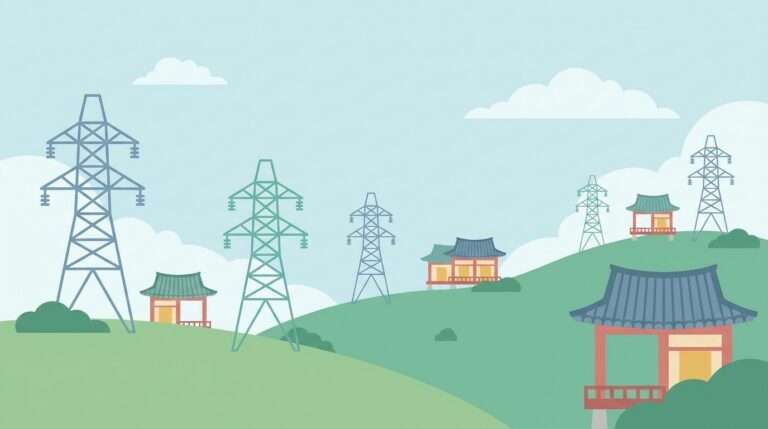
Mastering C1 Korean Energy Policy: Transmission Grids, CBAM, and Community Harmony
Phase 1: Empathy & Narrative Opening
안녕하세요! 매일한글 에디터입니다. (Annyeonghaseyo! It’s your Daily Hangul editor.)
Imagine walking into a high-stakes strategy meeting in Sejong or the headquarters of KEPCO in Naju. Outside, the news ticker is buzzing with updates on the European Union’s Carbon Border Adjustment Mechanism (CBAM). Inside, top energy analysts, provincial delegates, and corporate directors are locked in an intense discussion. Korean manufacturing giants need gigawatts of clean solar and offshore wind energy piped from the southern coasts up to the semiconductor mega-clusters in Gyeonggi-do. Yet, there is a massive bottleneck: local communities along the transmission corridors are protesting, and multi-agency regulatory permits are stalled in legislative limbo.
Have you ever tried expressing complex public-private tensions, regulatory fast-tracking, or equitable revenue-sharing models in Korean without sounding like you’re reading directly from an outdated paper dictionary? Many advanced learners stumble here. You know basic vocabulary like ‘전기’ (electricity) and ‘법’ (law), but bridging them into sophisticated policy terms such as ‘주민 수용성’ (community acceptance) or ‘인허가 의제’ (permitting deemed authorization) feels daunting. In this guide, backed by feedback from international energy consultants and trade attachés working right here in Seoul, we will unpack the exact high-level phrasing and cultural etiquette you need to advocate for grid expansion and community coexistence at a C1 level.
Phase 2: Core C1 Policy Expressions in Depth
1. 송전망 경과지 주민들과의 이익 공유를 제도화해야 합니다.
(Songjeonmang gyeonggwaji jumingwa-ui iik gong-yureul jedohwahae-ya hamnida.)
* Pronunciation: [Song-jeon-mang gyeong-gwa-ji ju-min-deul-gwa-ui i-ik gong-yu-reul je-do-hwa-hae-ya ham-ni-da] (Think: Song-jun-mahng gyung-gwa-jee joo-min-dul-gwa-wee ee-eek gohng-yoo-rul jeh-doh-hwa-hae-yah hahm-nee-dah)
* Meaning: Literal: “We must institutionalize the sharing of profits with the residents of transmission grid passing regions.” / Nuanced: “We must establish an institutionalized, statutory framework ensuring affected corridor communities share in the recurring economic benefits of the grid.”
* K-Culture Moment: In political or corporate dramas like Vincenzo or Agency, boardroom figures often contrast one-off compensations with sustainable systemic reform. This sentence represents that pivot from transactional pay-offs to ethical partnership.
* Editor’s Insight: Notice the nominalization ‘제도화’ (institutionalization). At the C1 level, using ‘-화하다’ (-ize/-ify) shifts your speech from informal requests into polished executive proposals.
* Situation Spectrum: Casual 🚫 | Semi-formal ⚠️ | Formal ✅
* 🤔 Think About It: In your home country, is regional infrastructure compensation purely legalistic and individual, or does it incorporate community-wide, collective shared dividends like Korea’s ‘햇빛연금’ (sunlight pensions)?2. 인허가 절차를 단축하는 특별법 제정이 시급해요.
(Inheoga jeolchareul danchukhaneun teukbyeolbeop jejeong-i sigeuphaeyo.)
* Pronunciation: [In-heo-ga jeol-cha-reul dan-chu-kha-neun teuk-byeol-beop je-jeong-i si-geu-phae-yo] (Think: In-huh-gah juhl-chah-rul dahn-chook-hah-noon took-byuhl-buhp jeh-jung-ee shee-goop-hae-yo)
* Meaning: Literal: “Enacting a special act that shortens licensing procedures is urgent.” / Nuanced: “Passing a special statutory act to streamline and fast-track the regulatory permitting pipeline is of paramount urgency.”
* K-Culture Moment: Similar to policy scenes in Designated Survivor: 60 Days, where officials rush legislative agendas through the National Assembly to avert trade crises.
* Editor’s Insight: ‘인허가’ combines ‘인가’ (approval) and ‘허가’ (permission). Combining this with ‘시급하다’ (to be pressing/urgent) creates an assertive, action-oriented policy assertion without sounding abrasive.
* Situation Spectrum: Casual 🚫 | Semi-formal ✅ | Formal ✅
* 🤔 Think About It: Why do you think ‘특별법’ (Special Acts) are so frequently proposed in Korea compared to standard legislative amendments when urgent national crises emerge?3. CBAM 대응을 위한 선제적 전력망 확충이 불가피합니다.
(CBAM dae-eung-eul wihan seonjejeok jeollyeokmang hwakchung-i bulgahapnida.)
* Pronunciation: [CBAM dae-eung-eul wi-han seon-je-jeok jeol-lyeong-mang hwak-chung-i bul-ga-pi-ham-ni-da] (Think: CBAM dae-oong-ul wee-hahn sun-jeh-juhk juhl-lyung-mahng hwahk-choong-ee bool-gah-pee-hahm-nee-dah)
* Meaning: Literal: “Preemptive power grid expansion for CBAM response is unavoidable.” / Nuanced: “Preemptive, proactive grid infrastructure build-out is essential if we are to safeguard our industrial export competitiveness under CBAM.”
* K-Culture Moment: Featured on economic analysis segments like KBS Sisa Window or JTBC Newsroom when discussing South Korea’s heavy reliance on steel and semiconductor exports to Europe.
* Editor’s Insight: The Sino-Korean word ‘선제적’ (proactive/preemptive) signals foresight, while ‘불가피하다’ (unavoidable) conveys that delay is no longer an option.
* Situation Spectrum: Casual 🚫 | Semi-formal ⚠️ | Formal ✅
* 🤔 Think About It: How does your native language express necessity? Notice how Korean often employs double negatives or formal constraints like ‘불가피’ (not possible to avoid) to project diplomatic weight.
Phase 3: Textbook Korean vs. Real Korean
Situation 1: Calling for urgent government action on grid permits
- 📖 교과서 한국어: 우리는 전선을 빨리 만들기 위해 법을 만들어야 합니다. (Urineun jeonseoneul ppalli mandeulgi wihe teukbyeolbeobeul mandeureoya hamnida.) – “We must make a law to make power lines quickly.”
- 🗣️ 진짜 한국어: 계통 지연을 해소하려면 인허가를 일괄 타결하는 특별법 제정이 절실합니다. (Gyeton ji-yeoneul haesoharyeomyeon inheogareul ilgwal tagyeolhaneun teukbyeolbeop jejeong-i jeolsilhamnida.) – “To resolve grid connection bottlenecks, enacting a special act for bundled permit fast-tracking is absolutely vital.”
- 💡 왜 다를까?: Policy discussions in Korean rely on formal Sino-Korean nouns (‘계통’ for power grid systems, ‘일괄 타결’ for package deal/bundled clearance, ‘절실하다’ for acute necessity) rather than native verbal stems like ‘빨리 만들기’.
Situation 2: Discussing compensation with regional representatives
- 📖 교과서 한국어: 주민들에게 돈을 더 많이 보상해 줍시다. (Jumindeurege doneul deo mani bosanghae jupsida.) – “Let us compensate the residents with more money.”
- 🗣️ 진짜 한국어: 단순 현금 보상을 지양하고, 주민 참여형 이익 공유제를 제도화해야 수용성을 높일 수 있습니다. (Dansun hyeongeum bosang-eul jiyanghago, jumin cham-yeohyeong iik gong-yuje-reul jedohwahae-ya suyongseong-eul nop-il su itseumnida.) – “We should move away from simple cash handouts and institutionalize a participatory benefit-sharing scheme to boost public acceptance.”
- 💡 왜 다를까?: In modern Korea, rural communities reject one-sided corporate compensation (‘단순 현금 보상’). Using nuanced expressions like ‘지양하다’ (to avoid/refrain from) and ‘수용성’ (receptivity/acceptance) shows high sociological acumen.
Phase 4: K-Culture Deep Dive & Non-Verbal Manners
4-1. 눈치 (Nunchi) & Town Hall Etiquette in Regional Korea
When visiting a provincial county hall (군청) or public hearing (주민설명회) in places like Haenam or Donghae, you cannot lead immediately with spreadsheets or carbon penalties. This runs counter to traditional Korean emotional rapport (Jeong and collective respect).
Before discussing high-voltage direct current (HVDC) lines, observe the room’s atmosphere (눈치를 보다). Greet local community elders with a respectful, two-handed handshake (두 손 악수) while tilting your upper body forward at 30 to 45 degrees. When tea is served, accept the cup with both hands. Rushing straight into technical timelines makes you look self-absorbed and dismissive of their land heritage. Acknowledge their past sacrifices first with phrases like: “그동안 지역 주민 여러분의 헌신이 있었기에 산업 발전이 가능했습니다” (“Our nation’s industrial progress was only possible thanks to the dedication of local residents like you”).
4-2. Cultural Code Analysis: The Balance of Sangsaeng (상생)
In contemporary Korean socio-economics, the dominant buzzword is ‘상생’ (mutual coexistence). Unlike pure free-market paradigms where financial settlements close a contract, Korean infrastructure demands moral legitimacy. When renewable solar plants or massive transmission towers cross historic farmlands, companies must prove that the project uplifts the region’s grandchildren through scholarship funds, agricultural solar pensions, and medical centers. Demonstrating an understanding of this ‘공동체적 책임’ (communal responsibility) elevates your communication from foreign technocrat to trusted cultural partner.
Phase 5: Real-World Policy Roleplay Scenario
Setting: A conference room at the Ministry of Trade, Industry and Energy (MOTIE) complex in Sejong.
Characters:
* Min-jun (민준): Strategic ESG Director at a global export consortium.
* Director Han (한 국장): Senior Director of Provincial Energy Grid Infrastructure.
Turn 1
민준: 국장님, 유럽 CBAM 발효 시점이 코앞인데 남부권 전력망 포화가 심각한 수준입니다.
(Gukjangnim, Yureop CBAM balhyo sijeom-i ko-ap-inde nambugwon jeollyeokmang pohwaga simgaghan sujun-imnida.)
“Director Han, with the EU CBAM implementation right around the corner, grid congestion across our southern region has reached a crisis point.”
🎭 [두 손으로 데이터 보고서를 건네며 진지한 눈빛으로]
Turn 2
한 국장: 저도 잘 알고 있습니다. 하지만 송전탑 경과지 주민분들의 반발과 부처 간 협의 지연으로 인허가가 멈춰 있어요.
(Jeodo jal algo itseumnida. Hajiman songjeontap gyeonggwaji juminbundeul-ui banbalgwa bucheo gan hyeop-ui ji-yeon-euro inheogaga meomchwo isseoyo.)
“I am well aware. However, due to backlash from corridor residents and inter-agency delays, permits are completely stalled.”
🎭 [안경을 벗고 미간을 짚으며 깊은 한숨을 쉰다]
Turn 3
민준: 기존의 일회성 보상 방식으로는 주민 수용성을 확보하기 어렵습니다. 연금형 이익 공유제를 제도화해야 합니다.
(Gijon-ui ilhoeseong bosang bangsik-euroneun jumin suyongseong-eul hwakbohagiga eoryeopseumnida. Yeon-geumhyeong iik gong-yuje-reul jedohwahae-ya hamnida.)
“With the old method of one-off payouts, securing community acceptance is impossible. We must institutionalize a pension-style benefit-sharing model.”
🎭 [신뢰감 있는 어조로 단호하게 제안하며]
Turn 4
한 국장: 이익 공유 모델 자체는 긍정적입니다만, 결국 지자체마다 인허가 기준이 제각각인 점이 걸림돌입니다.
(Iik gong-yu model jache-neun geungjeongjeog-imnida-man, gyeolguk jijache-mada inheoga gijun-i jegakgak-in jeom-i geollimdol-imnida.)
“The profit-sharing model itself is positive, but the ultimate hurdle is that permitting criteria vary wildly across local governments.”
🎭 [보고서의 지자체별 인허가 현황 표를 가리키며]
Turn 5
민준: 바로 그렇기 때문에 전력망 확충 특별법을 통해 인허가 절차를 패스트트랙으로 일원화해야 합니다.
(Baro geureokgi ttaemune jeollyeokmang hwakchung teukbyeolbeob-eul tonghae inheoga jeolchareul paeseuteuteuraeg-euro ilwonhwahae-ya hamnida.)
“Precisely why we must unify and fast-track permit procedures under a dedicated Special Grid Expansion Act.”
🎭 [상대방의 눈을 맞추며 설득력 있게 상체를 기울인다]
Turn 6
한 국장: 국회 설득이 관건이겠군요. 법안에 주민 지원금 분배 투명성을 보장하는 조항이 반드시 포함되어야 합니다.
(Gukhoe seoldeug-i gwangeon-igessgunyo. Beoban-e jumin jiwon-geum bunbae tumyeongseong-eul bojanghaneun johang-i bandeusi pohamdoeeoya hamnida.)
“Persuading the National Assembly will be key. The bill must mandate strict transparency provisions for dispersing community funds.”
🎭 [고개를 천천히 끄덕이며 메모장에 기록한다]
Turn 7
민준: 전적으로 동의합니다. 주민과 기업이 윈-윈(Win-Win)하는 상생 조항을 명문화하면 국회 통과도 탄력을 받을 것입니다.
(Jeonjeogeuro dong-uihamnida. Jumingwa gi-eob-i win-win-haneun sangsaeng johang-eul myeongmunhwahamyeon gukhoe tonggwado tanryeog-eul badeul geos-imnida.)
“I fully concur. Explicitly codifying win-win coexistence clauses will give legislative passage decisive momentum.”
🎭 [확신에 찬 미소와 함께 양손을 모으며]
Turn 8
한 국장: 좋습니다. 이번 주 정책 협의회 안건으로 상정하고 공동 브리핑 초안을 마련해 봅시다.
(Joeusseumnida. Ibeon ju jeongchaek hyeop-uihoe angeon-euro sangjeonghago gongdong beuriping choan-eul maryeonhae bopsida.)
“Agreed. Let’s table this at this week’s policy committee and prepare a draft for a joint briefing.”
🎭 [만족스러운 표정으로 서류를 정리하며 악수를 청한다]
🔀 Interactive Scenario Branch Point
At Turn 3, what if Min-jun had pressed forward differently? Which path would you choose?
- Option A: “국가 안보와 수출 기업을 위해 주민분들이 대승적으로 양보해야 하는 것 아닙니까?” (“Shouldn’t the residents make a sweeping concession for national security and export companies?”)
- ❌ Bad (Defensive Backlash): Triggering regional grievances! Asking residents to unilaterally sacrifice invokes memories of historical industrial displacement and breaks dialogue instantly.
- Option B: “법안 제정 전이라도 특별 인센티브 기금을 조성하여 주민 설명회를 선제적으로 개최하겠습니다.” (“Even before the bill passes, we will set up a special incentive fund and hold proactive town halls for residents.”)
- ⚠️ Risk (Premature Commitment): Promising unilateral corporate funds prior to legislative consensus creates regulatory liability and fiscal exposure.
- Option C: “주민을 단순 민원인이 아닌 발전 사업의 공동 파트너로 참여시키는 이익 공유 입법안을 건의해야 합니다.” (“We must recommend a benefit-sharing legislative bill that incorporates residents as co-partners in the power generation project rather than mere complainants.”)
- 🌟 Best (Strategic Mastery): Reframes citizens from obstructive ‘civil complainants’ (민원인) into long-term ‘partners’ (공동 파트너), capturing both ethical sentiment and policy consensus.
Phase 6: 10-Second Emotional Shadowing Drill
Practice these high-impact executive cadences. Emphasize pauses at / to convey gravitas.
- Drill 1
[💼 단호하면서도 정중하게 - Resolute yet courteous]
탄소국경조정제도에 유연하게 대응하려면 / 송전망 확충 특별법 제정이 / 무엇보다 선행되어야 합니다.
(Tansogukgyeongjojeongjedo-e yuyeonhage dae-eungharyeomyeon / songjeonmang hwakchung teukbyeolbeop jejeong-i / mueotboda seonhaengdoeeoya hamnida.)
“To respond nimbly to CBAM, / enacting the Special Grid Expansion Act / must take priority over everything else.” -
Drill 2
[🤝 상생을 강조하며 진정성 있게 - Emphasizing win-win coexistence with deep sincerity]
지역 사회와의 합당한 이익 공유 없이는 / 전력망 사업의 주민 수용성을 / 결코 담보할 수 없습니다.
(Ji-yeok sahoewa-ui hapdanghan iik gong-yu eopsineun / jeollyeokmang sa-eob-ui jumin suyongseong-eul / gyeolko dambohal su eopseumnida.)
“Without equitable benefit-sharing with local communities, / public acceptance of power grid projects / can never be guaranteed.” -
Drill 3
[⚡ 정책 브리핑하듯 명확하고 지적으로 - Clear and authoritative like an executive briefing]
개별 지자체 인허가를 일괄 의제 처리함으로써 / 공기 지연에 따른 천문학적 경제 손실을 / 막아야 합니다.
(Gae-byeol jijache inheogareul ilgwal uije cheoriham-eurosseo / gong-gi ji-yeon-e ttareun cheonmunhakjeok gyeongje sonsil-eul / mag-aya hamnida.)
“By processing individual municipal permits through bundled deemed approvals, / we must prevent / astronomical economic losses caused by construction delays.”
Phase 7: K-Culture Mini Dictionary
- 주민 수용성 (Jumin Suyongseong) | Community Acceptance / Public Receptivity
- Usage: Essential in renewable energy and public infrastructure project finance. Often paired with verbs like ‘확보하다’ (secure) or ‘제고하다’ (enhance).
- 전력 계통 포화 (Jeollyeok Gyetong Pohwa) | Power Grid Congestion / System Saturation
- Usage: Used by policymakers when power plants produce energy that transmission cables cannot carry due to capacity limits. Seen daily in energy news headlines.
- 인허가 의제 (Inheoga Uije) | Deemed Permitting / Bundled Regulatory Approval
- Usage: A regulatory mechanism where obtaining one primary national permit automatically satisfies dozens of subordinate municipal clearances.
- 상생 기금 (Sangsaeng Gigeum) | Coexistence & Mutual Growth Fund
- Usage: Corporate and regional investment vehicle designed to finance local healthcare, community education, and welfare in return for hosting infrastructure.
Phase 8: Strategic Expat Survival Kit
Top 3 Field Expressions
- 1. 실무 협의체를 구성합시다.
(Silmu hyeop-uiche-reul guseonghapsida.)
Pro Tip: Use this to wrap up circular policy meetings by securing a formal ‘working-level consultation group’. - 2. 주민 의견을 적극 수렴하겠습니다.
(Jumin uigyeon-eul jeokgeuk suryeomhagetseumnida.)
Pro Tip: A respectful commitment meaning “We will actively collect and integrate community opinions.” Perfect when facing regional skepticism. - 3. 법안 통과를 위해 총력을 기울이고 있습니다.
(Beoban tonggwareul wihe chongryeog-eul gi-urigo itseumnida.)
Pro Tip: Reassures overseas headquarters and clients that your Korean policy team is “devoting all efforts to pass the legislation.”
Editor’s Field Guide
When traveling beyond Seoul for regional consultations (such as the Energy Valley in Naju or coastal wind hubs in Mokpo), high-speed rail via KTX is standard. Don’t rely on global generic apps; keep updated train schedules and station connections using Naver Map app download. When dining with municipal counterparts in provincial capitals, always prepare for casual post-dinner conversation (Hoesik) where informal agreements are frequently cemented over regional delicacies.
Phase 9: “One Step Deeper” — The Culture of Collective Land Heritage
South Korea’s modern economic miracle was forged through lightning-fast, state-led infrastructure campaigns during the late 20th century. However, modern Korean democracy has introduced a vibrant culture of local self-governance and property rights. In contemporary Korea, rural land is not merely commercial real estate; it represents ancestral roots (Gohyang, 고향) and community heritage. Therefore, attempting to push through critical transmission cables under unilateral eminent domain creates insurmountable friction. Successful executives recognize that modern grid deployment is as much an exercise in empathetic social dialogue and collective wealth creation as it is an engineering feat.
💬 Your Turn: How does your home country balance the rapid industrial demand for green electricity with local community protests along power lines? Share your perspective in the comments below!
Phase 10: FAQ & Common Pitfalls
Q: Why is CBAM driving the urgency for South Korean domestic grid legislation?
A: Under CBAM, manufactured goods exported to the EU (like Korean steel and batteries) face heavy carbon tariffs unless produced with verified clean electricity. Because the bulk of South Korea’s utility-scale renewables are located in the southern coastal provinces while heavy factories are in the northern Seoul metropolitan region, industrial survival directly hinges on immediately moving green electrons northward via transmission lines.
Q: What is the linguistic difference between ‘보상’ (Bosang) and ‘이익 공유’ (Iik Gong-yu)?
A: ‘보상’ refers to one-time restitution or compensation for damages caused by land intrusion. Conversely, ‘이익 공유’ refers to ongoing dividend payments or participatory equity stakes in power generation, signaling a progressive partnership rather than an adversarial payoff.
Q: Can I use the word ‘패스트트랙’ (Fast-track) in formal Korean reports?
A: Yes! ‘패스트트랙’ is widely embraced in corporate and legislative Korean. However, in formal legal statutes, Korean draftsmen will typically write ‘인허가 절차 간소화 및 일괄 처리’ (simplification and bundled processing of permit procedures).
🚨 Common Mistakes Warning Board
- Mistake: Using ‘타협’ (Tahyup – compromise) carelessly in public town halls.
- Risk: Can imply giving up principles or backroom dealings.
- Correct Action: Use ‘합의 도출’ (Hab-ui dochul – reaching consensus) or ‘상생 협력’ (Sangsaeng hyeopryeok – win-win collaboration).
- Mistake: Confusing ‘주민’ (Jumin) with ‘국민’ (Gukmin).
- Risk: ‘국민’ means national citizens; ‘주민’ specifies local residents within a specific jurisdictional corridor.
- Correct Action: Always specify ‘경과지 주민’ (corridor residents) when discussing local transmission routes.
- Mistake: Overusing passive verb endings when pitching strategy.
- Risk: Saying “~인 것 같습니다” (It seems that…) makes leadership doubt your conviction in high-stakes negotiations.
- Correct Action: Conclude with definitive assertive endings like ‘~이 시급합니다’ (is urgent) or ‘~을 추진해야 합니다’ (we must advance…).
Phase 11: Action Mission Challenge
- 🥉 Bronze Mission (Solo Shadowing): Read aloud Phase 6’s Drill 1 three times. Record your voice on your phone, focusing on the rhythmic pause after each
/slash. - 🥈 Silver Mission (Social Networking): Write a brief bilingual LinkedIn or community update summarizing the importance of ‘주민 수용성’ in clean energy deployment using: “친환경 에너지 전환을 위해서는 송전망 확충과 주민 이익 공유가 필수적입니다.”
- 🥇 Gold Mission (Real-World Policy Analysis): Search Korean news portals (like Naver News) for ‘전력망 특별법’ (Special Grid Act). Identify two quotes from ministry officials and translate their main arguments into your study notebook.
- 🎮 K-Culture Mission: Watch an episode of a Korean business/political drama (Misaeng, Agency, or Queen of Tears). Spot any moment where a character tries to resolve a strike or community standoff—did they use cash compensation or a sustainable win-win proposal?
Phase 12: Interactive Quiz Challenge
1. Situational Judgment Quiz
You are presenting to the National Assembly Strategy Committee on how to resolve the bottleneck of transmission lines connecting southern solar hubs to Gyeonggi industrial clusters. Which sentence establishes the most authoritative, persuasive C1 posture?
* (A) 주민들이 화를 내니까 돈을 더 줘서 공사를 끝냅시다.
* (B) 경과지 주민과의 지속 가능한 이익 공유 체계를 제도화하고, 인허가를 단축하는 특별법 제정을 서둘러야 합니다.
* (C) CBAM 때문에 바쁘니까 환경 조사는 생략하고 전선을 깔아야 해요.
2. Fill-in-the-Blank
Fill in the missing Sino-Korean term:
“단순한 일회성 보상을 넘어, 주민들이 발전 사업에 주주로 참여하여 수익을 배분받는 [ ________ ] 모델을 구축해야 계통 연계 지연을 극복할 수 있습니다.”
3. True or False Culture Check
True or False: In Korean business and government infrastructure negotiations, citing legal compliance alone is culturally sufficient to override regional community protests along transmission routes without holding town halls (주민설명회).
👉 Click to reveal answers & explanations!
- Answer: (B)
- Explanation: Option (B) contains formal, precise C1 vocabulary (‘지속 가능한 이익 공유 체계’, ‘제도화’, ‘인허가 단축’, ‘특별법 제정’). Option (A) is too crude and dismissive of community rights, while (C) proposes illegal regulatory skipping.
- Answer: 이익 공유 (Iik Gong-yu) / 이익 공유제
- Explanation: ‘이익 공유’ (Benefit/Profit-sharing) is the definitive economic model where residents participate as stakeholders rather than passive objects of compensation.
- Answer: False
- Explanation: Procedural legalism without emotional and communal dialogue (Nunchi, town halls, stakeholder consensus) leads to intense public petitioning (Minwon), court injunctions, and physical construction standoffs in South Korea.
- Explanation: Procedural legalism without emotional and communal dialogue (Nunchi, town halls, stakeholder consensus) leads to intense public petitioning (Minwon), court injunctions, and physical construction standoffs in South Korea.







