

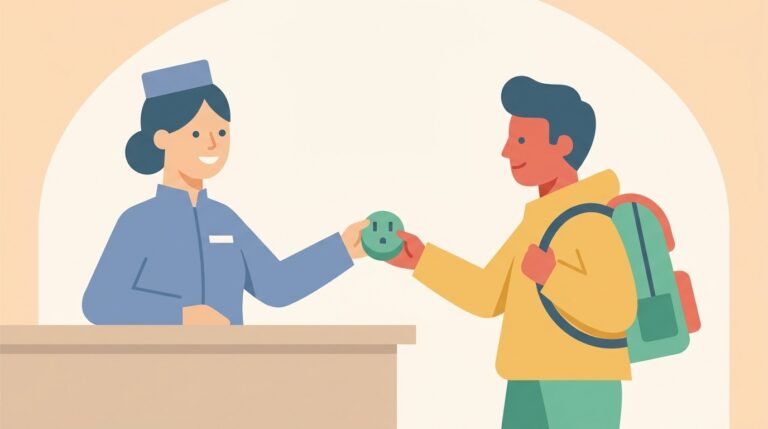
Phase 1: Empathy (Story Immersion Opening)
안녕하세요! 매일한글 에디터입니다. (Annyeonghaseyo! I am your Daily Hangul editor.)
Picture this: You just touched down at Incheon International Airport after a grueling 14-hour flight. You dragged your suitcase through the bustling subway, finally checked into a cozy boutique hotel in Hongdae, and collapsed onto the crisp white bed. You grab your phone to text your family that you made it safely, but horror strikes: your battery shows a flashing red 2%!
You frantically pull your flat-pin phone charger from your backpack, look at the wall outlet, and freeze. Staring back at you are two round, circular holes that look suspiciously like a cute little cartoon pig snout. Your flat plug won’t fit. Worse yet, the hotel room does not have open Wi-Fi, and your overseas roaming data is crawling at a snail’s pace.
Your heart races. You are exhausted, jet-lagged, and your battery is about to die. Can you simply walk down to the reception desk and ask for what you need in Korean, even if you are an absolute beginner?
Yes, you can! Many travelers panic in this exact moment, resorting to wild hand gestures or desperate English pantomiming. But with just three simple, polite sentences, you can get an adapter, connect to high-speed Wi-Fi, and feel like a competent Seoul local. This guide was built directly from real experiences of first-time travelers in Korea. Let’s make sure you never get stranded with a dead battery again!
Phase 2: Top 3 Core Expressions Deep Dive
1. 어댑터 빌릴 수 있어요? (Eodaepteo billil su isseoyo?)
- Pronunciation: [Uh-daep-teo bil-lil soo ee-ssuh-yo?] (Think of saying uh-depth-ter, then bill-lil, followed by sue ease-saw-yo with a gentle rising pitch at the end.)
- Meaning: Literal: “Is it possible to borrow an adapter?” | Real Nuance: “Can I borrow a plug adapter, please?”
- K-Culture Moment: In modern K-dramas like King the Land or Crash Landing on You, whenever travelers check into regional guesthouses, this exact sentence saves the day when foreign devices won’t fit Korean 220V round sockets.
- Editor’s Insight: Notice the pattern
~ㄹ 수 있어요? (~l su isseoyo?). This is the golden Swiss Army knife for beginners! It turns any verb stem into “Can I…?” or “Is it possible to…?” in a polite, friendly tone. - Situation Spectrum: Casual: ⚠️ | Semi-formal: ✅ | Formal: ✅
- 🤔 Think About It: In English, we often ask “Do you have an adapter?” But in Korean, asking directly if you can borrow it (
빌리다) shows clear intent and sounds much more natural at a service desk!
2. 와이파이 비밀번호 뭐예요? (Wa-i-pa-i bimilbeonho mwoyeyo?)
- Pronunciation: [Wah-ee-pah-ee bee-meel-buhn-ho mwo-yay-yo?] (Wah-ee-pah-ee sounds like “Wi-Fi”, bee-meel sounds like “secret”, and mwo-yay-yo asks “what is it?”)
- Meaning: Literal: “Wi-Fi secret number, what is it?” | Real Nuance: “What is the Wi-Fi password?”
- K-Culture Moment: Korea has the fastest public Wi-Fi on the planet! Even in humble street tteokbokki stalls or traditional Hanok stays, you will hear youngsters immediately asking for the
비번 (bibeon)upon sitting down. - Editor’s Insight:
비밀번호 (bimilbeonho)means password, but Koreans love shortcuts. You will often hear locals shorten this to just비번 (bibeon). At level A1, using the full word sounds very polite and crystal-clear. - Situation Spectrum: Casual: ✅ | Semi-formal: ✅ | Formal: ⚠️
- 🤔 Think About It: Koreans combine
비밀 (secret)and번호 (number)to say password. Isn’t “secret number” such a poetic way to describe access codes?
3. 돼지코 있어요? (Dwaejiko isseoyo?)
- Pronunciation: [Dwae-jee-ko eess-uh-yo?] (Dwae-jee rhymes with “wedge-y”, ko sounds like “co”, meaning “pig nose”!)
- Meaning: Literal: “Do you have a pig nose?” | Real Nuance: “Do you have a Korean plug adapter?”
- K-Culture Moment: Walk into any Daiso in Seoul or ask an Airbnb host, and using this slang will immediately earn you a warm, impressed smile. It is the ultimate insider travel keyword.
- Editor’s Insight: South Korea uses Type C and Type F round two-pin outlets. Because the two round holes resemble a pig’s snout, the country universally refers to standard 220V plug adapters as
돼지코 (dwaejiko). - Situation Spectrum: Casual: ✅ | Semi-formal: ✅ | Formal: ⚠️
- 🤔 Think About It: Using visual animal metaphors is huge in Korean everyday slang. Embracing playful words helps dissolve cultural barriers instantly.
Phase 3: Textbook Korean vs. Real Korean
Situation 1: Asking the front desk for an adapter
- 📖 교과서 한국어: 콘센트 변환기를 대여해 주시겠습니까? (Konsenteu byeonhwangireul daeyeohae jusigessseumnikka? / Would you be willing to lend me an electrical outlet converter?)
- 🗣️ 진짜 한국어: 혹시 돼지코 빌릴 수 있어요? (Hoksi dwaejiko billil su isseoyo? / By any chance, could I borrow a plug adapter?)
- 💡 왜 다를까?: Nobody talks like an instruction manual in real life! Adding
혹시 (hoksi - by any chance)softens your question, and using돼지코or어댑터sounds 100% natural and relaxed.
Situation 2: Asking for the Wi-Fi password
- 📖 교과서 한국어: 무선 인터넷 접속 암호를 가르쳐 주십시오. (Museon inteonet jeopsok amhoreul gareuchyeo jusipsio. / Please instruct me on the wireless internet access cipher.)
- 🗣️ 진짜 한국어: 와이파이 비번 어디에 있어요? (Wa-i-pa-i bibeon eodie isseoyo? / Where is the Wi-Fi password written?)
- 💡 왜 다를까?: In most hotels and guest houses, the password is typed on a card, key envelope, or the modem itself. Asking “where is it?” saves staff from spelling out complicated letters out loud!
Phase 4: K-Culture Deep Dive & Non-Verbal Manners
4-1. 눈치 (Nunchi) & Polite Hand Manners
When you approach the hotel front desk (프런트 - peureonteu), remember that body language speaks before your words do:
* The Two-Handed Handover: When the receptionist hands you the adapter or key card, never grab it with one hand. Receive it with both hands, or support your right wrist/forearm with your left hand while giving a slight 15-degree nod. This shows immense respect.
* Soft Eye Contact: Avoid staring intensely into the clerk’s eyes while thinking about Korean words. Instead, keep a warm smile, make eye contact, and drop your gaze slightly when you bow and say 감사합니다 (Gamsahamnida - Thank you).
4-2. The 220V “Dwaejiko” Culture Code
South Korea transitioned from 110V to 220V nationwide between 1973 and 2005. During this multi-decade project, households needed thousands of little converters to plug old appliances into new sockets. Because everyone thought the socket holes looked like snouts, the term 돼지코 (pig nose) stuck forever. In Korea, boutique hotels and traditional pensions will gladly lend them to you, but they may ask for a small cash deposit (around 1,000 KRW to 5,000 KRW) or simply note down your room number.
Phase 5: Real-Life Roleplay Scenario
Setting: 10:45 PM. The front desk of a stylish boutique hotel in Myeongdong. Dim warm lights, K-indie music playing softly.
Character: Min-woo (민우), a kind night-shift receptionist wearing neat black attire.
- Turn 1 (Traveler): 저기요, 실례합니다. (Jeogiyo, sillyehamnida.)
🎭 Action: Approaches the counter and bows head lightly with a nervous smile.
“Excuse me, pardon me.” -
Turn 2 (Min-woo): 네, 고객님! 무엇을 도와드릴까요? (Ne, gogaeknim! Mueoseul dowadeurilkkayo?)
🎭 Action: Stands upright, clasps hands in front, and smiles warmly.
“Yes, valued guest! How may I assist you?” -
Turn 3 (Traveler): 혹시 돼지코 빌릴 수 있어요? (Hoksi dwaejiko billil su isseoyo?)
🎭 Action: Points subtly at their dead smartphone.
“By any chance, can I borrow a plug adapter?” -
Turn 4 (Min-woo): 아, 어댑터요? 네, 대여 가능합니다! 몇 호실이세요? (A, eodaepteoyo? Ne, daeyeo ganeunghamnida! Myeot hosiliseoyo?)
🎭 Action: Opens a small drawer beneath the counter.
“Ah, an adapter? Yes, borrowing is possible! Which room number are you in?” -
Turn 5 (Traveler): 402호예요. (Sa-baek-i-ho-yeyo.)
🎭 Action: Shows room key envelope showing 402.
“It is room 402.” -
Turn 6 (Min-woo): 네, 체크아웃하실 때 반납해 주세요. (Ne, chekeu-aut-hasil ttae bannap-hae juseyo.)
🎭 Action: Places a black 220V adapter on the counter with both hands.
“Understood, please return it when you check out.” -
Turn 7 (Traveler): 그리고 와이파이 비밀번호 뭐예요? (Geurigo wa-i-pa-i bimilbeonho mwoyeyo?)
🎭 Action: Tilts head curiously and points to room card.
“And what is the Wi-Fi password?” -
Turn 8 (Min-woo): 카드 키 홀더 뒤쪽에 적혀 있습니다! (Kadeu ki holdeol dwitjjoge jeokhyeo itsseumnida!)
🎭 Action: Flips the guest's cardholder to point at the printed Wi-Fi code.
“It is printed on the back of your card key holder!”
🔀 Interactive Decision Fork
What should you say next to conclude this interaction like a polite pro?
- Option A: 진짜 고마워! 내일 줄게! (Jinjja gomawo! Naeil julge!)
Feedback: ❌ Risk! This is intimate casual talk (반말 – banmal). Even though Min-woo is friendly, using casual talk to service staff sounds rude! - Option B: 감사합니다! 잘 쓸게요. (Gamsahamnida! Jal sseulgeyo.)
Feedback: 🌟 Best! Perfect Korean manner! It means “Thank you! I will use it well.” Min-woo will be totally impressed by your natural charm. - Option C: 돼지코 내 거야? (Dwaejiko nae geoya?)
Feedback: ⚠️ Bad! This means “Is the pig nose mine?” The hotel is lending it to you, not gifting it! Keep it borrowed.
Phase 6: 10-Second Emotion Shadowing Drill
Practice these lines out loud with feeling! The / shows where to take a micro-breath.
[🥺 Desperate & Polite]
저기요… / 혹시 / 돼지코 빌릴 수 있어요?
(Jeogiyo… / hoksi / dwaejiko billil su isseoyo?)
“Excuse me… / by any chance / can I borrow a plug adapter?”-
[💡 Curious & Friendly]
와이파이 비번 / 어디에 적혀 있어요?
(Wa-i-pa-i bibeon / eodie jeokhyeo isseoyo?)
“Wi-Fi password / where is it written?” -
[😊 Relieved & Grateful]
정말 감사합니다! / 잘 쓸게요!
(Jeongmal gamsahamnida! / Jal sseulgeyo!)
“Thank you so much! / I will use it well!”
Phase 7: K-Culture Mini Dictionary
- 돼지코 (Dwaejiko): Plug Adapter / Converter
Usage: Colloquial term for a round 2-pin adapter. Everyone in Korea from taxi drivers to hotel concierges understands this. - 비번 (Bibeon): Password (Short for 비밀번호)
Usage: Daily slang used everywhere. Instead of the 5-syllable word, young Koreans always ask “비번 뭐예요? (Bibeon mwoyeyo?)”. - 프런트 (Peureonteu): Front Desk
Usage: Konglish adapted from “Front desk”. Dial ‘0’ on your room phone, and the receptionist will answer: “네, 프런트입니다! (Yes, front desk speaking!)”. - 비품 (Bipum): Room Amenities / Supplies
Usage: Official term for towels, bottled water, toiletries, and slippers provided in your hotel room.
Phase 8: Survival Kit for Travelers
Top 3 Survival Phrases
- 수건 더 주실 수 있어요? (Su-geon deo jusil su isseoyo?)
Translation: Can I get more towels?
Pro Tip: Korean standard hotel rooms often provide small face-towel sizes rather than huge bath sheets. You can ask for extras anytime for free! - 물 두 병만 더 주세요. (Mul du byeongman deo juseyo.)
Translation: Please give me two more bottles of water.
Pro Tip: Complimentary bottled water in Korean hotels is called생수 (saengsu). Most hotels provide extra bottles at no charge. - 방이 조금 추워요/더워요. (Bangi jogeum chuwoyo/deowoyo.)
Translation: The room is a little cold / hot.
Pro Tip: Korean buildings use heated flooring (온돌 - ondol) in winter and central air control in summer. The desk can adjust it remotely.
Editor’s Travel Note
- Navigation Tip: Google Maps does not provide accurate walking or driving navigation in South Korea due to local security laws. Before landing, complete your [Naver Map App Download and Setup] to locate 24-hour convenience stores and Daiso branches if you ever need to buy your own spare adapter for under 3,000 KRW.
- Deposit Etiquette: If the hotel asks for
보증금 (bojeunggeum - deposit), don’t be shocked! Hand over a 1,000-5,000 KRW bill, and take your receipt. You will get it back upon return.
Phase 9: “One Step Deeper” (Reflective Question)
In Western service settings, interactions are often defined by transactional clarity: you state your need, pay, and leave. In Korea, asking for a favor like borrowing an adapter taps into the traditional cultural dynamic of 정 (Jeong)—an affectionate, communal bond of caring for one another. When you add the little word 혹시 (hoksi - by any chance) to your request, you subtly signal that you respect the worker’s time and do not want to be a burden. This gentle consideration softens the heart of Korean staff immediately.
💬 Your Turn: Have you ever arrived in another country only to find out your electronics were totally incompatible with the wall outlets? How did you manage to get help?
Phase 10: FAQ & Common Mistakes
Q: Can I buy a “돼지코 (dwaejiko)” at a convenience store like CU or GS25?
A: Yes! Most major convenience stores in tourist areas (Myeongdong, Hongdae, Gangnam) stock multi-adapters and Korean travel plugs near the counter or stationery aisle. Just show the cashier your phone with the word 돼지코!
Q: What if the hotel front desk doesn’t have any adapters left to borrow?
A: Ask for the nearest Daiso by saying: “가장 가까운 다이소 어디에 있어요? (Gajang gakkaun Daiso eodie isseoyo? / Where is the nearest Daiso?)”. Daiso sells quality 220V travel adapters for 2,000 to 5,000 KRW.
Q: Does a Korean adapter convert voltage for hair straighteners or hair dryers?
A: No! A simple 돼지코 only changes the plug shape. South Korea runs on 220V at 60Hz. If your appliance is strictly 110V (standard for US/Canada), plugging it in through an adapter will burn the motor or blow a fuse. Make sure your device says “Dual Voltage 100V-240V”.
🚨 Common Mistakes Warning Board
- Mistake: Handing over the borrowed adapter with just one hand while looking at your smartphone.
Correct Action: Use both hands, make eye contact, and say “잘 썼습니다 (Jal sseotsseumnida – I used it well)”. - Mistake: Asking “돼지코 있어요?” to high-end 5-star hotel concierges (like The Shilla or Four Seasons).
Correct Action: In luxury formal hotels, use the elevated term: “어댑터 대여 가능할까요? (Eodaepteo daeyeo ganeunghalkkayo? – Is adapter rental available?)”. - Mistake: Leaving the borrowed adapter plugged into the room wall socket upon checkout.
Correct Action: Bring it down to the reception counter personally when returning your card key to get your deposit back.
Phase 11: Action Missions
- 🥉 Bronze Mission (Solo Shadowing): Look in the mirror, hold up your dead charger, and say “혹시 돼지코 빌릴 수 있어요?” 5 times until the words flow without pause.
- 🥈 Silver Mission (Social Media Share): Snap a picture of your travel charger next to an electrical outlet and post it on your Instagram Story with the caption: “Need a 돼지코 (Dwaejiko) right now! #DailyHangul”
- 🥇 Gold Mission (Real Life Action): Next time you check into any accommodation in Korea (or order at a cafe with low battery), ask the staff for the Wi-Fi code in Korean: “와이파이 비번 뭐예요?”
🎮 K-Culture Mission: Watch any hotel or cafe scene in a modern Korean drama (like Business Proposal or Welcome to Samdal-ri). Listen closely to how characters greet the front staff with 저기요 (jeogiyo) and notice if they hand items over with two hands!
Phase 12: Interactive Quiz Challenge
Test your skills before packing your suitcase!
Q1. Situational Judgment:
You need to borrow an adapter at your hostel desk. Which phrase is both polite and natural for an A1 beginner?
A) 돼지코 줘 (Dwaejiko jwo)
B) 돼지코 빌릴 수 있어요? (Dwaejiko billil su isseoyo?)
C) 어댑터 내놔 (Eodaepteo naenwa)
Q2. Fill in the Blank:
“와이파이 _______ 뭐예요?” (What is the Wi-Fi password?)
[ Hint: The 4-syllable word for password ]
Q3. True or False:
A standard “돼지코 (dwaejiko)” converter automatically changes 110V American curling irons safely into 220V electricity without needing dual-voltage support. (True / False)
👉 Click to reveal answers & explanations!
- Q1 Answer: B) 돼지코 빌릴 수 있어요?
Explanation: Option A and C use blunt, rude command forms (반말/반말 명령). Option B combines the natural nickname with the polite ending~ㄹ 수 있어요?. - Q2 Answer: 비밀번호 (bimilbeonho) (or the short slang 비번 – bibeon)
Explanation: “비밀번호 뭐예요?” means “What is the password?” - Q3 Answer: False!
Explanation: A 돼지코 only adapts physical plug prong shapes. High-heat appliances like hair straighteners and hair dryers need to be dual-voltage (100V-240V), or they will overheat and spark!







