

Going Cashless in Korea: Surviving 24 Hours with Just a Smartphone
Phase 1: Empathy (Story-Driven Opening)
안녕하세요! 매일한글 에디터입니다. (Hello! This is your Daily Hangul editor.)
Picture this: You step out of your Airbnb in the vibrant alleys of Yeonnam-dong on a crisp Saturday morning. You are wearing your comfiest oversized hoodie and sweatpants. No bag, no bulky wallet—just your smartphone gripped lightly in your palm.
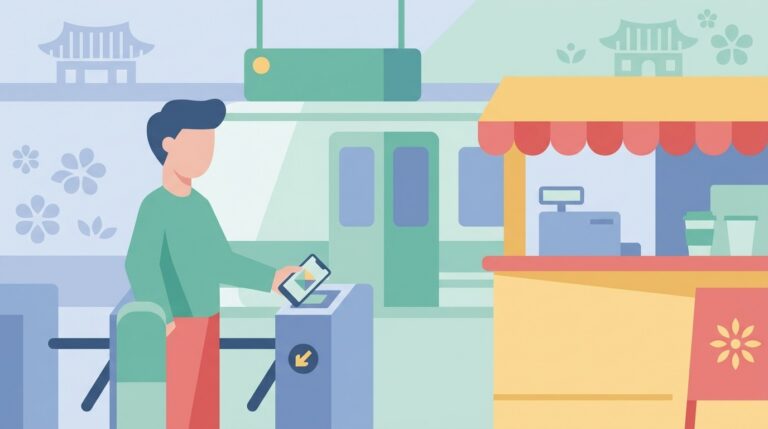
You tap your phone at the station turnstile with a light beep, hop on Line 2, grab an iced Americano at an automated robot cafe, and enjoy a warm bowl of sundubu-jjigae for lunch simply by tapping your screen at a digital counter. It feels like stepping into a cyberpunk utopia: seamless, lightning-fast, and completely liberating. Going out without a wallet causes zero inconvenience all day.
Yet, as you stand in line at a trendy dessert spot, you witness another reality: an elderly grandmother (halmeoni) squinting nervously at a glowing touchscreen kiosk, confused by nested menus and digital prompts, while a line builds up behind her. Korea is one of the fastest cashless societies on earth, but this hyper-speed digital transition brings both breathtaking convenience and real conversations about “digital exclusion” (디지털 소외).
In this lesson, curated from real feedback from intermediate learners living in Seoul, you won’t just learn textbook robotic phrases. You will master the exact words native Koreans use to discuss mobile lifestyle convenience, navigate self-service systems with grace, and express warm empathy toward those being left behind by digital progress.
Phase 2: Top 3 Core Expressions in Depth
1. 지갑 없이 스마트폰 하나만 들고 나와도 돼요. (Jigap eopsi seumateupon hanaman deulgo nawado dwaeyo.)
- Pronunciation: Jee-gap up-shee seu-mah-teu-pon ha-na-man deul-go na-wah-do dway-yo (Flow the “p” in jigap cleanly into eopsi as jee-gah-bup-shee).
- Meaning: “You can come out with just your smartphone and no wallet.”
- Literal: Wallet without smartphone only holding even if you exit it is okay.
- Nuance: A casual, reassuring statement highlighting total independence from cash and plastic cards.
- K-Culture Moment: In modern K-dramas, you often see young professionals running errands during lunch breaks carrying nothing but a phone with a lanyard case, completely unbothered by payment methods.
- Editor’s Insight: The pattern -아/어도 되다 expresses permission or ease (“it’s totally fine to…”). Attaching -만 (only) to 스마트폰 하나 emphasizes minimalism.
- Situation Spectrum: Casual: ✅ | Semi-formal: ✅ | Formal: ⚠️
- 🤔 Think About It: In your home country, do people still carry physical emergency cash? Why do you think Korea adopted digital tap-and-pay infrastructure so rapidly compared to other cultures?
2. 결제하는 데 아무 불편이 없어요. (Gyeoljehaneun de amu bulpyeoni eopseoyo.)
- Pronunciation: Gyul-jeh-ha-neun de ah-mu bool-pyun-ee up-so-yo (Make the gyeol vowel open like the “yeo” in “yonder”).
- Meaning: “There is zero inconvenience when paying.”
- Literal: In the matter of paying, any inconvenience does not exist.
- Nuance: Confidently expresses seamless convenience across transit, food, and shopping.
- K-Culture Moment: Heard constantly on Korean tech vlogs and YouTube street interviews reviewing mobile wallet systems like Samsung Pay or Apple Pay.
- Editor’s Insight: The grammar point -(으)ㄴ/는 데 means “in doing something” or “for the purpose of.” Combined with 아무 [명사]도 없다 (no [noun] whatsoever), it produces a natural, polished intermediate sentence structure.
- Situation Spectrum: Casual: ✅ | Semi-formal: ✅ | Formal: ✅
- 🤔 Think About It: Notice how Korean uses 불편이 없다 (inconvenience does not exist) rather than simply saying 매우 편하다 (it is very comfortable). Why do you think eliminating friction is such a valued concept in Korean society?
3. 키오스크 사용이 익숙하지 않아서 어려워하시는 분들도 계세요. (Kioseukeu sayongi iksukaji anaseo eoryeowohasineun bundeuldo gyeseyo.)
- Pronunciation: Kee-oh-seu-keu sah-yong-ee eek-soo-kah-jee ahn-ah-so uh-ryuh-wo-hah-shee-neun boon-deul-do gyeh-seh-yo.
- Meaning: “There are also people who find it difficult because they aren’t used to using kiosks.”
- Literal: Because kiosk use is not familiar, people who experience difficulty also exist.
- Nuance: A deeply empathetic, respectful phrase used in social discussions to acknowledge the digital divide facing the elderly.
- K-Culture Moment: Frequently featured on Korean current affairs broadcasts, documentary segments, and community forum discussions debating digital accessibility.
- Editor’s Insight: This sentence showcases master-level B1 honorific stacking: 어려워하다 (to experience difficulty as a third person) + -(으)시- (subject honorific) + 분들 (polite form of people) + 계시다 (honorific form of 있다).
- Situation Spectrum: Casual: ⚠️ | Semi-formal: ✅ | Formal: ✅
- 🤔 Think About It: When speaking about strangers or seniors facing difficulties, Korean instinctively elevates them with honorifics (분들, 계세요) while describing their hardship with gentle empathy. How does this compare to how social problems are discussed in your language?
Phase 3: Textbook Korean vs. Real Korean
Situation 1: Asking if mobile tap-to-pay works at the register
- 📖 교과서 한국어 (Textbook): 스마트폰으로 신용카드 전자 결제를 진행할 수 있습니까? (Seumateupon-euro sinyongkadeu jeonja gyeoljereul jinhaenghal su itseumnikka?) — “Is it possible to proceed with electronic credit card payment via smartphone?”
- 🗣️ 진짜 한국어 (Real-life): 폰으로 찍어도 돼요? (Pon-euro jjigeodo dwaeyo?) — “Can I just tap with my phone?” or “삼성페이/애플페이 돼요?”
- 💡 왜 다를까? (Why is it different?): Koreans rarely say “electronic payment process.” Instead, they use the vivid sensory verb 찍다 (to tap/stamp), which captures the physical action of tapping a phone or card against a reader.
Situation 2: Offering help to an older person struggling at a touchscreen
- 📖 교과서 한국어 (Textbook): 제가 이 디지털 기계 조작법을 가르쳐 드리겠습니다. (Jega i dijiteol gigye jojakbeobeul gareuchyeo deurigesseumnida.) — “I will teach you the operating method of this digital machine.”
- 🗣️ 진짜 한국어 (Real-life): 어르신, 주문 도와드릴까요? (Eoreusin, jumun dowadeurilkkayo?) — “Sir/Ma’am, may I help you with your order?”
- 💡 왜 다를까? (Why is it different?): Saying “I will teach you” sounds overly didactic and can cause embarrassment (체면 손상). Native speakers use the warm title 어르신 (honored senior) and phrase the offer as gentle assistance.
Phase 4: K-Culture Deep Dive & Non-Verbal Manners
4-1. 눈치 (Nunchi) & Payment Etiquette
When living completely cashless in Korea, non-verbal timing is everything:
1. The Screen Prep Ready: In busy subway stations or lunch-rush cafes, open your transit barcode or digital wallet screen before stepping up to the turnstile or counter. Pausing at the sensor to unlock your face recognition slows down the entire line and earns subtle sighs.
2. Two-Handed Device Holding: Even when paying with a smartphone, if the clerk holds out a scanner to scan your screen, hold your phone gently with both hands (or touch your right forearm with your left hand). It transforms a casual digital tap into a sign of traditional Korean politeness.
3. Patient Kiosk Distance: If an elderly customer is taking longer at a kiosk, stand at least two steps back to avoid hovering. Avoid tapping your foot or checking your watch visibly—practicing nunchi means giving them quiet, unpressured space.
4-2. Cultural Code: ‘Palli-Palli’ Efficiency vs. Digital Divide (디지털 소외)
Korea’s ultra-fast broadband and smartphone penetration rate (over 97%) gave birth to unprecedented daily convenience. However, this breakneck transformation has sparked nationwide soul-searching about 디지털 소외 (digital marginalization). In popular K-dramas, you often see generational warmth juxtaposed against cold technology—like a neighborhood youth showing a market vendor how to receive mobile orders. Knowing how to discuss both the pride in Korea’s technological speed and compassion for digital exclusion will make your Korean conversations significantly more meaningful.
Phase 5: Real-World Roleplay Scenario
Setting: A modern, kiosk-only lunch bistro in Gwanghwamun.
Characters: Alex (B1 Korean learner) and Min-su (a friendly local diner waiting behind him).
- Alex: (단말기를 보며 폰을 꺼내며 / Looking at the reader and taking out his phone)
🎭 행동 지문: 머뭇거리며 단말기를 가리킨다
저기요, 혹시 여기서 폰으로 찍어서 결제해도 돼요?
(Jeogiyo, hoksi yeogiseo pon-euro jjigeoseo gyeoljehaedo dwaeyo?)
“Excuse me, can I pay by tapping my phone here?” -
Min-su: (밝게 미소 지으며 / Smiling brightly)
🎭 행동 지문: 자신의 폰을 가볍게 흔든다
네, 그럼요! 화면 아래 센서에 폰 대시면 바로 돼요.
(Ne, geureomyo! Hwamyeon arae seonso-e pon daesimyeon baro dwaeyo.)
“Yes, of course! Just place your phone on the sensor below the screen.” -
Alex: (성공적으로 결제 후 감탄하며 / Impressed after a successful payment)
🎭 행동 지문: 가벼운 주먹을 쥐며 감탄한다
와, 진짜 빠르네요. 지갑 없이 나와도 하루 종일 아무 불편이 없어요.
(Wa, jinjja ppareuneyo. Jigap eopsi nawado haru jong-il amu bulpyeoni eopseoyo.)
“Wow, that’s really fast. Even without a wallet, there’s zero inconvenience all day.” -
Min-su: (고개를 끄덕이며 / Nodding)
🎭 행동 지문: 키오스크를 바라본다
맞아요. 요즘 한국은 카드나 현금 들고 다니는 사람이 거의 없죠.
(Majayo. Yojeum Hangugeun kadeuna hyeongeum deulgo danineun sarami geoui eopjyo.)
“Exactly. Hardly anyone carries cards or cash around in Korea these days.” -
Alex: (옆 키오스크의 할머니를 보며 / Looking at an elderly woman at the adjacent kiosk)
🎭 행동 지문: 목소리를 낮추며 걱정스러운 표정을 짓는다
그런데 저기 어르신처럼 키오스크 사용을 어려워하시는 분들도 계시네요.
(Geureonde jeogi eoreusin-cheoreom kioseukeu sayong-eul eoryeowohasineun bundeuldo gyesineyo.)
“But like that senior over there, there are also people who find kiosks difficult.” -
Min-su: (씁쓸한 표정으로 / With a bittersweet expression)
🎭 행동 지문: 조용히 공감하며 한숨을 쉰다
네, 편리하긴 한데 디지털 소외 문제가 생각보다 심각해요.
(Ne, pyeonrihagin hande dijiteol so-oe munjega saeng-gakboda simgakaeyo.)
“Yes, it is convenient, but the digital exclusion issue is more serious than people think.” -
Alex: (결심한 듯 / Determined)
🎭 행동 지문: 할머니 쪽으로 한 걸음 다가선다
제가 가서 주문 좀 도와드려도 괜찮을까요?
(Jega gaseo jumun jom dowadeuryeodo gwaenchaneulkkayo?)
“Would it be alright if I went over and helped her order?” -
Min-su: (엄지를 치켜세우며 / Giving a thumbs up)
🎭 행동 지문: 따뜻하게 웃는다
그럼요, 어르신께서 정말 고마워하실 거예요!
(Geureomyo, eoreusin-kkeseo jeongmal gomawohasil geoyeyo!)
“Of course, she will really appreciate that!”
🔀 Interactive Branching Point: What would you say to the grandmother?
- Choice A: “어르신, 괜찮으시면 제가 주문 도와드릴까요?” (Polite & Empathetic)
- Feedback (Best): Perfect! Using 어르신 paired with 괜찮으시면 (if it’s alright with you) gives the senior full autonomy and shows the highest level of warmth and cultural emotional intelligence.
- Choice B: “할머니, 이거 쉬워요. 그냥 이렇게 누르세요.” (Blunt & Condescending)
- Feedback (Bad): Calling a stranger “할머니” can sound patronizing, and telling someone struggling that an action is “easy” (쉬워요) unintentionally invalidates their struggle.
- Choice C: “직원 불러올 테니까 그냥 기다리세요.” (Risk of Misunderstanding)
- Feedback (Risk): While well-intentioned, telling them to “just wait” (그냥 기다리세요) can sound curt or dismissive in intermediate conversation.
Phase 6: 10-Second Emotion Shadowing Drill
Practice these lines out loud with the designated emotional rhythms:
[😊 Breezy & Amazed]
지갑 없이 나와도 / 하루 종일 / 아무 불편이 없어요!
(Jigap eopsi nawado / haru jong-il / amu bulpyeoni eopseoyo!)
Pause naturally after ‘nawado’ and lift your pitch slightly on ‘eopseoyo!’-
[🤔 Thoughtful & Empathetic]
편리하긴 한데… / 키오스크가 익숙하지 않은 분들도 계시잖아요.
(Pyeonrihagin hande… / kioseukeuga iksukaji aneun bundeuldo gyesijanhayo.)
Stretch out ‘hande…’ thoughtfully, then soften your tone warmly on ‘gyesijanhayo.’ -
[🤝 Gentle & Caring]
어르신, / 글씨가 작아서 잘 안 보이시죠? / 제가 도와드릴게요.
(Eoreusin, / geulssiga jagaseo jal an boisijyo? / jega dowadeurilgeyo.)
Deliver ‘eoreusin’ softly, emphasize ‘boisijyo?’ with an understanding nod.
Phase 7: K-Culture Mini Dictionary
- 캐시리스 (Kaesilliseu) | Cashless
- Used extensively in Korean media and tech reports (e.g., “캐시리스 매장” = cashless store). You will see signs on buses saying “현금 없는 버스” (cashless buses).
- 페이 (Pei) | Mobile Pay / Digital Wallet
- Koreans use “페이” as shorthand for any mobile NFC/MST payment service (Samsung Pay, Apple Pay, Naver Pay, Kakao Pay). Common phrase: “페이 결제 되나요?” (Do you take mobile pay?).
- 키오스크 (Kioseukeu) | Self-Service Order Kiosk
- Ubiquitous in Korean fast food, cafes, and mom-and-pop eateries. Used daily: “키오스크로 주문해 주세요” (Please order via the kiosk).
- 디지털 소외 (Dijeiteol So-oe) | Digital Exclusion / Digital Divide
- A vital social issue term describing the vulnerability of the elderly or disabled who lack access to smartphone apps and self-serve systems.
Phase 8: Survival Kit for Travelers
TOP 3 Cashless Survival Phrases
- “휴대폰으로 결제할게요.” (Hyudae-pon-euro gyeoljehalgeyo. / I’ll pay with my phone.)
- Pro Tip: Say this while holding your unlocked phone near the terminal card slot.
- “이거 화면 터치가 잘 안 돼요.” (Igeo hwamyeon teochiga jal an dwaeyo. / The screen touch isn’t working well.)
- Pro Tip: Great when facing an unresponsive touchscreen kiosk.
- “외국 카드도 결제 가능한가요?” (Oeguk kadeudo gyeolje ganeunghangayo? / Can I pay with a foreign card?)
- Pro Tip: Crucial for self-serve machines that occasionally decline international credit cards.
Editor’s Travel Note
- Navigation & Prep: Bookmark our Naver Map app navigation guide to search for nearby transit stations and store hours effortlessly.
- Transit Insight: Seoul buses on designated routes are 100% cashless. Make sure to preload your transit card or mobile transit app before boarding.
- Payment Backup: Even in a cashless society, international tourists should check our Korean mobile payment setup guide to ensure foreign credit cards or tourist transport passes (like Climate Card or WOWPASS) work across all neighborhood kiosks.
Phase 9: “한 발 더 깊이” (One Step Deeper: Thought Reflection)
Korea’s transition to a cashless society is a masterclass in technological pragmatism and collective adaptability. In a society that cherishes rapid service (palli-palli) and high social trust, leaving wallets behind is celebrated as the ultimate freedom. Yet, this high-speed shift holds up a mirror to Korean communal values. Traditional Korean markets flourished on jeong (정, emotional connection and warm banter between buyers and sellers). As touchscreens replace human greeting, Koreans are actively debating how to preserve warmth and ensure that our grandmothers and grandfathers are not left isolated on the digital sidewalk.
💬 Your Turn: How would you balance hyper-efficient digital kiosks with human warmth in your own hometown? Leave a comment below using the expression “~는 데 아무 불편이 없어요” or “~어려워하시는 분들”!
Phase 10: FAQ & Avoiding Misunderstandings
Q: Can foreign tourists use Apple Pay and Samsung Pay everywhere in Korea?
A: Apple Pay is widely accepted in major franchise convenience stores (CU, GS25, 7-Eleven), department stores, and supermarkets, but smaller independent street kiosks and legacy terminals may only support local MST/IC cards. Always carry one physical backup travel card (like WOWPASS or a Visa/Mastercard credit card).
Q: What is the exact difference between ‘어르신’ and ‘할머니/할아버지’?
A: While 할머니 (grandmother) and 할아버지 (grandfather) are endearing family terms, using them for unfamiliar seniors on the street can sometimes feel overly informal or highlight their old age. 어르신 is an honorific, respectful term meaning “honored elder” that sounds graceful, considerate, and polite.
Q: What should I do if a kiosk only accepts Korean phone authentication?
A: Some complex kiosks (especially at government offices or ticket booths) require a Korean social security number or local phone carrier authentication. If this happens, don’t panic—simply approach the counter and politely say: “외국인이라 인증이 어려운데 도와주실 수 있나요?” (I’m a foreigner so identity verification is difficult, could you help me?).
🚨 흔한 실수 (Common Mistakes) Warning Board
- ❌ Mistake 1: Handing cash to a driver on a “현금 없는 버스” (Cashless Bus).
- Correct Action: Keep a T-Money card or scan a mobile transportation pass. If trapped, drivers will hand you an account transfer slip, which is cumbersome to resolve.
- ❌ Mistake 2: Tapping your phone violently against the kiosk monitor screen.
- Correct Action: Touchscreen monitors are only for selections; the actual NFC/card reader is located below or beside the screen with a card icon!
- ❌ Mistake 3: Saying “지갑 없어요” (I have no wallet) when you mean you chose to leave it at home.
- Correct Action: Say “지갑 안 가지고 왔어요” (I didn’t bring my wallet) or “지갑 없이 나왔어요” (I came out without a wallet) to avoid sounding like you lost your belongings.
Phase 11: Action Missions & Community Engagement
- 🥉 Bronze Mission (Solo Shadowing): Stand in front of your mirror and practice saying: “지갑 없이 폰 하나만 들고 나와도 아무 불편이 없어요!” three times with a confident smile.
- 🥈 Silver Mission (Social Media Challenge): Snap a flat-lay photo of your smartphone alongside your favorite Korean cafe beverage and post it with the caption: “오늘 지갑 없이 외출 성공! 📱☕ #DailyHangul #CashlessKorea”.
- 🥇 Gold Mission (Real-Life Kindness): Next time you spot someone hesitating at an ordering machine in Korea or at a Korean store abroad, step forward and gently ask: “도와드릴까요?” (Shall I help you?).
🎮 K-Culture Mission: Watch an episode of a contemporary slice-of-life K-drama (such as Extraordinary Attorney Woo or Hospital Playlist) and spot whether characters pay with cash, physical plastic cards, or phone taps. Note down the exact verb they use at the cash register!
Phase 12: Interactive Quiz Challenge
Test your understanding of today’s lesson! Can you score 3 out of 3?
1. Situational Judgment:
You are at a self-checkout kiosk in a convenience store. You want to ask the clerk if you can pay with your smartphone. Which phrase is the most natural B1 Korean?
* A) 스마트폰으로 전자 결제 프로세스를 시행하겠습니다.
* B) 폰으로 찍어서 결제해도 돼요?
* C) 스마트폰 기계 조작을 완료해 주세요.
2. Fill-in-the-Blank:
Complete the sentence with the correct grammar points meaning “There is zero inconvenience in shopping without cash.”
현금 없이 쇼핑하는 ( ) 아무 불편이 없어요.
* A) 데
* B) 것
* C) 때
3. True or False Cultural Quiz:
True or False: In Korea, calling an unfamiliar senior at a self-serve kiosk “어르신” is considered much more polite and respectful than calling them “할머니” or “할아버지.”
👉 Click to reveal answers & explanations!
- Answer: B (폰으로 찍어서 결제해도 돼요?)
- Explanation: Native speakers naturally use “폰으로 찍다” (tap with phone) when paying at counters. Option A is textbook robotic, and Option C is an awkward demand.
- Answer: A (데)
- Explanation: The grammar pattern -(으)ㄴ/는 데 is used to mean “in doing / when it comes to [verb].” Shopping without cash = 쇼핑하는 데.
- Answer: True
- Explanation: “어르신” acknowledges elders with deep dignity and honor, avoiding presumptuous familial terms like grandmother/grandfather.
- Explanation: “어르신” acknowledges elders with deep dignity and honor, avoiding presumptuous familial terms like grandmother/grandfather.
Congratulations on finishing this guide! Keep practicing, stay observant of the culture around you, and enjoy your hassle-free cashless adventures with Daily Hangul! 🚀







