

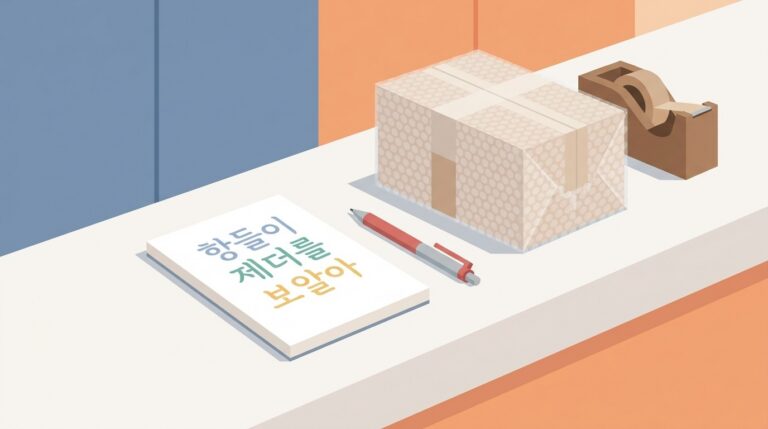
Phase 1: 공감 (A Friendly Post Office Rescue)
안녕하세요! 매일한글 에디터입니다. (Hello! This is your Daily Hangul editor.)
Picture this: You are on an unforgettable trip to Seoul. You spent yesterday wandering through the quaint alleys of Insadong, and you found the most delicate, handcrafted celadon tea set. Or maybe you waited three hours in line in Hongdae to secure a limited-edition porcelain figurine of your ultimate K-Pop bias. You love it, but your suitcase is already bursting at the seams. Sending it home via EMS (우체국 국제특급) is your best bet!
You walk into the local Korean post office (우체국 – ucheguk). The scent of fresh cardboard fills the air, packing tape rolls are screeching in harmony, and locals are swiftly assembling boxes like seasoned origami masters. You stand by the communal packing table clutching your fragile treasure. You wrapped it meticulously, but anxiety hits when you step up to the counter. How do you explain to the clerk that your package contains fragile items? What if it gets tossed around on the flight? You want to say: “I wrapped fragile items in several layers of bubble wrap before putting them in!”
Take a deep breath! Today, you’ll master the exact everyday Korean phrases that will turn this stressful post office visit into a breezy, satisfying victory. Based on hundreds of real expat and traveler experiences, this guide will make sure your precious souvenirs make it across the globe in one pristine piece.
Phase 2: 핵심 표현 3선 심층 분석 (Top 3 Must-Know Expressions)
1. 깨지기 쉬운 물건이에요 (Kkaejigi swiun mulgeon-ieyo)
- Pronunciation: [Kkae-ji-gi swi-un mul-geon-i-e-yo] (Think: “Kkeh-jee-ghee she-oon mool-gun-ee-yeh-yo”)
- Meaning: Literal: “It is an easy-to-break item.” | Real Nuance: “This is fragile / Please handle with care.”
- K-Culture Moment: Seen in countless Korean family dramas where a mother packs home-made side dishes in glass jars (반찬통) to send to her child living in Seoul, warning the courier with this exact sentence.
- Editor’s Insight: The pattern
-기 쉬워요means “easy to [verb]”. Combining깨지다(to break) with쉬운(easy) turns it into the most natural adjective for “fragile”. - Situation Spectrum: Casual: ⚠️ | Semi-formal: ✅ | Formal: ✅
- 🤔 Think About It: In English, we usually give an instruction (“Handle with care”). Why do you think Korean directly describes the condition of the object (“It breaks easily”) to inspire the listener’s care?
2. 뽁뽁이로 여러 겹 감쌌어요 (Ppokppogiro yeoreo gyeop gamssasseoyo)
- Pronunciation: [Ppok-ppo-gi-ro yeo-reo gyeop gam-ssa-sseo-yo] (Sounds like popping two tiny balloons: “Ppok-ppok-ee-roh yaw-raw gyup gahm-ssah-ssuh-yo”)
- Meaning: Literal: “I wrapped it in multiple layers using bubble wrap.” | Real Nuance: “Don’t worry, I cushioned it thoroughly!”
- K-Culture Moment: You will hear K-Pop idols say this on YouTube unboxing vlogs when packing delicate photocards or lightsticks for lucky giveaway winners.
- Editor’s Insight: While the technical administrative term is
완충재(cushioning material), almost 99% of Koreans affectionately say뽁뽁이(ppok-ppok-i) because of the popping sound it makes when squeezed. - Situation Spectrum: Casual: ✅ | Semi-formal: ✅ | Formal: ⚠️
- 🤔 Think About It: How does using playful sound words (onomatopoeia) like ppok-ppok-i make administrative errands feel so much friendlier in Korea?
3. 파손주의 스티커 붙여 주세요 (Pason-juui seutikeo buchyeo juseyo)
- Pronunciation: [Pa-son-ju-ui seu-ti-keo bu-chyeo ju-se-yo] (Think: “Pah-sohn-joo-ee soo-tee-kuh boo-chyuh joo-seh-yo”)
- Meaning: “Please attach a ‘Fragile / Handle With Care’ sticker.”
- K-Culture Moment: The red-and-white
파손주의sticker is an iconic sight in Korean logistics, slapped decisively onto parcels containing everything from Jeju hallabong oranges to skincare ampoules. - Editor’s Insight:
파손(breakage/damage) +주의(caution/care). Adding-아/어 주세요makes your request both polite and unmistakably clear. - Situation Spectrum: Casual: 🚫 | Semi-formal: ✅ | Formal: ✅
- 🤔 Think About It: Notice the polite balance here: combining formal Sino-Korean vocabulary (
파손주의) with the friendly request form (-주세요).
Phase 3: 교과서 한국어 vs 진짜 한국어 (Textbook vs. Real-Life Korean)
Situation 1: Asking where the packaging materials are
- 📖 교과서 한국어 (Textbook Korean): 완충재가 어디에 비치되어 있습니까? (Wanchungjaega eodie bichidoeeo isseumnikka? / Where is the cushioning material placed?)
- 🗣️ 진짜 한국어 (Real Korean): 저기요, 뽁뽁이 더 있어요? (Jeogiyo, ppokppogi deo isseoyo? / Excuse me, is there more bubble wrap?)
- 💡 왜 다를까? (Why the difference?): Nobody uses high-level Sino-Korean words like ‘비치되어 있다’ (be placed/provided) at the packing table. A simple
저기요and the lively word뽁뽁이works like a charm.
Situation 2: Emphasizing the fragile contents to the postal clerk
- 📖 교과서 한국어 (Textbook Korean): 내용물 파손에 각별히 유의해 주시기 바랍니다. (Naeyongmul pasone gakbyeolhi yuihae jusigi baramnida. / Please pay exceptional attention to the breakage of contents.)
- 🗣️ 진짜 한국어 (Real Korean): 안에 유리라서 조심히 다뤄주세요! (Ane yuriraseo josimhi darwojuseyo! / There’s glass inside, so please handle it gently!)
- 💡 왜 다를까? (Why the difference?): Stating the specific fragile material (like
유리glass, or도자기ceramics) prompts clerks to treat your parcel with immediate personal care rather than robotic bureaucratic protocol.
Phase 4: K-Culture 딥다이브 & 비언어적 매너 (Cultural Nuances & Etiquette)
4-1. 눈치 (Nunchi) & Post Office Body Language
- Two-Handed Box Delivery: When lifting your parcel onto the electronic scale next to the clerk, place it gently using both hands. Dropping or shoving it onto the scale signals carelessness.
- The Communal Packing Table Etiquette: Korea Post provides free scissors, rulers, and packing tape at central island counters. The unspoken rule? Use the tape dispenser smoothly, cut it cleanly, and place it right back in the center so the next person can grab it without waiting.
- The ‘H-Tape’ Standard: Koreans secure boxes in an “H” shape (one long strip down the middle seam, two across the edges). Doing this shows the postal worker you took packing seriously before asking for extra care!
4-2. Culture Code: The Art of Korean “Safe Shipping”
Korea has one of the fastest and most efficient parcel ecosystems in the world (택배 문화). Because millions of packages zip across the peninsula overnight, safe packing is considered a personal courtesy to the courier. When shipping glassware or K-Pop merchandise, over-protecting items with thick layers of bubble wrap and sturdy box corners is practically a national pastime. Showing the clerk that you’ve already wrapped it well instantly earns mutual respect.
Phase 5: 실전 롤플레이 시나리오 (Real-World Roleplay Scenario)
Setting: A bustling Korea Post branch in Gwanghwamun, Seoul. Alex, a foreign traveler holding a taped package, approaches Postal Clerk Park at Counter 3.
- Alex: 저기요, 이거 미국으로 EMS 보낼 건데요. (Jeogiyo, igeo miguk-euro EMS bonael geondeyo. / Excuse me, I’d like to send this to the US via EMS.)
🎭 Alex places the box gently near the counter with a slight polite nod. - Clerk Park: 네, 저울 위에 올려주세요. 안에 뭐가 들었나요? (Ne, jeoul wie ollyeojuseyo. Ane mwoga deureonnayo? / Yes, please place it on the scale. What’s inside?)
🎭 Clerk points to the digital scale with an open palm. - Alex: 도자기 컵이에요. 깨지기 쉬운 물건이에요. (Dojagi keob-ieyo. Kkaejigi swiun mulgeon-ieyo. / They are ceramic cups. They are fragile items.)
🎭 Alex carefully shifts the parcel onto the scale platform. - Clerk Park: 혹시 포장은 단단히 하셨어요? (Hoksi pojang-eun dandanhi hasyeosseoyo? / By any chance, did you pack it solidly?)
🎭 Clerk taps the box lightly to check for movement inside. - Alex: 네, 뽁뽁이로 여러 겹 감싸서 넣었어요. (Ne, ppokppogiro yeoreo gyeop gamssaseo neoeosseoyo. / Yes, I wrapped them in several layers of bubble wrap before putting them in.)
🎭 Alex smiles warmly and gestures with both hands displaying thickness. - Clerk Park: 다행이네요. 그래도 빨간 파손주의 스티커 하나 붙여드릴게요. (Dahaeng-ineyo. Geuraedo ppalgan pasonjuui seutikeo hana buchyeodeurilgeyo. / That’s a relief. Still, I’ll attach a red fragile sticker for you.)
🎭 Clerk pulls a bright red sticker from under the counter and applies it neatly. - Alex: 정말 감사합니다! 요금은 얼마예요? (Jeongmal gamsahamnida! Yogeumeun eolmayeyo? / Thank you so much! How much is the postage fee?)
🎭 Alex retrieves a credit card from their wallet. - Clerk Park: 무게는 1.8kg이고, 3만 8천 원입니다. 카드를 꽂아주세요. (Mugeneun il-jeom-pal-kiro-igo, saman palcheon won-imnida. Kadeureul kkojajuseyo. / The weight is 1.8kg, and it comes to 38,000 won. Please insert your card.)
🎭 Clerk gestures toward the card terminal with a friendly smile.
🔀 인터랙티브 분기점 (Interactive Fork: Your Response)
What would you say if the clerk asks: “상자 안에 빈 공간이 좀 흔들리는데 괜찮으세요?” (There’s some empty space shaking inside the box, is that okay?)
- Choice A: “신문지나 뽁뽁이 더 넣어서 다시 포장할게요!” (I will add more newspaper or bubble wrap and repack it!)
Feedback: Best! The clerk will deeply appreciate your diligence, and your souvenirs won’t break mid-flight. - Choice B: “그냥 대충 테이프 많이 감아주세요.” (Just wrap a lot of tape roughly around it.)
Feedback: Bad. Tape outside does not prevent contents from colliding inside. You risk damage and sound dismissive. - Choice C: “직원분이 알아서 채워주시면 안 돼요?” (Can’t the staff fill it up for me?)
Feedback: Risk. Post office employees are not responsible for packing your personal items. It creates awkward tension.
Phase 6: 10초 감정 섀도잉 드릴 (10-Second Emotion Shadowing Drill)
Read these aloud, hitting the pause points (/) and matching the exact emotion in brackets:
[😊 자신감 있고 명확하게 - Confidently and clearly]
깨지기 쉬운 물건이라 / 뽁뽁이로 여러 겹 / 감쌌어요!
(Kkaejigi swiun mulgeon-ira / ppokppogiro yeoreo gyeop / gamssasseoyo!)-
[🥺 정중하고 간절하게 - Courteously and earnestly]
부탁드릴게요, / 파손주의 스티커 / 꼭 붙여 주세요!
(Butakdeurilgeyo, / pasonjuui seutikeo / kkok buchyeo juseyo!) -
[😄 홀가분하고 상쾌하게 - Relieved and upbeat]
EMS 요금은 / 카드로 / 결제할게요!
(EMS yogeumeun / kadeuro / gyeoljehalkeoyo!)
Phase 7: K-Culture 미니 사전 (Mini Dictionary)
- 뽁뽁이 (Ppokppogi) | Bubble wrap
Everyday onomatopoeia for air cushion wrap. Everyone from convenience store workers to postmasters understands this better than technical terms. - 완충재 (Wanchungjae) | Cushioning material
The formal term seen on postal claim forms, customs documents, and shipping insurance guides. - 파손주의 (Pason-juui) | Fragile / Handle With Care
Four Sino-Korean characters (破損注意) that ensure couriers take extra precaution during transport. - 송장 (Songjang) | Shipping label / Waybill
The paper label (or digital barcode) containing sender, receiver, and customs declarations.
Phase 8: 여행자를 위한 생존 키트 (Traveler’s Survival Kit)
서바이벌 표현 TOP 3 (Survival Phrases)
- 테이프 어디 있어요? (Te-ipeu eodi isseoyo?)
Where is the packaging tape?
👉 Pro Tip: Look around the large central wooden table before asking—it’s usually mounted in heavy metal tape dispensers! - EMS 송장 어디서 써요? (EMS songjang eodiseo sseoyo?)
Where do I fill out the EMS shipping label?
👉 Pro Tip: Korea Post encourages digital entry. Look for the QR codes on the counter for the mobile form. - 상자 3호 하나 주세요 (Sangja sam-ho hana juseyo)
Please give me one Box Number 3.
👉 Pro Tip: Korean post offices sell standardized boxes from size 1호 (smallest) to 5호 (large suitcase size). You pay for the box at the counter.
Editor’s Travel Note
Before heading to the post office, you can save up to 5% on EMS shipping rates by filling out your customs declarations online in advance. Check out the 인터넷 우체국 EMS 사전접수 웹사이트 to complete your address and customs contents digitally in English. When you arrive at the branch, just show the barcode on your phone—no tedious paperwork required!
Phase 9: “한 발 더 깊이” (Cultural Mindset)
In many countries, a post office counter is purely transactional. In Korea, however, you will notice a unique community spirit around the packaging counter. Strangers will hold down cardboard flaps for each other, pass tape rolls with a quiet nod, and share leftover bubble wrap without being asked. This comes from 정 (jeong)—the Korean concept of unspoken warmth and shared empathy. When you say, “뽁뽁이로 여러 겹 감쌌어요,” you aren’t just stating a packaging fact; you are reassuring the clerk that you respect the safety of your package and the courier’s effort.
💬 Your Turn: Have you ever shipped something fragile from overseas, or are you preparing to send your Korean travel souvenirs home? What item are you most worried about breaking? Share in the comments below!
Phase 10: FAQ & 오해 방지 (FAQ & Common Mistakes)
Q: Can I get free bubble wrap at all Korean post offices?
A: Most neighborhood branches offer complimentary rolls of bubble wrap at the packaging tables for casual use. However, if you are sending a massive box requiring whole rolls, you may need to purchase extra cushioning or pay a nominal fee.
Q: Does putting a ‘파손주의’ sticker guarantee an automatic refund if it breaks?
A: No. While the sticker encourages gentle handling, postal insurance policies require that items are adequately protected with certified inner cushioning. If a ceramic mug breaks because it was loose in an empty box, insurance claims can be denied!
Q: What should I write for item descriptions on the EMS label?
A: Write specific, simple English nouns (e.g., “Ceramic Mug”, “K-Pop Photobook”, “Snacks”). Avoid vague words like “Souvenirs” or “Gifts,” as international customs may hold the package.
🚨 흔한 실수 (Common Mistakes TOP 3)
- Calling bubble wrap “버블랩” (Bubble wrap): While younger Koreans might understand, elderly postal staff will look confused. Always say 뽁뽁이 (ppokppogi).
- Taping before weighing: At some branches, you must pay for the box first. Don’t seal your package before verifying that no prohibited items (like lithium batteries or perfume) are hidden inside!
- Writing the address in Korean characters for foreign EMS: Always write the recipient’s destination address in English for international shipments.
Phase 11: 액션 미션 & 참여 유도 (Action Missions)
- 🥉 Bronze Mission: Stand in front of your mirror and practice the shadowing sentence: “깨지기 쉬운 물건이에요!” 3 times with clear pronunciation.
- 🥈 Silver Mission: When wrapping a gift or package at home, take a photo of the bubble wrap and post it to Instagram Stories with the caption: “뽁뽁이로 감쌌어요! #DailyHangul”.
- 🥇 Gold Mission: Walk into a Korean post office, buy a box, pack a souvenir using the H-tape method, and tell the clerk: “파손주의 스티커 붙여 주세요!”
- 🎮 K-Culture Mission: Watch any Korean variety show where celebrities move homes or unbox packages, and listen carefully to see if you can spot the word 뽁뽁이 in the wild!
Phase 12: 인터랙티브 퀴즈 챌린지 (Interactive Quiz Challenge)
1. Situation Decision:
You are sending fragile glassware to your home country. What is the most natural way to inform the postal clerk?
a) 완충재를 많이 샀습니다.
b) 깨지기 쉬운 물건이라 뽁뽁이로 여러 겹 감쌌어요.
c) 깨지면 직원분이 책임지세요.
2. Fill-in-the-Blank:
“Please put on a ‘Fragile / Handle With Care’ sticker.”
👉 [ ] 스티커 붙여 주세요. (Hint: 4 Sino-Korean syllables)
3. True or False:
True or False: The word ‘뽁뽁이’ is only used by children and should never be used at a real post office counter.
👉 Click to reveal answers & explanations!
- Answer: b) 깨지기 쉬운 물건이라 뽁뽁이로 여러 겹 감쌌어요. (This is the most natural, polite, and reassuring explanation!)
- Answer: 파손주의 (Pason-juui) (The essential postal keyword for fragile items.)
- Answer: False! ‘뽁뽁이’ is recognized and loved by everyone across Korea, including professional postal workers and news reporters.







