

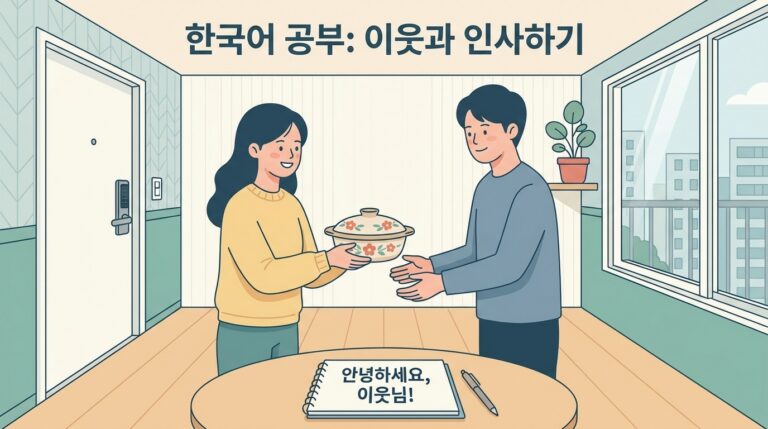
The Art of Jeong: How to Share Food with Your Korean Neighbors Without Feeling Awkward
Phase 1: Empathy (A Story-Driven Opening)
안녕하세요! 매일한글 에디터입니다.
Picture this: It is a rainy Tuesday evening in your Seoul apartment. The rhythmic sound of rain against your window has inspired you to fry up a golden batch of crispy kimchi pancakes (김치전). The appetizing aroma fills the corridor outside. You made way too much, and your mind drifts to your next-door neighbor—the sweet grandmother or the quiet college student who always politely holds the elevator door open for you.
You scoop a warm stack onto a nice plate, step out into the quiet hallway, and raise your knuckles to knock. Then, sudden panic hits. What if they think I am strange? What if they suspect food poisoning? What exact words do I say so I do not sound pushy or bizarre?
If you grew up in a culture where an unannounced knock at 7 PM with home-cooked food triggers suspicion, your anxiety makes total sense. But here in Korea, this simple act is the beating heart of 정 (Jeong)—the unspoken, deep communal affection that knits society together. Over the past decade coaching international residents across Korea, I have seen students transform cold, anonymous studio hallways into heartwarming support systems with just one small dish and the right phrases. Today, let us ensure you step up to that door with absolute confidence and cultural finesse.
Phase 2: Core Expressions Deep Dive
Here are the three golden phrases that unlock genuine warmth and dissolve social awkwardness:
1. 이것 좀 드셔보세요. (Igeot jom deusyeoboseyo.)
- Pronunciation: [I-geot jom deu-syeo-bo-se-yo] (Sounds like: “ee-gut” + “chom” + “dew-sure-bo-say-yo”)
- Meaning: Literal: “Please try eating a little bit of this.” / Real Nuance: “I made this with warm intentions; please taste it comfortably without feeling pressured!”
- K-Culture Moment: Seen in nearly every family-centered K-Drama like Reply 1988 (응답하라 1988), where kids run across village alleyways carrying covered bowls between houses right before dinnertime.
- Editor’s Insight: The secret anchor of this sentence is 좀 (jom), meaning “a little.” Even if you are offering a massive container of food, saying “좀” humbles your gift so the recipient does not feel an immediate burden of indebtedness.
- Situation Spectrum: Casual: ⚠️ | Semi-formal: ✅ | Formal: ✅
- 🤔 Think About It: Why does Korean politeness emphasize minimizing your own offering rather than highlighting how great the gift is?
2. 음식을 좀 넉넉하게 해서 나눠 먹으려고 가져왔어요. (Eumsig-eul jom neongneokhage haeseo nanwo meogeuryeogo gajyeowasseoyo.)
- Pronunciation: [Eum-si-geul jom neong-neo-kha-ge hae-seo na-nwo meo-geu-ryeo-go ga-jyeo-was-seo-yo] (Think: “oom-sheeg-eul” + “nung-nuk-ha-geh”…)
- Meaning: Literal: “I cooked generously, so I brought some to share and eat together.” / Real Nuance: “I ended up cooking plenty, and you naturally crossed my mind!”
- K-Culture Moment: When a neighbor comes back from visiting countryside parents with a big box of fruit or home-made kimchi and shares the bounty.
- Editor’s Insight: 넉넉하게 (neongneokhage) conveys abundance and goodwill. It frames your gesture as sharing surplus joy rather than giving away unwanted leftovers.
- Situation Spectrum: Casual: ✅ | Semi-formal: ✅ | Formal: ⚠️
- 🤔 Think About It: In many Western contexts, saying “I made too much” can sound like dumping leftovers. Why does it signal natural generosity in Korean apartment culture?
3. 입맛에 맞으실지 모르겠네요. (Immas-e majeusilji moreugenneyo.)
- Pronunciation: [Im-ma-se ma-jeu-sil-ji mo-reu-gen-ne-yo] (Notice the sound change: ‘ip-mat-e’ blends naturally into ‘im-ma-se’)
- Meaning: Literal: “I do not know if this suits your palate.” / Real Nuance: “I hope this pleases your taste buds; please excuse my humble cooking!”
- K-Culture Moment: Handing over a specialty dish from your home country or family side dishes (반찬) to someone you hold in high regard.
- Editor’s Insight: This is the ultimate humility buffer. Even Michelin-level Korean home cooks use this phrase. It respects the neighbor’s personal preference while preventing any awkward pressure to shower you with praise.
- Situation Spectrum: Casual: ⚠️ | Semi-formal: ✅ | Formal: ✅
- 🤔 Think About It: How does placing consideration on the receiver’s palate reflect Korea’s high-context communication style?
Phase 3: Textbook Korean vs. Real Korean
Situation 1: Offering food at the door
- 📖 Textbook Korean: 이 음식을 당신에게 선물로 드립니다. (I eumsig-eul dangsin-ege seonmullo deurimnida.)
- 🗣️ Real Korean: 옆집인데요, 전 좀 부쳤는데 따뜻할 때 드세요. (Yeopjim-inde-yo, jeon jom buchyeonneunde ttatteuthal ttae deuseyo. / “I am from next door; I fried some pancakes, so please enjoy them while they are warm!”)
- 💡 Why is it different? The pronoun “당신” (dangsin) sounds aggressive or overly dramatic in spoken Korean, and calling casual food a formal “선물” (gift) creates heavy pressure. Stating who you are (옆집인데요) and pointing out the dish’s warmth (따뜻할 때 드세요) feels spontaneous and considerate.
Situation 2: Returning the empty dish
- 📖 Textbook Korean: 그릇을 돌려드립니다. 감사합니다. (Geureus-eul dollyeodeurimnida. Gamsahamnida.)
- 🗣️ Real Korean: 정말 잘 먹었어요! 빈 그릇으로 드리기 뭐해서 과일 좀 담았어요. (Jeongmal jal meogeosseoyo! Bin geureuseuro deurigi mwohaeseo gwail jom damasseoyo. / “I really enjoyed it! I felt bad returning an empty dish, so I put in some fruit.”)
- 💡 Why is it different? In Korean culture, handing back an empty plate (빈 그릇) breaks the cycle of mutual affection. Adding a couple of tangerines or candies demonstrates thoughtful manners.
Phase 4: K-Culture Deep Dive & Non-Verbal Manners
4-1. Nunchi (눈치) & Body Language Checklist
- The Two-Hand Rule (양손): Always hold the plate or container with both hands, elbows tucked close to your torso, paired with a modest 15-to-30-degree bow.
- Hallway Eye Contact: Look at the recipient warmly, but avoid peering past them into their apartment. Maintaining door privacy is crucial in compact Korean urban housing.
- Optimal Timing: Never knock during standard dinner preparation rush (around 5:30 to 6:30 PM) or late evening (after 8:30 PM). A weekend afternoon or right around 7:15 PM is ideal.
4-2. Culture Code: The Tupperware Economy & Banchan Culture
In Korean apartment life, food is not merely nutrition; it is community insurance. When someone shares side dishes (반찬 품앗이), they are indirectly telling you: “We live in close quarters, and I recognize you as safe and valued.” Utilizing disposable containers is common for convenience nowadays, but sharing food on real tableware signals a desire for ongoing, respectful neighborly relations.
Phase 5: Real-Life Roleplay Scenario
Setting: Outside Apartment 302 on a Sunday evening. You are standing with a plate of homemade mandu (dumplings). Your neighbor, Mrs. Park (박 아주머니), answers the door.
- You: (두 손으로 접시를 들고 가볍게 인사하며) 안녕하세요! 저 301호 사는 사람인데요. (Annyeonghaseyo! Jeo sambaeg-il-ho saneun saram-inde-yo.) (🎭 Holding the plate with both hands and bowing gently: “Hello! I live in room 301.”)
- Mrs. Park: 어머, 301호 총각/아가씨! 무슨 일이에요? (Eomeo, sambaeg-il-ho chong-gak/agassi! Museun irieyo?) (🎭 Looking pleasantly surprised: “Oh, neighbor from 301! What brings you here?”)
- You: 오늘 만두를 좀 넉넉하게 만들어서요. 이것 좀 드셔보세요. (Oneul mandureul jom neongneokhage mandeureoseoyo. Igeot jom deusyeoboseyo.) (🎭 Smiling warmly: “I made extra dumplings today. Please have a taste of these.”)
- Mrs. Park: 어머나, 세상에! 직접 만든 거예요? 솜씨가 대단하네요! (Eomeona, sesang-e! Jikjeop mandeun geoyeyo? Somssiga daedanhane-yo!) (🎭 Clapping hands in admiration: “Oh my goodness! You made these yourself? What wonderful culinary skill!”)
- You: 별거 아니에요. 입맛에 맞으실지 모르겠네요. 따뜻할 때 드세요! (Byeolgeo anieyo. Immas-e majeusilji moreugenneyo. Ttatteuthal ttae deuseyo!) (🎭 Shrugging modestly: “It is nothing special. I hope it suits your taste. Please eat while they are hot!”)
- Mrs. Park: 아이고, 너무 고마워요. 주말인데 쉬지도 않고 이런 걸 다 챙겨주고… (Aigo, neomu gomawoyo. Jumal-inde swijido anko ireon geol da chaeng-gyeojugo…) (🎭 Receiving the dish with both hands: “Oh, thank you so much. Spending your weekend to share this with me…”)
- You: 맛있게 드셔주시면 제가 더 기쁘죠. 그럼 편한 저녁 보내세요! (Mas-itge deusyeojusimyeon jega deo gippeojyo. Geureom pyeonhan jeonyeok bonaeseyo!) (🎭 Stepping back politely: “If you enjoy them, that makes me even happier. Have a restful evening!”)
- Mrs. Park: 고마워요! 그릇은 깨끗이 씻어서 갖다 줄게요! (Gomawoyo! Geureus-eun kkaekkeusi ssiseoseo gatda julgeyo!) (🎭 Waving with a warm smile: “Thank you! I will wash the plate clean and bring it back!”)
🔀 Interactive Decision Point
Two days later, Mrs. Park knocks on your door, hands your clean plate back filled with fresh Jeju mandarins and homemade kimchi. How do you respond?
- Choice A: 손사래를 치며 “아니에요! 돈으로 주세요!” (Anieyo! Doneuro juseyo! / “No! Give me money instead!”)
- Outcome: ❌ Bad. Demanding money completely breaks social etiquette and turns warm communal sharing into a crude transaction.
- Choice B: “어머, 아주머니 잘 먹겠습니다! 빈 그릇만 주셔도 되는데 감사해요!” (Eomeo, ajumeoni jal meokgetseumnida! Bin geureutman jusyeodo doeneunde gamsahaeyo! / “Oh, Mrs. Park, thank you! Returning the empty dish would have been plenty, but I appreciate this so much!”)
- Outcome: 🌟 Best. You acknowledge her thoughtful effort with genuine delight while maintaining humble etiquette.
- Choice C: 문을 살짝만 열고 아무 말 없이 그릇만 낚아챈다. (Grab the dish silently with a cracked door.)
- Outcome: ⚠️ Risk. She might assume you are offended or unapproachable, creating awkward hallway tension for months.
Phase 6: 10-Second Emotion Shadowing Drill
Practice these natural rhythm pauses (marked with /) and match the suggested emotions out loud:
[😊 친절하고 수줍게 / Friendly & Modest]
옆집인데요, / 전 좀 부쳤는데 / 따뜻할 때 드세요.
(Yeopjim-inde-yo, / jeon jom buchyeonneunde / ttatteuthal ttae deuseyo.)-
[ 따뜻하고 넉넉하게 / Warm & Generous]
음식을 좀 넉넉하게 해서 / 나눠 먹으려고 가져왔어요.
(Eumsig-eul jom neongneokhage haeseo / nanwo meogeuryeogo gajyeowasseoyo.) -
[ 겸손하고 정중하게 / Humble & Courteous]
별건 아니지만, / 입맛에 맞으실지 모르겠네요.
(Byeolgeon anijiman, / immas-e majeusilji moreugenneyo.)
Phase 7: K-Culture Mini Dictionary
- 정 (Jeong) [Jeong]: Ineffable Korean communal affection, empathy, and loyalty built over shared time and space.
- Usage: Used everywhere from neighborhood greetings to enduring friendships: “정 들었어요” (I have grown attached).
- 덤 (Deom) [Deom]: The complimentary extra scoop or bonus item given at markets or local eateries out of sheer generosity.
- Usage: In traditional markets: “이모, 덤 좀 더 주세요!” (Auntie, please give me a little extra!).
- 품앗이 (Pum-asi) [Pum-a-si]: Traditional cooperative reciprocal labor exchange among villagers, now applied to sharing child care or homemade side dishes (반찬 품앗이).
- Usage: Collaborative community building among neighbors living close together.
- 이웃사촌 (I-ut-sachon) [I-ut-sa-chon]: Literally “neighbor-cousin”; the concept that a close neighbor who helps you in times of need is dearer than a distant relative.
- Usage: Praising a helpful neighbor: “역시 먼 친척보다 가까운 이웃사촌이 낫네요” (A close neighbor is truly better than a distant cousin).
Phase 8: The Resident’s Survival Kit
Top 3 Doorstep Survival Expressions
- 혹시 매운 음식 드실 수 있으세요? (Hoksi maeun eumsik deusil su isseuseyo?)
- Pro Tip: Check for spice tolerance if you are bringing dishes made with chili peppers or gochujang.
- 그릇은 천천히 돌려주셔도 돼요. (Geureus-eun cheoncheonhi dollyejusyeodo dwaeyo.)
- Pro Tip: Relieves immediate pressure on your neighbor to wash and return the tableware right away.
- 약소하지만 맛있게 드세요. (Yaksokhajiman mas-itge deuseyo.)
- Pro Tip: A sophisticated B1 phrase meaning: “It is a humble offering, but please enjoy it.”
Editor’s Travel & Living Note
Living in Korea becomes exponentially smoother when you integrate with community platforms. Try to explore localized neighborhood hubs using the Naver Map app navigation features to find fresh ingredients, or check second-hand and local community discussions on the Karrot Market official platform to observe how residents in your district interact politely.
Phase 9: One Step Deeper (Reflective Essay)
Historically, traditional Korean dwellings (hanok) lacked high security fences; village compounds operated with open courtyards where one family’s celebrations or struggles were known to all. Modern high-rise apartment complexes with digital keypads and soundproof steel doors threatened to extinguish that communal spirit. Yet, the persistent survival of food sharing proves that 정 (Jeong) refuses to disappear behind concrete walls. Handing a warm plate across a threshold is not a transactional trade; it is a gentle declaration of human presence amidst urban isolation.
💬 Your Turn: Have you ever experienced an unexpected act of generosity from a neighbor in Korea or in your home country? Share your story in the comments below!
Phase 10: FAQ & Avoiding Misunderstandings
Q: What if my neighbor has dietary restrictions or food allergies?
A: In modern Korea, allergies and vegetarianism are increasingly understood. Simply add the considerate question: “혹시 못 드시는 음식 있으세요?” (Hoksi mot deusineun eumsik isseuseyo? / “Is there any food you cannot eat?”) before handing it over.
Q: Is it rude to share store-bought snacks or fruit instead of home-cooked food?
A: Not at all! A box of seasonal strawberries, bakery rolls, or rice cakes (떡) is widely welcomed and often preferred by neighbors who worry about food hygiene.
Q: Must I return the plate filled with food immediately?
A: No. Take your time! Wash the dish thoroughly, place a light token inside (such as individually wrapped cookies or seasonal fruit), and return it within 3 to 5 days.
🚨 Common Mistakes Alert Board
- Mistake 1: Handing over the dish with one hand while holding a phone.
- Correct Action: Put your phone in your pocket; present the plate using both hands with a respectful posture.
- Mistake 2: Returning a bare, empty container.
- Correct Action: Even if it is just two packaged snacks or a candy bar, never return a hollow container.
- Mistake 3: Lingering at the doorway hoping to enter.
- Correct Action: Keep doorstep interactions under 90 seconds. Korean home interiors are private spaces.
Phase 11: Action Missions
- 🥉 Bronze Mission (Solo Shadowing): Stand in front of your mirror and practice the 3 core expressions using both hands and polite bows.
- 🥈 Silver Mission (Community Engagement): Leave a comment below introducing your favorite dish in Korean using the formula: “저는 [음식 이름]을/를 제일 좋아해요!”
- 🥇 Gold Mission (Real-world Execution): Buy a box of seasonal tangerines or bakery goods, share 3 to 4 with a neighbor or your building security guard (경비 아저씨), and say: “이것 좀 드셔보세요!”
- 🎮 K-Culture Mission: Watch an episode of Hospital Playlist (슬기로운 의사생활) or Reply 1988 and spot every time characters exchange side dishes without asking for anything in return.
Phase 12: Interactive Quiz Challenge
Test your understanding of Korean neighbor etiquette:
- Situation Judgment: You baked cookies and want to share them with your elderly neighbor. Which sentence is the most natural and polite?
- A) 이 쿠키를 당신에게 선물로 바칩니다.
- B) 쿠키를 좀 구웠는데, 입맛에 맞으실지 모르겠네요.
- C) 제가 만든 쿠키니까 남기지 말고 다 드세요.
- Fill in the Blank: “음식을 좀 ________ 해서 나눠 먹으려고 가져왔어요.” (Hint: An adverb meaning generously/abundantly)
-
True or False: Returning a borrowed plate completely empty is considered good manners because it shows you finished every bite cleanly.
👉 Click to view answers and explanations
- Answer: B — “쿠키를 좀 구웠는데, 입맛에 맞으실지 모르겠네요.” It expresses thoughtful modesty and polite consideration without archaic terms like “당신”.
- Answer: 넉넉하게 (neongneokhage) — This indicates cooking in warm abundance to share.
- Answer: False — Returning an empty dish (빈 그릇) is discouraged in Korean cultural etiquette. Adding small snacks or fruit demonstrates reciprocal warmth and Jeong!







