

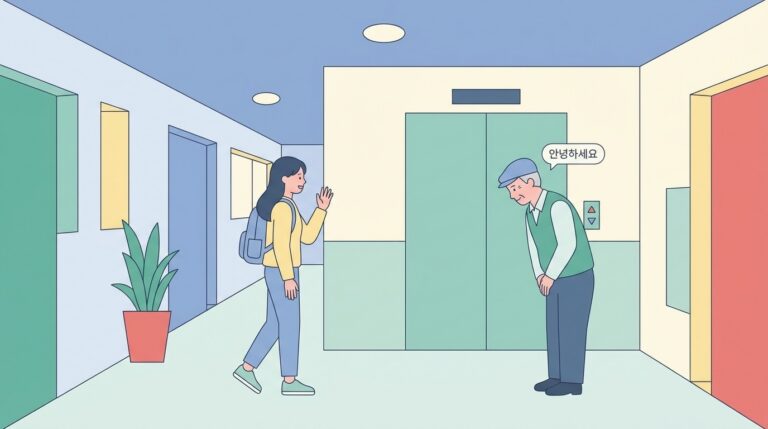
Stop The Elevator Awkwardness: How to Greet Your Korean Neighbors Like a Local
Phase 1: Empathy (Storytelling Opening)
안녕하세요! 매일한글 에디터입니다. (Hello! This is your Daily Hangul editor.)
Picture this: You step into the quiet elevator of your Korean apartment building after a long day of exploring or working in Seoul. Just before the stainless steel doors glide shut, an elderly neighbor steps inside carrying a bag of fresh mandarins. Suddenly, the enclosed space feels twice as small. Your eyes meet for a split second, panic surges through your veins, and your gaze drops instantly to your shoes. You desperately want to be polite, but your mind races: Is ‘Annyeonghaseyo’ too loud? Should I bow all the way to ninety degrees? What if they ask me a question I cannot understand?
If you have ever felt that sting of elevator awkwardness in Korea, take a deep breath: you are definitely not alone! In fact, over 80% of our beginners at Daily Hangul report that everyday neighbor encounters—in hallways, lobbies, and recycling stations—trigger far more speaking anxiety than ordering food at a restaurant. But here is the comforting secret: Koreans do not expect foreign residents or visitors to deliver eloquent speeches in the hallway. Mastering just a handful of warm, low-pressure A2-level greetings and mastering a gentle nod will instantly break the ice, turning awkward silence into genuine neighborhood warmth. Let’s conquer hallway anxiety together!
Phase 2: Core 3 Expressions In-Depth
1. 안녕하세요! (Annyeonghaseyo!)
- Pronunciation: An-nyeong-ha-se-yo! (Sound analogy: Think of saying ‘Ahn’ like ‘on’, ‘nyoung’ like ‘young’, and ‘ha-se-yo’ like an upbeat ‘ha-say-yo!’).
- Meaning: Literal: “Are you at peace?” | Real Nuance: “Hello! / Good morning / Good afternoon.”
- K-Culture Moment: You hear this in every single K-drama whenever a character walks into an apartment building lobby and spots the security guard (gyeongbiamjeossi).
- Editor’s Insight: Deliver this with a cheerful upward lilt on the last syllable (-yo!). You do not need a grand, dramatic bow; a crisp 15-degree head tilt is perfect.
- Situation Spectrum: Casual ⚠️ | Semi-formal ✅ | Formal ✅
- 🤔 Think About It: In English, we often ask “How are you?” without expecting a deep answer. Korean “안녕하세요” asks whether you are in peace. What does this reveal about community care in Korean society?
2. 좋은 하루 보내세요! (Joeun haru bonaeseyo!)
- Pronunciation: Jo-eun ha-ru bo-nae-se-yo! (Sound analogy: ‘Jo-eun’ sounds like ‘Joe’ + ‘un’, followed by ‘ha-roo bo-nay-say-yo’).
- Meaning: Literal: “Please spend a good day.” | Real Nuance: “Have a wonderful day!”
- K-Culture Moment: Classic morning scene in Reply 1988 where neighbors bump into each other on their way to school and work, wishing each other a great day.
- Editor’s Insight: This phrase is the ultimate elevator exit line during morning rush hour (7:30 AM to 9:00 AM). Drop this right as the elevator doors slide open for your neighbor.
- Situation Spectrum: Casual ⚠️ | Semi-formal ✅ | Formal ✅
- 🤔 Think About It: English speakers say “Have a nice day” almost on autopilot. In Korean, wishing someone a good day carries a warm, thoughtful touch that brightens a busy morning.
3. 조심히 들어가세요! (Josimhi deureogaseyo!)
- Pronunciation: Jo-sim-hi deu-reo-ga-se-yo! (Sound analogy: ‘Jo-seem-hee’ + ‘deu-row-ga-say-yo’).
- Meaning: Literal: “Please enter carefully.” | Real Nuance: “Get home safely! / Have a good evening!”
- K-Culture Moment: Frequently heard at the end of emotional family K-dramas when neighbors part ways at their front doorsteps after sharing food.
- Editor’s Insight: Notice that you say deureogaseyo (enter) because the other person is heading into their own apartment or home! It is uniquely Korean, expressing protective care for your neighbor’s arrival home.
- Situation Spectrum: Casual 🚫 | Semi-formal ✅ | Formal ✅
- 🤔 Think About It: Why do Koreans emphasize “entering safely” rather than simply saying “goodbye”? How does home represent ultimate security in residential culture?
Phase 3: Textbook Korean vs Real Korean
Situation 1: Stepping into the elevator with an older neighbor
- 📖 교과서 한국어 (Textbook): 안녕하십니까, 이웃님? (Annyeonghasimnikka, i-ut-nim?) — “Greetings, esteemed neighbor?”
- 🗣️ 진짜 한국어 (Real Life): 안녕하세요~ (Annyeonghaseyo~) + light head nod.
- 💡 왜 다를까? (Why the difference?): Nobody uses the word “이웃님” (neighbor-nim) face-to-face in an apartment elevator! A soft, smiling “안녕하세요~” with gentle eye contact feels infinitely more natural and friendly.
Situation 2: Getting off the elevator before your neighbor
- 📖 교과서 한국어 (Textbook): 안녕히 계십시오. (Annyeonghi gyesipsio.) — “Please remain in peace (ultra-formal).”
- 🗣️ 진짜 한국어 (Real Life): 먼저 내릴게요, 좋은 하루 되세요! (Meonjeo naerilgeyo, joeun haru doeseyo!) — “I am getting off first, have a great day!”
- 💡 왜 다를까? (Why the difference?): “안녕히 계십시오” sounds like you are leaving a corporate boardroom presentation. Mentioning that you are getting off first (meonjeo naerilgeyo) shows practical consideration inside the elevator.
Phase 4: K-Culture Deep Dive & Non-Verbal Manners
4-1. 눈치 (Nunchi) & Gestures: The Magic of 목례 (Mok-rye)
In Korean residential spaces, greeting manners are 50% spoken words and 50% body language. When you encounter a neighbor in a hallway or elevator, never lock intense eye contact from ten feet away—that can be perceived as confrontational! Instead, use 목례 (Mok-rye): a polite, 15-to-30-degree nod from the neck and shoulders.
* Keep your hands loosely clasped in front of your waist or gently resting at your sides.
* Lower your gaze slightly during the nod, then look back up with a warm, soft smile.
* If you are wearing headphones or a beanie, briefly touch or lower your earbuds to signal that you are acknowledging their presence.
4-2. Culture Code: Apartment Life & “Side-Dish Diplomacy”
Over 60% of South Koreans live in high-rise apartments (apateu) or multi-family villas. Because walls and floors are closely shared, Koreans are sensitive to noise and personal boundaries. Saying hello in the corridor is not just small talk; it acts as an invisible social contract saying, “I am a safe, courteous, and considerate neighbor living next to you.” In classic Korean neighborhoods, this neighborly warmth even extended to sharing freshly made Kimchi or seasonal fruit over the fence—a traditional virtue known as 정 (Jeong).
Phase 5: Real-Life Roleplay Scenario
Setting: 6:30 PM. The elevator lobby on the 1st floor of an apartment building in Mapo, Seoul. You are waiting for the elevator holding a grocery bag. Your neighbor from Unit 702, Mrs. Park (박 아주머니), walks in carrying a parcel.
- Turn 1 (You): (🎭 Bowing your head lightly at 15 degrees with a bright face) 안녕하세요! (Annyeonghaseyo!) — “Hello!”
- Turn 2 (Mrs. Park): (🎭 Surprised and delighted, smiling warmly) 어머, 안녕하세요! 퇴근길이에요? (Eomeo, annyeonghaseyo! Toegeun-girieyo?) — “Oh my, hello! Are you on your way home from work?”
- Turn 3 (You): (🎭 Nodding pleasantly) 네, 마트 다녀왔어요. 날씨가 춥네요! (Ne, mateu danyeowasseoyo. Nalssiga chumpneyo!) — “Yes, I just came back from the grocery store. The weather is chilly!”
- Turn 4 (Mrs. Park): (🎭 Looking at the elevator button display) 맞아요, 오늘 바람이 많이 불어요. 몇 층 가요? (Majayo, oneul barami mani bureoyo. Myeot cheung gayo?) — “Indeed, it’s very windy today. Which floor are you going to?”
- Turn 5 (You): (🎭 Pointing gently toward the panel) 저는 5층이에요. 눌러주셔서 감사합니다! (Jeoneun o-cheung-ieyo. Nulleojusyeoseo gamsahamnida!) — “I’m going to the 5th floor. Thank you for pressing the button!”
- Turn 6 (Mrs. Park): (🎭 Chuckling softly) 별말씀을요. 한국말 참 잘하시네요! (Byeolmalsseumeullyo. Hangukmal cham jalhasineyo!) — “Don’t mention it. Your Korean is truly so good!”
- Turn 7 (Elevator arrives at 5th floor – Ding!) (You): (🎭 Stepping back slightly so she has space, bowing lightly) 칭찬 감사합니다! 먼저 들어갈게요, 조심히 들어가세요! (Chingchan gamsahamnida! Meonjeo deureogalgeyo, josimhi deureogaseyo!) — “Thank you for the compliment! I will head in first, get home safely!”
- Turn 8 (Mrs. Park): (🎭 Waving warmly as the door starts closing) 네~ 푹 쉬어요! (Ne~ puk swieoyo!) — “Yes~ Rest well!”
🔀 Interactive Branching Point: When the door opens at Floor 5, what should you do?
- Option A: Silently sprint out of the elevator without looking back.
- Feedback: [Bad] This can leave the neighbor wondering if you were uncomfortable or upset. An elevator ride deserves a polite sign-off!
- Option B: Say “야, 잘 가! (Ya, jal ga! – Hey, see ya!)” with a finger gun gesture.
- Feedback: [Risk] Huge linguistic trap! “야 (ya)” and “잘 가 (jal ga)” are informal banmal used strictly with close childhood friends or younger peers. Using this with an older neighbor will create massive cultural shock.
- Option C: Turn slightly, bow your head, and say “먼저 내릴게요, 좋은 저녁 보내세요! (Meonjeo naerilgeyo, joeun jeonyeok bonaeseyo!)”
- Feedback: [Best] 100/100 points! Courteous, natural, and proves you understand modern Korean apartment etiquette effortlessly.
Phase 6: 10-Second Emotion Shadowing Drill
Practice these lines aloud using the emotion guidance and rhythm slashes (/):
[😊 Bright & Friendly]
안녕하세요! / 좋은 하루 보내세요!
(An-nyeong-ha-se-yo! / Jo-eun ha-ru bo-nae-se-yo!)-
[🤝 Courteous & Helpful]
먼저 타세요. / 몇 층 가세요?
(Meon-jeo ta-se-yo. / Myeot cheung ga-se-yo?) -
[😌 Soft & Respectful]
먼저 들어갈게요, / 조심히 들어가세요!
(Meon-jeo deu-reo-gal-ge-yo, / Jo-sim-hi deu-reo-ga-se-yo!)
Phase 7: K-Culture Mini Dictionary
- 이웃 (I-ut) | Neighbor / Neighborhood community | Refers to people living adjacent to you. In Korea, harmonious relations with your i-ut are considered essential for peaceful residential living.
- 엘리베이터 (El-li-be-i-teo) | Elevator / Lift | The central social arena of Korean apartment complexes where brief greetings and basic etiquette take place every day.
- 분리수거 (Bun-ri-su-geo) | Waste sorting & recycling | The communal area where neighbors frequently run into each other on designated collection days while flattening cardboard or sorting plastics.
- 반상회 (Ban-sang-hoe) | Neighborhood residential meeting | A monthly or quarterly gathering where residents discuss apartment maintenance, parking rules, and neighborhood events.
Phase 8: Survival Kit for Travelers & Expats
Top 3 Survival Phrases for Apartment Life
- 몇 층 누르세요? (Myeot cheung nureuseyo?)
- Meaning: “Which floor should I press for you?”
- Pro Tip: Stand near the elevator button panel, make brief eye contact with an entering neighbor, and offer this phrase. You will instantly be crowned the kindest resident on the floor!
- 먼저 타세요. (Meonjeo taseyo.)
- Meaning: “Please get on first / After you.”
- Pro Tip: Hold the “Open” (열림) button while gesturing politely with an open palm.
- 죄송합니다, 먼저 내릴게요. (Joesonghamnida, meonjeo naerilgeyo.)
- Meaning: “Excuse me, I am stepping out first.”
- Pro Tip: Essential when the elevator is crowded and your floor arrives.
Editor’s Travel Note
Navigating Korean residential areas is much easier with the right tools. Skip global map apps that lack transit accuracy in Korea and make sure to use a Naver Map app download for English navigation. It provides precise building entrance directions and floor layout info. When walking in residential corridors at night, keep your footsteps light, as Korean floors feature hollow heating pipes underneath (ondol) that easily transmit thumping sounds!
Phase 9: “One Step Deeper” (Thinking Question)
In traditional Korea, the concept of 정 (Jeong)—an emotional bond of affection, empathy, and mutual attachment—meant that neighbors knew everything about each other’s households. Today’s Korea is hyper-modern and urbanized; apartments prioritize privacy, soundproofing, and personal boundaries. Yet, when an elevator door opens, that latent desire for communal safety and mutual respect sparks alive in a simple 15-degree nod. A hallway greeting in Korea is not an intrusion into someone’s privacy; it is a gentle reassurance that says, “We share this roof, and you are safe here.”
💬 Your Turn: How do people in your home country usually react when sharing an elevator with strangers? Do they chat, stare at phones, or offer a friendly “hello”? Share your story in the comments below!
Phase 10: FAQ & Avoiding Misunderstandings
Q: What should I do if an elderly neighbor ignores my greeting in the hallway?
A: Do not take it personally! In Korea, many senior citizens may feel shy, have diminished hearing, or simply be caught off guard when addressed by an international resident. Continue to offer a polite head nod (mok-rye) whenever you cross paths—your consistency and warmth will definitely be appreciated over time.
Q: Can I use “안녕 (Annyeong)” if I see small children in the building?
A: Yes! If you meet young kids (roughly elementary school age or younger), saying “안녕~ (Annyeong~)” with a friendly wave is warm and natural. However, always use polite language (jondaenmal, such as 안녕하세요) if the child’s parents are standing beside them.
Q: Is it customary to give small gifts to neighbors when moving into a Korean studio or villa?
A: In traditional apartment buildings, new residents used to distribute 이사 떡 (Isa tteok – moving-in rice cakes) to the floors directly above, below, and next door. Nowadays, in studio one-room buildings, simple pre-packaged snacks or a polite note left by the door are more than enough to introduce yourself.
🚨 Common Mistakes (흔한 실수) Warning Board
- Mistake: Offering a Western-style handshake (ak-su) to an elderly neighbor in the elevator.
- Correct Action: Keep personal physical distance. A modest head nod with hands resting politely in front is the golden standard.
- Mistake: Saying “잘 가 (Jal ga – Bye)” to older residents.
- Correct Action: Always remember that casual endings (banmal) are strictly for close friends. Stick with “조심히 들어가세요! (Josimhi deureogaseyo!)”.
- Mistake: Making direct, unbroken eye contact while riding the elevator.
- Correct Action: Acknowledge your neighbor when entering, then shift your gaze comfortably toward the floor indicator panel or your phone screen.
Phase 11: Action Mission & Engagement
Take your neighbor greeting skills from theory to practice with this 3-tier challenge:
* 🥉 Bronze Level (Solo Practice): Stand in front of your mirror today. Practice bowing at a 15-degree angle while smoothly pronouncing: “안녕하세요! 좋은 하루 보내세요!” five times without stumbling.
* 🥈 Silver Level (Social Sharing): Record an audio note of your elevator greeting and send it to your Korean study buddy or post it on your language-learning feed.
* 🥇 Gold Level (Real-World Mission): The very next time you enter your building’s elevator, lobby, or recycling area, make eye contact, smile, and deliver a warm “안녕하세요!” to whoever you meet.
🎮 K-Culture Mission: Watch any modern slice-of-life K-drama (like Hospital Playlist or My Liberation Notes). Spot the exact moment a character steps into an elevator or stairwell. Notice their head tilt, their tone of voice, and how quickly their neighbor responds!
Phase 12: Interactive Quiz Challenge
Test how well you mastered today’s neighborhood etiquette!
Q1. [Situation Judgment] You enter your apartment elevator at 8:00 AM on a Monday morning. Your neighbor holds the door open for you. What is the most polite and natural response?
a) “안녕! (Annyeong!)”
b) “감사합니다, 좋은 하루 보내세요! (Gamsahamnida, joeun haru bonaeseyo!)”
c) “안녕히 계십시오, 아저씨. (Annyeonghi gyesipsio, ajeossi.)”
Q2. [Fill in the Blank] When you step off the elevator on your floor in the evening, leaving your neighbor inside, complete this caring sentence:
“먼저 들어갈게요, _________ 들어가세요!”
Q3. [True / False Cultural Check] In Korean apartment etiquette, you should maintain intense eye contact with your neighbor throughout the entire 30-second elevator ride to show respect. (True / False)
👉 Click here for answers & detailed explanations!
- Q1 Answer: b) 감사합니다, 좋은 하루 보내세요!
- Explanation: Expressing gratitude for holding the door and wishing them a great day is the gold standard for morning elevator etiquette. Option (a) is disrespectful banmal, while (c) is overly archaic and stiff.
- Q2 Answer: 조심히 (Josimhi)
- Explanation: “조심히 들어가세요! (Josimhi deureogaseyo!)” translates to “Get home safely!” or “Please enter carefully!”, showing warm consideration for their journey back inside their home.
- Q3 Answer: False
- Explanation: Prolonged, direct staring can feel intimidating or intrusive in high-density Korean apartment environments. Acknowledge with a soft nod upon entering, and then relax your gaze toward the floor display panel!
- Explanation: Prolonged, direct staring can feel intimidating or intrusive in high-density Korean apartment environments. Acknowledge with a soft nod upon entering, and then relax your gaze toward the floor display panel!







