

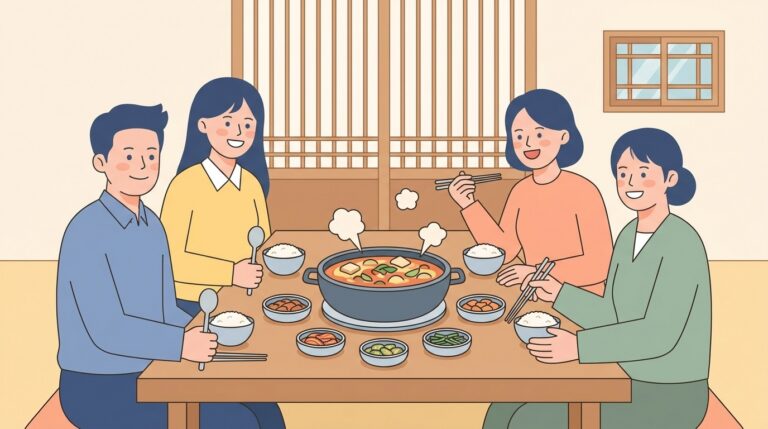
Why Koreans Always Say ‘We’ Instead of ‘I’: The Secret of Jeong and Community Spirit
Phase 1: Empathy (스토리 몰입형 오프닝)
안녕하세요! 매일한글 에디터입니다.
Have you ever sat at a bustling traditional Korean restaurant, looked at the small metal bowls filling up every square inch of the table, and suddenly panicked about which dish belongs to you? Or perhaps you tuned into a favorite K-drama like Reply 1988 and wondered why neighbors send their children across alleyways carrying bowls of piping hot side dishes, or why someone affectionately calls their own mother “우리 엄마” (uri eomma—our mother) instead of “my mother”? As an international learner stepping into intermediate Korean (B2), this is the exact moment where pure grammar rules hit a cultural wall.
In many Western cultures, personal autonomy and defined personal space are the foundational pillars of polite interaction. But in Korea, the invisible social glue known as 정 (Jeong) turns that concept on its head. Understanding Jeong is not just an academic exercise; it is the master key to unlocking authentic Korean friendships, workplace relationships, and dining culture. Many of our intermediate students tell us, “I knew all the honorifics, but I still felt like an outsider until I understood why people kept trying to share everything with me!” Today’s guide is built on real classroom epiphanies and real-life experiences in Seoul. By the time you finish this guide, you will transition from speaking “textbook Korean” to navigating social gatherings with the warmth and emotional intelligence of a true local insider.
Phase 2: 핵심 표현 3선 심층 분석
1. 우리 (Uri)
- Pronunciation: [Uri] (Sounds like oo-ree, smooth and rolling, like “ooh-ring” without the “-ng”)
- Meaning: Literal: Our / We | Real Nuance: My / Belonging to our shared world (a badge of affectionate inclusion)
- K-Culture Moment: Think of classic neighborhood dramas where someone introduces their family or hometown. Even an only child referring to their parent will say, “우리 엄마예요” (Uri eommayeyo – This is our mom). If you say “내 엄마” (nae eomma), native speakers will find it strikingly distant or jarringly possessive.
- Editor’s Insight: Using “우리” signals that the speaker views the listener as part of the same trusted social circle. In business, calling your workplace “우리 회사” (uri hoesa) shows loyalty and shared responsibility.
- Situation Spectrum: Casual ✅ | Semi-formal ✅ | Formal ✅
- 🤔 Think About It: In your native language, would referring to your own home or partner as “ours” in front of a stranger sound strange? What does this say about boundary lines in Korean society?
2. 같이 먹어요 (Gachi meogeoyo)
- Pronunciation: [Gachi meogeoyo] (Sounds like gah-chee muh-gaw-yo. Notice the palatalization where ‘t’ + ‘i’ turns into a soft ‘ch’ sound)
- Meaning: Literal: Let’s eat together | Real Nuance: I acknowledge you, I care about your well-being, and you are welcome in my space.
- K-Culture Moment: In workplace K-dramas, whenever an overworked junior colleague is sitting alone at their desk during lunch, an empathetic senior coworker pops their head in and says, **”밥 아직 안 먹었죠? 같이 먹어요!” (Bap ajik an meogeotjyo? Gachi meogeoyo! – You haven’t eaten yet, right? Let’s eat together!)
- Editor’s Insight: Food in Korea is rarely just fuel; it is the primary currency of emotional connection. Declining this invitation without acknowledging the warmth behind it can feel like a subtle social rejection.
- Situation Spectrum: Casual ✅ | Semi-formal ✅ | Formal ⚠️ (In strictly hierarchical business settings, suggest “식사 함께하시겠습니까?”)
- 🤔 Think About It: When was the last time someone inviting you for food felt like an invitation into their inner emotional circle rather than just a lunch break?
3. 정들었어요 (Jeongdeureosseoyo)
- Pronunciation: [Jeong-deu-reo-sseo-yo] (Sounds like jung-dew-raw-ssuh-yo, with ‘jeong’ pronounced like a relaxed English “young” starting with a soft ‘j’)
- Meaning: Literal: Jeong has entered [me] | Real Nuance: I have grown emotionally attached / I’ve developed a fond, unbreakable bond over time.
- K-Culture Moment: In healing reality variety shows like Jinny’s Kitchen or Three Meals a Day, cast members tear up on the final day, looking at their makeshift kitchen or local stray pets, saying: “벌써 정들었나 봐요.” (Beolsseo jeongdeureonna bwayo. – I guess I’ve already grown attached.)
- Editor’s Insight: Jeong isn’t romantic love; it is an unspoken affection developed through shared time, mutual vulnerability, and even small shared hardships. You can even develop Jeong for an old sweater, a worn-out neighborhood cafe, or an eccentric neighbor!
- Situation Spectrum: Casual ✅ | Semi-formal ✅ | Formal ✅
- 🤔 Think About It: Does your native tongue have a single word that describes affection built purely through the passage of shared time, even without romantic passion?
Phase 3: 교과서 한국어 vs 진짜 한국어
Situation 1: Offering to share your snacks or side dishes
- 📖 교과서 한국어: “이 음식을 당신과 나누어 먹고 싶습니다.” (I eumsigeul dangsingwa nanueo meokgo sipsumnida. – I wish to divide and eat this food with you.)
- 🗣️ 진짜 한국어: “이거 좀 드셔보세요. 같이 나눠 먹어요!” (Igeo jom deusyeoboseyo. Gachi nanwo meogeoyo! – Try a bit of this. Let’s share it together!)
- 💡 왜 다를까? The textbook sentence relies on the unnatural pronoun “당신” (dangsin), which creates distance or even confrontational tension. Real Koreans drop unnecessary pronouns and use proactive, communal invitations with softer imperative forms like “~보세요”.
Situation 2: Asking if an acquaintance or colleague is doing well
- 📖 교과서 한국어: “그동안 안녕하셨습니까? 식사는 하셨습니까?” (Geudong-an annyeonghasyeotseumnida? Siksaneun hasyeotseumnida? – Have you been peaceful in the meantime? Have you eaten a meal?)
- 🗣️ 진짜 한국어: “요즘 밥은 잘 챙겨 먹고 다녀요? 얼굴 보니까 반갑네요!” (Yojeum babeun jal chaenggyeo meokgo danyeoyo? Eolgul bonikka banggamneyo! – Are you making sure to eat well these days? So good to see your face!)
- 💡 왜 다를까? Asking someone if they are “eating well on the go” (챙겨 먹다) expresses personal care rooted in community spirit. It’s the hallmark of warm, intermediate Korean conversational flow.
Phase 4: K-Culture 딥다이브 & 비언어적 매너
4-1. 눈치 (Nunchi) & Table Manners for Community Spirit
In a communal culture, consideration is displayed through small, proactive actions before anyone asks.
* The Chopstick & Napkin Setup: When sitting down at a dining table with Koreans, look for the metal cutlery drawer. It is customary for the youngest or the most proactive person to take napkins, place them in front of everyone around the table, and lay out chopsticks and spoons for each person. Doing this shows immediate communal awareness (눈치, Nunchi).
* The Two-Handed Pour: When pouring water or drinks from a communal bottle, hold the bottle with your right hand while lightly supporting your right wrist or forearm with your left hand. This physical posture reflects modesty and deep-seated relational respect.
* The “Last Piece” Dilemma (눈치 싸움): When only one piece of pajeon (pancake) or dakgalbi remains on a shared plate, Koreans rarely take it immediately. Leaving that piece is called the “politeness piece” (양보의 미덕). If you want it, first ask the table: “이거 더 드실 분 계세요?” (Is anyone else going to eat this?).
4-2. Cultural Code Analysis: “Bapsim” and the Generosity of “Deom”
Why is food at the core of Jeong? Historically, through agricultural teamwork (Pumasi) and recovery from poverty post-war, making sure your neighbor did not starve was communal survival. This gave birth to 밥심 (Bapsim—the strength derived from rice) and 덤 (Deom—free extras added by vendors).
When a restaurant owner (Imo-nim) slides a complimentary steamed egg (Gyeran-jjim) onto your table with a rough “서비스예요!” (It’s on the house!), she isn’t just marketing—she is expressing maternal Jeong. Accepting it enthusiastically with genuine gratitude is the ultimate cultural harmony.
Phase 5: 실전 롤플레이 시나리오
[Background & Characters]
You (Alex, an intermediate foreign professional working in Seoul) are having lunch with Minho (a warm, experienced senior colleague who embodies the spirit of Jeong) at an authentic Kimchi-jjigae restaurant in Mangwon-dong.
- Turn 1 (Minho): “알렉스 씨, 여기 김치찌개는 라면 사리 넣어서 같이 나눠 먹어야 제맛이에요.”
(Alex, this kimchi stew tastes best when we put in ramen noodles and share it together.)
🎭 Placing the burner in the middle of the table and grinning warmly -
Turn 2 (Alex): “아, 선배님! 냄비 하나로 다 같이 먹는 거죠? 제가 국자 챙겨 드릴까요?”
(Ah, Sunbaenim! We eat together from one pot, right? Shall I grab the ladle for you?)
🎭 Reaching for the metal ladle and napkins attentively -
Turn 3 (Minho): “오, 눈치 빠른데요! 역시 우리 팀 막내답네요. 제가 먼저 덜어줄게요.”
(Oh, quick on your feet! Truly our team’s youngest. Let me scoop some into your bowl first.)
🎭 Ladling tender pork and tofu into Alex's bowl with generous care -
Turn 4 (Alex): “감사합니다! 그런데 한국에서는 왜 사적인 것도 다 ‘우리’라고 불러요?”
(Thank you! By the way, why do people in Korea call personal things ‘our’ so often?)
🎭 Blowing gently on the hot stew and looking curious -
Turn 5 (Minho): “우리는 밥도 정도 나누는 사이니까요. ‘내 것’보다 ‘우리 것’이 훨씬 든든하잖아요.”
(Because we share meals and jeong together. ‘Our thing’ feels much more comforting than ‘my thing’.)
🎭 Refilling the side dish of seasoned seaweed for the table -
Turn 6 (Alex): “듣고 보니 마음이 따뜻해지네요. 저도 이제 이 동네에 정들었나 봐요.”
(Hearing that warms my heart. I think I’ve grown attached to this neighborhood too.)
🎭 Taking a hearty bite and smiling with genuine ease -
Turn 7 (Minho): “정들었으면 이제 완전히 우리 식구죠! 계란말이도 시켰으니까 사양 말고 많이 먹어요.”
(If you’ve built jeong, you’re officially our family! I ordered rolled omelet too, so don’t be shy and eat plenty.)
🎭 Pushing the freshly arrived rolled omelet closer to Alex's bowl -
Turn 8 (Alex): “선배님 덕분에 정말 든든해요! 맛있게 잘 먹겠습니다.”
(Thanks to you Sunbaenim, I feel so supported! I will enjoy this meal wholeheartedly.)
🎭 Holding up chopsticks with both hands in polite appreciation
🔀 인터랙티브 분기점 (Interactive Branch)
Minho points at the last remaining slice of rolled omelet (Gyeran-mari) and insists: “알렉스 씨, 마지막 한 점 남았는데 드세요!” (Alex, there’s one piece left, eat it!) How do you respond?
- Choice A: “선배님도 같이 드셔야죠! 제가 반 잘라서 나눠 먹을게요.” (Sunbaenim, you should have some too! Let me cut it in half so we share it.)
👉 [Best Choice – 100 Points]: Demonstrates top-tier Nunchi and captures the exact soul of Jeong. You don’t reject his kindness, but you ensure the communal bond remains balanced. - Choice B: “아니요, 배불러서 못 먹겠습니다. 선배님이 드십시오.” (No, I am too full to eat. Please eat it yourself, Sunbaenim.)
👉 [Risk Choice – 50 Points]: While formally polite, the stiff rejection shuts down the affectionate momentum and creates awkward social distance. - Choice C: “네! 감사합니다!” and instantly pops the whole piece into your mouth without hesitation.
👉 [Bad Choice – 20 Points]: While honest, it misses the playful Korean table ritual of offering back and showing communal modesty.
Phase 6: 10초 감정 섀도잉 드릴 (Emotion Shadowing Drill)
Read these aloud while mimicking the pitch peaks and pauses marked by /.
- [😊 따뜻하고 정겹게 / Warm and inviting]
“우리, / 혼자 먹지 말고 / 같이 / 나눠 먹어요!”
(Uri, / honja meokji malgo / gachi / nanwo meogeoyo!)
(Let’s not eat alone, let’s share it together!) -
[🥺 아련하고 애정 어린 목소리로 / Nostalgic and fond]
“처음엔 낯설었는데, / 벌써 / 이 동네에 / 정들었나 봐요.”
(Cheoeumen natseoreonneunde, / beolsseo / i dongnee / jeongdeureonna bwayo.)
(It was unfamiliar at first, but I guess I’ve already grown deeply attached to this neighborhood.) -
[🤝 배려심 넘치고 싹싹하게 / Attentive and courteous]
“선배님, / 뜨거우니까 / 제가 / 국자로 먼저 / 덜어 드릴게요!”
(Seonbaenim, / tteugeounikka / jega / gukjaro meonjeo / deoreo deurilgeyo!)
(Sunbaenim, since it’s boiling hot, let me scoop some into your bowl first!)
Phase 7: K-Culture 미니 사전 (핵심 키워드 4선)
- 정 (情, Jeong)
Translation: Ineffable collective affection and empathetic bond.
Daily Usage: A relational gravity built over shared time. It explains why Koreans forgive quirky flaws in longtime friends or feel immense loyalty toward regular mom-and-pop shops. - 우리 (Uri)
Translation: We / Us / Our.
Daily Usage: Used colloquially in place of “my” (내) to indicate shared social membership. Found everywhere from “우리 학교” (our school) to “우리 남편” (our husband—meaning my husband). - 덤 (Deom)
Translation: Something extra given for free; a bonus of goodwill.
Daily Usage: In traditional markets or street food stalls, when an elderly vendor tosses an extra dumpling or apple into your bag with a warm smile, that is deom. - 품앗이 (Pumasi)
Translation: Traditional communal labor exchange.
Daily Usage: While historically used for farming or Kimjang (making winter kimchi together), modern Koreans use this metaphor when colleagues take turns helping each other finish tight deadlines.
Phase 8: 여행자를 위한 생존 키트 (Traveler’s Survival Kit)
서바이벌 표현 TOP 3
- “이거 같이 먹을래요?” (Igeo gachi meogeullaeyo?)
Pro Tip: Perfect icebreaker at a hostel, campus lounge, or co-working space when you open a bag of snacks. - “이모님, 너무 맛있어서 밥 한 공기 더 주세요!” (Imo-nim, neomu masisseoseo bap han gong-gi deo juseyo!)
Pro Tip: Addressing female restaurant owners respectfully as Imo-nim (auntie) and complimenting the food guarantees extra side dishes and broad smiles. - “다음에 제가 꼭 대접할게요!” (Daeume jega kkok daejeophalgeyo!)
Pro Tip: When an older Korean insists on paying the bill for the table, don’t wrestle their credit card away. Accept it gracefully and promise this line for next time.
Editor’s Travel Note
- When exploring alleyway restaurants in Seoul, reserve group-friendly local gems ahead of time using the CatchTable reservation app to experience communal dining without long wait lines.
- Use the Naver Map navigation download guide to find small neighborhood spots marked as 착한가격업소 (Good Price Businesses), where traditional Jeong and generous Deom side dishes are alive and well.
Phase 9: “한 발 더 깊이” (생각 질문)
In highly individualistic societies, personal boundaries resemble brick walls: they protect personal freedom, but they can occasionally induce intense social isolation. In Korean society, the boundary between “you” and “me” is porous, like a paper sliding door (창호지). While this can occasionally feel overwhelming or intrusive to newcomers, it also provides an extraordinary emotional safety net. When disaster strikes or personal tragedy occurs, this collective “Uri” mindset rallies an entire community to your side.
💬 Your Turn: In your home culture, how do people show unspoken collective care? Does your language have any concept comparable to Jeong? Share your reflections in the comments below!
Phase 10: FAQ & 오해 방지 (FAQ Schema)
Q: Does calling someone’s spouse “우리 남편” or “우리 아내” mean they literally share the spouse?
A: Absolutely not! In Korean, “우리” (uri) has transformed linguistically into an emotional marker meaning “the person who belongs to our family unit.” It conveys warmth and collective humility rather than communal ownership.
Q: Is splitting the bill (Dutch pay) frowned upon in Korea today?
A: Among younger generations (MZ generation) and casual friends, splitting the bill (더치페이 or N분의 1) is very common! However, when an older person (선배, 부장님) invites you out, insisting on splitting the bill down to the exact coin can make them lose face. The golden rule: let the elder treat you once, and you treat them to coffee right after!
Q: What should I do if a restaurant owner gives me free food (서비스/덤) that I cannot eat due to dietary restrictions?
A: Never dismiss it flatly. Express immense gratitude first: “어머, 챙겨주셔서 정말 감사해요! 그런데 제가 알레르기가 있어서 못 먹어요. 정말 죄송해요!” Showing that you received their heart (마음) matters far more than actually consuming the dish.
🚨 흔한 실수 (Common Mistakes) 경고판
- ❌ Mistake 1: Introducing South Korea as “제 나라” (My country).
👉 Correct Action: Always say “우리 나라” (Our country). Saying “제 나라” sounds strangely arrogant or disconnected. - ❌ Mistake 2: Eating only your single chosen side dish at a shared table.
👉 Correct Action: Side dishes are shared property! Feel free to gently rotate the plates so everyone has comfortable reach. - ❌ Mistake 3: Saying “고마워” or “감사합니다” in an overly flat, formal tone when someone offers food.
👉 Correct Action: Accompany your thanks with bodily gestures—a slight tilt of the head, both hands on the table, and an expressive smile.
Phase 11: 액션 미션 & 참여 유도
- 🥉 Bronze Mission (Solo Drill): Look into the mirror and practice saying: “이거 같이 나눠 먹어요!” three times with the warmest, brightest tone possible.
- 🥈 Silver Mission (Social Share): The next time you post a photo of Korean food or your study session on Instagram, caption it using the hashtag #우리 and tag a friend you consider part of your inner circle.
- 🥇 Gold Mission (Real-life Execution): At your next gathering with Korean friends or colleagues, set out the chopsticks and napkins for the entire table before the food arrives, and see how their faces light up!
- 🎮 K-Culture Mission: Watch an episode of Hospital Playlist (슬기로운 의사생활) and count how many times the five doctors share food from a single takeout box or call each other “우리”.
Phase 12: 인터랙티브 퀴즈 챌린지
Q1. Situational Judgment:
You are eating Budae-jjigae with Korean coworkers. One coworker is busy stirring the pot and refilling the water. What is the most appropriate action?
* A) Wait quietly until they serve your plate.
* B) Say: “선배님, 제가 할게요! 덜어 드릴까요?” and take over the ladle.
* C) Pull the pot toward your side of the table so you can eat first.
Q2. Fill in the Blank:
한국에서는 ‘내 학교’, ‘내 회사’ 대신에 보통 [ ] 학교, [ ] 회사라고 부릅니다.
Q3. True or False:
“정 (Jeong)” can only be built between two people who have fallen in love romantically. (True / False)
👉 Click to reveal answers & explanations!
- Q1 Answer: B — Taking proactive initiative to share the work and serve others is the ultimate sign of community mindfulness (눈치 and 정).
- Q2 Answer: 우리 (Uri) — Koreans universally substitute “우리” in institutional and family contexts to foster collective unity.
- Q3 Answer: False — Jeong is non-romantic! It forms through shared everyday experiences, empathy, neighborhood familiarity, and mutual care over time.







