

Phase 1: Empathy & Story Immersion
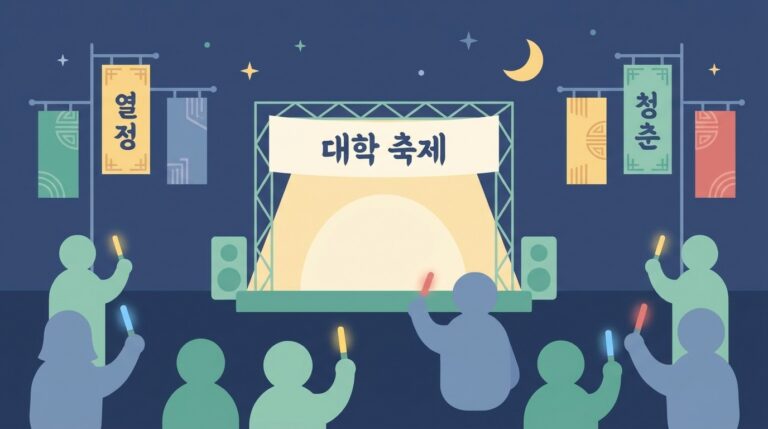
안녕하세요! 매일한글 에디터입니다. (Hello! This is your Daily Hangul editor.) If you find yourself walking across a Korean university campus in mid-May, you will immediately notice the electric buzz hanging in the air. Bright promotional banners flank every walkway, food truck aromas drift past the library, and students gather in tight circles, eyes glued to their smartphones. But look closer, and you will realize they aren’t just checking class announcements. They are refreshing the official student council Instagram page, waiting for the final artist drop of the annual university festival, known as Daedongje (대동제).
Suddenly, someone gasps: “미쳤다, 이번에 뉴진스랑 싸이 온대!” (Unbelievable, NewJeans and Psy are performing this year!) Yet, as thrilling as it is to see festival stages rivaling multi-million-dollar music award shows, another conversation inevitably brews inside the student lounge. You hear senior students murmuring about soaring celebrity appearance fees—sometimes topping 40 to 50 million KRW for a single 30-minute set—and questioning whether student council activity fees (학생회비) are being squandered on short-lived spectacle instead of student welfare.
For advanced Korean learners, this scenario exposes a classic linguistic pain point. While intermediate textbooks prepare you to say basic sentences like “축제가 재미있어요” (The festival is fun), they leave you entirely unequipped to engage in the high-stakes sociopolitical discourse of Korean campus life. How do you articulate the delicate balance between collegiate tradition and commercialized entertainment? How do you critique budget allocation without sounding dismissive of the communal spirit? Drawing directly from campus audit minutes and authentic student debates, this guide will elevate your Korean proficiency to a true C2 level, giving you the cultural fluency to debate university festival lineups, booking budgets, and ticketing ethics like a bona fide insider.
Phase 2: Core Expressions Deep Dive
1. 배보다 배꼽이 더 크다 (Bae-boda baekkop-i deo keuda)
- Pronunciation: [Bae-bo-da baek-kko-bi deo keu-da] (Think of ‘Bae’ like the English slang ‘bae’, and ‘baekkop’ sounding like ‘pack-cope’ with a crisp double-k)
- Meaning: Literally, “The belly button is bigger than the belly.” Figuratively, it refers to a situation where incidental or peripheral expenses vastly outweigh the primary objective or total budget.
- K-Culture Moment: Commonly heard in campus student council budget hearings or YouTube campus documentaries when analyzing festival finance reports, specifically when the celebrity booking fee accounts for more than 70% of the entire festival expenditure.
- Editor’s Insight: At the C2 level, using this idiom demonstrates an intuitive grasp of native irony. Instead of stating dryly, “연예인 섭외 비용이 과도합니다” (Celebrity booking fees are excessive), invoking this metaphor delivers a sharp, culturally resonant critique of fiscal mismanagement.
- Situation Spectrum: Casual (✅) | Semi-formal (✅) | Formal (⚠️ – Prefer using ‘주객이 전도되다’ in official institutional reports)
- 🤔 Think About It: Why does Korean culture emphasize body-part metaphors when discussing structural disproportion? How does this compare to English expressions like “the tail wagging the dog”?
2. 피켓팅을 방불케 하다 (Piketing-eul bangbulke hada)
- Pronunciation: [Pi-ket-ting-eul bang-bul-ke ha-da] (A blend of ‘Blood/Pi’ + ‘Ticketing’, followed by ‘bang-bool-keh’)
- Meaning: Literally, “To be reminiscent of a bloodbath ticketing battle.” It conveys an intensely competitive ticketing environment where acquiring an admission wristband feels like survival combat.
- K-Culture Moment: Used when discussing the fierce rivalry among students to enter the designated “Student Priority Zone” (재학생 존), where scalpers and external fans clash with campus security.
- Editor’s Insight: The portmanteau 피켓팅 (Blood + Ticketing) combined with the sophisticated literary verb 방불케 하다 (to vividly resemble/evoke) elevates your register from basic slang to analytical commentary.
- Situation Spectrum: Casual (✅) | Semi-formal (✅) | Formal (✅)
- 🤔 Think About It: In your native culture, do educational institutions restrict campus festival access exclusively to tuition-paying students, or are campuses fundamentally open civic spaces?
3. 등록금 낭비 논란을 점화하다 (Deungnokgeum nangbi nonran-eul jeomhwahada)
- Pronunciation: [Deung-nok-geum nang-bi non-ra-neul jeom-hwa-ha-da] (Notice the nasal assimilation: ‘Deung-rok’ becomes ‘Deung-nok’)
- Meaning: “To ignite controversy over the wastage of tuition funds.” Expresses the activation of public debate regarding whether institutional funds are being squandered.
- K-Culture Moment: Headlines on campus forums such as Everytime (에브리타임) whenever an A-list idol group receives a disproportionate appearance fee while campus library facilities lack heating or repair.
- Editor’s Insight: 점화하다 (to ignite/spark) is a high-register verb used in political and editorial commentary. Pairing it with 논란 (controversy) signals that you are dissecting institutional governance rather than merely gossiping.
- Situation Spectrum: Casual (⚠️) | Semi-formal (✅) | Formal (✅)
- 🤔 Think About It: Does paying mandatory student activity fees entitle a student to demand high-profile pop culture entertainment, or should universities prioritize academic infrastructure?
Phase 3: Textbook Korean vs. Real Korean
Situation 1: Praising an exceptionally star-studded festival lineup
- 📖 교과서 한국어: 이번 대학교 축제의 초청 연예인 명단은 매우 화려해서 기대가 됩니다. (Ibeon daehakgyo chukje-ui chocheong yeon-yein myeongdan-eun maeu hwaryeohaeseo gidaega doemnida. / The invited celebrity list for this university festival is very lavish, so I am looking forward to it.)
- 🗣️ 진짜 한국어: 이번 총학 섭외력 진짜 미쳤다! 라인업 완전 찢었네. (Ibeon chonghak seobwoeryeok jinjja michyeotda! Rain-eop wanjeon jjijeonne. / The Student Council’s booking power is insane! This lineup completely tore up the stage.)
- 💡 왜 다를까?: Native Korean undergraduates condense “Student Council” to 총학 and personify their organizational networking capability as 섭외력 (recruitment/booking power). The slang 찢었다 (literally: tore it) expresses peak artistic and curated excellence.
Situation 2: Criticizing reckless overspending on celebrity talent
- 📖 교과서 한국어: 축제 예산 중에서 연예인 섭외 비용이 차지하는 비율이 지나치게 높습니다. (Chukje yesan jung-eseo yeon-yein seobwoe biyong-i chajihaneun biyur-i jinachige nopsumnida. / The proportion of celebrity booking fees within the festival budget is excessively high.)
- 🗣️ 진짜 한국어: 연예인 몇 팀 부르느라 예산 영끌해서 다른 프로그램은 다 흐지부지됐잖아. (Yeon-yein myeot tim bureuneura yesan yeong-kkeul-haeseo dareun peurogeuraem-eun da heujibujidwaetjana. / They scraped every last penny together just to book a few celebrities, so all the other student programs fizzled out.)
- 💡 왜 다를까?: The colloquial term 영끌하다 (pulling together even soul fragments) communicates fiscal desperation, while 흐지부지되다 highlights how student-led initiatives lose momentum due to a lack of resources.
Phase 4: K-Culture Deep Dive & Non-Verbal Manners
4-1. 눈치 (Nunchi) & Non-Verbal Etiquette on Campus
When discussing festival finances on a Korean campus, context is everything. If you are sitting with members of the Student Council planning committee (축제기획단), avoid bluntly complaining about ticket queues or demanding why an artist only performed three songs. Student council officers often endure weeks of unpaid overtime, intense contract negotiations, and security management.
* The Empathetic Pause: Before expressing an opinion on festival costs, soften your stance with non-verbal affirmation: nodding slowly, sighing empathetically (“고생 많으셨겠어요” – You must have suffered so much), and acknowledging administrative strain before transitioning to budget critique.
* Vocal Modulation: When addressing sensitive financial topics during open student general meetings (학생총회), maintain a calm, measured pitch (차분한 어조). Speaking too fast or aggressively using rhetorical questions can be perceived as personal hostility (공격적 태도) rather than constructive civic engagement.
4-2. Cultural Code Analysis: The Evolution of Daedongje (대동제)
The term Daedongje (대동제) is deeply ideological. Emerging from the democratization movements of the 1970s and 1980s, the festival was rooted in Daedong (大同)—signifying collective unity, class solidarity, and student-worker autonomy. Traditional festivals revolved around Madangguk (traditional satirical theater), Pungmul (folk percussion), and student political forums.
In the 21st century, however, universities exist under market pressures. Festivals have evolved into branding competitions. High-tier universities leverage multi-artist lineups featuring Grammy-nominated or Billboard-charting K-pop icons to signal institutional prestige and lure prospective applicants. This commodification has triggered ongoing friction between traditionalists advocating for grassroots student culture and modern cohorts who view the festival as a rare stress relief (스트레스 해소) concert subsidised by student fees.
Phase 5: Real-Life Roleplay Scenario
Setting: Midnight outside the Student Union Hall during festival setup. You are sharing canned coffee with Min-seo, the Chief of Festival Planning, who looks exhausted.
- Min-seo: 하, 진짜 이번 라인업 공개되고 나서 에브리타임에서 여론 갈리는 거 봤어? (Ha, jinjja ibeon rain-eop gonggaedoego naseo Ebeuritaim-eseo yeoron gallineun geo bwasseo?)
🎭 Massaging her temples while scrolling through her phone.
(Sigh, did you see how polarized the opinions are on Everytime after we dropped the lineup?) -
Learner: 대충 봤지. 싸이랑 아이브 섭외했다고 환호하는 쪽이랑, 섭외비로 예산 탕진했다고 비판하는 쪽으로 나뉘었더라. (Daechung bwatji. Ssa-irang A-i-beu seobwoehaetdago hwanhohaneun jjok-irang, seobwoebiro yesan tangjinhaetdago bipanhaneun jjok-euro nani-eotdeora.)
🎭 Leaning forward with a neutral, attentive posture.
(I skimmed through it. It seems split between those cheering for booking Psy and IVE, and those criticizing the council for blowing the budget on booking fees.) -
Min-seo: 솔직히 연예인 섭외 안 하면 아무도 축제에 안 오잖아. 작년 축제 기억나? 학생 참여형 부스만 열었다가 썰렁하다고 욕먹었거든. (Soljiki yeon-yein seobwoe an hamyeon amudo chukjee an ojana. Jangnyeon chukje gieongna? Haksaeng cham-yeohyeong buseuman yeoreotdaga sseolleonghadago yongmeogeotgeodeun.)
🎭 Shrugging defensively with an aggrieved tone.
(Honestly, if we don’t book stars, nobody shows up to the festival. Remember last year? We focused on student-led booths, and people trashed us for being dead and boring.) -
Learner: 그 딜레마는 이해해. 그런데 섭외비 지출이 너무 커서 학술제나 복지 예산이 축소되면 학생들 반발을 사는 것도 당연하지. (Geu dillemaneun i-haehae. Geureonde seobwoebi jichur-i neomu keoseo haksuljena bokji yesan-i chuksodwoemyeon haksaengdeul banbar-eul saneun geotdo dang-yeonhaji.)
🎭 Offering a warm, understanding nod while maintaining a steady gaze.
(I understand that dilemma. But if talent expenditures are so high that academic forums or student welfare budgets get slashed, backlash is inevitable.) -
Min-seo: 맞아. 섭외비만 8천만 원이 깨졌으니… 외부인 티켓 팔아서 메우려고 했더니 이번엔 암표 때문에 난리고. (Maja. Seobwoebiman pal-cheonman won-i kkae-jyeosseuni… Oebuin tiket paraseo me-u-ryeogo haetdeoni ibeonen ampyo ttaemune nanrigo.)
🎭 Lowering her voice cautiously.
(True. Talent fees alone broke 80 million KRW… When we tried to cover it by selling public tickets, ticket scalpers caused total chaos.) -
Learner: 외부인 유입 때문에 재학생들이 무대조차 못 본다면 주객전도라는 지적이 나올 수밖에 없어. (Oebuin yu-ip ttaemune jaehaksaengdeur-i mudaejocha mot bondamyeon jugaekjeondoraneun jijeog-i na-ol subakke eopseo.)
🎭 Tapping gently on the table to emphasize the point.
(If enrolled students can’t even see the stage because of outsiders flooding the venue, people will inevitably point out that the priorities have completely flipped.) -
Min-seo: 그래서 재학생 전용 존을 엄격하게 통제하기로 했어. 학생증 모바일 검수 시스템도 도입했고. (Geuraeseo jaehaksaeng jeonyong jon-eul eomgyeokhage tongjehagiro haesseo. Haksaengjeung moba-il geomsu siseutemdo do-iphaetgo.)
🎭 Sitting upright with renewed resolve.
(That’s why we decided to enforce strict access to the enrolled student zone. We also rolled out a mobile student ID verification system.) -
Learner: 그나마 다행이네. 축제가 단순한 무료 콘서트가 아니라 학내 구성원의 화합이라는 본질을 잃지 않았으면 좋겠어. (Geunama dahaeng-ine. Chukjega dansunhan muryo konseoteuga anira hangnae guseong-won-ui hwahab-iraneun bonjir-eul ilchi anatseumyeon jokeesseo.)
🎭 Smiling gently and holding up the coffee can in solidarity.
(That’s a relief. I just hope the festival doesn’t become just another free concert, but preserves its essence of bringing campus members together.)
🔀 Interactive Choice Point
Min-seo asks: “How should we justify this 80 million KRW talent fee during the upcoming student financial audit next week?”
- Option A: “학생들의 축제 만족도 설문조사 결과와 외부 홍보 효과를 데이터로 입증하면서, 차기 축제 예산 상한제 도입을 대안으로 제시해 봐.” (Best: Empathetic, analytically sound, and offers institutional reform.)
- Option B: “연예인 안 부르면 축제 망하는 거 뻔한데 왜 눈치를 봐? 그냥 밀어붙여.” (Bad: Dismissive of institutional democracy and student oversight; escalates council controversy.)
- Option C: “영수증 처리를 대충 다른 복지 항목으로 돌려 막는 게 안전하지 않을까?” (Risk: Suggests financial manipulation; unethical and grounds for campus disciplinary action.)
Phase 6: 10-Second Emotional Shadowing Drill
[😤 한탄하듯이 / Exasperated]
라인업이 아무리 화려해도 / 학생 자치 예산을 전부 탕진해 버리면 / 대체 무슨 의미가 있겠어?
(Rain-eob-i amuri hwaryeohaedo / haksaeng jachi yesan-eul jeonbu tangjinhae beorimyeon / daeche museun uimiga itgesseo?)
“No matter how flashy the lineup is / if we blow the entire student governance budget / what on earth is the point?”-
[🤩 감탄하며 / Awestruck]
이번 총학생회 섭외력은 / 역대급이라는 평가를 / 받을 수밖에 없어!
(Ibeon chonghaksaenghoe seobwoeryeog-eun / yeokdaegeub-iraneun pyeong-gareul / badeul subakke eopseo!)
“The talent booking prowess of this student council / cannot help but be evaluated / as truly legendary!” -
[🧐 단호하고 이성적으로 / Resolute & Analytical]
축제의 상업화를 방지하고 / 재학생들의 관람 권리를 보장하는 / 제도적 장치가 시급합니다.
(Chukje-ui sang-eophwareul bangjihago / jaehaksaengdeur-ui gwallam gwonnireul bojanghaneun / jedojeok jangchiga sigeuphamnida.)
“Preventing the commercialization of our festival / and safeguarding the viewing rights of enrolled students / requires urgent institutional mechanisms.”
Phase 7: K-Culture Mini Dictionary
-
대동제 (Daedongje)
Literal: Great Unity Festival.
Usage: The official nomenclature for South Korean university festivals. Historically, it celebrated student solidarity and pro-democracy activism; today, it denotes multi-day campus festivals featuring food stalls, club performances, and celebrity concerts. -
학생회비 (Haksaenghoebi)
Literal: Student Council Fee.
Usage: A voluntary yet socially expected fee paid alongside semester tuition. It funds autonomous student governance, welfare equipment, departmental events, and festival productions. High-profile artist booking controversies often center on whether this fee was ethically spent. -
섭외력 (Seobwoeryeok)
Literal: Casting / Booking Power.
Usage: The capability of an organization or student council to negotiate, secure, and contract high-demand public figures, performers, or speakers within limited temporal and financial parameters. -
암표상 (Ampyosang)
Literal: Scalper / Illegal Ticket Dealer.
Usage: Individuals who exploit open admission or acquire student wristbands via fraudulent verification to resell them at exorbitant prices to external fans wanting to see major idol headliners.
Phase 8: Campus Survival Kit
Survival Expressions TOP 3
-
재학생 존 입장 팔찌는 어디서 배부하나요?
(Jaehaksaeng jon ipjang paljjineun eodiseo baebuhanayo?)
Pro Tip: Always keep your mobile student ID card (모바일 학생증) and physical verification ready before asking this, as queues move quickly and regulations are strict. -
외부인 출입 제한 구역인가요?
(Oebuin churip jehan gu-yeog-in-gayo?)
Pro Tip: Essential phrase if you are visiting another university’s festival during spring season to avoid being turned away at security barriers. -
학생회비 납부 내역 확인 부탁드립니다.
(Haksaenghoebi napbu naeyeok hwag-in butakdeurimnida.)
Pro Tip: Many campuses give wristband priority to those who paid their student council fees; having your electronic payment receipt saved prevents unnecessary disputes.
Editor’s Campus Life Note
To navigate Korean campus festivals smoothly, ensure you have the Everytime campus community application installed and verified with your student credentials. Real-time updates about lineup changes, crowd surges, and lost property surface here hours before official notices. If visiting other universities across Seoul, navigate transport using Naver Map transit navigation, as bus routes surrounding universities are frequently detoured during late-night festival street parades.
Phase 9: One Step Deeper
The annual debate surrounding festival lineups in South Korea holds up a mirror to the anxieties of young adults navigating a fiercely competitive society. For today’s college students, who shoulder heavy credit loads, job-seeking preparations (취업 준비), and economic pressures, the university festival is no longer an extended socio-political rally—it is one of the few sanctioned cultural escapes where they can feel collective ecstasy. However, when corporate funding and sky-high booking costs dominate the conversation, the university risks shifting from a sanctuary of shared growth to an entertainment marketplace. Exploring this tension in Korean allows you to participate not merely as a spectator, but as an informed member of the campus community.
💬 Your Turn: Does your home university invest institutional funds in celebrity headliners, or is student life strictly independent from mainstream commercial culture? Share your thoughts in Korean below!
Phase 10: FAQ & Avoiding Misunderstandings
Q: Can non-students or foreign travelers enter Korean university festivals?
A: Yes, in most cases! Korean university campuses are generally open public grounds. However, the prime viewing area right in front of the stage—known as the 재학생 존 (Enrolled Student Zone)—strictly requires institutional ID verification. External visitors must stand in the outer 외부인 존 (General Public Zone), where sightlines are limited and queues form hours in advance.
Q: Why do university festivals spend so much on celebrity headliners instead of student bands?
A: In the digital age, a university’s festival lineup directly impacts institutional reputation on social media and helps with student recruitment. Furthermore, student council popularity relies heavily on festival success ratings; an underwhelming lineup often triggers immediate public backlash on student portals.
Q: Are festival wristbands transferable or resalable?
A: Absolutely not. Reselling festival admission wristbands or student credentials violates university regulations and may trigger legal prosecution under Korean laws governing ticket scalping (경범죄처벌법). Campus security teams actively cross-reference photo IDs against wristband numbers.
🚨 Common Mistakes Warning Board
- Calling the event a “파티” (Party) instead of “축제” (Chukje) or “대동제” (Daedongje):
Wrong Action: “오늘 대학교 파티 라인업 봤어?”
Correct Action: “오늘 대동제 라인업 확인했어?” (University festivities are collective institutional festivals, not private parties.) - Assuming all campus events are paid for by standard tuition:
Wrong Action: Blaming the university president directly for festival artist selections.
Correct Action: Directing inquiries to the autonomous 총학생회 (General Student Council), who manages festival allocation separate from academic administration. - Using overly informal language with student council security volunteers:
Wrong Action: Saying “야, 나 들어가도 돼?” to student staff guarding boundaries.
Correct Action: Polite semi-formal address: “학생증 확인하면 입장 가능한가요?”
Phase 11: Action Missions
- Bronze Mission (Solo Drill): Record yourself shadowing the C2 analytical phrase in Phase 6: “축제의 상업화를 방지하고 재학생들의 관람 권리를 보장하는 제도적 장치가 시급합니다.” Match the intonation and pauses.
- Silver Mission (Social Listening): Search the hashtag
#축제라인업or#대동제on Instagram or YouTube Shorts. Identify three recurring slang terms used by students evaluating this year’s lineup. - Gold Mission (Real Debate): Join a discussion thread on your university’s campus board (or simulated forum) regarding festival funds. Write a 3-sentence balanced opinion in Korean evaluating celebrity booking versus student welfare.
- 🎮 K-Culture Mission: Watch a full live campus festival performance fancam of an artist like Psy or Younha performing at Yonsei (Akaraka) or Korea University (Ipselenti). Pay special attention to how the student MC introduces the act!
Phase 12: Interactive Quiz Challenge
1. Contextual Judgment
Which of the following responses is most appropriate when your Korean classmate complains that 60% of the student council budget went to booking a single idol group?
* A) “연예인 봤으니 본전 뽑은 거 아니야?” (Since you saw celebrities, didn’t you get your money’s worth?)
* B) “섭외비 지출이 과도해서 정작 학생 복지 사업이 위축된다면 주객전도라고 볼 수 있지.” (If talent costs are so excessive that student welfare contracts, priorities have reversed.)
* C) “어차피 등록금은 학교에 내는 거니까 총학이랑은 아무 상관없어.” (Tuition is paid to the school anyway, so it has nothing to do with the council.)
2. Fill-in-the-Blank
완성형 문장을 만드세요: 이번 축제는 연예인 섭외 비용이 너무 커서, 배보다 ( ) 더 큰 상황이 벌어졌다.
3. True / False Cultural Fact
True or False: The historical origin of the Korean university festival name 대동제 (Daedongje) comes from corporate marketing partnerships introduced in the late 1990s.
👉 Click here to reveal answers & explanations!
1. Answer: B
Explanation: Option B expresses a sophisticated, nuanced view balancing entertainment and administrative integrity. Option A is overly dismissive, while Option C shows ignorance of how student fees are governed.
2. Answer: 배꼽이 (baekkop-i)
Explanation: The complete Korean idiom is 배보다 배꼽이 더 크다 (the belly button is bigger than the belly).
3. Answer: False
Explanation: Daedongje originated during the 1970s and 1980s democratization movements, emphasizing communal equality and student solidarity, not corporate sponsorship.







