

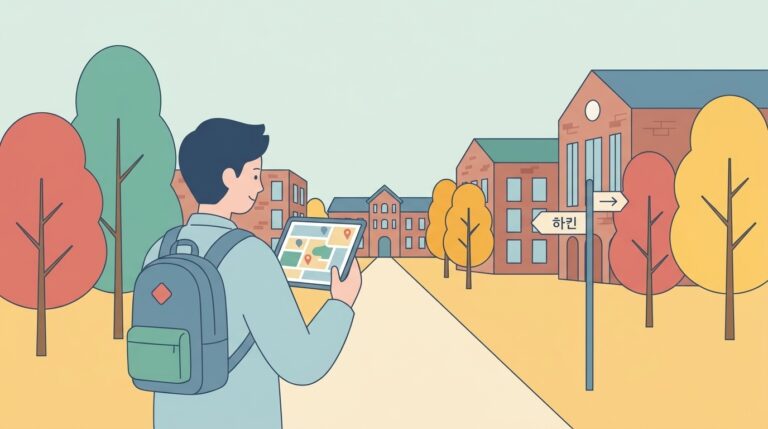
Lost on Campus? Find Your Korean Classroom in Under 3 Minutes!
Phase 1: Empathy (Welcome to the Campus Maze!)
안녕하세요! 매일한글 에디터입니다. (Hello! This is your Daily Hangul editor.)
Picture this: It is your very first week on a Korean university campus. The morning air is crisp, students are rushing by with giant iced Americanos, and your class starts in exactly five minutes. You glance at your timetable: 인문관 302호 (Inmun-gwan 302-ho). You look around, and you are standing at the base of a hill so steep it looks like Mount Everest, surrounded by towering glass and granite structures labeled only in swift Korean calligraphy. A wave of mild panic hits you—which building is which, and why does room 302 seem to be located on the fourth floor?!
If you have ever watched the university rom-com drama Cheese in the Trap or Weightlifting Fairy Kim Bok-joo, you know Korean campuses are notoriously scenic, massive, and confusing. You don’t need a vocabulary of 5,000 words to survive this morning. With just three simple, friendly expressions, you can transform from a lost freshman into a confident campus regular. This practical guide is crafted directly from our 10 years of mentoring international exchange students in Seoul—let’s make sure you never walk into the wrong lecture hall again!
Phase 2: Core Expressions Deep Dive
1. 저기요, 302호가 어디예요? (Jeogiyo, sambek-i-hoga eodiyeyo?)
- Pronunciation: Jeo-gi-yo, sahm-baek-ee-ho-ga eo-dee-ye-yo? (Think of “Jeo-gi” sounding like “joggy”, and “sambek” sounding like “some-beck”).
- Meaning: “Excuse me, where is Room 302?”
- K-Culture Moment: You will hear this constantly in campus dramas when a frazzled freshman drops their books and asks a chic senior (sunbae) standing near the student lounge for directions.
- Editor’s Insight: 저기요 (Jeogiyo) literally means “Over there,” but functionally it is the polite, magic opener to grab someone’s attention without sounding rude. 호 (Ho) denotes room numbers, preceded by Sino-Korean counting (il, i, sam).
- Situation Spectrum:
- Casual (with friends): ⚠️ (Use 여기 302호 어디야? instead)
- Semi-formal (with classmates / strangers): ✅ (Perfect!)
- Formal (with professors): ⚠️ (Use 교수님, 연구실이 어디입니까?)
- 🤔 Think About It: In English, we often say “Sorry to bother you.” Why do Koreans point attention toward space (저기 – “over there”) rather than apologizing for initiating a conversation?
2. 혹시 이 건물이 인문관 맞아요? (Hoksi i geonmuri inmun-gwan majayo?)
- Pronunciation: Hok-si ee geon-mool-ee in-moon-gwan mah-ja-yo? (Hoksi sounds like the English name “Hawk” + “see”).
- Meaning: “By any chance, is this building the Humanities Hall?”
- K-Culture Moment: The classic first-day scene where two students glance up at the building plaque together, realize they share the same major, and become instant friends.
- Editor’s Insight: 혹시 (Hoksi) means “by any chance” or “perchance.” Putting 혹시 at the front of a sentence instantly softens your tone, signaling modesty and polite hesitation.
- Situation Spectrum:
- Casual: ⚠️
- Semi-formal: ✅ (Best for campus strangers)
- Formal: ✅
- 🤔 Think About It: How does softening a question with “by any chance” change the psychological pressure placed on the listener to give a correct answer?
3. 몇 층으로 가야 해요? (Myeot cheungeuro gaya haeyo?)
- Pronunciation: Myeot cheung-eu-ro gah-yah hae-yo? (Myeot sounds like the English word “mutt”, and cheung rhymes with “sung”).
- Meaning: “Which floor should I go to?”
- K-Culture Moment: That awkward elevator lobby moment when a student rushes in right as the doors are closing and asks someone inside which floor the mega-lecture hall is on.
- Editor’s Insight: Korean buildings built on hills often have split-level designs where the “ground entrance” is technically the 2nd or 3rd floor (B1/B2 anomalies). Asking this saves you stairs!
- Situation Spectrum:
- Casual: ⚠️
- Semi-formal: ✅
- Formal: ✅
- 🤔 Think About It: When navigating vertical spaces, why is confirming the floor often more urgent than asking for the exact room in dense urban campuses?
Phase 3: Textbook Korean vs. Real Korean
Situation 1: Asking someone where a lecture room is
- 📖 교과서 한국어 (Textbook): 실례지만, 4층 강의실이 어디에 위치합니까? (Sillyejiman, sa-cheung gang-uisiri eodie wichi-hamnikka? – “Pardon me, where is the 4th-floor lecture room situated?”)
- 🗣️ 진짜 한국어 (Real-world): 저기요, 401호 가려면 어디로 가요? (Jeogiyo, sa-baek-il-ho garyeomyeon eodiro gayo? – “Excuse me, how do I get to Room 401?”)
- 💡 왜 다를까? (Why the difference?): Real Koreans rarely use formal Sino-Korean verbs like 위치하다 (to be located) in everyday conversation. Instead, they use simple conditional structures like -려면 (if you want to get to…).
Situation 2: Asking if you arrived at the right building
- 📖 교과서 한국어 (Textbook): 이곳이 사회과학대학 본관입니까? (Igos-i sahoegwahak-daehak bongwan-imnikka? – “Is this location the main building of the College of Social Sciences?”)
- 🗣️ 진짜 한국어 (Real-world): 여기 사회관 맞아요? (Yeogi sahoegwan majayo? – “Is this the Social Sciences Hall?”)
- 💡 왜 다를까? (Why the difference?): College students consistently abbreviate long official building names (e.g., 사회과학대학 becomes simply 사회관).
Phase 4: K-Culture Deep Dive & Non-Verbal Manners
4-1. 눈치 (Nunchi) & Body Language
When asking for directions on a Korean campus:
1. Do not tap someone’s shoulder directly. It can startle people who are walking with earphones. Instead, walk slightly into their peripheral view, give a gentle 15-degree head nod (목례, mungnye), and say “저기요…” in a gentle, questioning pitch.
2. The Two-Hand Phone Tilt: When asking about a specific room code, open your university app or syllabus on your phone, hold the phone securely with both hands, and tilt it toward them. Using two hands demonstrates respect and avoids misunderstandings.
4-2. The Cultural Phenomenon: 과잠 (Gwajam) & Campus Topography
Korean universities are famous for 과잠 (Gwajam)—custom varsity bomber jackets showing the university crest on the back, the student’s college major on the sleeve, and their admission year on the wrist. If you are lost, spotting someone wearing a 과잠 that matches your college department is the best shortcut! They know every secret underground tunnel connecting the buildings.
Phase 5: Real-World Roleplay Scenario
Setting: Outside the Central Library courtyard at 8:52 AM. Wind is blowing. You are looking at a red-brick building with confusion. You spot Min-su, a senior student wearing a navy department jacket.
- You: 저기요, 실례지만 길 좀 물어볼게요. (Jeogiyo, sillyejiman gil jom mureobolgeyo.)
🎭 Hands politely folded in front, giving a mild head bow.
(“Excuse me, sorry to bother you, but may I ask for directions?”) -
Min-su: 네, 어디 찾으세요? (Ne, eodi chajeuseyo?)
🎭 Stops walking, pulls out one earbud, and looks at you pleasantly.
(“Yes! Where are you looking for?”) -
You: 혹시 경영관 205호가 어디예요? (Hoksi gyeong-yeong-gwan i-baek-o-hoga eodiyeyo?)
🎭 Showing the course timetable on your mobile phone screen.
(“By any chance, where is Business Hall Room 205?”) -
Min-su: 아, 경영관이요? 여긴 인문관이에요! (A, gyeong-yeong-gwaniyo? Yeogin inmun-gwaniyeyo!)
🎭 Chuckles warmly, pointing toward the hill behind you.
(“Ah, the Business Hall? This here is the Humanities Hall!”) -
You: 헐, 정말요? 수업이 5분 뒤에 시작해요! (Heol, jeongmalyo? Sueobi o-bun dwie sijakhaeyo!)
🎭 Eyes widening in panic.
(“Oh no, really? My class starts in 5 minutes!”) -
Min-su: 걱정 마세요! 저쪽 출구로 나가서 바로 오른쪽 언덕이에요. (Geokjeong maseyo! Jeojjok chulguro nagaseo baro oreunjjok eondeogieyo.)
🎭 Points an open palm toward the glass corridor on the right.
(“Don’t worry! Exit through that door and go right up the hill.”) -
You: 아, 저기 유리문 지나서요? 정말 감사합니다! (A, jeogi yurimun jinaseoyo? Jeongmal gamsahamnida!)
🎭 Giving a relieved 30-degree bow.
(“Ah, past that glass door? Thank you so much!”) -
Min-su: 네, 뛰어가면 2분이면 돼요. 화이팅! (Ne, ttwieogamyeon i-bun-imyeon dwaeyo. Hwaiting!)
🎭 Flashes an encouraging fist-pump smile.
(“Yes, if you sprint you’ll make it in 2 minutes. Good luck!”)
🔀 Interactive Choice Point
You exit the glass door, but you see two paths: an outdoor staircase and a basement walkway.
* Choice A: Ask a passing student: “저기요, 경영관 계단으로 가요?” (Jeogiyo, gyeong-yeong-gwan gyedaneuro gayo?)
* Outcome (Best): The student confirms taking the stairs cuts through the wind and leads straight to the 2nd floor entrance!
* Choice B: Walk silently into the basement walkway without asking anyone.
* Outcome (Risk): You might end up in the campus heating plant basement and miss your attendance check.
* Choice C: Yell loudly across the yard: “야! 경영관 어디야?!” (Ya! Gyeong-yeong-gwan eodiya?!)
* Outcome (Bad): Using banmal (informal speech) on strangers will result in bewildered glares and immense secondhand embarrassment.
Phase 6: 10-Second Emotion Shadowing Drill
Repeat these lines out loud, matching the rhythm slashes (/) and feeling the emotional cues:
[😰 Panicked & in a hurry]
저기요! / 302호가 / 어디예요? / 늦었어요!
(Jeogiyo! / Sambek-i-hoga / eodiyeyo? / Neujeosseoyo! – “Excuse me! / Where is Room 302? / I’m late!”)-
[🥺 Polite & asking for help softly]
혹시… / 이 건물이 / 학생회관 / 맞나요?
(Hoksi… / i geonmuri / haksaenghoegwan / mannayo? – “By any chance… / is this building / the Student Union / right?”) -
[😊 Relieved & extremely grateful]
아! / 찾았어요. / 정말 / 감사합니다!
(Ah! / Chajasseoyo. / Jeongmal / gamsahamnida! – “Ah! / I found it. / Truly / thank you so much!”)
Phase 7: K-Culture Mini Dictionary
- 강의실 (Gang-uisil) | Lecture Room | The standard term for classroom inside universities, as opposed to 교실 (Gyosil) used primarily for elementary through high schools.
- 과잠 (Gwajam) | Department Jacket | A portmanteau of 학과 (department) + 잠바 (jumper). The unofficial national uniform of Korean college students.
- 학관 (Hakgwan) | Student Union Building | Short for 학생회관. The heart of campus containing cheap student cafeterias, post offices, stationery shops, and club rooms.
- 새내기 (Saenaegi) | Freshman / Newcomer | A sweet native Korean word for first-year university students who are still wide-eyed and looking for their classrooms.
Phase 8: Student Survival Kit
Top 3 Survival Phrases
- 1. 몇 호예요? (Myeot ho-yeyo?) – “Which room number is it?”
Pro Tip: Use this when your study buddy mentions class but forgot to text the room number. - 2. 엘리베이터 어디 있어요? (Ellibeiteo eodi isseoyo?) – “Where is the elevator?”
Pro Tip: Essential for 6-story Korean humanities halls without central air-conditioned corridors. - 3. 길을 잃어버렸어요. (Gireul ireobeoryeosseoyo.) – “I am lost.”
Pro Tip: Say this with a sheepish smile; campus security (경비원 아저씨) will happily point the way.
Editor’s Travel Note: Campus Navigation Apps
Google Maps does not provide detailed pedestrian footpaths inside South Korean campuses due to local map data regulations. Download the Naver Map pedestrian navigation app or KakaoMap campus locator. Both apps provide 3D building outlines, accurate room indices, and even show campus shuttle bus stop schedules in real time!
Phase 9: One Step Deeper (Cultural Reflection)
In Western universities, asking a random peer for directions often starts with an apology for interruption (“Sorry to bother you”). In South Korea, campus culture is built upon an extended family mindset (선후배 문화 – Senior-Junior culture). Fellow students do not view being asked for directions as an intrusion; rather, it activates their natural instinct to guide a junior (후배). Opening with a friendly 저기요 establishes an immediate, benevolent collective bond.
💬 Your Turn: How does asking for directions on your hometown campus compare to Korea? Have you ever gotten lost on a giant university hill? Share your funniest memory in the comments below!
Phase 10: FAQ & Avoiding Misunderstandings
Q: Can I call another university student “선생님 (Teacher)” if I need help?
A: No! 선생님 is too formal and reserved for professors, doctors, or older elders. Address fellow students neutrally with 저기요 (Jeogiyo) or 학생분 (Haksaeng-bun – “student”).
Q: Why do room numbers start with letters, like B101 or C304?
A: ‘B’ stands for Basement (지하), while letters like ‘C’ or ‘N’ usually designate wings (Central, North) or specific donor halls. If you see 지하 1층, look for stairwells going downward!
Q: Is it okay to knock on the classroom door if I arrive late?
A: Knocking loudly draws attention to yourself. In Korea, if the lecture has already started, quietly slide the back door open, bow your head slightly toward the professor, and slip into the nearest empty seat.
🚨 Common Mistakes Alert Board
- Mistake: Calling an unfamiliar student “야! (Hey!)” or “너 (You)”.
Correct Action: Always initiate with 저기요 (Jeogiyo) or 실례합니다 (Sillyehamnida). - Mistake: Asking “이 방 어디예요?” (Where is this room?).
Correct Action: Rooms in universities are called 호 or 강의실, not 방 (which refers to residential bedrooms). - Mistake: Assuming Floor 1 is always the ground entrance on hill campuses.
Correct Action: Check the building directory (층별 안내도) right beside the entrance door.
Phase 11: Action Missions
- 🥉 Bronze Mission: Stand in front of your mirror and practice saying: “저기요, 302호가 어디예요?” 5 times with natural hand gestures.
- 🥈 Silver Mission: Write down your actual current classroom numbers in Korean Sino-numbers (e.g., 501호 -> 오백일호) and post it in your study notes.
- 🥇 Gold Mission: Next time you enter a building in Korea, ask someone: “혹시 여기가 [Building Name] 맞아요?” and successfully navigate without English!
- 🎮 K-Culture Drama Mission: Watch an episode of campus dramas like Weightlifting Fairy Kim Bok-joo or Love Playlist, and spot at least one student wearing a 과잠.
Phase 12: Interactive Quiz Challenge
Question 1: Situational Judgment
You are standing in front of a building looking for Room 402. Class starts in 2 minutes. You see a student walking by. What is the most polite and natural way to ask?
* A) 야, 402호 어디냐?
* B) 저기요, 혹시 402호가 어디예요?
* C) 이 방에 들어오십시오.
Question 2: Fill-in-the-Blank
“Excuse me, which floor should I go to?”
* 저기요, 몇 _____으로 가야 해요? (힌트: floor)
Question 3: Cultural True or False
- True or False: Google Maps works just as well as Naver Map when searching for indoor Korean university classrooms and campus hill shortcuts.
👀 Click here to reveal the Quiz Answers & Explanations!
- Answer: B (저기요, 혹시 402호가 어디예요?). Choice A is disrespectful informal language to a stranger, and Choice C commands them to enter a room!
- Answer: 층 (Cheung). The complete sentence is: 몇 층으로 가야 해요?
- Answer: False! Korean government spatial data regulations restrict foreign servers from hosting high-precision local mapping data. You must use Naver Map or KakaoMap for campus footpaths.







