

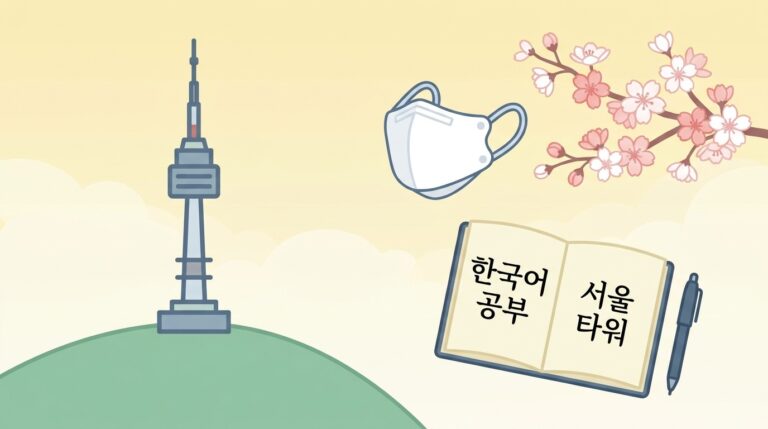
Phase 1: 공감 (Story-Immersive Opening)
안녕하세요! 매일한글 에디터입니다.
Picture this: You wake up in Seoul on a breezy Tuesday morning, buzzing with excitement. You planned a picture-perfect picnic at Yeouido Hangang Park, complete with convenience-store ramen and strawberry milk. You pull open your curtains expecting crystal-blue skies, but instead, the iconic N Seoul Tower is shrouded in a murky, sepia-toned haze. You step outside, take a deep breath, and immediately feel an uncomfortable, chalky scratch at the back of your throat. Within minutes, you notice that nearly every commuter around you is sporting a crisp white KF94 mask, heads buried in their phones checking a colorful widget app.
Welcome to spring in Korea, where talking about 미세먼지 (fine dust) isn’t just small talk—it’s an absolute daily survival skill. When I first mentored international students in Sinchon, so many learners told me: “Teacher, I know how to say ‘오늘 날씨가 맑아요 (The weather is sunny today)’, but how do I naturally tell my Korean coworker that my throat hurts, or ask the convenience store clerk for the right protective mask without sounding like a robotic medical pamphlet?”
Understanding how to talk about fine dust will instantly level up your social fluency from textbook beginner to street-smart insider. This guide compiles real feedback from over a decade of coaching B1 learners, giving you the natural slang, cultural context, and conversational confidence you need to tackle dusty days like a true local.
Phase 2: 핵심 표현 3선 심층 분석
1. 미세먼지가 심해서 마스크를 써야 해요. (Misemeonjiga simhaeseo maseukeureul sseoya haeyo.)
- Pronunciation: [Mi-se-meon-ji-ga shim-hae-seo ma-seu-keu-reul sseo-ya hae-yo] (Think of shim as in “shimmer” and sseo like a sharp English “sir” with strong tension).
- Meaning: Literal: “Because fine dust is severe, I must wear a mask.” / Nuance: “The dust is pretty bad today, so we really should mask up.”
- K-Culture Moment: You will hear this in almost every lifestyle V-log or morning variety show when cast members step outdoors and hand out masks to the crew.
- Editor’s Insight: Notice the connector -아서/어서 (-aseo/eoseo) here. Instead of two choppy sentences, Koreans naturally fuse the environmental cause with their immediate action. Using 심하다 (simhada – to be severe) rather than just 나쁘다 (nappeuda – to be bad) makes you sound significantly more native.
- Situation Spectrum: Casual: ✅ (with 반말) | Semi-formal: ✅ | Formal: ⚠️ (Use ‘착용해야 합니다’ in formal broadcasts)
- 🤔 Think About It: In many Western cultures, masks are traditionally linked to personal illness. In Korea, masks are an environmental shield. How does your native language express protective routines against climate factors?
2. 오늘 목이 너무 칼칼해요. (Oneul mogi neomu kalkalhaeyo.)
- Pronunciation: [Oh-neul mo-gi neo-mu kal-kal-hae-yo] (Kal-kal sounds like the brisk crunch when slicing a crisp apple).
- Meaning: Literal: “Today my throat is very 칼칼.” / Nuance: “My throat feels dry, scratchy, and irritated.”
- K-Culture Moment: A character in a K-Drama finishes filming an outdoor scene, coughs lightly, and asks their manager for a warm citron tea (유자차).
- Editor’s Insight: The word 칼칼하다 (kalkalhada) is an expressive sensory word (의태어/의성어 family). While textbooks teach 목이 아파요 (my throat hurts), 칼칼하다 specifically describes that gritty, coarse feeling caused by dust or spicy soup. Using it will make your Korean friends look at you in utter shock and admiration!
- Situation Spectrum: Casual: ✅ | Semi-formal: ✅ | Formal: ⚠️
- 🤔 Think About It: Notice how Korean possesses dozens of distinct onomatopoeic adjectives for bodily discomfort. Why do you think sensory adjectives are so richly developed in conversational Korean?
3. 공기 질이 진짜 안 좋아요. (Gonggi jiri jinjja an joayo.)
- Pronunciation: [Gong-gi ji-ri jin-jja an jo-ah-yo] (Jiri sounds like “jee-ree” with a light, tapped ‘r’).
- Meaning: Literal: “The air quality is really not good.” / Nuance: “The air quality is awful today.”
- K-Culture Moment: Coworkers looking out the office window during a coffee break, holding their iced Americanos while checking the yellow skies.
- Editor’s Insight: 공기 질 (air quality) is the conversational shorthand for 대기질 (atmospheric quality). Pairing it with 진짜 (jinjja – really) creates a natural, relatable statement when starting conversations in an elevator or breakroom.
- Situation Spectrum: Casual: ✅ | Semi-formal: ✅ | Formal: ✅
- 🤔 Think About It: Commenting on shared weather discomfort creates an immediate in-group bond in Korean society. How does weather talk serve as a social lubricant in your own culture?
Phase 3: 교과서 한국어 vs 진짜 한국어
Situation 1: Warning a friend not to stay outside
- 📖 교과서 한국어 (Textbook): “오늘 대기 오염 수치가 높으니 외출을 자제하십시오.” (Oneul daegi oyeom suchiga nopeuni oechureul jajehasipsio. – As air pollution levels are high today, please refrain from going outdoors.)
- 🗣️ 진짜 한국어 (Real-life): “오늘 미세먼지 장난 아니니까 웬만하면 나가지 마.” (Oneul misemeonji jangnan aninikka wenmanhamyeon nagaji ma. – The fine dust is no joke today, so try not to go outside if you can help it.)
- 💡 왜 다를까? Textbook Korean uses administrative broadcast announcements. In real life, Koreans use 장난 아니다 (to be no joke / extreme) to describe intense weather and 웬만하면 (if possible / unless necessary) to sound soft and caring.
Situation 2: Asking someone if they brought a mask
- 📖 교과서 한국어 (Textbook): “황사 방지용 마스크를 준비하셨습니까?” (Hwangsa bangjiyong maseukeureul junbihasyeotseumnikka? – Have you prepared a yellow-dust prevention mask?)
- 🗣️ 진짜 한국어 (Real-life): “너 마스크 챙겼어? 없으면 편의점에서 사자.” (Neo maseukeu chaenggyeosseo? Eopseumyeon pyeon-uijeom-eseo saja. – Did you pack a mask? If not, let’s grab one at the convenience store.)
- 💡 왜 다를까? Real conversation revolves around the dynamic verb 챙기다 (to pack / take care of / bring) rather than the formal 준비하다 (to prepare).
Phase 4: K-Culture 딥다이브 & 비언어적 매너
4-1. 눈치 (Nunchi) & Mask Gestures
When fine dust spikes to ‘나쁨 (Bad)’ or ‘매우 나쁨 (Very Bad)’, etiquette shifts instantly:
* The Cough Etiquette: Never cough into your open palm. Always cough into your inner sleeve or crook of your elbow. If you cough without a mask on a crowded line 2 subway car, expect instant side-eyes from local grandmothers (할머니).
* The Offer Gesture: If you pull out a fresh spare mask from your bag, always offer one to your companion with both hands: “하나 더 있는데 쓰실래요? (I have an extra one, would you like to wear it?)”. It is considered the peak of everyday Korean consideration (배려).
4-2. The Samgyeopsal Myth (황사와 삼겹살)
In Korea, whenever yellow dust (황사) or fine dust (미세먼지) blankets the peninsula, local barbecue joints pack to the brim. There is an urban myth that pork belly oil “slides down and cleanses the fine dust lodged in your throat.” While modern pulmonologists have debunked this claim, the cultural ritual remains immortalized in K-Food culture: bad air days are simply the best excuse to gather with friends for sizzling 삼겹살 (pork belly) and a bottle of soju!
Phase 5: 실전 롤플레이 시나리오
Setting: Outside a cafe near Hongik University Station. You are meeting your Korean language exchange partner, Minho (민호), who notices the hazy sky.
- 민호: “오늘 하늘 봤어요? 미세먼지 수치 진짜 심각하네요.”
(Oneul haneul bwasseoyo? Misemeonji suchi jinjja simgakhaneyo.)
“Did you see the sky today? The fine dust levels are really serious.”
🎭 [하늘을 올려다보며 미간을 찌푸린다 / Looks up at the sky and furrows his brow] -
You: “맞아요. 아침에 나왔는데 벌써 목이 칼칼해요.”
(Majayo. Achime nawanneunde beolsseo mogi kalkalhaeyo.)
“I know. I came out this morning and my throat is already scratchy.”
🎭 [목을 살짝 매만지며 / Gently touches throat] -
민호: “어? 그런데 마스크 안 썼네요? 편의점 들렀다 갈까요?”
(Eo? Geureonde maseukeu an sseonneyo? Pyeon-uijeom deulleotta galkkayo?)
“Oh? But you’re not wearing a mask? Shall we drop by a convenience store?”
🎭 [가방 주머니를 뒤적이며 / Rummages through backpack pockets] -
You: “네, 좋아요. 일반 덴탈 마스크도 괜찮을까요?”
(Ne, joayo. Ilban dental maseukeudo gwaenchaneulkkayo?)
“Yes, please. Would a regular dental mask be okay too?” -
민호: “안 돼요! 오늘은 초미세먼지라서 꼭 KF94 마스크를 써야 해요.”
(An dwaeyo! Oneureun chomisemeonjiraseo kkok KF-gusa maseukeureul sseoya haeyo.)
“No way! Today has ultrafine dust, so you must wear a KF94 mask.”
🎭 [검지 손가락을 단호하게 흔들며 / Wags index finger firmly] -
You: “아, KF 숫자가 높을수록 차단율이 높은 거죠?”
(A, KF sutjaga nopeulsurok chadanyuri nopeun geojyo?)
“Ah, the higher the KF number, the higher the filtering rate, right?” -
민호: “빙고! 얼른 사러 가요. 제가 목캔디도 하나 사줄게요.”
(Binggo! Eolleun sareo gayo. Jega mok-kaendido hana sajulgeyo.)
“Bingo! Let’s hurry and buy one. I’ll buy you a throat lozenge too.”
🎭 [편의점 문을 활짝 열어주며 / Holds the convenience store door open] -
You: “고마워요, 민호 씨! 오늘 야외 산책 대신 실내로 갈까요?”
(Gomawoyo, Minho ssi! Oneul ya-oe sanchaek daesin sillnae-ro galkkayo?)
“Thanks, Minho! Shall we head indoors instead of doing an outdoor walk?”
🔀 인터랙티브 분기점: How should you respond when Minho buys the mask for you?
- Option A: “고마워요! 다음엔 제가 삼겹살 쏠게요. 먼지 씻어내야죠!” (Thanks! Next time I’ll treat you to Samgyeopsal. We’ve got to wash away the dust!)
Feedback: Best! Perfect cultural wit and reciprocation. Shows conversational warmth and deep familiarity with Korean cultural banter. - Option B: “돈 얼마예요? 계좌이체 할게요.” (How much is it? I will transfer the money.)
Feedback: Risk. A bit too transactional for a small 1,500 KRW gesture between close acquaintances. Can come off cold. - Option C: “마스크 답답한데 그냥 안 쓰면 안 돼요?” (Masks are stuffy, can’t I just skip wearing it?)
Feedback: Bad. Dismisses your friend’s practical care and health concern.
Phase 6: 10초 감정 섀도잉 드릴
Practice these pauses (/) and tones aloud:
[😷 답답하고 걱정스럽게 - Stuffy & concerned]
“오늘 / 미세먼지가 너무 심해서 / 숨쉬기가 힘들어요.”
(Oneul / misemeonjiga neomu simhaeseo / sumswigiga himdeureoyo.)
Today / because the fine dust is so bad / it’s hard to breathe.-
[💡 단호하면서도 다정하게 - Firm yet caring]
“목 칼칼하니까 / 물 많이 마시고 / 마스크 꼭 챙겨!”
(Mok kalkalhanikka / mul mani masigo / maseukeu kkok chaenggyeo!)
Since your throat is scratchy / drink lots of water / and make sure to take a mask! -
[😮 깜짝 놀라며 공감하듯 - Surprised & empathetic]
“하늘 좀 봐! / 필터 씌운 것처럼 / 온통 노랗네.”
(Haneul jom bwa! / Pilteo ssuiun geotcheoreom / ontong noranne.)
Look at the sky! / Just like someone put a filter on it / it’s completely yellow.
Phase 7: K-Culture 미니 사전
- 미세먼지 (Misemeonji) | Particulate Matter (PM10)
Usage: Used universally in daily weather forecasts, casual greetings, and smart device alerts. - 초미세먼지 (Chomisemeonji) | Ultrafine Particulate Matter (PM2.5)
Usage: The smaller, more hazardous dust particles that penetrate deep into lungs; requires at least KF80 or KF94 ratings. - 삼겹살 데이 (Samgyeopsal-dei) | March 3rd (Pork Belly Day)
Usage: Coincides with peak spring yellow dust season when grocery sales of pork belly skyrocket nationwide. - KF94 (K-F-gusa) | Korean Filter Standard (94% filtration)
Usage: The gold-standard mask classification regulated by the Korean Food and Drug Safety Ministry. Always specify “KF94” when buying at pharmacies.
Phase 8: 여행자를 위한 생존 키트
서바이벌 표현 TOP 3
- “KF94 마스크 어디에 있어요?” (KF-gusa maseukeu eodie isseoyo? – Where are the KF94 masks?)
Pro Tip: Walk up to the convenience store counter and show both fingers forming a ’94’ if your pronunciation wavers. - “목캔디 하나만 주세요.” (Mok-kaendi hanaman juseyo. – Please give me one pack of throat candy/lozenges.)
Pro Tip: Keep these in your day pack; they relieve the dry scratchiness instantly during subway commutes. - “오늘 공기 안 좋으니까 실내에서 만나요.” (Oneul gonggi an joeunikka sillnae-eseo mannayo. – The air isn’t good today, so let’s meet indoors.)
Pro Tip: Use this to effortlessly reschedule outdoor palace visits to spots like COEX Mall or The Hyundai Seoul.
Editor’s Travel Note
Before stepping outside each morning, check the live air condition via the MiseMise App on Google Play/App Store. It displays intuitive emoji faces (from smiling blue to frowning devilish black) so you don’t have to decode raw chemical metrics. If you see yellow or red, immediately adjust your plans using Naver Map Subway Navigation to travel through climate-controlled underground arcades rather than walking street alleys.
Phase 9: 한 발 더 깊이 (Reflective Insight)
In many individualistic cultures, health precautions are deeply personal choices. In Korea, however, masking during severe dust or illness is an act of communal harmony known as 배려 (Baeryeo – thoughtful consideration for others). Putting on a mask when the alert sounds signals to those around you: “I am mindful of public health, I respect our shared air, and I take responsibility for my presence in our shared community.” Language reflects this balance—notice how warnings are almost always phrased as mutual suggestions rather than strict prohibitions.
💬 Your Turn: How does your home country react to seasonal air conditions or fog? Would wearing a mask cause people to ask if you are sick? Drop your thoughts in the comments below!
Phase 10: FAQ & Common Mistakes
Q: Can I just use a regular cotton or aesthetic black fashion mask during fine dust days?
A: Unfortunately, no. Cotton fashion masks filter out less than 20% of microscopic particulate matter. Look specifically for KF80, KF94, or KF99 logos stamped clearly on the package at convenience stores (편의점) or pharmacies (약국).
Q: Why do Koreans say “목이 칼칼하다” instead of just “목이 아프다”?
A: 목이 아프다 implies soreness or pain like a bacterial strep infection. 목이 칼칼하다 captures the exact sandpaper sensation of dry, dusty air. Native speakers prefer precision with sensory expressions.
Q: Is 황사 (Hwangsa) the exact same thing as 미세먼지 (Misemeonji)?
A: Not quite. 황사 refers specifically to Asian Yellow Dust storms blown in from the Gobi Desert containing natural mineral soil. 미세먼지 refers to industrial fine particulate matter and micro-pollution.
🚨 흔한 실수 (Common Mistakes) Top 3
- Saying “마스크를 입다” (Wearing a mask):
Mistake: Using 입다 (for clothing).
Correct Action: Always use 마스크를 쓰다 (to wear a mask). - Confusing ‘먼지’ with ‘미세먼지’:
Mistake: Saying “오늘 먼지가 많아요” to describe the sky.
Correct Action: Say “미세먼지가 심해요” for weather/pollution contexts. - Overusing formal broadcast language in casual texts:
Mistake: Texting a friend “외출을 자제하세요”.
Correct Action: Text naturally: “오늘 공기 안 좋으니까 웬만하면 나가지 마!”
Phase 11: 액션 미션 & 참여 유도
- 🥉 Bronze Mission (Solo): Stand in front of your mirror and practice saying “미세먼지가 심해서 마스크를 써야 해요” 3 times with smooth pacing using the slash marks in Phase 6.
- 🥈 Silver Mission (Social): Check today’s air index in your city. Post an Instagram story with a sky photo and caption it in Korean: “오늘 공기 질이 [좋아요 / 안 좋아요]!”
- 🥇 Gold Mission (Real-world): Next time you walk into a Korean market or convenience store, ask the staff: “KF94 마스크 있어요?” completely in Korean.
- 🎮 K-Culture Mission: Watch an episode of a modern K-variety show (like I Live Alone or Running Man) and spot whether the cast checks air quality apps before going camping or exercising.
Phase 12: 인터랙티브 퀴즈 챌린지
Q1. [Situational Judgement] Your Korean colleague says: “오늘 목이 너무 칼칼하네요.” What is the most natural, empathetic response?
1. “네, 오늘 삼겹살 먹으러 갈까요?”
2. “축하드려요!”
3. “옷을 따뜻하게 입으세요.”
4. “수영하러 가실래요?”
Q2. [Fill-in-the-Blank] Fill in the missing verb to complete the natural sentence:
“미세먼지가 심하니까 외출할 때 마스크를 꼭 ( ________ ) 해요.”
Q3. [True or False] True or False: General cotton fashion masks protect you just as well as KF94 masks against fine particulate matter.
👉 Click to view Answers & Explanations (정답 및 해설 보기)
- Q1 Answer: 1번 (“네, 오늘 삼겹살 먹으러 갈까요?”)
Explanation: Suggesting pork belly to soothe a dry throat shows brilliant Korean cultural wit! Options 2, 3, and 4 are unrelated. - Q2 Answer: 써야 (from 쓰다)
Explanation: For masks, glasses, and hats, the verb is always 쓰다, becoming 써야 해요 with the -아/어야 하다 grammar pattern. - Q3 Answer: False (거짓)
Explanation: Cotton masks cannot block microscopic PM2.5 ultrafine dust. You need certified KF80 or KF94 masks.







