

Phase 1: 공감 (Story-driven Intro)
안녕하세요! 매일한글 에디터입니다.
Imagine strolling through the picturesque wooden pavilions of Namsangol Hanok Village on a crisp Saturday afternoon. Suddenly, the sharp, cheerful melody of the taepyeongso (traditional horn) fills the air, accompanied by the deep beat of the buk drum. You turn the corner, and a sea of vibrant cobalt blue and crimson silk appears before your eyes. You have just stumbled upon a genuine jeontong hollye (Korean traditional wedding)!
The groom stands proud in royal ceremonial robes, and the bride appears like a royalty from your favorite historical K-drama, complete with bright red dots painted on her cheeks. Your heart races: Can I watch this? Is it rude to stand here? What if someone talks to me, or what if I want to congratulate them? Many travelers freeze up right here, worried their presence might disrupt a sacred family event. But here is the secret our Daily Hangul learners always discover: Korean traditional weddings are open celebrations of communal joy (janchi), and friendly observers are welcomed with open arms! With just a handful of simple A2-level phrases and basic manners, you can transform from an awkward onlooker into an appreciative guest.
Phase 2: 핵심 표현 3선 심층 분석
1. 축하드려요! (Chukhadeuryeoyo!)
- Pronunciation: [Chuk-ha-deu-ryeo-yo] (Think of popping a party popper: “Chook!” followed by a soft, polite “ha-deu-ryeo-yo”.)
- Meaning: Literal: “I offer congratulations!” | Real Nuance: “Congratulations to you!” (Warm, polite, and universally respectful).
- K-Culture Moment: You hear this in every drama wedding scene when guests greet the family at the reception desk, bowing politely with both hands together.
- Editor’s Insight: While textbook Korean often teaches 축하합니다 (chukhahamnida), everyday Koreans prefer 축하드려요 (chukhadeuryeoyo) because the verb ending -드려요 (-deuryeoyo) adds a layer of gentle modesty toward the receiver.
- Situation Spectrum: Casual: ⚠️ (To close peers, say 축하해!) | Semi-formal: ✅ (Perfect for ceremonies) | Formal: ✅
- 🤔 Think About It: In English, we simply say “Congratulations!” Regardless of who we talk to. Why do you think Korean adds a specific humble verb (드리다) when wishing someone well?
2. 사진 찍어도 돼요? (Sajin jjigeodo dwaeyo?)
- Pronunciation: [Sa-jin jji-geo-do dwae-yo?] (The “jji” sounds like the sharp snap of a camera shutter: “jee!”)
- Meaning: Literal: “Is taking a picture permissible?” | Real Nuance: “May I take a photo?”
- K-Culture Moment: Seen in travel variety shows like 2 Days & 1 Night whenever cast members ask permission before snapping shots in historical spots.
- Editor’s Insight: The grammar formula [-아/어도 돼요?] is an A2 superpower. It turns any action into a polite request for permission. Using this shows deep cultural awareness and respect for personal space.
- Situation Spectrum: Casual: ⚠️ | Semi-formal: ✅ (Ideal for asking staff or onlookers) | Formal: ✅
- 🤔 Think About It: Asking permission before photographing people in traditional dress creates an immediate bond of mutual respect. How does this compare to photography culture in your hometown?
3. 신랑 신부 멋져요! (Sillang sinbu meotjyeoyo!)
- Pronunciation: [Sil-lang sin-bu meot-jyeo-yo!] (“Sil-lang” flows like “seal-lahng”, and “meot” sounds like “mutt” with a rising tone.)
- Meaning: Literal: “The groom and bride are cool/splendid!” | Real Nuance: “The groom and bride look amazing!”
- K-Culture Moment: When a crowd gasps and cheers as the newlyweds conclude the ritual and bow to the guests.
- Editor’s Insight: 멋져요 (meotjyeoyo) works for both men and women when someone looks regal, dignified, and stylish. It is less formal than 아름다우세요 (areumdauseoyo), making it approachable for beginner speakers.
- Situation Spectrum: Casual: ✅ | Semi-formal: ✅ | Formal: ⚠️ (Use 멋지십니다 for strict formal announcements)
- 🤔 Think About It: Notice that 신랑 (groom) comes before 신부 (bride) in Korean set phrases. Paying attention to paired words gives clues about language rhythm.
Phase 3: 교과서 한국어 vs 진짜 한국어
Situation 1: Congratulating the Couple
- 📖 교과서 한국어: 결혼을 진심으로 축하드립니다. (Gyeorhoneul jinsimeuro chukhadeurimnida.) — “I sincerely offer my congratulations on your marriage.”
- 🗣️ 진짜 한국어: 결혼 진짜 축하드려요! (Gyeorhon jinjja chukhadeuryeoyo!) — “Really big congratulations on your wedding!”
- 💡 왜 다를까?: While the textbook version is suited for writing in formal guestbooks, native speakers talking in person casually add 진짜 (jinjja – really) to sound warmer and more heartfelt.
Situation 2: Asking About a Ceremonial Object
- 📖 교과서 한국어: 저 물건의 명칭은 무엇입니까? (Jeo mulgeonui myeongching-eun mueosimnikka?) — “What is the designation of that object?”
- 🗣️ 진짜 한국어: 저거 뭐예요? (Jeogeo mwoyeyo?) — “What is that over there?”
- 💡 왜 다를까?: Real life does not require vocabulary like “designation” (명칭). Pointing politely and using 저거 뭐예요? is natural, clear, and perfectly polite at level A2.
Phase 4: K-Culture 딥다이브 & 비언어적 매너
4-1. 눈치 (Nunchi) & Gestures
- The Two-Handed Clasp: If a ceremony attendant offers you a program flyer or traditional wedding candy (yeot or tteok), always receive it using both hands (or support your right forearm with your left hand). This small gesture signals respect.
- The Courtyard Perimeter: Traditional weddings take place outdoors in hanok courtyards. Keep a respectful distance of at least two meters from the central red-and-blue carpet path. Never cross over the mat while the officiant (jipnye) is speaking.
- Gentle Clapping: When the groom enters or the bride takes her seat, follow the lead of the older aunties (imonim). Modest, rhythmic clapping at chest level is the norm.
4-2. Cultural Code Analysis: The Wooden Goose & Red Cheeks
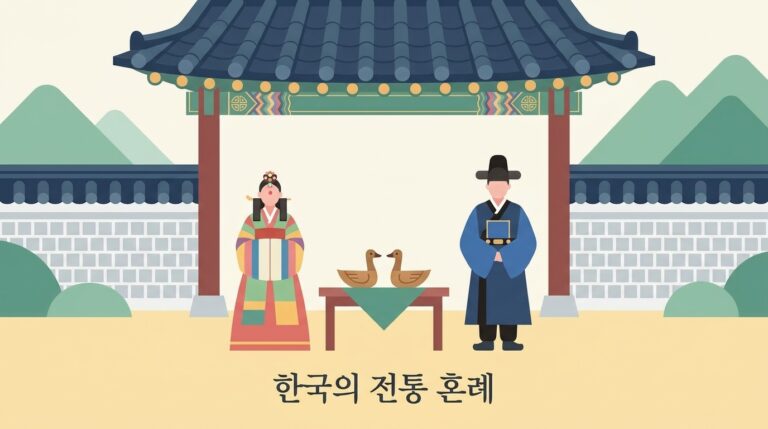
- The Wooden Goose (기러기 – Gireogi): You will see the groom place a carved wooden goose on a table. In Korean folklore, wild geese pair for life. If one dies, the other remains alone. Presenting the wooden goose is the groom’s solemn promise of lifelong loyalty.
- Yeonji Gonji (연지곤지): The red circular spots on the bride’s cheeks (yeonji) and forehead (gonji) are not just makeup! In traditional belief, the vibrant red color wards off evil spirits (aekun) and ensures that the bride enters her new home purely and safely.
Phase 5: 실전 롤플레이 시나리오
Setting: A sunny Saturday at Namsangol Hanok Village. You are watching a ceremony from the courtyard edge. Min-ji, a ceremony coordinator wearing a gentle mint-green hanbok, smiles at you.
- Turn 1 (Min-ji): 안녕하세요! 혼례 구경하러 오셨어요? (Annyeonghaseyo! Hollye gugyeonghareo osyeosseoyo?)
🎭 Smiling warmly while handing you an information leaflet.
“Hello! Did you come to watch the traditional wedding?” - Turn 2 (You): 네, 맞아요! 구경해도 돼요? (Ne, majayo! Gugyeonghaedo dwaeyo?)
🎭 Taking the leaflet with both hands and bowing your head slightly.
“Yes, that’s right! May I watch?” - Turn 3 (Min-ji): 그럼요! 편하게 보세요. 사진도 찍을 수 있어요. (Geureomyo! Pyeonhage boseyo. Sajindo jjigeul su isseoyo.)
🎭 Gesturing toward the courtyard viewing area.
“Of course! Please enjoy comfortably. You can also take photos.” - Turn 4 (You): 와, 감사해요! 저기 신랑 신부 멋져요! (Wa, gamsahaeyo! Jeogi sillang sinbu meotjyeoyo!)
🎭 Looking admiringly toward the ceremony pavilion with a bright smile.
“Wow, thank you! The groom and bride over there look so wonderful!” - Turn 5 (Min-ji): 신부 볼에 빨간 점 보이죠? ‘연지곤지’라고 해요. (Sinbu bore ppalgan jeom boijyo? ‘Yeonjigonji’rago haeyo.)
🎭 Lightly tapping her own cheek with a gentle giggle.
“You see the red dots on the bride’s cheeks, right? We call them ‘yeonji gonji.'” - Turn 6 (You): 연지곤지요? 진짜 예뻐요! (Yeonjigonjiyo? Jinjja yeppeoyo!)
🎭 Nodding thoughtfully, repeating the new cultural word clearly.
“Yeonji gonji? It’s really pretty!” - Turn 7 (Min-ji): 끝나고 신랑 신부에게 축하 인사 한마디 해주세요! (Kkeutnago sillang sinbuege chukha insa hanmadi haejuseyo!)
🎭 Pointing toward the photo zone at the end of the courtyard.
“After it ends, please give the bride and groom a short word of congratulations!” - Turn 8 (You): 네! 꼭 ‘축하드려요’라고 말할게요! (Ne! Kkok ‘chukhadeuryeoyo’rago malhalgeyo!)
🎭 Beaming with newfound confidence.
“Yes! I will definitely say ‘Congratulations!’ to them!”
🔀 Interactive Decision Point
The ceremony concludes, and the couple steps to the photo area. What do you do?
* Option A: Walk directly in front of the official photographer with your smartphone flash turned on.
Feedback: [Bad] This blocks the professional photographer and disrupts family portraits. Always step to the side and turn off your flash.
* Option B: Wait until other guests finish, step toward the couple, bow slightly with a smile, and say: “결혼 축하드려요!” (Gyeorhon chukhadeuryeoyo!).
Feedback: [Best!] Polite, respectful, and joyful! The couple and family will be delighted by your thoughtful Korean greeting.
* Option C: Shout loudly across the courtyard: “축하해!” (Chukhahae!).
Feedback: [Risk] 축하해 is informal Korean (banmal). Saying this to strangers or elders will sound surprisingly blunt and rude!
Phase 6: 10초 감정 섀도잉 드릴
Practice matching the cadence and emotion of native speakers! Pause momentarily at each slash (/).
[😊 Warm and polite]
결혼 / 진짜 / 축하드려요!
(Gyeorhon / jinjja / chukhadeuryeoyo!)-
[🤔 Polite curiosity]
저기요, / 사진 / 찍어도 돼요?
(Jeogiyo, / sajin / jjigeodo dwaeyo?) -
[🤩 Sincere admiration]
한복이 / 진짜 / 멋져요!
(Hanbogi / jinjja / meotjyeoyo!)
Phase 7: K-Culture 미니 사전
- 신랑 (Sillang) & 신부 (Sinbu)
Meaning: Groom & Bride.
Usage: Used throughout the wedding day. At regular modern weddings, the MC will say: “신랑, 신부 입장!” (Groom and bride, enter!). - 전통혼례 (Jeontong hollye)
Meaning: Traditional wedding ceremony.
Usage: Refers specifically to the Joseon-dynasty style ritual featuring hanbok, outdoor settings, and ritual bowing. - 연지곤지 (Yeonji gonji)
Meaning: Red cosmetic spots on the cheeks and forehead.
Usage: In daily life, Koreans also say this jokingly when a child has two bright red blush spots from running in the cold. - 기러기 (Gireogi)
Meaning: Wild goose (symbol of marital fidelity).
Usage: Often mentioned during traditional gift exchanges (jeonanrye), symbolizing the promise to stay faithful forever.
Phase 8: 여행자를 위한 생존 키트
Survival Expressions TOP 3
- 축하드려요! (Chukhadeuryeoyo!) — Congratulations!
Pro Tip: Bow your head 15 to 30 degrees while saying this to instantly double your polite impression. - 여기 앉아도 돼요? (Yeogi anjadeon dwaeyo?) — May I sit here?
Pro Tip: Many wedding courtyards set up wooden benches for observers. Always ask neighboring elderly folks before claiming a seat. - 감사합니다! (Gamsahamnida!) — Thank you!
Pro Tip: Use this whenever staff guide you or offer you a small tea cup.
Editor’s Travel Note
- Where to watch free or open traditional weddings: Namsangol Hanok Village (near Chungmuro Station, Subway Lines 3 & 4) frequently hosts authentic weddings on weekends in spring (April–June) and autumn (September–November).
- Navigation Guide: To avoid getting lost in the subway maze, use the Naver Map application download to search for “Namsangol Hanok Village” (남산골한옥마을) and check arrival gates.
Phase 9: “한 발 더 깊이” (생각 질문)
In many Western cultures, a wedding is an exclusive private affair reserved strictly for those with formal RSVP invitations. In Korea, traditional weddings embody the communal spirit of janchi (잔치)—a village-wide festival where sharing food, music, and laughter with passing travelers was believed to multiply blessings for the newlyweds. Today’s hanok ceremonies carry forward this welcoming hospitality.
💬 Your Turn: Have you ever attended a wedding in another country? How does the idea of open, celebratory courtyard weddings compare to wedding traditions in your culture? Share your thoughts in the comments below!
Phase 10: FAQ & 오해 방지 (FAQ Schema)
Q: Can tourists attend a traditional wedding if they don’t know the couple?
A: Yes! Public venues like Namsangol Hanok Village or the Korean Folk Village host open courtyard ceremonies where quiet, respectful observers are warmly invited to watch and take photos from designated viewing zones.
Q: Do I need to give congratulatory money (축의금 – chug-uigeum) if I am just watching?
A: No. As an onlooker enjoying the cultural spectacle from the public viewing perimeter, you are not expected to give gift envelopes. Your warm applause and polite greetings are more than enough!
Q: What should I wear if I plan to visit a hanok village and might see a wedding?
A: Smart-casual clothing is completely fine. Avoid all-white dresses (as that can resemble modern bridal wear), and wear neat, comfortable shoes since you will be walking across gravel courtyards.
🚨 Common Mistakes (흔한 실수) TOP 3
- Mistake: Shouting 축하해! (Chukhahae!) to the bride and groom.
Correct Action: Always use polite honorifics: 축하드려요! (Chukhadeuryeoyo!). - Mistake: Stepping onto the central blue-and-red ceremonial mat.
Correct Action: Walk along the gravel borders and keep off the raised wooden staging platforms. - Mistake: Taking photos with intense flash directly in front of the officiant.
Correct Action: Disable flash and shoot from the guest boundary lines.
Phase 11: 액션 미션 & 참여 유도
- 🥉 Bronze Mission (Solo Practice): Repeat 축하드려요! five times out loud using the two-handed bow posture in front of your mirror.
- 🥈 Silver Mission (Social Media): Find a photo of a Korean traditional wedding on Instagram or Pinterest and comment with: 신랑 신부 멋져요! (The groom and bride look awesome!).
- 🥇 Gold Mission (Real Life Action): Visit Namsangol Hanok Village during your Seoul trip, watch a live ceremony, and say 축하드려요 to the wedding party!
- 🎮 K-Culture Mission: Watch episode 1 of a historical K-drama (like The King’s Affection or 100 Days My Prince) and spot the wooden goose (기러기) and red cheek dots (연지곤지)!
Phase 12: 인터랙티브 퀴즈 챌린지
Q1. Situational Judgment:
You are standing next to an elderly guest at a traditional wedding, and you want to ask if you can take a picture of the courtyard. Which sentence is most natural?
1. 사진 찍어라! (Sajin jjigeora!)
2. 사진 찍어도 돼요? (Sajin jjigeodo dwaeyo?)
3. 사진을 찍는다. (Sajineul jjinneunda.)
Q2. Fill-in-the-Blank:
To tell the groom and bride they look splendid, you say:
“신랑 신부 _______!” (Hint: meot-jyeo-yo)
Q3. True or False:
The wooden goose (gireogi) presented by the groom symbolizes wealth and financial prosperity.
👉 Click to reveal answers & explanations!
- A1: 2번: 사진 찍어도 돼요? (The pattern -아/어도 돼요 is the standard polite way to ask for permission at the A2 level).
- A2: 멋져요 (meotjyeoyo). Full sentence: 신랑 신부 멋져요!
- A3: False (F)! The wild goose represents lifelong fidelity and loyalty because geese mate for life.







