

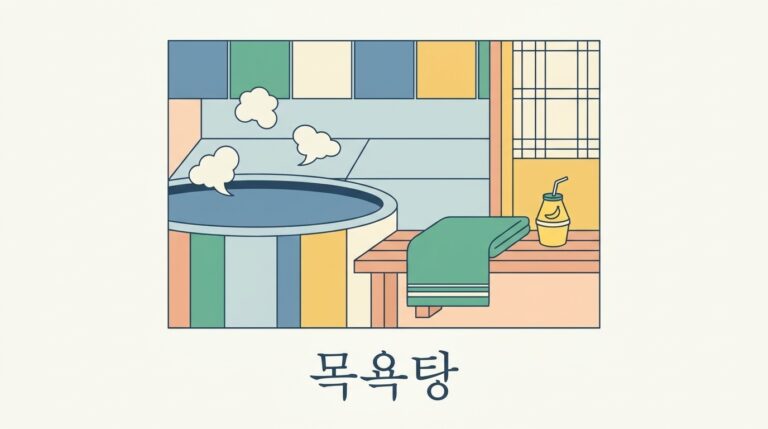
The Ultimate Beginner’s Guide to the Korean Body Scrub: Wash Away Fear and Glow Like a K-Drama Star
Phase 1: Empathy & Story Intro
안녕하세요! 매일한글 에디터입니다. (Hello! I’m your Daily Hangul editor.)
Picture this: You step into the steamy, echoing sanctuary of a traditional Korean mokyoktang (목욕탕, bathhouse) or jjimjilbang (찜질방). You’ve watched your favorite K-drama characters bond here with sheep-head towel hats, cracking baked eggs on each other’s foreheads. But today, you decided to be brave. You booked the legendary Korean body scrub service (sesin, 세신). Suddenly, you are lying completely vulnerable on a vinyl waterproof table, staring at a seasoned ajumma or ajusshi who is wearing waterproof black underwear and brandishing a rough green viscose mitt—the world-famous “Italy towel.”
Your heart races. What if it hurts? What if you roll over the wrong way? How do you say “gentle, please!” without sounding rude? Don’t panic! You are not the first traveler to feel terrified right before the scrub of a lifetime. Based on years of feedback from foreign learners visiting Seoul, mastering just three simple, polite A1-level phrases will turn your awkward nightmare into the most invigorating, baby-soft wellness experience of your life. Let’s unlock the secrets to bathing like a true local!
Phase 2: Top 3 Core Expressions
1. 때 밀어 주세요. (Ttae mireo juseyo.)
- Pronunciation: [Ttae mi-reo ju-se-yo] (Say “tteh” like in ‘teddy’, “me-raw”, followed by “jew-say-yo”)
- Meaning: Literal: “Please push my dead skin.” ➔ Real Nuance: “I’d like a body scrub service, please.”
- K-Culture Moment: Seen frequently in weekend family dramas where a son or daughter takes their elderly parent to a bathhouse to lovingly scrub their back as an act of filial devotion.
- Editor’s Insight: The word ttae (때) literally refers to dead skin cells and dirt. In Western culture, talking about your body grime sounds embarrassing, but in Korea, ttae is viewed naturally as something your body produces that simply needs regular clearing.
- Situation Spectrum: Casual ⚠️ | Semi-formal ✅ | Formal ✅
- 🤔 Think About It: In your native language, is scrubbing dead skin discussed so openly, or is it treated as an unspoken private matter? Why do you think Korean culture embraces it as communal hygiene?
2. 살살 해 주세요. (Salsal hae juseyo.)
- Pronunciation: [Sal-sal hae ju-se-yo] (“Sal” rhymes with “pal”. Say it twice like a soft, soothing whisper: “Sal-sal”)
- Meaning: Literal: “Please do it softly/gently.” ➔ Real Nuance: “Please be gentle, it’s a bit too strong for me!”
- K-Culture Moment: Common in variety shows where a cast member gets a surprise sports massage or body scrub and squeals in pain, begging the specialist to go easy.
- Editor’s Insight: Sal-sal (살살) is an onomatopoeic/mimetic word evoking a gentle, light touch like a spring breeze. Using this word instantly shows vulnerability and politeness without sounding confrontational.
- Situation Spectrum: Casual ⚠️ | Semi-formal ✅ | Formal ✅
- 🤔 Think About It: Notice how repeating syllables in Korean (salsal, tok-tok, banjjak-banjjak) creates a softer, friendlier emotional tone. Does your language have cute sound repetitions like this?
3. 시원해요! (Siwonhaeyo!)
- Pronunciation: [Si-won-hae-yo] (Sounds like “Sea-one-hey-yo”)
- Meaning: Literal: “It is cool/chilly.” ➔ Real Nuance: “This feels deeply relieving and wonderfully refreshing!”
- K-Culture Moment: Whenever an older Korean man sinks into a piping-hot bath tub or gets his shoulders scrubbed, he sighs deeply and says, “Ah~ siwonhada!“
- Editor’s Insight: Siwonhada is Korea’s most paradoxical word. It describes a cooling sensation, but Koreans use it when drinking scalding soup, sitting in hot water, or enduring a stinging scrub. It expresses the mental release of tension.
- Situation Spectrum: Casual ⚠️ | Semi-formal ✅ | Formal ✅
- 🤔 Think About It: How does your culture express physical relief when something slightly intense or hot actually feels good?
Phase 3: Textbook Korean vs. Real Korean
Situation 1: Requesting a gentle scrub
- 📖 교과서 한국어 (Textbook): 피부가 아프지 않게 문질러 주십시오. (Pibuga apeuji anke munjilleo jusipsio. – “Please rub so that my skin does not hurt.”)
- 🗣️ 진짜 한국어 (Real-life): 살살 해 주세요. (Salsal hae juseyo. – “Please do it gently.”)
- 💡 Why the difference? Nobody speaks in stiff literary imperatives while unclothed on a scrub table! Salsal hae juseyo is natural, brief, and crystal clear.
Situation 2: Asking if you can get scrubbed now
- 📖 교과서 한국어 (Textbook): 제가 지금 세신 서비스를 받을 수 있습니까? (Jega jigeum sesin seobiseureul badeul su isseumnikka? – “May I receive the exfoliation service now?”)
- 🗣️ 진짜 한국어 (Real-life): 지금 때 밀 수 있어요? (Jigeum ttae mil su isseoyo? – “Can I get a scrub right now?”)
- 💡 Why the difference? Real Koreans prefer conversational, direct verb phrases (ttae mil su isseoyo?) over corporate-sounding noun compounds.
Phase 4: K-Culture Deep Dive & Non-Verbal Manners
4-1. Nunchi (눈치) & Body Gestures at the Scrub Station
- The Limp Noodle Posture: When the scrub master (sesinsa) moves your arm or leg, do not help them by lifting your own limb! If you tense up or try to lift your leg, it makes scrubbing harder. Go completely limp like soft silken tofu (sundubu).
- Eye Contact Etiquette: Keep your eyes gently closed or cast downward. Staring directly into the scrub master’s face can feel awkward for both of you, especially given the lack of clothing.
- The Modesty Towel Flip: When walking across the open bathhouse floor to the scrub table, carry your small hand towel folded in front of your pelvic area. Once you lie down on the table, the scrubber will place the towel over your private area or face naturally.
4-2. Cultural Code: The Green “Italy Towel” (이태리 타월)
Why is it called an Italy Towel if it is uniquely Korean? In 1962, a textile inventor in Busan imported viscose yarn manufactured in Italy and wove it into a rough, corrugated mitt. It was revolutionary for lifting dead skin! Today, it is an indispensable staple of Korean domestic life. Undergoing sesin is seen as shedding past fatigue, stress, and spiritual sluggishness, leaving you purified and renewed.
Phase 5: Real-World Roleplay Scenario
Setting: In the steamy bathing hall of Myeongdong Spa. You have soaked in the warm tub for 20 minutes to soften your skin. You approach the scrub master, Sesinsa Imonim (세신사 이모님), wearing her signature black apron.
- Turn 1 (Learner): 저기요, 지금 때 밀 수 있어요?
(Jeogiyo, jigeum ttae mil su isseoyo?)
“Excuse me, can I get a scrub now?”
🎭 Action: Timidly raising one hand while holding your modesty towel. -
Turn 2 (Scrubber): 네, 탕에 15분 이상 있었어요?
(Ne, tange sib-o-bun isang isseosseoyo?)
“Yes! Have you soaked in the tub for at least 15 minutes?”
🎭 Action: Adjusting her rubber gloves and nodding toward the warm tub. -
Turn 3 (Learner): 네, 20분 있었어요!
(Ne, i-sip-bun isseosseoyo!)
“Yes, I’ve been in for 20 minutes!”
🎭 Action: Smiling warmly and pointing back to the hot bath. -
Turn 4 (Scrubber): 좋아요. 이리 누우세요. 엎드리세요.
(Joayo. Iri nu-useyo. Eopdeuriseyo.)
“Great. Lie down here. Face down, please.”
🎭 Action: Splashing warm water across the vinyl table to rinse it. -
Turn 5 (Learner): 네! 그런데 저 피부가 약해서 살살 해 주세요.
(Ne! Geurende jeo pibuga yakhaeseo salsal hae juseyo.)
“Okay! But my skin is sensitive, so please do it gently.”
🎭 Action: Lying down slowly on your stomach and relaxing your shoulders. -
Turn 6 (Scrubber): 알겠어요, 아프면 말해요. 자, 시작해요!
(Algesseoyo, apeumyeon malhaeyo. Ja, sijakhaeyo!)
“Understood, tell me if it hurts. Here we go!”
🎭 Action: Rhythmically rubbing your back with the green mitt. -
Turn 7 (Scrubber): 안 아파요? 괜찮아요?
(An apayo? Gwaenchanayo?)
“Does it hurt? Are you okay?”
🎭 Action: Pausing momentarily to tap your shoulder gently. -
Turn 8 (Learner): 안 아파요. 정말 시원해요! 감사합니다!
(An apayo. Jeongmal siwonhaeyo! Gamsahamnida!)
“It doesn’t hurt. It feels so refreshing! Thank you!”
🎭 Action: Sighing happily into the table with totally relaxed muscles.
🔀 Interactive Choice Point
The scrubber vigorously rubs your right arm and it starts to sting. What do you do?
- Choice A: Say nothing, grit your teeth, and bear it until your skin turns bright red.
- Choice B: Shout: “하지 마세요! 아파요!” (Haji maseyo! Apayo! – “Stop doing that! It hurts!”)
- Choice C: Tap the table gently and say with a polite smile: “이모님, 조금만 살살 해 주세요~” (Imonim, jogeumman salsal hae juseyo~ – “Auntie, just a little bit gentler, please~”)
Feedback:
* Choice A (Bad): You risk getting friction burn (ttae-sal) and ruining your vacation. Always speak up!
* Choice B (Risk): “하지 마세요!” sounds like an abrupt, harsh command. It might shock or offend the scrubber.
* Choice C (Best): Perfect! Adding Imonim (affectionate term for middle-aged women) and jogeumman (just a little) makes your request polite, friendly, and 100% effective.
Phase 6: 10-Second Emotion Shadowing Drill
Practice these lines with native rhythm and breathing. Pay close attention to the pause slash (/) and emotional tone!
[🥺 살짝 수줍고 조심스럽게 / A bit shy and gentle]
저기요, / 때 밀어 주세요.
(Jeogiyo, / ttae mireo juseyo.)
“Excuse me… / please give me a scrub.”-
[🙏 간절하고 부드럽게 / Polite and pleading]
피부가 약해요. / 살살 해 주세요.
(Pibuga yakhaeyo. / Salsal hae juseyo.)
“My skin is sensitive. / Please be gentle.” -
[😍 속이 후련하고 개운하게 / Utterly relieved and blissful]
와, / 정말 시원해요!
(Wa, / jeongmal siwonhaeyo!)
“Wow, / this feels amazingly refreshing!”
Phase 7: K-Culture Mini Dictionary
- 때 (Ttae) | Dead skin cells / Body grime
Usage: Found in daily life and expressions. Ttae-reul milda means to scrub dead skin. Figuratively, ttae-reul beotgida means shedding old bad habits. - 이태리 타월 (Itaeri Tawol) | Viscose Exfoliating Mitt (Italy Towel)
Usage: Usually green for standard coarseness, yellow for sensitive skin/facial use, and red for extra-coarse scrubbing. - 세신사 (Sesinsa) | Professional Body Scrub Specialist
Usage: Highly respected artisans of bathhouse culture who master angle, pressure, and skin care techniques. - 바나나맛 우유 (Banana-mat Uyu) | Banana Flavored Milk
Usage: The sacred post-scrub beverage! After losing water and electrolytes in the sauna, Koreans head straight to the cooling fridge for this nostalgic sweet drink.
Phase 8: Traveler’s Survival Kit
🧰 Survival Expressions TOP 3
- 따뜻한 물 주세요. (Tatteuthan mul juseyo.)
➔ “Please give me warm water.” (Pro Tip: Useful if you need the scrubber to rinse your hair or back with warmer water.) - 돌아누울까요? (Doranulkkayo?)
➔ “Should I roll over?” (Pro Tip: The scrubber usually pats the table when it’s time to flip, but asking shows high Korean awareness!) - 얼마예요? (Eolmayeyo?)
➔ “How much is it?” (Pro Tip: Scrubbing is usually paid separately at the bathhouse counter or inside using your locker electronic key wristband.)
🗺️ Editor’s Travel Note
- Finding Bathhouses: Google Maps often lags in Korea. Make sure you install the Naver Map app on iOS or Android to search for nearby “Mokyoktang” (목욕탕) or “Jjimjilbang” (찜질방).
- Payment Etiquette: In modern Korean saunas, never bring cash or credit cards into the wet area! Tap your electronic key wristband (key-band) at the scrub station, then settle your bill at the front desk when leaving.
Phase 9: A Step Deeper (Reflection)
In Western society, nudity is heavily tied to privacy and sexuality. In Korea, however, communal bathing fosters almom ujeong (알몸 우정)—literally “naked friendship.” Stripping away clothing, makeup, and designer labels strips away societal hierarchy, corporate titles, and pretense. On the scrub table, everyone is simply a human being shedding yesterday’s dust. It is the ultimate expression of Jeong (정), the deep bond of mutual empathy and shared warmth.
💬 Your Turn: Would you be willing to try the “Italy towel” scrub in Korea, or does communal bathing feel too intimidating? Drop your thoughts in the comments below!
Phase 10: FAQ & Avoiding Misunderstandings
Q: Do I need to wear a swimsuit during the scrub service?
A: No! In traditional gender-segregated Korean bathhouse wet zones, swimsuits are strictly prohibited because they are considered unsanitary. You must be completely bare. Don’t worry—nobody is looking at you, and the scrub masters treat bodies with total medical neutrality.
Q: Does the scrub hurt?
A: It can feel scratchy or prickly if it’s your first time, like a brisk dry-brushing session. If you soak in hot water for 15–20 minutes first, the dead skin rolls off smoothly without pain. Remember your magic phrase: 살살 해 주세요 (Salsal hae juseyo)!
Q: Should I tip the scrub master?
A: Tipping is not customary in South Korea. The price listed on the board (typically 25,000 to 40,000 KRW for a basic scrub) covers everything. A bow and a cheerful “Gamsahamnida!” is the best reward.
🚨 Common Mistakes (흔한 실수) TOP 3
- Mistake: Jumping onto the scrub table immediately upon entering the bathhouse.
Correct Action: Soak in a warm pool for at least 15 minutes first to soften dead skin cells. Otherwise, scrubbing will hurt your skin. - Mistake: Shaving your legs or face right before getting scrubbed.
Correct Action: Never shave right before sesin! The rough mitt will cause intense stinging on micro-cuts. - Mistake: Stiffening your body when the scrub master moves your arms and legs.
Correct Action: Relax completely like a ragdoll. Let the master move your limbs effortlessly.
Phase 11: Action Missions
- 🥉 Bronze Mission (Solo Vocal Drill): Practice saying “살살 해 주세요!” 5 times in front of your mirror with a polite, soft expression.
- 🥈 Silver Mission (Social Share): Share this guide with a travel buddy and ask them: “Would you do a Korean body scrub with me?”
- 🥇 Gold Mission (Real-world Challenge): Next time you visit a Korean spa or buy an Italy towel online, order a scrub or exfoliate at home using the word “시원해요!”
- 🎮 K-Culture Mission: Watch an episode of a Korean variety show (like Running Man or I Live Alone) featuring a jjimjilbang visit and spot the green scrub mitt in the background!
Phase 12: Interactive Quiz Challenge
Test what you’ve learned today! Click on the toggle to check your answers.
- Situation Question: You are on the scrub table and the pressure feels a little too harsh. Which phrase should you say?
- (A) 빨리 해 주세요. (Ppalli hae juseyo.)
- (B) 살살 해 주세요. (Salsal hae juseyo.)
- (C) 저기 누우세요. (Jeogi nu-useyo.)
- Fill-in-the-Blank: After a satisfying, deeply relaxing body scrub, Koreans say: “정말 ________!” (It feels so refreshing!)
-
True or False: You should wear your swimsuit while getting a scrub from a sesinsa in the wet bathhouse.
👉 Click to reveal answers & explanations!
-
Answer: (B) 살살 해 주세요.
Explanation: (A) means “Please do it quickly,” and (C) means “Please lie down over there.” (B) politely asks the scrubber to be gentle. -
Answer: 시원해요 (Siwonhaeyo)
Explanation: Siwonhaeyo describes the pleasant, invigorating relief felt after heat, a massage, or a good scrub! -
Answer: False.
Explanation: Traditional bathhouses prohibit swimsuits inside gender-segregated wet bathing halls. Everyone is natural and bare!







