

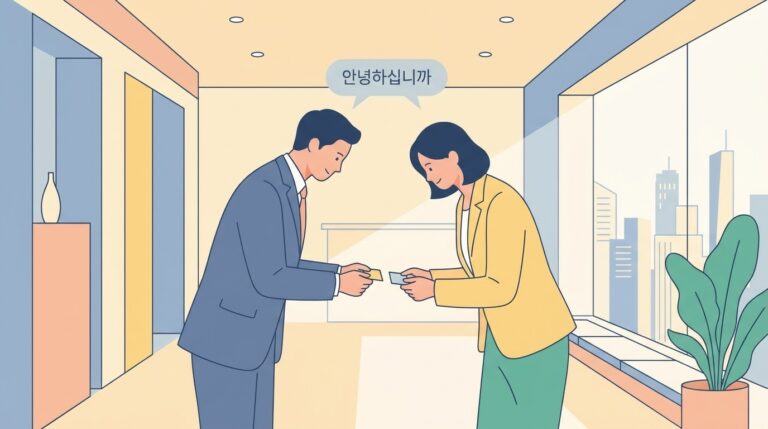
The Nuance Trap: Mastering Korean Titles and Honorific Addressing Like a True Insider
Phase 1: Empathy & Narrative Opening
안녕하세요! 매일한글 에디터입니다.
Imagine this scenario: You are standing inside a sunlit, panoramic conference room on the 32nd floor of a glass tower in Teheran-ro, Gangnam. You have prepared your cross-border strategy presentation for weeks. Your slides are pristine, your industry data is airtight, and your Korean pronunciation is remarkably smooth. As the client’s managing director nods approvingly, you decide to close the distance and build immediate rapport. With a warm smile, you look straight at him and say: “김 팀장, 좋은 의견 고마워요!” (Kim timjang, joeun uigyeon gomawoyo! / Thanks for the great feedback, Team Leader Kim!).
In less than a second, the room temperature plummets below zero. The managing director blinks in quiet astonishment. Your Korean colleagues freeze, their eyes darting to their notepads in sheer sociopragmatic agony. You used his official title, you acknowledged his input, and you spoke polite Korean—or so you thought. What happened? By dropping the essential honorific suffix -님 (-nim) and using informal polite verb endings (고마워요 instead of 감사드립니다), you inadvertently sounded like a 65-year-old chairman reprimanding a rookie intern.
At the C2 level, foreign learners rarely stumble over syntax or basic vocabulary; instead, they navigate the treacherous, high-stakes minefield of Korean interpersonal dynamics. Here, titles (직함 / jikham) and terms of address (호칭 / hoching) do not simply convey professional utility—they encode corporate hierarchy, mutual face-saving (체면 / chemyeon), institutional solidarity, and situational nunchi. Based on real coaching feedback from C-suite global executives and multinational strategists working in Seoul, this guide unpacks the sociolinguistic mechanics of Korean addressing systems so you never suffer an unintentional professional misstep again.
Phase 2: Core Expressions Deep Dive
+---------------------------------------------------------------------------------------------------+
|                                 CORE HONORIFIC ADDRESS ARCHITECTURE                                |
|                                                                                                   |
|   [Surname / Full Name]  +  [Organizational Title / 직급]  +  [Honorific Suffix / -님]            |
|           이 (Lee)       +        팀장 (Team Leader)       +         님 (Nim)       = 이 팀장님    |
+---------------------------------------------------------------------------------------------------+
1. 직함 + 님 (Jikham + nim) — Corporate Title with Inherent Honorific
- Pronunciation: [Jik-ham-nim] (Think of the word “nimble” stripped down to a crisp, resonant “nim”)
- Meaning: Literal: “[Title] Honored Person” | Nuance: The absolute baseline of corporate respect and standard protocol when addressing superiors or equals across Korean business ecosystems.
- K-Culture Moment: In the classic corporate drama Misaeng: Incomplete Life (미생), intern Jang Geu-rae never simply addresses his immediate superior as “오상식” (Oh Sang-sik); it is relentlessly and rhythmically punctuated as “오 과장님” (Oh gwajangnim / Manager Oh) or “차장님” (Chajangnim) to affirm their structural relationship.
- Editor’s Insight: Omitting the -님 (-nim) when speaking directly to a superior turns your statement into a condescending downward appraisal. You only drop -님 when discussing an in-group subordinate to an out-group external client, or when an executive addresses their lower-tier staff.
- Situation Spectrum:
- Casual: 🚫 (Sounds absurdly bureaucratic among intimate friends)
- Semi-formal: ✅
- Formal: ✅
- 🤔 Think About It: In English, calling your boss “Tim” signals approachability and flat organizational efficiency. In Korea, why does removing someone’s professional title strip away their hard-earned social identity?
2. 성명 + 프로님 / 매니저님 (Seongmyeong + Peuronim / Maenijeonim) — The Horizontal Hybrid Title
- Pronunciation: [Peu-ro-nim] / [Mae-ni-jeo-nim] (Phonetically resembles “Pro-neem” and “Manager-neem”)
- Meaning: Literal: “Professional [Name]” / “Manager [Name]” | Nuance: The modern tech and conglomerate response to rigid hierarchy. Adopted by giants like Samsung, CJ, and Kakao to foster agile communication while preserving Korean honorific safety.
- K-Culture Moment: In modern startup media like the K-Drama Start-Up (스타트업) or tech documentaries set in Pangyo Techno Valley, you rarely hear militaristic titles like 부장님 (Bujangnim / Department Head). Instead, peers address each other as “도산 프로님” (Dosan peuronim) or “달미 매니저님” (Dalmi maenijeonim).
- Editor’s Insight: Even in companies advertising a “flat culture” (수평적 문화), never make the rookie mistake of dropping the -님. Calling a senior colleague just “민수 프로” without the honorific suffix instantly marks you as culturally tone-deaf.
- Situation Spectrum:
- Casual: ⚠️ (Acceptable if teasing work colleagues after hours)
- Semi-formal: ✅
- Formal: ✅
- 🤔 Think About It: How does attaching an egalitarian title like “Pro” to an ancient honorific suffix like “-nim” reflect modern Korea’s struggle between global Silicon Valley ideals and foundational Confucian values?
3. 직함 + 께 여쭙다 (Jikham-kke yeojjupda) — Humble Deferential Inquiries
- Pronunciation: [Jik-ham-kke yeo-jju-op-da] (Crisp double consonant ‘kk’ followed by an introspective ‘yeo-jjup’)
- Meaning: Literal: “To humbly inquire unto [Title]” | Nuance: The pinnacle of C2-level professional deference, replacing the basic 물어보다 (mureoboda / to ask) with the humble honorific verb 여쭙다.
- K-Culture Moment: Watch political or business dramas like Queen of Tears or Reborn Rich. When a top-tier executive approaches a group chairman, they never say “상무님한테 물어볼게요”. They glide smoothly into: “이 사안은 부회장님께 먼저 여쭙는 것이 순서인 듯합니다.” (I saaneun buhoejangnim-kke meonjeo yeojjjupneun geosi sunseoin deuthamnida / It seems appropriate to first consult the Vice Chairman on this matter.)
- Editor’s Insight: Pairing the correct title with substandard grammar nullifies your politeness. Using the particle -께 (-kke) instead of -한테 (-hante) or -에게 (-ege) elevates your speech to board-level precision.
- Situation Spectrum:
- Casual: 🚫
- Semi-formal: ⚠️ (Can sound overly dramatic for ordering lunch)
- Formal: ✅
- 🤔 Think About It: Notice how the speaker humbles their own action (여쭙다) rather than simply elevating the listener. What does this reveal about the reciprocal nature of Korean social status?
Phase 3: Textbook Korean vs. Real Native Korean
Scenario 1: Clarifying an Unfamiliar Superior’s Rank During a Cross-Functional Meeting
- 📖 교과서 한국어 (Textbook Korean):
- 당신의 직급이 무엇입니까?
- (Dangsin-ui jikgeubi mueosimnikka? / What is your rank?)
- 🗣️ 진짜 한국어 (Real Native Korean – C2 Professional):
- 실례지만, 제가 결례를 범하지 않도록 직함을 어떻게 불러드리면 편하실지 여쭤봐도 되겠습니까?
- (Sillyejiman, jega gyeollyereul beomhaji antorok jikhameul eotteoke bulleodeurimyeon pyeonhasilji yeojjwo-bwado doegesseumnikka? / Excuse me, but to ensure I do not commit a faux pas, may I ask how you would prefer to be addressed?)
- 💡 왜 다를까? (Socio-Cultural Context):
Using 당신 (dangsin) in a professional setting is catastrophic—it is either an intimate pronoun between married couples or a confrontational trigger right before a street altercation. Native Korean professionals avoid the second-person pronoun entirely, utilizing self-deprecating circumlocutions to ask for the other party’s preferred designation.
Scenario 2: Referring to Your Own Company’s Director When Speaking to an External Client
- 📖 교과서 한국어 (Textbook Korean):
- 우리 최 부장님께서 제안서를 보내셨습니다.
- (Uri Choe bujangnim-kkeseo jean-seoreul bonaesyeosseumnida. / Our Department Head Mr. Choi sent the proposal.)
- 🗣️ 진짜 한국어 (Real Native Korean – C2 Professional):
- 저희 부서 담당자인 최민수 부장이 전달해 드린 제안서 내용 검토 부탁드립니다.
- (Jeohui buseo damdangjain Choe Minsu bujang-i jeondalhae deurin jeanseo naeyong geomto butakdeurimnida. / Please review the proposal delivered by Department Head Minsu Choi from our team.)
- 💡 왜 다를까? (Socio-Cultural Context):
This illustrates the classic principle of 압존법 (Apgjonbeop) and corporate out-group etiquette. When speaking to an external client, the client is the ultimate party of honor. Therefore, elevating your own internal boss with honorific markers like -님 or -께서 in front of an external partner violates business boundaries. Instead, you use the humble collective 저희 (jeohui) and drop the -님 from your boss’s title.
Phase 4: K-Culture Deep Dive & Non-Verbal Manners
+---------------------------------------------------------------------------------------------------+
|                             NON-VERBAL PROTOCOL: THE BUSINESS CARD RITE                           |
|                                                                                                   |
|   [Two Hands Supporting Card]  --->  [Slight 15° Bow]  --->  [Study Title for 3-5 Seconds]        |
|       Do NOT put it away!      ---> Keep on table at top-left of your meeting notebook.            |
+---------------------------------------------------------------------------------------------------+
4-1. 눈치 (Nunchi) & The Physical Choreography of Addressing
In Korea, language does not operate in an acoustic vacuum. When exchanging business cards (명함 / myeongham) at the start of a meeting:
1. The Double-Handed Hand-off: Hold the card with both hands, thumbs securing the corners without covering your name or company logo. Accompany this with a crisp, reverent 15-degree head bow.
2. The 5-Second Title Gaze: Never slide a received business card straight into your pocket or wallet. Doing so suggests you disregard the person’s professional rank and social personhood. Study the card for three to five seconds, visually registering their official title (직위 / 직책).
3. Acoustic Confirmation: Look up, make respectful eye contact, and verbally confirm their title: “아, 전략기획실의 박 상무님이시군요. 말씀 많이 들었습니다.” (Ah, you are Managing Director Park from the Strategic Planning Division. I have heard great things). Place the card visibly on the table beside your notepad for the duration of the meeting.
4-2. Cultural Code Analysis: The Structural Shift of Corporate Korea
Traditional corporate Korea inherited a quasi-military hierarchy from 20th-century developmental capitalism: 사원 (Associate) → 대리 (Assistant Manager) → 과장 (Manager) → 차장 (Senior Manager) → 부장 (Department Head) → 이사/상무/전무 (Directors/VPs) → 사장 (President). Each step is tied to seniority, age, and institutional gravity.
However, the contemporary workplace is navigating an unprecedented linguistic schism. Modern conglomerates like SK, CJ, and tech conglomerates operating out of Pangyo have replaced this ladder with unified suffixes like ~님 or English corporate monikers (e.g., calling an executive “Brian님”). Yet, beneath this seemingly democratic veneer, the underlying social fabric remains intensely honorific-sensitive. Even when using an English name, dropping the -님 suffix or failing to employ polite verbal morphology (하십시오체 / 해요체) will disrupt workplace harmony. Cultural agility means understanding the form changes, but the duty of mutual deference remains immutable.
Phase 5: Real-Life Roleplay Scenario
Setting: A sleek conference room overlooking the Han River in Yeouido. A high-stakes collaborative workshop between a Silicon Valley strategic consultancy and a top-tier Korean asset management firm.
Characters:
* Alex (You): Senior Strategy Consultant representing the international advisory team.
* Director Min-soo Choi (최민수 상무 / Choe Minsu Sangmu): Veteran Managing Director of the Korean firm; pragmatic, sharp, and values professional decorum.
[Yeouido Corporate Boardroom: Coffee steam rising, projectors displaying quarterly valuations]
- Turn 1 (Alex):
- 최 상무님, 바쁘신 일정 중에도 귀한 시간 내어 주셔서 진심으로 감사드립니다.
- (Choe sangmunim, bappeusin iljeong jung-edo gwihan sigan naeeo jusyeoseo jinsimeuro gamsadeurimnida.)
- “Managing Director Choi, thank you very much for sparing your valuable time despite your demanding schedule.”
🎭 [Both hands rested neatly on the conference table, maintaining an engaged, upright posture]
- Turn 2 (Director Choi):
- 별말씀을요, 알렉스 팀장님. 이번 글로벌 포트폴리오 다각화 건은 저희 이사회에서도 관심이 지대합니다. 준비하신 초안을 보시지요.
- (Byeolmalsseumeullyo, Allekkseu timjangnim. Ibeon geullobeol poteupolrio dagakhwa geoneun jeohui isa-hoe-eseodo gwansimi jidaehamnida. Junbihasin choaneul bosijiyo.)
- “Not at all, Team Lead Alex. Our board of directors is exceptionally keen on this global portfolio diversification project. Let us look at your draft.”
🎭 [Gestures toward the projection screen while maintaining a measured, calm expression]
- Turn 3 (Alex):
- 네, 상무님. 저희 분석팀에서 최근 거시경제 변동성을 반영하여 세 가지 시나리오를 구성해 보았습니다.
- (Ne, sangmunim. Jeohui bunseoktim-eseo choegeun geosigyeongje byeondongseong-eul banyeonghayeo se gaji sinarioreul guseonghae boatseumnida.)
- “Yes, Director Choi. Our analytics team has formulated three potential scenarios reflecting recent macroeconomic volatility.”
🎭 [Clicks to slide 4, pointing with an open palm rather than an index finger]
- Turn 4 (Director Choi):
- 흠, 2번 시나리오의 환율 리스크 헤징 모델이 다소 공격적으로 설정된 것 같은데요? 우리 리스크관리팀 기준치와는 괴리가 있어 보입니다.
- (Heum, ibeon sinario-ui hwanyul riseukeu hejing modeli daso gonggyeokjeog-euro seoljeongdoen geot gateundeyo? Uri riseukeugwanlitim gijunchiwaneun goeriga isseo boimnida.)
- “Hmm, the currency risk hedging model in Scenario 2 appears somewhat aggressively configured. It seems divergent from our risk management department’s benchmark.”
🎭 [Folds his hands, leaning back slightly with an analytical, questioning gaze]
- Turn 5 (Alex):
- 그 부분에 대해 말씀 올리겠습니다. 단기적인 변동 폭은 클 수 있으나, 파생상품 포지션을 통해 손실 상쇄가 가능하도록 설계했습니다.
- (Geu bubune daehae malsseum olligesseumnida. Dangijeogin byeondong pogeun keul su isseuna, pasaengsangpum pojisyeoneul tonghae sonsil sangswaega ganeunghadorok seolgyehaetseumnida.)
- “Allow me to address that point. While short-term volatility might be elevated, it has been designed to offset losses through derivative positions.”
🎭 [Speaks with calm confidence, softening the disagreement with humble speech forms]
- Turn 6 (Director Choi):
- 일리가 있군요. 그렇다면 이 세부 모델링을 다음 주 전략기획 회의 때 대표이사님께도 직접 설명해 주실 수 있겠습니까?
- (Illiga itgunyo. Geureotamyeon i sebu modeling-eul daeum ju jeonlyakgihoek hoeui ttae daepyo-isanim-kkedo jikjeop seolmyeonghae jusil su itgesseumnikka?)
- “That makes sense. In that case, would you be able to present this detailed modeling directly to our CEO during next week’s strategic planning session?”
🎭 [Nods slowly, acknowledging the rigorous methodology]
- Turn 7 (Alex):
- 영광입니다. 대표이사님과 임원진 분들께서 명확히 판단을 내리실 수 있도록 보완 자료를 철저히 구비해 두겠습니다.
- (Yeong-gwang-imnida. Daepyo-isanim-gwa imwonjin bundeulkkeseo myeonghwakhi pandaneul naerisil su itdorok bowan jaryoreul cheoljeohi gubihae dugesseumnida.)
- “It would be a privilege. We will thoroughly prepare supplementary materials to ensure the CEO and executive board have absolute clarity for decision-making.”
🎭 [Incline torso slightly forward to signal readiness and unwavering dedication]
- Turn 8 (Director Choi):
- 좋습니다. 그럼 오늘 논의된 수정 사항을 반영하여 내일 퇴근 전까지 공유 부탁드립니다. 고생 많으셨습니다, 알렉스 팀장님.
- (Joeusseumnida. Geureom oneul nonuidoen sujeong sahangeul banyeonghayeo naeil toegeun jeonkkaji gong-yu butakdeurimnida. Gosaeng maneusyeotseumnida, Allekkseu timjangnim.)
- “Excellent. Please reflect the adjustments discussed today and share them by the end of the day tomorrow. Exceptional work, Team Lead Alex.”
🎭 [Extends a hand for a handshake, supported underneath by his left wrist]
🔀 Interactive Branching Point
During Turn 5, Director Choi questioned your risk hedging calculations. If you wanted to pause the presentation to verify his team’s specific internal risk metrics, what would you say?
- Choice A: “민수 씨, 그 기준치가 정확히 어떻게 되나요? 다시 검토해 보죠.” (Min-soo ssi, what are those benchmarks exactly? Let’s review it.)
- Choice B: “상무님, 실례가 되지 않는다면 리스크관리팀의 내부 기준 지표를 저희가 먼저 확인해 봐도 되겠습니까?” (Director Choi, if it is not an imposition, may we first review your risk management team’s internal benchmark indicators?)
- Choice C: “당신 팀의 기준치가 무엇인지 지금 말씀해 주세요.” (Tell me right now what your team’s benchmarks are.)
+---------------------------------------------------------------------------------------------------+
|                                    BRANCHING FEEDBACK ANALYSIS                                    |
+---------------------------------------------------------------------------------------------------+
| Choice A [HIGH RISK]: Addressing a Managing Director as '~씨' completely obliterates professional |
| etiquette. '~씨' is only used between peers of equal age or downward to juniors.                 |
|                                                                                                   |
| Choice B [BEST]: Flawless. Uses '상무님', hedges politely with '실례가 되지 않는다면', and retains  |
| deferential inquiry forms ('-여쭤봐도/확인해 봐도 되겠습니까').                                    |
|                                                                                                   |
| Choice C [CATASTROPHIC]: Uses '당신' and a harsh imperative. This will terminate the contract.    |
+---------------------------------------------------------------------------------------------------+
Phase 6: 10-Second Emotion Shadowing Drill
Practice reading these sentences aloud, pausing precisely at the / marks and channeling the emotional indicators.
[💼 Professional Deference & Poise]- 최 상무님, / 바쁘신 일정 중에도 / 귀한 시간 내어 주셔서 / 진심으로 감사드립니다.
- (Choe sangmunim, / bappeusin iljeong jung-edo / gwihan sigan naeeo jusyeoseo / jinsimeuro gamsadeurimnida.)
[🤝 Strategic Humility in Disagreement]- 그 부분에 대해 / 말씀 올리겠습니다. / 단기 변동 폭은 클 수 있으나, / 리스크 헤징 모델을 통해 / 충분히 보완 가능합니다.
- (Geu bubune daehae / malsseum olligesseumnida. / Dangi byeondong pogeun keul su isseuna, / riseukeu hejing modereul tonghae / chungbunhi bowan ganeunghamnida.)
[🎯 Decisive Executive Commitment]- 대표이사님과 / 임원진 분들께서 / 명확히 판단을 내리실 수 있도록, / 보완 자료를 / 철저히 준비하겠습니다.
- (Daepyo-isanim-gwa / imwonjin bundeulkkeseo / myeonghwakhi pandaneul naerisil su itdorok, / bowan jaryoreul / cheoljeohi junbihaegesseumnida.)
Phase 7: K-Culture Mini Dictionary
- 압존법 (Apgjonbeop): The traditional grammatical doctrine wherein an individual lowers a superior when speaking to an even higher-ranking superior (e.g., traditionally not using -님 for your manager when speaking to the CEO). While relaxing in daily speech, it remains a structural undercurrent in business communication.
- 수평적 호칭 (Supyeongjeok hoching): Contemporary “horizontal addressing systems” where corporations substitute hierarchical titles with unifiers like 매니저님 (Manager-nim) or English personal names + 님.
- 체면 (Chemyeon): Social face, dignity, and external honor. Misusing someone’s title in front of their colleagues or clients destroys chemyeon, inflicting reputational damage far beyond the immediate conversation.
- 존칭 접미사 ‘-님’ (Jonching jeommisa ‘-nim’): The quintessential Korean honorific suffix attached to professions, kinship, and organizational titles to transform an objective functional label into an act of social reverence.
Phase 8: Expat & Traveler Survival Kit
+---------------------------------------------------------------------------------------------------+
|                                 EVERYDAY STREET & SERVICE SURVIVAL                                 |
+---------------------------------------------------------------------------------------------------+
|  1. 사장님! (Sajangnim!)      --> For shopkeepers, taxi drivers, restaurant owners.               |
|  2. 기사님! (Gisanim!)        --> For bus, delivery, and taxi drivers specifically.               |
|  3. 선생님! (Seonsaengnim!)   --> For older strangers when asking for directions respectfully.    |
+---------------------------------------------------------------------------------------------------+
- Top 3 Everyday Honorific Hacks:
- “사장님, 주문할게요!” (Sajangnim, jumunhalgeyo! / Boss/Owner, we’re ready to order!)
- Pro Tip: Never shout “저기요!” at upscale dining establishments. Using 사장님 instantly elevates the interaction and often unlocks bonus side dishes (서비스 / seobiseu).
- “기사님, 시청역 앞에서 내려주시겠어요?” (Gisanim, Sicheong-yeok ap-eseo naeryeojusigesseoyo? / Driver, could you drop me off in front of City Hall Station?)
- Pro Tip: Addresses public transit and taxi operators with deep professional dignity.
- “선생님, 실례지만 길 좀 여쭤봐도 될까요?” (Seonsaengnim, sillyejiman gil jom yeojjwo-bwado doelkkayo? / Teacher/Elder, excuse me, may I ask you for directions?)
- Pro Tip: When an older Korean citizen is not your relative, 선생님 (Teacher) is the most elegant, non-intrusive way to initiate dialogue.
- Editor’s Travel & Tech Note:
When maneuvering through business districts like Pangyo Valley or Yeouido, download the [스마트 네이버 지도 앱 설치 및 활용 가이드] to effortlessly locate corporate tower entrances and underground arcades where business lunches transpire.
Phase 9: “One Step Deeper” (Sociolinguistic Essay)
In Western linguistic structures, identity is fundamentally atomic and absolute: an individual exists with an autonomous name, irrespective of whom they face. Korean, by contrast, perceives identity as inherently relational and contextual. You are never merely an individual operating in a void; you are an older brother (형), a departmental senior (선배), a managing director (상무님), or a customer (손님).
When you use an incorrect title in Korea, you do not just commit a grammatical error—you momentarily dismantle the relational matrix that preserves interpersonal order and collective safety. Korean honorifics are not tools of subjugation; they are an intricate social armor. By granting someone their precise title and honorific altitude, you subtly establish your own sophistication, demonstrating that you possess the cultivated discernment to perceive the complex societal lattice around you.
💬 Your Turn: Have you ever experienced an awkward encounter in Korea or while speaking Korean where titles created unexpected tension? Share your story in the comments below—let’s dissect the nunchi dynamics together!
Phase 10: FAQ & Avoiding Misunderstandings
Q: Can I use “~씨” (~ssi) when speaking to my colleagues if we are the same age?
A: Be exceptionally careful. While textbook materials often introduce ~씨 (e.g., 민수 씨) as a general polite marker, in corporate contexts it denotes equal or lower hierarchical standing. Using ~씨 toward anyone of higher rank—or even an older junior colleague—is perceived as passive-aggressive or condescending. Unless explicitly invited to use ~씨, default to [Title + 님] or [Full Name + 직함 + 님].
Q: Why do people get offended if I call them “당신” (Dangsin)? Isn’t it just “You”?
A: 당신 is one of the most misunderstood words in the Korean language. While it functions as a poetic second-person pronoun in literature or a term of endearment between middle-aged married couples, using it toward a colleague or stranger in daily life implies: “You, whom I have no obligation to respect.” It is the quintessential word spoken right before people exchange blows in a dispute. Never use it in business.
Q: What should I call my female supervisor? Can I use “언니” (Eonni) or “누나” (Nuna) if we get close?
A: Absolute red line: Never import kinship terms (오빠, 형, 누나, 언니) into the office, even if you regularly drink together after work. Doing so compromises professional boundaries and makes other team members deeply uncomfortable. Maintain [Title + 님] within corporate walls; save casual kinship titles exclusively for private personal spaces if explicitly agreed upon.
+---------------------------------------------------------------------------------------------------+
|                               🚨 COMMON MISTAKES & INSTANT FIXES                                  |
+---------------------------------------------------------------------------------------------------+
| 1. Calling your boss by surname only: "김, 이것 좀 보세요." (Kim, look at this.)                  |
|    --> Correct Action: Always append title and honorific: "김 부장님, 이것 확인 부탁드립니다."       |
|                                                                                                   |
| 2. Self-elevating with '-님': "저는 글로벌 마케팅 팀장님이신 알렉스입니다."                        |
|    --> Correct Action: Never attach -님 to yourself! "저는 글로벌 마케팅 팀장 알렉스입니다."       |
|                                                                                                   |
| 3. Over-honoring objects: "커피가 나오셨습니다." (The coffee has arrived [honoring coffee]).     |
|    --> Correct Action: Honor the person, not the beverage: "주문하신 커피 나왔습니다."              |
+---------------------------------------------------------------------------------------------------+
Phase 11: Action Mission & Participation
- 🥉 Bronze Level (Solo Muscle Memory):
Stand in front of a mirror with a business card in both hands. Practice introducing yourself and confirming the other party’s fictional title (“아, 이사님, 처음 뵙겠습니다”) 10 times until your vocal pitch remains level and calm. -
🥈 Silver Level (Observation & Social Tagging):
Watch an episode of an office-themed K-Drama (e.g., Agency, Misaeng, or Search: WWW). Note down three distinct moments where a subordinate switches registers when an external client enters the room. Share your observations on social media with the tag#DailyHangulNuance. -
🥇 Gold Level (Real-World Application):
In your next real business exchange, email correspondence, or dining experience in Korea, bypass generic greetings and employ an intentional title (e.g., 대표님, 사장님, or 담당자님) coupled with humble verb phrasing. -
🎮 K-Culture Mission:
Listen to the lyrics of contemporary K-Pop songs or dialogue snippets in historical K-Dramas (사극 / Sageuk). Can you spot where the word “그대” (Geudae) is used instead of “당신”? Notice why poetic addressing differs fundamentally from modern workplace realities!
Phase 12: Interactive Quiz Challenge
Test your C2-level intuition with these situational puzzles.
1. Situational Judgment
You are in a strategic business meeting with an external vendor. The vendor asks you where your company’s Chief Executive Officer (대표이사) is. Which response represents the most sophisticated corporate decorum?
- A) 우리 대표이사님은 지금 바쁘셔서 못 오셨습니다.
- B) 저희 대표이사님께서는 다른 일정으로 참석이 어려우십니다.
- C) 저희 대표는 현재 해외 출장 중이라 이번 회의에는 참석하지 못했습니다.
- D) 당신의 사장님께 먼저 말씀드리겠습니다.
2. Fill-in-the-Blank
Fill in the blank with the appropriate humble verb and particles to achieve C2-level corporate deference:
* “제가 이 프로젝트의 최종 예산안과 관련하여 다음 주 월요일에 상무님( ) 직접 ( )도 되겠습니까?”
3. True / False Cultural Insight
- Statement: When an enterprise introduces a “horizontal culture” and adopts English nicknames (e.g., “Dave”), it is culturally acceptable to address Dave without any honorific particle, even if he is the 55-year-old Executive Vice President.
- [ True / False ]
👉 Click to reveal answers & deep explanations
Answers & Linguistic Analysis
- Answer: C
- Deep Explanation: When communicating with external organizations, classic corporate humility dictates that you do not over-elevate your internal executive in front of external clients (압존법 principles applied to corporate entities). Option C utilizes the humble group descriptor 저희 (jeohui) and refers to the CEO by their objective functional title 대표 (daepyo) without the self-elevating suffix -님 or subject marker -께서. Options A and B mistakenly elevate your own executive over the client, while Option D dangerously deploys 당신.
- Answer: -께 / 여쭈어봐도 (or 말씀 올려도)
- Deep Explanation: The sentence requires the reverent dative particle -께 (-kke) to replace ~한테, and the humble deferential verb 여쭙다 (yeojjupda) or 말씀 올리다 (malsseum ollida) instead of 물어보다.
- Answer: FALSE
- Deep Explanation: Even in companies implementing English names or horizontal structures, corporate Korea virtually always appends -님 to the moniker (e.g., “Dave님”). Dropping the honorific entirely disregards Korean cultural etiquette and generates unnecessary friction.
- Deep Explanation: Even in companies implementing English names or horizontal structures, corporate Korea virtually always appends -님 to the moniker (e.g., “Dave님”). Dropping the honorific entirely disregards Korean cultural etiquette and generates unnecessary friction.
Keep your honorific ears open, your nunchi sharp, and your business cards held high with both hands! 다음 레슨에서 만나요!







