

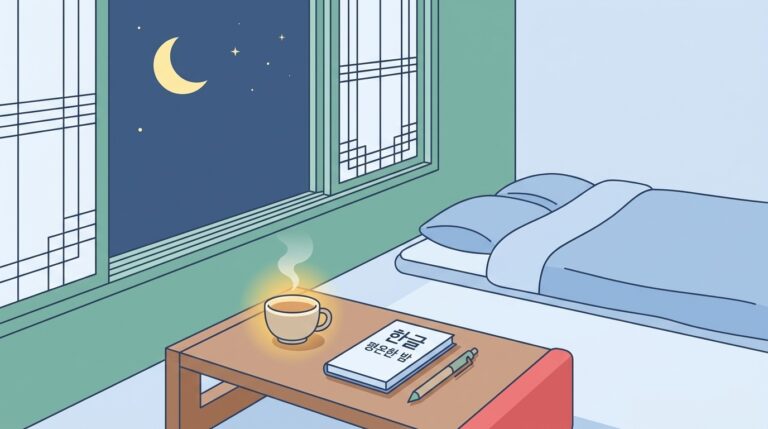
Phase 1: 공감 (Story-driven Opening)
안녕하세요! 매일한글 에디터입니다.
Imagine this scenario straight out of a melancholic night sequence in an acclaimed K-Drama like Daily Dose of Sunshine (정신병동에도 아침이 와요) or Doctor Slump (닥터슬럼프). You are lying flat on your bed in the quiet hours of 3:00 AM. Outside your window, the distant hum of Seoul’s Olympic Expressway blends into the dim red glow of rooftop neon crosses. Your physical body is exhausted from navigating a high-pressure workday, studying intense Korean grammar, or managing life abroad. Yet, the moment your head touches the pillow, your brain refuses to switch off. You toss, turn, stare at the digital clock on your phone, and dread the morning alarm.
Dealing with sleep disorders in a foreign country is profoundly unsettling. When you try to convey your agony, simple textbook phrases like “잠을 못 잤어요” (I didn’t sleep) fail to capture the suffocating sensation of acute insomnia, midnight racing thoughts, or your reluctance to depend on heavy sleeping pills. As a C1-level learner, you need the sophisticated linguistic toolkit to converse with Korean psychiatrists (정신건강의학과 전문의), articulate precise sleep patterns to local pharmacists, and discuss mental wellness without feeling misunderstood. This guide is crafted directly from real clinical consultation scripts, psychiatric clinical counseling cases in Seoul, and expatriate survival feedback. Let’s explore the genuine linguistic nuances of sleep and mental recovery in Korea.
Phase 2: 핵심 표현 3선 심층 분석 (Top 3 Core Expressions)
1. 밤새 뒤척이다가 뜬눈으로 밤을 지새웠어요. (Bamsae dwicheogidaga tteunnuneuro bameul jisaewosseoyo.)
- Pronunciation: [Bamsae dwicheogidaga tteunnuneuro bameul jisaewosseoyo] (Think of the sound: bahm-seh dwi-cheok-ee-dah-gah tteun-noon-eu-ro bahm-eul jee-seh-woh-ssoe-yo. The dwi-cheok mimics the physical rustling friction of bedsheets!)
- Meaning:
- Literal: Having tossed and turned all night, I spent the night with open, floating eyes.
- Actual Nuance: Expresses pure, restless insomnia where physical agitation meets severe cognitive exhaustion. It indicates that you didn’t catch even a few minutes of restful REM sleep.
- K-Culture Moment: Often uttered by sleep-deprived characters in K-dramas arriving at work, holding an iced Americano like a lifeline while recounting a brutal night of overthinking.
- Editor’s Insight: Notice the poetic yet raw phrase “뜬눈으로 밤을 지새우다.” “뜬눈” literally means unclosed, alert eyes. Using this instead of simply “잠을 안 잤어요” demonstrates native-level descriptive empathy and depth.
- Situation Spectrum:
- Casual: ✅ (밤새 뒤척이다가 뜬눈으로 밤 지새웠어)
- Semi-formal: ✅ (밤새 뒤척이다가 뜬눈으로 밤을 지새웠어요)
- Formal: ✅ (밤새 뒤척이다가 뜬눈으로 밤을 지새웠습니다)
- 🤔 Think About It: In English, we often say “I didn’t sleep a wink.” Korean instead evokes a vivid visual image of keeping the eyes suspended wide open (tteunnun) while actively bearing the passing night. How does this image shift the experience of insomnia from passive absence to active endurance?
2. 수면 리듬이 완전히 깨져서 일상생활에 지장이 커요. (Sumyeon rideumi wanjeonhi kkaejyeoseo ilsangsaenghware jijangi keoyo.)
- Pronunciation: [Sumyeon rideumi wanjeonhi kkaejyeoseo ilsangsaenghware jijangi keoyo] (Smooth clinical flow: soo-myeon ree-deum-ee wahn-jeon-hee kkeh-jyeo-seo eel-sahng-seng-hwah-reh jee-jahng-ee kuh-yo.)
- Meaning:
- Literal: My sleep rhythm is completely broken, so the hindrance to daily life is large.
- Actual Nuance: “My circadian rhythm has completely collapsed, causing serious impairment in my day-to-day functional routine.”
- K-Culture Moment: The quintessential statement delivered by white-collar workers or university students sitting across from a physician at a university hospital sleep clinic.
- Editor’s Insight: At a C1 level, replacing “힘들어요” (it is hard) with “일상생활에 지장이 커요” instantly shifts your communication into an objective, clinically diagnostic tone. Korean doctors prioritize determining whether your condition constitutes clinical impairment (지장).
- Situation Spectrum:
- Casual: ⚠️ (Sounds overly formal/clinical among close peers unless used humorously)
- Semi-formal: ✅ (수면 리듬이 완전히 깨져서 일상생활에 지장이 커요)
- Formal: ✅ (수면 리듬이 완전히 붕괴되어 일상생활에 지장이 큽니다)
- 🤔 Think About It: Korean culture places immense focus on functional productivity and communal contribution. Why might Korean medical diagnostics emphasize “hindrance to daily life” (지장) as the primary benchmark for prescribing targeted treatment?
3. 의존성이나 내성이 생길까 봐 수면제 복용이 망설여져요. (Uijonseong-ina naeseong-i saenggilkka bwa sumyeonje bogyong-i mangseoryeojyeoyo.)
- Pronunciation: [Uijonseong-ina naeseong-i saenggilkka bwa sumyeonje bogyong-i mangseoryeojyeoyo] (wee-jon-seong-ee-nah neh-seong-ee seng-geel-kkah bwah soo-myeon-jeh boh-gyong-ee mahng-suh-ryeo-jyeo-yo.)
- Meaning:
- Literal: Worrying that dependency or tolerance will form, my intake of sleeping pills is hesitated.
- Actual Nuance: “I am quite hesitant to take sleeping medication because I’m genuinely worried about developing physical tolerance or psychological dependence.”
- K-Culture Moment: A reflective counseling scene in a medical drama where a protagonist refuses sedation until the doctor reassuringly explains the difference between modern z-drugs, sleep inducers, and cognitive behavioral therapy.
- Editor’s Insight: Korean distinguishes clearly between “수면유도제” (sleep inducers, often OTC antihistamine derivatives like doxylamine or diphenhydramine) and “수면제” (prescription hypnotics/sedatives like Zolpidem). Knowing this prevents misunderstandings at the pharmacy.
- Situation Spectrum:
- Casual: ✅ (의존성 생길까 봐 수면제 먹기 좀 망설여져)
- Semi-formal: ✅ (의존성이나 내성이 생길까 봐 수면제 복용이 망설여져요)
- Formal: ✅ (의존성 및 내성 발생에 대한 우려로 약물 복용을 망설이고 있습니다)
- 🤔 Think About It: Mental health medication has moved from an unspoken taboo to an active topic of modern self-care in urban Korea. How do people in your home country view sleep medication compared to holistic mental wellness?
Phase 3: 교과서 한국어 vs 진짜 한국어 (Textbook vs. Real Korean)
Situation 1: Describing morning brain fog and the paradox of insomnia to a friend
- 📖 교과서 한국어: 잠을 잘 못 자서 매우 피곤합니다. (Jameul jal mot jaseo maeu pigonhapnida. / I did not sleep well, so I am very tired.)
- 🗣️ 진짜 한국어: 머리는 깨질 것 같이 멍한데, 이상하게 밤만 되면 정신이 말똥말똥해져요. (Meorineun kkaejil geot gachi meonghande, isanghage bamman doemyeon jeongsini malttongmalttonghaejyeoyo. / My head feels foggy and split open from fatigue, but strangely, the moment night comes, my mind turns completely wide awake and alert.)
- 💡 왜 다를까?: Native speakers use sensory mimetic adverbs like “멍하다” (vacant, brain-fogged) and “말똥말똥하다” (wide-eyed and relentlessly alert) to communicate the exhausting paradox of circadian desynchronization.
Situation 2: Asking a doctor about tapering medication or exploring gentle therapies
- 📖 교과서 한국어: 약한 약으로 처방해 주세요. (Yakhan yageuro cheobanghae juseyo. / Please prescribe me weak medicine.)
- 🗣️ 진짜 한국어: 초기에는 서방형 제제나 의존성이 적은 비약물적 치료법부터 병행해 볼 수 있을까요? (Chogieneun seobanghyeong jejena uijonseongi jeogeun biyakmuljeok chiryobeobputeo byeonghaenghae bol su isseulkkayo? / In the beginning, could we combine an extended-release formulation with low-dependency, non-pharmacological therapies?)
- 💡 왜 다를까?: High-level Korean healthcare navigation demands precision. “약한 약” sounds childish in a psychiatric consultation; phrasing it as “서방형 제제” (extended-release formula) or “비약물적 치료” (non-pharmacological treatment) establishes intellectual rapport with the specialist.
Phase 4: K-Culture 딥다이브 & 비언어적 매너 (Deep Dive & Non-Verbal Manners)
4-1. 눈치(Nunchi) & Gestures in Korean Mental Healthcare
When entering a 정신건강의학과 (Department of Mental Health Clinic) in Korea, the clinic atmosphere is designed to be whisper-quiet, private, and discreet.
* Posture & Tone: Avoid overly theatrical complaints. Korean clinicians respond best to composed, chronological reporting accompanied by moderate vocal volume and slight, respectful head tilts. Maintain soft eye contact rather than an intense stare, which can be perceived as confrontational.
* The Sleep Diary Gesture: If you kept notes on your phone, do not wave your screen at the doctor. Instead, hold your smartphone with both hands, slightly lower your gaze, and ask: “수면 일지를 대략 적어왔는데, 혹시 참고가 되실까요?” (I roughly jotted down a sleep diary, could this be of reference?). This shows humility, high Nunchi, and therapeutic cooperation.
4-2. Culture Code Analysis: From “갓생 (God-saeng)” Burnout to Conscious Resting
South Korea’s modern generation coined the slang “갓생” (living a flawless, hyper-productive life like God). However, this relentless pursuit of self-optimization triggered an unprecedented epidemic of sleep-onset disorders. The cultural counter-movement has transformed Korean wellness: Hanok sound meditation, herbal tea (ssanghwa-cha and chamomile infusions), and specialized sleep tech clinics are booming in Gangnam and Pangyo. Insomnia is no longer viewed as personal weakness; it is recognized as a biological warning sign of chronic overstimulation. Knowing how to articulate this stress within Korean societal boundaries will dramatically deepen your relationships with Korean peers.
Phase 5: 실전 롤플레이 시나리오 (Real-World Roleplay Scenario)
- Setting: Dr. Park’s warm, wood-paneled psychiatric and sleep therapy clinic in Mapo-gu, Seoul.
- Characters: Dr. Park (박 원장님 – an attentive, empathetic specialist) and Alex (알렉스 – a foreign professional suffering from 2 months of chronic sleep deprivation).
턴 1 (Dr. Park): 알렉스 님, 어서 오세요. 지난주에 작성해 주신 문진표를 봤는데, 수면 문제로 일상에 지장이 많으시다고요. 구체적으로 어떤 상태이신가요? (Alex-nim, eoseo oseyo. Jinanju-e jakseonghae jusin munjinpyoreul bwanneunde, sumyeon munjero ilsang-e jijang-i maneusidagoyo. Guchejeogeuro eotteon sangtae-isinkayo?)
“Welcome, Alex. Looking at the preliminary questionnaire you filled out last week, it seems sleep issues are causing serious disruptions to your daily routine. What is the specific situation?” 🎭 [온화한 눈빛으로 모니터와 알렉스를 번갈아 바라보며]
턴 2 (Alex): 네, 원장님. 두 달 전부터 침대에 누우면 잡생각이 꼬리를 물어서 잠들기까지 서너 시간이 걸려요. (Ne, wonjangnim. Du dal jeonbuteo chimdae-e nuumyeon japsaenggagi kkorireul mureoseo jamdeulgikkaji seoneo sigani geollyeoyo.)
“Yes, Doctor. Starting about two months ago, whenever I lie down in bed, random anxious thoughts chase one another endlessly, taking three to four hours just to fall asleep.” 🎭 [초조한 듯 손가락을 가볍게 매만지며]
턴 3 (Dr. Park): 입면 장애가 뚜렷하신 상태군요. 새벽에 중간중간 깨는 일도 잦으신 편인가요? (Ipmyeon jang-aega tturyeothasin sangtaegunyo. Saebyeoge jungganjunggan kkaeneun ildo jajeusin pyeon-ingayo?)
“You are exhibiting distinct sleep-onset insomnia. Do you also frequently wake up in the middle of the dawn?” 🎭 [차분하게 메모를 적어 내려가며]
턴 4 (Alex): 네, 겨우 잠들어도 한두 시간 만에 눈이 번쩍 떠지고, 그 뒤로는 뜬눈으로 밤을 새우기 일쑤예요. (Ne, gyeou jamdeureodo handu sigan mane nuni beonjjeok tteojigo, geu dwironeun tteunnuneuro bameul sae-ugi ilssuyeyo.)
“Yes, even when I finally manage to sleep, my eyes pop wide open within an hour or two, and after that, I usually end up staying wide awake till morning.” 🎭 [피로가 묻어나는 목소리로 고개를 끄덕이며]
턴 5 (Dr. Park): 낮 동안 피로도와 집중력 저하가 상당하셨겠어요. 카페인 섭취량이나 스마트폰 사용 습관은 어떠세요? (Nat dong-an pirodowa jipjungnyeok jeohaga sangdanghasyeokgesseoyo. Kapein seopchwiryhang-ina seumateupon sayong seupgwaneun eotteoseyo?)
“The daytime fatigue and drop in concentration must have been severe. What are your caffeine intake and smartphone habits like?” 🎭 [공감하듯 고개를 끄덕이며]
턴 6 (Alex): 졸음을 쫓으려고 커피를 하루 네 잔씩 마시다 보니 악순환에 빠진 것 같아요. (Joreumeul jjochuryeogo keopireul haru ne janssik masida boni aksunhwane ppajin geot gatayo.)
“Because I drink about four cups of coffee a day to stave off sleepiness, I feel like I’ve fallen into a vicious cycle.” 🎭 [씁쓸하게 자조적인 미소를 지으며]
턴 7 (Dr. Park): 전형적인 각성 상태의 지속입니다. 단기적으로 멜라토닌 수용체 작용제나 수면유도 요법을 고려할 수 있는데, 약물 복용에 대한 생각은 어떠신가요? (Jeonhyeongjeogin gakseong sangtae-ui jisogimnida. Dangijeogeuro mellatonin suyongche jagyongjena sumyeon-yudo yobeobeul goryeohal su inneunde, yakmul bogyong-e daehan saenggakeun eotteosinkayo?)
“This is a classic continuation of a hyperarousal state. In the short term, we can consider melatonin receptor agonists or sleep induction therapy. What are your thoughts regarding medication?” 🎭 [안심시키듯 나긋나긋한 어조로]
턴 8 (Alex): 의존성이나 내성이 생길까 봐 걱정돼서, 가급적 비약물적 치료와 생활 습관 교정을 병행하고 싶어요. (Uijonseong-ina naeseong-i saenggilkka bwa geokjeongdwaeseo, gageupjeok biyakmuljeok chiryowa saenghwal seupgwan gyojeong-eul byeonghaenghago sipeoyo.)
“I am worried about developing dependency or tolerance, so if possible, I would like to combine non-pharmacological treatment with lifestyle habit correction.” 🎭 [진지하고 또렷한 어조로 자신의 의사를 밝히며]
🔀 인터랙티브 분기점 (Interactive Branching Point)
Doctor Park smiles understandingly and asks: “그럼 구체적으로 치료 계획을 어떻게 시작해 보고 싶으신가요?” (Then, specifically, how would you like to commence your treatment plan?) How should Alex respond?
- 선택지 A: “가장 강력한 수면제 한 달 치 바로 처방해 주세요. 당장 내일 출근해야 하거든요.” (Gajang gangnyeokhan sumyeonje han dal chi baro cheobanghae juseyo. Dangjang naeil chulgeunhaeya hageodeunyo. / Just prescribe me a month’s worth of the strongest sleeping pills. I have to go to work tomorrow.)
- 피드백 (Bad): ❌ Demanding high-potency sedatives immediately raises drug-seeking red flags under Korea’s strict psychiatric drug monitoring system (DUR – Drug Utilization Review). Doctors will refuse and conduct extensive psychological screening.
- 선택지 B: “우선 수면 위생을 교정하면서 의존성이 낮은 약제를 최소 용량으로 단기 처방받고 싶습니다.” (Useon sumyeon wisaeng-eul gyojeonghamyeonseo uijonseong-i najeun yakjereul choeso yongnyang-euro dangi cheobangbatgo sipsumnida. / First, while correcting my sleep hygiene, I would like a short-term prescription for low-dependency medication at the minimal dosage.)
- 피드백 (Best): 🌟 Flawless C1 phrasing! Demonstrates clinical literacy, balanced self-awareness, and cooperative patient behavior. Doctor Park can safely prescribe appropriate therapy.
- 선택지 C: “생각해 보니 병원 약은 겁나니까 그냥 참고 에너지 드링크로 버텨볼게요.” (Saenggakhae boni byeong-won yageun geomnanikka geunyang chamgo eneoji deuringkeuro beotyeobolgeyo. / On second thought, clinic medication scares me, so I’ll just bear with it and survive on energy drinks.)
- 피드백 (Risk): ⚠️ Passive avoidance will intensify autonomic nervous system dysregulation, worsening daytime panic and chronic insomnia.
Phase 6: 10초 감정 섀도잉 드릴 (Emotional Shadowing Drill)
Practice these high-frequency therapeutic sentences aloud. Match the tone markers and breath pauses (/).
[😮💨 극심한 피로와 답답함 - Overwhelmed Exhaustion]
침대에 누우면 / 잡생각이 꼬리를 물어서 / 도저히 잠들 수가 없어요.
(Chimde-e nuumyeon / japsaenggagi kkorireul mureoseo / dojeohi jamdeul suga eopseoyo.)
Pause after each slash, letting out a soft sigh on “잡생각이”.-
[🩺 신중하고 차분하게 - Calm, Prudent Medical Inquiry]
수면제에 전적으로 의존하기보다는 / 수면 위생을 개선하면서 / 서서히 수면 패턴을 되찾고 싶습니다.
(Sumyeonjee jeonjeog-euro uijonhagibodaneun / sumyeon wisaeng-eul gaeseonhamyeonseo / seoseohi sumyeon paeteoneul doechatgo sipsumnida.)
Deliver with clear articulation and stable cadence. -
[🥺 지푸라기라도 잡는 절박함 - Earnest Hope for Recovery]
낮에는 몽롱해서 일이 손에 안 잡히고 / 밤에는 각성 상태가 계속되는데 / 저 나아질 수 있을까요?
(Najeneun mongnonghaeseo iri sone an japhigo / bameneun gakseong sangtaega gyesokdoeneunde / jeo naajil su isseulkkayo?)
Slightly drop pitch on “손에 안 잡히고”, rising gently in the question ending “있을까요?”.
Phase 7: K-Culture 미니 사전 (Mini Dictionary)
- 수면 위생 (Sumyeon Wisaeng): Sleep Hygiene. In clinical Korean settings, this refers to standardized stimulus-control behaviors (e.g., dimming bedroom lights, removing screens, fixed wake-up times).
- 각성 상태 (Gakseong Sangtae): Hyperarousal State. Used by therapists to describe when the sympathetic nervous system stays stuck in high alert during bedtime.
- 입면 장애 (Ipmyeon Jang-ae) vs. 수면 유지 장애 (Sumyeon Yuji Jang-ae): Sleep-Onset Insomnia vs. Sleep-Maintenance Insomnia. Crucial technical distinction: the former is inability to fall asleep within 30 minutes; the latter is frequent nocturnal awakenings.
- 수면 빚 (Sumyeon Bit): Sleep Debt. A widely used concept in Korean media explaining cumulative sleep deficits that trigger metabolic and depressive symptoms.
Phase 8: 여행자를 위한 생존 키트 (Traveler Survival Kit)
Survival Expressions TOP 3
- 약국에서 처방전 없이 살 수 있는 순한 수면유도제 있을까요?
(Yakgug-eseo cheobangjeon eopsi sal su inneun sunhan sumyeon-yudoje isseulkkayo?)
Pro Tip: This asks the pharmacist for an OTC sleep inducer (like antihistamines) without needing an official hospital prescription. - 시차 적응에 실패해서 며칠째 밤을 꼬박 새우고 있어요.
(Sicha jeogeung-e silpaehaeseo myeochiljjae bameul kkobak sae-ugo isseoyo.)
Pro Tip: Perfect for tourists experiencing severe jet lag seeking quick pharmaceutical counseling. - 다음 날 아침에 멍하거나 졸음이 남지 않는 약으로 추천해 주세요.
(Daeum nal achime meonghageona joreumi namji anneun yageuro chucheonhae juseyo.)
Pro Tip: Highlights your desire to prevent “hangover grogginess” (숙취 현상) common with older antihistaminic aids.
Editor’s Travel Note
- Finding English-speaking Clinics: Download the 굿닥(Goodoc) 병원 예약 가이드 to filter nearby psychiatric and sleep neurology clinics with English consultations.
- Korean Pharmacy Etiquette: Pharmacies marked 약 (Yak) near major metro stations stock herbal stress-relieving formulations like 천왕보심단 (Cheonwangbosimdan – a traditional herbal sedative ideal for palpitations and sleep anxiety).
Phase 9: “한 발 더 깊이” (Cultural Essay)
For decades, South Korea’s rapid economic ascent was fueled by the cultural proverb “사당오락 (Sa-dang-o-rak)”—sleep four hours and pass, sleep five hours and fail. Rest was historically viewed not as a human biological necessity, but as a luxury sacrificed on the altar of competitive survival. Yet, contemporary Korean society is experiencing a profound paradigm shift: restorative sleep is reclaiming its rightful status as the foundation of mental autonomy. By learning the precise vocabulary of sleep therapy, you are not merely memorizing medical terms; you are actively participating in a cultural discourse that values holistic human restoration over relentless exhaustion.
💬 Your Turn: Does your culture treat insomnia as a temporary inconvenience or a serious health metric? Have you ever felt hesitant to discuss sleep therapy openly? Share your perspective in the comments below!
Phase 10: FAQ & 오해 방지 (FAQ Schema)
Q: Can foreign residents visit a Korean 정신건강의학과 (psychiatry clinic) using National Health Insurance (NHIS)?
A: Yes. If you are enrolled in Korean National Health Insurance (국민건강보험), psychiatric consultations and sleep therapy are fully covered under standard co-pay rates (typically 10,000 to 25,000 KRW for consultation and basic medication). You can book an appointment directly without requiring a referral slip from a general practitioner.
Q: What is the real difference between 수면유도제 and 수면제 in Korea?
A: 수면유도제 (Sleep Inducers) are non-prescription over-the-counter medications purchased at local pharmacies without doctor visits, primarily containing diphenhydramine or doxylamine. In contrast, 수면제 (Hypnotics/Sedatives, e.g., Zolpidem/Stilnox) are strictly regulated psychotropic drugs requiring psychiatric or neurological prescriptions under Korea’s electronic medical network.
Q: Will visiting a mental wellness clinic for insomnia impact my Korean visa status or corporate records?
A: No. Korean medical records are strictly protected under the Personal Information Protection Act and Medical Service Act. Employers, immigration offices, and outside parties have zero legal access to your psychiatric diagnostic history (F-codes). Medical confidentiality is rigorously enforced.
🚨 흔한 실수 (Common Mistakes) 경고판
- Mistake 1: Saying “마약 주세요” (Give me narcotics) when asking for strong medicine.
- Correct Action: Never joke about “마약”. Say: “효과가 즉각적인 전문의약품 처방이 필요한지 상담받고 싶습니다.” (I would like to consult whether an immediate-acting prescription medication is necessary.)
- Mistake 2: Mixing up “자다” with clinical sleep conditions.
- Correct Action: Instead of saying “잠을 못 잔 병이에요” (It is a not-sleeping sickness), use exact clinical terminology: “불면증 (Insomnia)”, “수면 장애 (Sleep disorder)”, or “입면 지연 (Sleep-onset latency)”.
- Mistake 3: Stopping psychiatric sleep medication abruptly (Cold Turkey).
- Correct Action: Always ask the physician about tapering: “약을 서서히 줄여나가는 감량 계획(테이퍼링)은 어떻게 되나요?” (What is our gradual reduction/tapering plan?).
Phase 11: 액션 미션 & 참여 유도 (Action Missions)
- 🥉 Bronze Mission (Solo Speaking Drill): Record your voice describing your sleep patterns using the phrase: “침대에 누우면 잡생각이 꼬리를 물어서 잠들기가 힘들어요.” Focus on natural phrasing and pausing.
- 🥈 Silver Mission (SNS Expression Share): Post a picture of your favorite calming tea or bedtime book on Instagram or Threads with the caption: “수면 위생을 위해 오늘 밤은 스마트폰을 멀리하고 푹 쉬어보려고요. #매일한글 #멘탈케어”.
- 🥇 Gold Mission (Real-world Roleplay): Next time you visit a Korean pharmacy, inquire about mild relaxation aids: “스트레스 때문에 잠들기 어려운데, 생약 성분의 순한 안정제나 수면유도제가 있을까요?”
- 🎮 K-Culture Mission: Watch an episode of Doctor Slump or My Mister. Notice how characters discuss burnout, emotional exhaustion, and late-night insomnia over quiet moments.
Phase 12: 인터랙티브 퀴즈 챌린지 (Interactive Quiz Challenge)
Q1. Situational Judgment
You are experiencing frequent midnight awakenings and want to explain to a Korean doctor that you wake up every two hours and cannot fall back asleep. Which sentence is the most natural at C1 level?
– A) 잠이 없어서 계속 일어나요.
– B) 수면 유지 장애가 있어서 두 시간 간격으로 깨고 다시 잠들지 못해요.
– C) 밤에 자꾸 눈을 뜨니까 약을 많이 주세요.
👉 정답 및 해설 확인하기 (Click to expand answer)
정답: B
해설: “수면 유지 장애” (Sleep-maintenance insomnia) is the precise medical descriptor. Option A is overly simplistic, while Option C is demanding and unclinical.
Q2. Fill-in-the-Blank
Complete the following clinical dialogue:
“수면제는 오래 복용하면 약효가 떨어지는 ( )이 생길 수 있으므로 단기간만 사용하는 것이 원칙입니다.”
(Because prolonged use of sleeping pills can lead to [ ], which lowers efficacy, short-term usage is the general rule.)
– A) 의존성 (Dependency)
– B) 내성 (Tolerance)
– C) 수면위생 (Sleep Hygiene)
👉 정답 및 해설 확인하기 (Click to expand answer)
정답: B (내성)
해설: While “의존성” means psychological/physical addiction, “내성” specifically designates biological drug tolerance (needing higher doses for the same effect).
Q3. True or False Cultural Quiz
In South Korea, you must receive a referral letter (진료의뢰서) from a family medicine doctor before you can book an appointment at a local private 정신건강의학과 (psychiatry clinic). (True / False?)
👉 정답 및 해설 확인하기 (Click to expand answer)
정답: False
해설: Local private psychiatric clinics (의원급) in South Korea allow direct walk-ins and phone bookings without any prior referral slip. A referral is only required if you visit a tertiary general hospital (상급종합병원/대학병원).







