

Phase 1: 공감 (Story-driven Opening)
안녕하세요! 매일한글 에디터입니다. (Hello! I’m your Daily Hangul editor.)
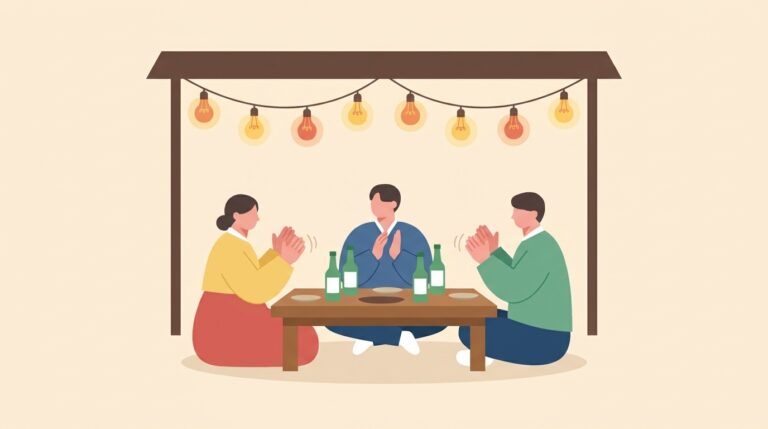
Picture this: You are sitting at a bustling pocha (tent bar) in Hongdae. Neon signs flicker overhead, empty green soju bottles crowd the stainless steel table, and crispy seafood pancake sizzles nearby. Suddenly, someone slams both palms onto the table in a rapid syncopated rhythm. In unison, everyone starts chanting in a melodic, hypnotic tempo: “Baskin~ Robbins~ Thirty~ One!” Before your brain can even process what ice cream has to do with alcohol, your Korean friend leans over with wild eyes, pointing a finger straight at you: “Your turn! Count!” Panic strikes. Do you say three numbers? One number? Do you clap? Why is everyone staring? You hesitate for two seconds, and the table erupts into a celebratory roar: “Masi-myeon-seo bae-u-neun sul-ge-im!” (A drinking game you learn while drinking!) An overflowing shot of soju lands directly in front of you.
If you have ever felt frozen during a Korean drinking round, take a deep breath. You are not alone. Korean drinking games like Baskin Robbins 31 and 3-6-9 (Sam-Yuk-Gu) move at lightning speed, blending language skills, number reflexes, and subtle social antennae (nunchi). Based on feedback from hundreds of our intermediate learners who survived their first company dinner (hoesik) or university orientation, mastering these games is not about being a math genius—it is about knowing the rhythmic cues, the survival phrases, and the unwritten social safety valves. By the end of this guide, you won’t just survive the table; you’ll be leading the chants.
Phase 2: 핵심 표현 3선 심층 분석 (3 Essential Expressions)
1. 마시면서 배우는 술게임! (Masi-myeon-seo bae-u-neun sul-ge-im!)
- Pronunciation: [Ma-si-myeon-seo bae-u-neun sul-ge-im] (Sounds like: mah-she-myun-suh bay-oo-noon sool-geh-eem)
- Meaning: “A drinking game you learn while drinking!” (Literal) vs. “Don’t worry if you don’t know the rules—you’ll figure it out every time you take a penalty drink!” (Nuance)
- K-Culture Moment: Often sung as an upbeat group chant in variety shows like New Journey to the West or K-dramas whenever a newcomer admits they don’t know how to play.
- Editor’s Insight: This is Korean social hospitality masked as tough love. Koreans do not expect foreign friends to be master players instantly; they use this chant to make losing feel like a fun initiation rather than an embarrassment.
- Situation Spectrum: Casual (✅) | Semi-formal (⚠️ – acceptable among colleagues of similar rank) | Formal (🚫)
- 🤔 Think About It: In many Western cultures, explaining all rules thoroughly before starting is considered polite. Why does Korean drinking culture prioritize immediate, experiential action over rulebook perfection?
2. 이번 판만 봐주세요! (I-beon pan-man bwa-ju-se-yo!)
- Pronunciation: [I-beon pan-man bwa-ju-se-yo] (Sounds like: ee-bun pahn-mahn bwah-joo-seh-yo)
- Meaning: “Please look kindly upon me just this round!” (Literal) vs. “Cut me some slack just this once, please!” (Nuance)
- K-Culture Moment: When a rookie miscounts in 3-6-9, they put their hands together in a prayer pose, scrunch their face with an endearing aegyo pout, and plead for a free pass.
- Editor’s Insight: The verb 보다 (boda, to see/look) combined with -아/어 주다 (-a/eo juda, to do for someone) idiomatically means “to let someone off the hook” or “overlook an error.” It shows you acknowledge your mistake while playfully bargaining for mercy.
- Situation Spectrum: Casual (✅) | Semi-formal (✅) | Formal (🚫)
- 🤔 Think About It: Notice the balance between honorific speech (-요) and playful begging. How does Korean etiquette allow flexibility within hierarchy through language softeners?
3. 아싸, 걸렸다! (Assa, geol-lyeot-da!)
- Pronunciation: [As-sa, geol-lyeot-da] (Sounds like: ah-ssah, gul-lyut-tah)
- Meaning: “Oh yeah, you got snagged!” (Literal) vs. “Yes! You blew it, penalty drink for you!” (Nuance)
- K-Culture Moment: The instantaneous victory shout everyone yells in chorus when someone claps on the wrong number during 3-6-9 or gets stuck saying “31” in Baskin Robbins.
- Editor’s Insight: 걸리다 (geollida) literally means “to be caught, trapped, or snagged.” Assa is the universal Korean exclamation of pure triumph (like “Score!”). It sounds aggressive in textbook translation, but among friends, it is purely joyful bantering.
- Situation Spectrum: Casual (✅) | Semi-formal (⚠️) | Formal (🚫)
- 🤔 Think About It: What words exist in your native language that turn someone else’s harmless mistake into an affectionate group celebration?
Phase 3: 교과서 한국어 vs 진짜 한국어 (Textbook vs. Real Korean)
Situation 1: Asking someone to explain the game rules
- 📖 교과서 한국어: 게임 규칙을 설명해 주시겠습니까? (Ge-im gyu-chi-geul seol-myeong-hae ju-si-get-seum-ni-kka? – “Would you please explain the game regulations to me?”)
- 🗣️ 진짜 한국어: 이거 룰이 어떻게 돼요? 알려주세요! (I-geo ru-ri eo-tteo-ke dwae-yo? Al-lyeo-ju-se-yo! – “How does this rule work? Teach me!”)
- 💡 왜 다를까?: In a lively pub setting, words like 규칙 (gyuchik, formal regulations) sound like a courtroom trial. Real speakers borrow the English loanword 룰 (rul, rule) combined with the natural phrase 어떻게 돼요? (how does it work?).
Situation 2: Begging for a substitute drinker or asking to pass
- 📖 교과서 한국어: 술을 더 이상 마실 수 없으니 대신 마셔 주십시오. (Su-reul deo i-sang ma-sil su eop-seu-ni dae-sin ma-syeo ju-sip-si-o. – “As I can drink no more alcohol, please drink in my stead.”)
- 🗣️ 진짜 한국어: 저 한 잔만 살려주세요! 흑기사 없어요? (Jeo han jan-man sal-lyeo-ju-se-yo! Heuk-gi-sa eop-seo-yo? – “Please spare me just this one shot! Any Black Knight for me?”)
- 💡 왜 다를까?: Native speakers use theatrical, dramatic verbs like 살려주다 (sal-lyeo-ju-da, “save my life”) rather than dry medical refusals. Calling for a 흑기사 (heukgisa, Black Knight) immediately turns a potential mood killer into a romantic comedy scene.
Phase 4: K-Culture 딥다이브 & 비언어적 매너 (Deep Dive & Body Language)
4-1. 눈치 (Nunchi), Table Rhythms, and Visual Clues
Korean drinking games are 30% math and 70% sensory synchronization. Watch the hands and eyes around you:
1. The Beat of the Table: In both Baskin Robbins 31 and 3-6-9, the group keeps time by tapping thighs or pounding the table gently in a steady four-four tempo. Do not break the beat. If you pause your speech to think for more than one second, you forfeit.
2. The 3-6-9 Silent Clap: The golden rule of 3-6-9 (Sam-Yuk-Gu): You never say numbers that contain 3, 6, or 9 out loud. Instead, you clap. For numbers with double digits like 33, 36, or 39, you must clap twice. If you accidentally whisper “three” while clapping, your sharp-eared friends will catch you immediately.
3. Penalty Shot Etiquette: When you lose and take your penalty shot (beol-ju), remember core Korean etiquette: turn your head slightly away from any older peers or seniors at the table, cover your glass with two hands if drinking with respected companions, and finish it smoothly in one clean gulp (won-syat).
4-2. Cultural Code Analysis: The Collective Spirit of Korean Play
Why do Koreans play such high-pressure games while drinking? In many workplaces and universities, the strict social hierarchy (seonbae-hubae, boss-subordinate) can create emotional distance during normal daylight hours. Drinking games act as an institutional “equalizer.” For those 15 minutes of 3-6-9, a freshman can eliminate a senior director, shout “Assa, geol-lyeot-da!”, and force them to chug a shot without violating social safety codes. It is cathartic bonding dressed up as friendly combat.
Phase 5: 실전 롤플레이 시나리오 (Real-World Role-Play)
Setting: A crowded pocha near Sinchon. Neon beer signs glow, and K-pop plays softly in the background. You are sitting with Minji, an energetic Korean classmate who loves hype energy, and Junho, a mischievous upperclassman.
- 민지 (Minji): 자, 우리 분위기 띄우게 369 게임 할까? (Ja, u-ri bu-nwi-gi tti-u-ge sam-yuk-gu ge-im hal-kka?)
🎭 Hands flat on the table, grinning excitedly at you.
“Alright, shall we play 3-6-9 to hype up the vibe?” -
나 (Learner): 좋아요! 근데 저 아직 조금 헷갈려요. (Jo-a-yo! Geun-de jeo a-jik jo-geum het-gal-lyeo-yo.)
🎭 Smiling sheepishly while tapping your fingers.
“Sounds good! But I’m still a little confused about the rules.” -
민지 (Minji): 3, 6, 9 들어간 숫자에는 말하지 말고 박수! 알지? 시작! (Sam, yuk, gu deul-eo-gan sut-ja-e-neun mal-ha-ji mal-go bak-su! Al-ji? Si-jak!)
🎭 Clapping twice on her jeans in rhythm.
“For numbers with 3, 6, or 9, don’t speak, just clap! Got it? Start!” -
준호 (Junho): 일! (Il!)
🎭 Points his finger forward cleanly.
“One!” -
민지 (Minji): 이! (I!)
🎭 Tilts her head and turns instantly to face you.
“Two!” -
나 (Learner): [Claps hands firmly without saying a word!]
🎭 Maintains steady eye contact with Junho.
“[Clap!]” -
준호 (Junho): 사! (Sa!)
🎭 Smiles approvingly at your quick reflex.
“Four!” -
민지 (Minji): 오! (O!)
🎭 Shifts posture toward Junho.
“Five!”
🔀 인터랙티브 분기점 (Interactive Decision Point)
It is Junho’s turn for the number 6. But Junho gets distracted by a food delivery, panics, and accidentally yells out: “Yuk!” (Six!)
What do you do?
- Choice A: Say nothing, look down at your glass politely, and pretend you didn’t notice his mistake so he doesn’t feel bad.
- Choice B: Point both fingers at Junho with a big laugh and shout: “아싸, 걸렸다! 마셔라!” (Assa, geol-lyeot-da! Ma-syeo-ra!)
- Choice C: Stop the game and begin explaining in English why saying six is grammatically incorrect in 3-6-9.
Feedback:
* Choice A (Risk – Buzzkill): Korean drinking games thrive on energetic call-outs! If you stay silent out of excessive politeness, the rhythm stumbles and the table loses momentum.
* Choice B (Best – Flawless Cultural Adaptation!): Bingo! You caught the senior red-handed. Pointing out the mistake with playful enthusiasm (Assa!) is exactly what Korean friends want. Junho will happily chug his penalty drink and praise your sharp nunchi.
* Choice C (Bad – Academic Overkill): This isn’t a grammar classroom! Giving a lecture halts the party atmosphere and makes things unnecessarily awkward.
Phase 6: 10초 감정 섀도잉 드릴 (10-Second Emotion Shadowing Drill)
Read these out loud, observing the slash marks (/) for timing pauses and channeling the emotional cue!
[😊 신나고 리듬감 있게 - Bouncy and full of party energy]
마시면서 배우는 / 술게임! / 원샷!
(Ma-si-myeon-seo bae-u-neun / sul-ge-im! / Won-syat!)
“Learning while drinking / drinking game! / Bottoms up!”-
[🥺 불쌍하고 애교 섞어서 - Pouty, dramatic begging for mercy]
제발 / 이번 한 번만 / 봐주세요~!
(Je-bal / i-beon han beon-man / bwa-ju-se-yo~!)
“Please / just this one time / let me off the hook~!” -
[😈 장난기 가득하고 통쾌하게 - Mischievous, triumphant call-out]
걸렸다! / 핑계 대지 말고 / 마셔요!
(Geol-lyeot-da! / Ping-gye dae-ji mal-go / ma-syeo-yo!)
“Caught you! / Stop making excuses / drink up!”
Phase 7: K-Culture 미니 사전 (Mini Dictionary)
- 벌주 (Beol-ju) | Penalty Drink
Usage: The drink consumed by whoever breaks a game rule. In wild college gatherings, it might be a chaotic mix (poktanju) of beer and soju, but among considerate adults, it is usually just a single standard shot. - 눈치게임 (Nun-chi-ge-im) | The Intuition Game
Usage: A spontaneous number game where players randomly stand up and count sequentially without coordinating. If two people stand up and shout the same number at the same time, both lose. It measures your social awareness. - 흑기사 / 흑장미 (Heuk-gi-sa / Heuk-jang-mi) | Black Knight (Male) / Black Rose (Female)
Usage: A volunteer hero who drinks your penalty drink on your behalf. According to tradition, if someone acts as your heukgisa, you must grant them a wish (sowon) later! - 주량 (Ju-ryang) | Alcohol Tolerance / Capacity
Usage: A standard introductory question at Korean dinners: “주량이 어떻게 되세요?” (What is your drinking tolerance?) Usually measured in bottles of soju (e.g., soju han byeong = one bottle).
Phase 8: 여행자를 위한 생존 키트 (Traveler’s Survival Kit)
Top 3 Survival Phrases
- “저 술 잘 못 마셔요.” (Jeo sul jal mot ma-syeo-yo.)
Meaning: I cannot drink alcohol well.
Pro Tip: Say this smilingly right at the start. Koreans deeply respect honest self-awareness over someone who silently drinks beyond their limit and falls ill. - “물 한 잔만 주세요.” (Mul han jan-man ju-se-yo.)
Meaning: Please give me a glass of water.
Pro Tip: Keeping a cup of cold water right next to your shot glass is the top secret for pacing yourself during intense games. - “사이다로 대신할게요!” (Sa-i-da-ro dae-sin-hal-ge-yo!)
Meaning: I will substitute with Chilsung Cider (lemon-lime soda)!
Pro Tip: Joining game rounds with soda keeps you involved in the social laughter without consuming a single drop of alcohol.
Editor’s Travel Note
Navigating Seoul after midnight requires practical digital tools. If your game night stretches past 12:30 AM, subways stop running. Before entering the pub, make sure you install the reliable Kakao T taxi booking app guide so you aren’t stranded trying to flag cabs in the rain. To locate authentic 24-hour hangover soup (haejangguk) restaurants nearby, use the official Naver Map navigation app, which provides real-time Korean operating hours far more accurately than international map apps.
Phase 9: “한 발 더 깊이” (Cultural Reflection Essay)
At first glance, Korean drinking games might seem loud, high-stakes, and relentless. Yet beneath the rapid clapping and chorus chants lies an ancient, communal longing for jeong (deep affective connection). In a society governed by rigorous work ethics, honorific language layers, and polite reserve, the drinking table functions as a sanctioned playground. When you play Baskin Robbins 31, all status dissolves; everyone is simply human, laughing at their own clumsy fingers and slips of the tongue. It is a shared ritual where vulnerability is celebrated, not penalized.
💬 Your Turn: Have you ever played a game with coworkers or friends where standard hierarchies were temporarily thrown out the window? How does your culture break the ice during social celebrations? Share your stories in the comments below!
Phase 10: FAQ & 흔한 실수 (FAQ & Avoiding Misunderstandings)
Q: What if I lose Baskin Robbins 31? What are the exact rules?
A: Players take turns counting consecutive numbers starting from 1 up to 31. On your turn, you can say one, two, or three numbers (e.g., “1, 2, 3” or just “4”). The person forced to say the final number “31” loses and drinks the penalty shot! Strategy tip: If you can successfully land on the number 30 on your turn, the next person is mathematically trapped and must say 31.
Q: Can I refuse a penalty drink if I feel tipsy or don’t drink alcohol?
A: Absolutely, 100% yes. Modern Korean drinking culture has shifted dramatically toward personal safety. If you cannot drink, cross your forearms in an “X” shape with a gentle smile and say: “오늘은 그만 마실게요!” (I’ll stop drinking for today!) or ask for water/cider. Good friends will cheer for your participation in the game even if you only drink water.
Q: In 3-6-9, do I clap when saying the number 13?
A: Yes! Because 13 contains the digit 3, you must clap instead of speaking. For 33, 36, and 39, you must clap twice. Missing the second clap on 33 is the most common reason people get caught!
🚨 흔한 실수 (Common Mistakes) 경고판
- Mistake: Whispering numbers under your breath while clapping during 3-6-9.
Correct Action: Keep your mouth completely closed during clap numbers. Any vocalization counts as speaking the forbidden digit! - Mistake: Downing a penalty drink facing straight toward your boss or elder.
Correct Action: Turn your torso 45 degrees to the side and shield the bottom of your shot glass with your left hand. - Mistake: Forcing someone else to drink after they verbally express discomfort.
Correct Action: Korean drinking games are about shared laughter. If someone waves their hands or reaches their limit, cheer their effort and switch their glass to water immediately.
Phase 11: 액션 미션 & 참여 유도 (Action Missions)
- 🥉 Bronze Level: Count from 1 to 20 aloud in Korean alone in your room, clapping on 3, 6, 9, 13, 16, and 19 without hesitating on the rhythm.
- 🥈 Silver Level: Teach the rules of Baskin Robbins 31 to an international friend or practice saying “이번 판만 봐주세요!” in a cute voice in front of the mirror.
- 🥇 Gold Level: During your next meal or drink with Korean acquaintances, initiate the game yourself by tapping the table rhythm and saying: “우리 베스킨라빈스 써티원 할까요?” (Shall we play Baskin Robbins 31?)
- 🎮 K-Culture Mission: Watch an episode of a Korean variety show featuring drinking games (like Workman pocha episode or Youngji’s No Prepare) and see if you can spot someone yelling “Assa, geol-lyeot-da!”
Phase 12: 인터랙티브 퀴즈 챌린지 (Interactive Quiz Challenge)
Test your drinking game mastery before heading out tonight!
- Situation Judgment: You are playing Baskin Robbins 31. The player right before you stops at the number 27. It is now your turn. How many numbers should you say to guarantee you do not lose on your next turn?
- Fill in the Blank: When you desperately want your group to pardon your mistake just this once, you say:
“이번 판만 ________!” - True / False: During 3-6-9, when the sequence reaches the number 36, the player must clap once and say “Yuk!”
👉 Click to view answers and explanations!
- Answer: Say three numbers: “28, 29, 30!”
Explanation: If you say 28, 29, and 30, the next player has no choice but to say the fatal number 31! You win the game! - Answer: 봐주세요 (bwa-ju-se-yo)
Explanation: 이번 판만 봐주세요 translates to “Please let me slide just this once!” - Answer: False!
Explanation: The number 36 contains two game digits (3 and 6). Therefore, you must clap twice (zzak-zzak!) and say absolutely nothing out loud!







