

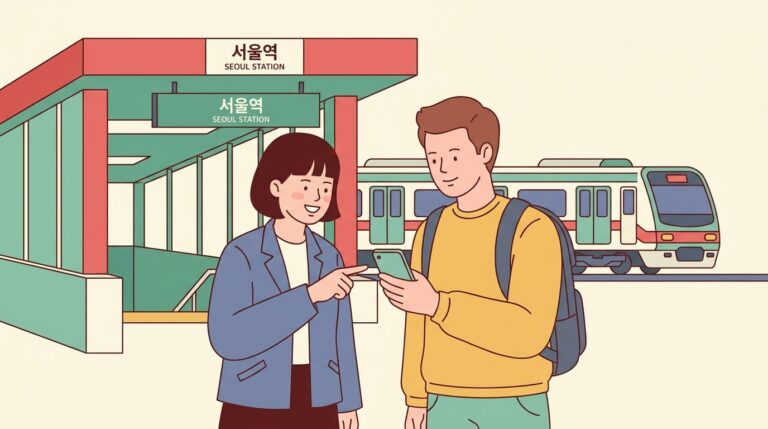
Help! My Phone Died: How to Politely Borrow a Phone in Korea (A1 Guide)
Phase 1: Empathy (Story Opening)
안녕하세요! This is your Daily Hangul editor.
Picture this: It is 10:30 PM in the neon-lit maze of Hongdae. You just had the most incredible Korean barbecue dinner, but as you pull out your phone to check the subway route back to your hotel, the screen blinks black. 0% battery. You do not speak fluent Korean, your hotel address is saved only in your phone notes, and your friends are waiting across town. Panic begins to settle in. We have all seen this classic scene in K-Dramas where the protagonist looks around desperately in the pouring rain. But real life does not have a soundtrack—it just has cold sweat!
Borrowing someone’s smartphone in a foreign country feels intimidating, especially in tech-savvy South Korea where a phone carries someone’s entire digital life. Don’t worry! With just two or three gentle, polite phrases, local Koreans will instantly recognize your emergency and step up to help with immense warmth (jeong, 정). This guide comes straight from real experiences coaching beginner travelers who turned stressful battery disasters into heartwarming local memories.
Phase 2: 3 Core Expressions In-Depth
1. 핸드폰 좀 빌려주실 수 있나요? (한글)
- Pronunciation: Ha-en-deu-pon jom bil-lyeo-ju-sil su in-na-yo? (Sounds like: Han-deh-pon jom peel-yeo-joo-sheel soo een-nah-yo?)
- Meaning: “Could you please lend me your phone?” (Literal: Phone [a little] lend-can you?)
- K-Culture Moment: Think of that iconic moment in romantic comedies where the lead loses their bag and nervously asks a stranger outside a subway station to make an urgent call.
- Editor’s Insight: The tiny word 좀 (jom) translates literally to “a little,” but in Korean, it works like magic fairy dust. It instantly softens your request from a demanding command into a courteous plea.
- Situation Spectrum:
- Casual: 🚫 (Too polite for close pals)
- Semi-formal (Polite to strangers): ✅ (The gold standard!)
- Formal: ⚠️ (Understood, but slightly conversational)
- 🤔 Think About It: In English, we say “Can I borrow…?” focusing on I. In Korean, you say “Could you lend…?” focusing on the listener’s generous action. How does shifting the focus to the other person change the tone?
2. 배터리가 없어요. (한글)
- Pronunciation: Bae-teo-ri-ga eop-seo-yo. (Sounds like: Beh-tuh-ree-gah up-so-yo)
- Meaning: “My battery is dead.” (Literal: “Battery does not exist / is absent.”)
- K-Culture Moment: K-Pop idols during livestream broadcasts suddenly exclaiming this right before their phone dies on camera.
- Editor’s Insight: In English, we say a battery is “dead.” In Korean, simply state that it doesn’t exist (없어요). You can tap your dark phone screen while saying this to communicate your situation in one second.
- Situation Spectrum:
- Casual: ⚠️ (Needs to drop yo to be casual)
- Semi-formal: ✅ (Perfect for explaining your problem)
- Formal: ⚠️
- 🤔 Think About It: Why do you think Korean expresses absence rather than “death” of a device? Simplicity often trumps drama in Korean daily utility verbs.
3. 전화 한 통만 쓸 수 있을까요? (한글)
- Pronunciation: Jeon-hwa han tong-man sseul su is-seul-kka-yo? (Sounds like: Jun-hwah han tong-mahn seul soo ees-seul-kkah-yo?)
- Meaning: “May I make just one phone call?” (Literal: “Phone call one unit-only can I use?”)
- K-Culture Moment: A stranded traveler asking a convenience store clerk for permission to call their guest house host.
- Editor’s Insight: 한 통 (han tong) means “one phone call counter.” Adding -만 (-man) means “only.” This assures the owner: “I will not browse your photos or waste your minutes; I only need one 30-second call.”
- Situation Spectrum:
- Casual: 🚫
- Semi-formal: ✅ (Very considerate & clear)
- Formal: ✅
- 🤔 Think About It: Setting clear boundaries upfront reduces social friction. Koreans deeply respect people who respect their personal space.
Phase 3: Textbook Korean vs. Real Korean
- Situation 1: Explaining your phone is out of power
- 📖 교과서 한국어 (Textbook): 휴대전화의 전원이 꺼졌습니다. (Hyu-dae-jeon-hwa-ui jeon-won-i kkeo-jyeot-seum-ni-da. – “The mobile telephone power has ceased.”)
- 🗣️ 진짜 한국어 (Real-life): 배터리가 나갔어요. (Bae-teo-ri-ga na-gat-seo-yo. – “My battery went out.”) or 배터리 없어요. (Bae-teo-ri eop-seo-yo.)
- 💡 왜 다를까? Textbook Korean uses formal Sino-Korean terms like hyudaejeonhwa (휴대전화), but real Koreans universally say haendeupon (핸드폰) or just state the battery went out (nagasseoyo).
- Situation 2: Asking for a brief call
- 📖 교과서 한국어 (Textbook): 당신의 전화기를 저에게 빌려주십시오. (Dang-sin-ui jeon-hwa-gi-reul jeo-e-ge bil-lyeo-ju-sip-si-o. – “Please lend your telephone device to me.”)
- 🗣️ 진짜 한국어 (Real-life): 전화 딱 한 번만 써도 될까요? (Jeon-hwa ttak han beon-man sseo-do doel-kkayo? – “Could I use your phone just once?”)
- 💡 왜 다를까? Never use the word dangsin (당신) with strangers—it sounds aggressive or overly dramatic! Koreans omit the pronoun “you” completely and add soft emphatic words like ttak (딱 – just/precisely).
Phase 4: K-Culture Deep Dive & Non-Verbal Manners
4-1. Nunchi (눈치) & Body Language
Smartphones in Korea contain mobile banking, KakaoTalk private chats, and digital ID cards. Asking to touch someone’s phone requires high 눈치 (Nunchi – social awareness):
1. Show, Don’t Just Tell: Hold your dead phone in both hands and show the dark screen. Tap the power button to prove it is dead.
2. The Two-Hand Grip (두 손): When receiving or returning their phone, always hold it with both hands. It shows profound gratitude and care.
3. Keep Your Distance: Step one step back and keep the screen visible to them while dialing so they know you aren’t peeking through their gallery or private apps.
4-2. Tech & Everyday Culture
Korea is among the most hyper-connected societies in the world. Because everyone depends on their device, people understand battery panic deeply! Most convenience stores (CU, GS25, 7-Eleven) offer portable battery rental kiosks called 보조배터리 대여 (Bojo-baeteori daeyeo). Furthermore, Korean cafes are famous for having wall outlets under almost every table. Locals are typically very empathetic when you show them your empty battery bar.
Phase 5: Real-World Roleplay Scenario
- Setting: A quiet street corner near Gangnam Station Exit 11, around 9:45 PM. You need to call your travel companion who has the hotel key.
- Characters:
- You (A1 Korean Explorer)
- Min-ji (A 20-something local waiting for her friend, carrying a cute tote bag)
Dialogue:
1. You: 저기요… 죄송한데요. (Jeo-gi-yo… joe-song-han-de-yo. / “Excuse me… I am sorry to bother you.”) 🎭 Bow head slightly at a 15-degree angle, showing empty phone screen.
2. Min-ji: 네? 무슨 일이세요? (Ne? Mu-seun ir-i-se-yo? / “Yes? What is the matter?”) 🎭 Looks curious and attentive.
3. You: 핸드폰 배터리가 없어요. (Haen-deu-pon bae-teo-ri-ga eop-seo-yo. / “My phone has no battery.”) 🎭 Points to dead black screen with a shy, apologetic smile.
4. Min-ji: 아, 진짜요? 곤란하시겠네요. (A, jin-jja-yo? Gon-ran-ha-si-gen-ne-yo. / “Oh, really? That must be tough!”) 🎭 Expresses immediate empathy.
5. You: 혹시 전화 한 통만 쓸 수 있을까요? (Hok-si jeon-hwa han tong-man sseul su is-seul-kka-yo? / “By any chance, could I make just one call?”) 🎭 Clasps hands together in a polite pleading posture.
6. Min-ji: 아, 네! 여기 있어요. (A, ne! Yeo-gi it-seo-yo. / “Ah, yes! Here you go.”) 🎭 Unlocks the phone and brings up the keypad before handing it over.
7. You: 정말 감사합니다! (Jeong-mal gam-sa-ham-ni-da! / “Thank you so very much!”) 🎭 Receives phone with both hands, dials carefully, and finishes in 30 seconds.
8. You: 잘 썼습니다! 복 받으실 거예요! (Jal sseot-seum-ni-da! Bok bad-eu-sil geo-ye-yo! / “Thank you for letting me use it! May you be blessed!”) 🎭 Hands phone back with two hands and a 45-degree bow.
🔀 Interactive Decision Point: What do you say when Min-ji looks hesitant?
- Option A: “야! 폰 줘!” (Ya! Pon jwo! – “Hey! Give me phone!”)
- Result (Bad): Extreme casual disrespect! Min-ji will walk away immediately.
- Option B: “길만 물어볼게요. 편의점 어디예요?” (Gil-man mur-eo-bol-ge-yo. Pyeon-ui-jeom eo-di-ye-yo? – “I’ll just ask directions. Where is the convenience store?”)
- Result (Risk): Safe pivot, but doesn’t solve your immediate call emergency.
- Option C: “스피커폰으로 딱 1분만 할게요!” (Seu-pi-keo-pon-eu-ro ttak il-bun-man hal-ge-yo! – “I will do it on speakerphone for just 1 minute!”)
- Result (Best!): Offering to use speakerphone proves you won’t touch their private data. Instantly puts them at ease!
Phase 6: 10-Second Emotion Shadowing Drill
Practice matching the emotional pitch! Follow the slashes / for brief breathing pauses:
[🥺 Desperate yet polite]- 저기요… / 핸드폰 배터리가 / 없어요. (Jeo-gi-yo… / haen-deu-pon bae-teo-ri-ga / eop-seo-yo.)
[🙏 Earnest and considerate]- 혹시… / 전화 한 통만 / 쓸 수 있을까요? (Hok-si… / jeon-hwa han tong-man / sseul su is-seul-kka-yo?)
[😊 Heartfelt and deeply relieved]- 도와주셔서 / 정말 / 감사합니다! (Do-wa-ju-syeo-seo / jeong-mal / gam-sa-ham-ni-da!)
Phase 7: K-Culture Mini Dictionary
- 배터리 (Bae-teo-ri) | Battery
- The English word borrowed into Korean! Just pronounce it with crisp, short Korean vowels: Bae-teo-ri.
- 충전기 (Chung-jeon-gi) | Charger
- Composed of Chung-jeon (charge) + gi (machine). You can ask any cafe barista: “충전기 있어요?” (Chung-jeon-gi it-seo-yo? – “Do you have a charger?”).
- 보조배터리 (Bo-jo-bae-teo-ri) | Power bank / Portable battery
- Bojo means “auxiliary/backup.” Rentable at subway stations and convenience stores throughout Seoul and Busan.
- 통화 (Tong-hwa) | Phone conversation
- Used when referring to the act of calling. “통화 끝났어요” (Tong-hwa kkeut-nat-seo-yo) means “I’m done with the call.”
Phase 8: Traveler Survival Kit
TOP 3 Emergency Expressions
- 1. 충전 좀 할 수 있을까요? (Chung-jeon jom hal su is-seul-kka-yo?)
- Pro Tip: Use this inside cafes or restaurants while holding up your cable.
- 2. 지도 한 번만 봐도 될까요? (Ji-do han beon-man bwa-do doel-kkayo?)
- Pro Tip: Use this when you only need to check a street map rather than place a call.
- 3. 공중전화 어디 있어요? (Gong-jung-jeon-hwa eo-di it-seo-yo?)
- Pro Tip: Payphones are rare now, but still exist near major subway turnstiles in Korea!
Editor’s Travel Note
- Emergency Navigation Backup: Before leaving your accommodation, save offline maps on the 네이버 지도 앱 다운로드 (Naver Map app). Google Maps does not provide accurate walking routes in South Korea due to national security map data regulations.
- Battery Rental Services: Look out for yellow or green kiosks named “충전돼지” (Piggy Charge) inside subway stations. You can rent a power bank with an international credit card for around 1,000 KRW per hour.
Phase 9: “한 발 더 깊이” (One Step Deeper)
In South Korea, a smartphone is essentially an individual’s digital identity sanctuary—it contains their resident ID verification, bank certificates, and chat logs. Handing an unlocked phone to a stranger requires real courage on the lender’s part. However, Korea’s deep-rooted cultural fabric of 정 (Jeong – collective affection and empathy for fellow human beings) usually triumphs over wariness when someone is genuinely stranded. When you express respect for their boundaries through gentle language and two-handed etiquette, you turn a potential risk into a beautiful cultural exchange.
💬 Your Turn: Have you ever experienced your phone battery dying in another country? How did people in that country react when you asked for help? Share your stories below!
Phase 10: FAQ & Common Mistakes
Q: Will people think I am trying to steal their phone?
A: In major cities like Seoul, violent street theft is extraordinarily rare. However, people may worry about financial phishing or privacy invasion. If you clarify that you only need a quick phone call (전화 한 통만) or offer to let them hold the phone on speakerphone, any suspicion evaporates immediately.
Q: What if they say “아… 죄송해요” (No, I’m sorry)?
A: Never take it personally! They might be out of cellular minutes, in an extreme hurry, or simply shy about speaking to foreigners. Just nod politely, say “괜찮습니다, 감사합니다!” (Gwaen-chan-seum-ni-da, gam-sa-ham-ni-da! – “It’s okay, thank you!”) and head into the nearest convenience store.
Q: Can I ask staff at subway station information desks?
A: Yes! Subway station customer offices (Yeok-mu-sil, 역무실) are often equipped with emergency chargers or landline phones and staff are trained to help stranded commuters.
🚨 Common Mistakes Warning Board
- Grabbing the phone with one hand: In Korea, taking an object with one hand from an unfamiliar person can appear flippant or dismissive. Correct Action: Extend both hands with elbows slightly tucked.
- Speaking English loudly without a greeting: Starting directly with “Excuse me, phone please!” can startle locals. Correct Action: Start gently with “저기요… 죄송한데요” (Jeo-gi-yo… joe-song-han-de-yo).
- Opening other apps or prolonged screen time: Do not check your social media or wander through other menus. Correct Action: Dial the number, make the call succinctly, and return it right away.
Phase 11: Action Missions
- 🥉 Bronze Mission (Solo Practice): Stand in front of your mirror with your phone turned off. Practice tapping the dead screen and saying: “핸드폰 배터리가 없어요. 좀 빌려주실 수 있나요?” 5 times smoothly.
- 🥈 Silver Mission (Social Audio): Record yourself saying “전화 한 통만 쓸 수 있을까요?” on your voice memo app and listen back to ensure your tone sounds gentle, not demanding.
- 🥇 Gold Mission (Real Life): Next time you visit a Korean cafe or restaurant, ask the server politely: “혹시 충전기 있어요?” (Hok-si chung-jeon-gi it-seo-yo? – “Do you happen to have a charger?”).
- 🎮 K-Culture Mission: Watch any episode of a contemporary K-Drama (like Crash Landing on You or Business Proposal) and spot how characters react whenever their smartphone battery dies unexpectedly.
Phase 12: Interactive Quiz Challenge
1. Situational Judgment: Your phone just died outside Myeongdong Station. Which person and approach is the most effective and polite?
* A) Tap a teenager running down the stairs and shout: “핸드폰 줘!”
* B) Approach a shop staff member calmly, bow slightly, show your screen, and say: “죄송한데요, 배터리가 없어요. 혹시 전화 한 통만 쓸 수 있을까요?”
* C) Stand next to someone and peer directly over their shoulder at their screen.
2. Fill-in-the-Blank: Complete the polite softening phrase:
“핸드폰 (___) 빌려주실 수 있나요?” *(Hint: A tiny one-syllable word meaning “a little”)*
3. True or False: In Korea, handing something to or receiving something from a helpful stranger with one hand is considered the most respectful posture.
* [ ] True
* [ ] False
👉 Click here for Answers & Explanations
- Answer: B – Approaching someone calmly with a polite opening and two hands demonstrates maximum respect and guarantees a helpful response.
- Answer: 좀 (jom) – Adding jom softens requests effortlessly into polite Korean!
- Answer: False – Always use two hands (두 손) to receive and return items to convey gratitude and politeness!






