

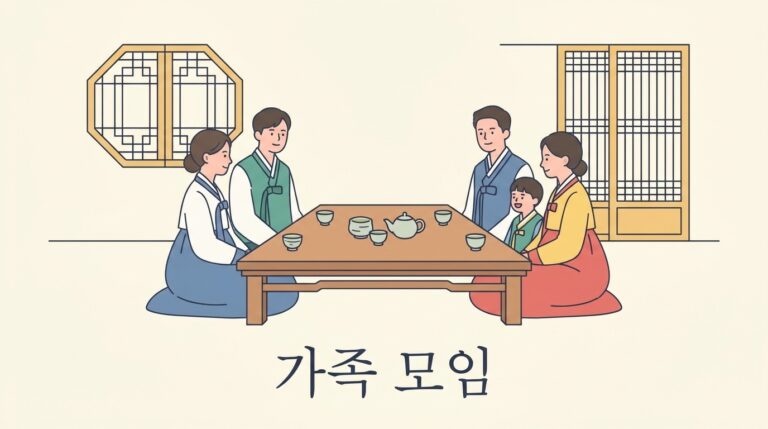
Phase 1: Empathy (Story Opening)
안녕하세요! This is your Daily Hangul editor, your companion through the intricate tapestry of Korean life.
Picture this quintessential scene straight out of a prime-time K-drama: you are standing inside an immaculate, hushed private dining room of a traditional Hanjeongsik restaurant in Samcheong-dong. The floor is lined with polished pine, pristine white ceramic tableware reflects the soft candlelight, and thirty miniature side dishes wait in geometric symmetry. Across the thresholds, both sets of parents exchange sweeping, razor-sharp bows. You can practically hear the ice cubes trembling inside the roasted barley tea. Suddenly, your partner’s father gestures toward the long low-rise table. Your pulse races as questions flood your mind: Who sits where? Did we just inadvertently steer the patriarch toward the drafty service entrance? What happens if someone brings up real estate prices or dowry expectations?
If your palms are sweating just imagining this, take heart. The Korean pre-wedding family meeting, known as 상견례 (Sanggyeonrye), is widely regarded even by native Koreans as the single most nerve-wracking diplomatic summit of their adult lives. It is not merely a social dinner; it is an ancient protocol where two distinct family lineages (gamun) negotiate unspoken boundaries, respect, and compatibility. Over the past decade, I have guided dozens of advanced international learners through this exact threshold. With the right socio-pragmatic blueprint, seating formula, and rhetorical mastery, you can transform this intimidating trial into a tour de force of cross-cultural elegance. Let us walk through the definitive playbook.
Phase 2: Core Expressions Deep Dive
To navigate a Sanggyeonrye at a C2 proficiency level, you must leave basic declarative statements behind. The goal here is 겸양 (gyeomyang)—the art of elevated humility and reciprocal elevation.
1. 모자란 점이 많겠지만 너그럽게 보아주십시오
- Pronunciation: Mojaran jeomi manketjiman neogeureopge boaju-sipsio (Sounds like: moh-jah-ran jum-ee mahn-get-jee-mahn nuh-geu-ruhp-geh boh-ah-joo-sheep-shee-oh)
- Meaning: Literal: “Although there are many lacking points, please look upon them generously.” / Nuance: “I entrust my child (or myself) to your family’s gracious guidance with total humility.”
- K-Culture Moment: Heard in almost every family drama (such as My Father is Strange or Father, I’ll Take Care of You) when parents finalize the wedding blessing. It signals surrender of familial arrogance.
- Editor’s Insight: Do not interpret “모자란 점” (flaws/shortcomings) literally. This is not self-deprecation or an admission of defect; it is the ultimate Confucian rhetorical buffer that disarms potential maternal or paternal scrutiny.
- Situation Spectrum: Casual: 🚫 | Semi-formal: ⚠️ | Formal: ✅
- 🤔 Think About It: In many Western traditions, introducing oneself or one’s partner highlights strengths and accomplishments. Why does Korean high culture view leading with vulnerability and humility as the highest display of dignity?
2. 자식 농사를 참 잘 지으셨습니다
- Pronunciation: Jasik nongsa-reul cham jal jieusyeotseumnida (Sounds like: jah-sheek nohn-sah-reul chahm jahl jee-euh-syut-seum-nee-dah)
- Meaning: Literal: “You have farmed your children truly well.” / Nuance: “You have raised your child with exemplary character, upright virtue, and devotion.”
- K-Culture Moment: The highest compliment one set of in-laws can deliver to another when observing the bride or groom’s poised table manners and respectful demeanor.
- Editor’s Insight: Comparing child-rearing to farming (nongsa) invokes Korea’s agrarian ethos, where a bountiful harvest represents decades of backbreaking parental sacrifice. Praising the adult child directly can sound patronizing, but praising the parents’ “farming” honors the lineage.
- Situation Spectrum: Casual: 🚫 | Semi-formal: ⚠️ | Formal: ✅
- 🤔 Think About It: Notice how the compliment shifts praise away from the individual’s inherent talent to the parents’ multi-decade devotion. How does your native language verbally credit parents for an adult’s character?
3. 바쁘신 와중에도 이렇게 귀한 걸음 해주셔서 감사드립니다
- Pronunciation: Bappeusin wajung-edo ireoke gwihan georeum haejusyeoseo gamsadeurimnida (Sounds like: bah-ppeu-sheen wah-joong-eh-doh ee-ruh-keh gwee-hahn guh-reum hae-joo-syuh-suh gahm-sah-deuh-reem-nee-dah)
- Meaning: Literal: “Even in the midst of busyness, thank you for making such a precious walk/step here.”
- Nuance: “We deeply recognize the heavy time, effort, and social gravitas you have invested to grace us with your presence.”
- K-Culture Moment: Uttered by the prospective groom or host family the exact second both parties stand face-to-face inside the room before seating.
- Editor’s Insight: In Korean linguistic philosophy, an elder’s movement is never trivial. Calling their journey a “precious step” (귀한 걸음) honors the physical and symbolic labor of the elder party traveling across town or provinces.
- Situation Spectrum: Casual: 🚫 | Semi-formal: ⚠️ | Formal: ✅
- 🤔 Think About It: Contrast “Thanks for coming today!” with acknowledging the physical “steps” (걸음) taken. How does spatial language in Korean encode aristocratic respect?
Phase 3: Textbook Korean vs. Real Native Korean
When meeting future in-laws, standard intermediate textbook phrasing often lands flat or unintentionally blunt. Here is how C2 speakers calibrate nuance:
Situation 1: Praising your prospective partner’s integrity in front of their parents
- 📖 교과서 한국어:
“민우 씨는 아주 착하고 성실해서 믿을 수 있는 사람입니다.”
(Min-woo ssi-neun aju chakhago seongsilhaeseo mideul su inneun saram-imnida. / “Min-woo is very nice and sincere, so he is a reliable person.”) - 🗣️ 진짜 한국어 (C2 Elevated):
“듣던 대로 인품이 참 반듯하셔서, 부모님의 깊은 정성과 가르침이 그대로 느껴집니다.”
(Deutdeon daero inpumi cham bandeuthasyeoseo, bumonim-ui gipeun jeongseong-gwa gareuchimi geudaero neukkyeojimnida. / “Just as I had heard, his moral character is so upright that I can immediately sense your profound devotion and wisdom in raising him.”) - 💡 왜 다를까?: Intermediate textbooks focus on simple adjectives like ‘착하다’ (nice). At a Sanggyeonrye, calling someone ‘nice’ sounds juvenile. Elevated Korean uses words like ‘인품’ (moral caliber) and ‘반듯하다’ (upright), gracefully redirecting the merit to the parents.
Situation 2: Steering conversation away from sensitive financial or dowry disputes
- 📖 교과서 한국어:
“예단이나 집값 이야기는 지금 하지 말고 나중에 해요.”
(Yedan-ina jipgap iyagineun jigeum haji malgo najung-e haeyo. / “Don’t talk about dowries or house prices now; let’s talk about it later.”) - 🗣️ 진짜 한국어 (C2 Elevated):
“구체적인 절차나 준비 사항은 저희 둘이 차근차근 상의해서 어르신들 염려 없으시도록 꼼꼼히 챙기겠습니다.”
(Guchejeogin jeolchana junbi sahang-eun jeohi duri chageunchageun sang-uihaeseo eoreusindeul yeomnyeo eopseusidorok kkomkkomhi chaenggigetseumnida. / “As for the specific procedures and preparations, the two of us will consult thoroughly step by step so that the elders will have no cause for worry.”) - 💡 왜 다를까?: Outright rejecting a topic (하지 마세요) creates an unbearable loss of face (che-myeon). The C2 native strategy uses protective deference: reassuring the elders that the couple will handle the logistics independently, neutralizing tension before it sparks.
Phase 4: K-Culture Deep Dive & Non-Verbal Manners
                    [ Scenic Window / Deep Interior ]
                           (THE SEAT OF HONOR)
           Father (Aboenim)        |        Father (Aboenim)
           Mother (Eomeonim)       |        Mother (Eomeonim)
           Prospective Groom       |        Prospective Bride
           (or Bride)              |        (or Groom)
                       [ Service Sliding Door ]
                           (THE LOWER SEAT)
4-1. Nunchi & Seating Protocol: Sangseok (상석) vs. Haseok (하석)
Seating at a Sanggyeonrye is an exact science rooted in historic Joseon court layout:
* The Anchor (상석 – Sangseok / Upper Seat): The seat farthest from the sliding door, typically facing the room entrance or offering the best view of the garden/alcove, belongs strictly to the fathers, followed directly by the mothers.
* The Buffer (하석 – Haseok / Lower Seat): The seats closest to the entrance are designated for the prospective bride and groom. Why? You are the executive liaisons of the room. You must effortlessly refill water glasses, receive dishes from the server (baecheop), open and close sliding doors discreetly, and slip out undetected when it is time to settle the bill.
* The 45-Degree Gaze: Avoid locking direct, unblinking eye contact with your future father-in-law when he drinks or speaks. Maintain an attentive 45-degree angle of respect, nodding gently (kkeudeogim) while keeping both hands placed gently on your lap or the table’s edge.
4-2. Cultural Code Analysis: The Art of Taboo Elimination
In modern Korean sociology, Sanggyeonrye is famous for being a minefield of comparison (bigyo munhwa).
* The Red Lines: Never initiate talk regarding exact real estate valuations, specific apartment brand names (e.g., “Xi”, “Acro”, “Raemian”), political affiliations, religious dogmas, or quantitative dowry splits (예단/예물 – Yedan/Yemul). If an elder wanders into this territory, the bride or groom must swiftly deploy filial deflection.
* The Golden Zones: Health regimens, warm memories of the partner’s childhood traits, mutual culinary preferences, and congratulating the other side on recent family milestones or hobbies (hiking, golf, gardening). Focus exclusively on shared warmth.
Phase 5: Real-World Roleplay Scenario
Setting: A private room at a traditional Hanjeongsik establishment in Jongno, Seoul. Warm floor heating (Ondol), exquisite Celadon ceramics. The prospective groom (Min-woo) and international partner (Alex) are hosting Min-woo’s parents and Alex’s mother.
- Turn 1 (Father-in-law – Aboenim):
“안으로 들어오시지요. 날씨가 제법 쌀쌀한데 오시느라 고생 많으셨습니다.”
(Aneuro deureoosijiyo. Nalssiga jeobeop ssalssalhande osineura gosaeng maneusyeosseumnida.)
“Please come inside. The weather has turned quite chilly; it must have been a taxing trip to get here.” -
Turn 2 (Alex):
(🎭 Performing a polite 30-degree bow, gesturing toward the interior seats)
“아버님, 어머님, 바쁘신 와중에도 이렇게 귀한 걸음 해주셔서 진심으로 감사드립니다. 안쪽 따뜻한 자리로 모시겠습니다.”
(Aboenim, eomeonim, bappeusin wajung-edo ireoke gwihan georeum haejusyeoseo jinsimeuro gamsadeurimnida. Anjjok ttatteuthan jariro mosigetseumnida.)
“Father, Mother, thank you so much from the bottom of my heart for taking such precious steps despite your busy days. Please let me escort you to the warm inner seats.” -
Turn 3 (Mother-in-law – Eomeonim):
(Sitting down and looking warmly at Alex)
“알렉스 이야기를 민우한테서 참 많이 들었어요. 듣던 대로 참 인상이 맑고 차분하시네요.”
(Alex iyagireul Min-wuhanteseo cham mani deureosseoyo. Deutdeon daero cham insang-i malgo chabunhasineyo.)
“I heard so much about Alex from Min-woo. Just as I was told, your impression is so radiant and serene.” -
Turn 4 (Alex):
(🎭 Lowering head slightly, hands clasped, speaking with a gentle, humble tone)
“과찬이십니다, 어머님. 민우 씨가 늘 부모님의 배려와 사랑에 대해 깊이 감사하고 있어서, 저 또한 꼭 뵙고 싶었습니다.”
(Gwachanisipnida, eomeonim. Min-woo ssiga neul bumonim-ui baeryeowa sarang-e daehae gipi gamsahago isseoseo, jeo ttohan kkok boepgo sipeosseumnida.)
“You flatter me beyond my merits, Mother. Min-woo always speaks with deep gratitude about your boundless care and love, so I too longed to meet you.” -
Turn 5 (Father-in-law – Aboenim):
(Sipping hot corn silk tea, clearing throat)
“그런데 두 사람, 서울 시내에 전세 아파트 구하기가 만만치 않을 텐데… 신혼집 문제는 어떻게 구상하고 있나?”
(Geureonde du saram, Seoul sinaee jeonse apateu guhagiga manmanchi aneul tende… sinhonjip munjeneun eotteoke gusanghago inna?)
“By the way, you two… securing a Jeonse apartment in downtown Seoul won’t be easy. What concrete plans do you have regarding the newlyweds’ home?” -
Turn 6 (Alex):
(🎭 Exchanging a steady, reassuring look with Min-woo before answering)
“어르신들께서 걱정하시지 않도록, 저희 두 사람이 각자의 상황에 맞춰 무리하지 않는 선에서 지혜롭게 조율하고 있습니다. 세부적인 부분은 저희가 하나씩 준비하여 보고드리겠습니다.”
(Eoreusindeulkkeseo geokjeonghasiji antorok, jeohi du sarami gakja-ui sanghwang-e matchwo murihaji anneun seoneseo jihyéropge joyulhago isseumnida. Sebujeogin bubuneun jeohiga hanassik junbihayeo bogodeurigetseumnida.)
“So that our respected elders need not worry, the two of us are coordinating wisely within sensible bounds tailored to our circumstances. We will organize each detail step by step and keep you honored with updates.” -
Turn 7 (Mother-in-law – Eomeonim):
(Smiles visibly relieved, turning to Alex’s mother)
“사부인, 어쩜 이렇게 아이들이 든든하고 속이 깊을까요. 자식 농사를 참 훌륭하게 지으셨습니다.”
(Sabuin, eojjeom ireoke aideuri deundeunhago sogi gipeulkkayo. Jasik nongsa-reul cham hullyunghage jieusyeotseumnida.)
“In-law, how on earth did our children grow up to be so reliable and deeply considerate? You have truly harvested an exemplary child.” -
Turn 8 (Alex’s Mother / Alex facilitating):
(Lifting teacup with two hands)
“모자란 점이 많겠지만, 두 사람이 서로 아끼며 배울 수 있도록 어르신들의 너그러운 지도 편달을 부탁드립니다.”
(Mojaran jeomi manketjiman, du sarami seoro akkimiya baeul su 있도록 eoreusindeul-ui neogeureoun jido pyeondareul butakdeurimnida.)
“Though they may have many shortcomings, we ask for your generous guidance and wisdom so that the two of you may cherish and learn from one another.”
🔀 Interactive Decision Fork
In Turn 5, when Father-in-law probes regarding the expensive apartment deposit, what is your strategy?
* Choice A: Say: “저희는 대출받아서 마포구에 있는 30평대 아파트를 이미 계약하기로 했습니다.” (“We already decided to take out loans and contract a 30-pyeong apartment in Mapo-gu.”)
* Choice B: Deploy the C2 Protocol in Turn 6: Reassure fiscal prudence and autonomy without quoting numbers, promising to keep them informed with respect.
* Choice C: Look at your partner and whisper: “민우야, 네가 대답해. 난 잘 모르겠어.” (“Min-woo, you answer this. I don’t really know.”)
Feedback Breakdown:
- Choice A (Risk – High Friction): Quoting exact dimensions (pyeong) and debt mechanisms puts financial metrics into the room. If the parents feel the debt is hazardous or compare it with relatives’ homes, an immediate debate over familial contribution ensues.
- Choice B (Best – C2 Master): Perfect score. It recognizes the father’s protective concern, removes the topic from public negotiation, and establishes the young couple as responsible adults while honoring parental oversight.
- Choice C (Bad – Submissive Failure): Passing the microphone helplessly makes you appear unready for adulthood and dependent, signaling poor marital communication right in front of both matriarchs.
Phase 6: 10-Second Emotional Shadowing Drill
Shadow these high-stakes sentences out loud. Match the breath breaks (/) and embody the prescribed psychological posture.
[🌸 진중하고 깍듯하게 - With deep solemnity and polish]
“바쁘신 와중에도 / 이렇게 귀한 걸음 해주셔서 / 양가 어르신들께 / 깊이 감사드립니다.”
(Bappeusin wajung-edo / ireoke gwihan georeum haejusyeoseo / yangga eoreusindeulkke / gipi gamsadeurimnida.)-
[🕊️ 온화하고 안심시키듯 - With reassuring warmth and grace]
“세부적인 절차는 / 저희 둘이 차근차근 상의하여 / 염려 없으시도록 / 꼼꼼하게 살피겠습니다.”
(Sebujeogin jeolchaneun / jeohi duri chageunchageun sang-uihayeo / yeomnyeo eopseusidorok / kkomkkomhage salpigetseumnida.) -
[✨ 지극한 겸양의 태도로 - In utmost respectful humility]
“부족한 점이 많겠지만 / 따뜻한 가르침으로 / 너그럽게 보아주시길 / 청합니다.”
(Bujokhan jeomi manketjiman / ttatteuthan gareuchimeuro / neogeureopge boajusigil / cheonghamnida.)
Phase 7: K-Culture Mini Dictionary
-
상견례 (Sang-gyeon-rye | 相見禮):
Literal Translation: “The Mutual Meeting Ceremony.” Historically, an elite Joseon rite where prospective in-laws inspect clan honor and harmony. Today, it represents the formal turning point where marriage planning shifts from a private dating promise to an official socio-legal alliance. -
상석과 하석 (Sang-seok & Ha-seok | 上席 & 下席):
Literal Translation: “The High Seat and Lower Seat.” The spatial hierarchy governing all Korean banquet rooms. Sitting in the wrong seat instantly breaks decorum; understanding the topography of the room shows fluent cultural literacy. -
덕담 (Deok-dam | 德談):
Literal Translation: “Virtue Talk.” Words of shared blessings, auspicious wishes, and goodwill offered by elders to younger generations. Accepting Deokdam with a slight head bow and quiet assent is essential. -
체면 (Che-myeon | 體面):
Literal Translation: “Body Face / Public Dignity.” The non-negotiable Korean socio-cultural currency. At a Sanggyeonrye, neither family must ever lose their chemyeon. All critical topics must be phrased to preserve the pride of the other clan.
Phase 8: Traveler’s Survival Kit
Top 3 Sanggyeonrye Survival Phrases
- “음식이 입에 맞으실지 모르겠습니다.”
(Eumsigi ibe majeusilji moreugetseumnida.)
Pro Tip: Uttered when the first main course is served. It means “I hope the cuisine suits your refined palate.” It showcases gracious host anxiety even if the restaurant is a Michelin-starred establishment. - “말씀 편하게 낮추셔도 괜찮습니다.”
(Malsseum pyeonhage natchusyeodo gwaenchansseumnida.)
Pro Tip: Offered by the younger learner to future parents-in-law after initial pleasantries. It gives them permission to use soft, comfortable half-honorific speech (haeyoche) rather than hyper-rigid formal speech, creating warmth. - “제가 잠시 다녀오겠습니다.”
(Jega jamsi danyeoogetseumnida.)
Pro Tip: The discreet code phrase used by the groom or bride around the time dessert/fruit is served to slip out and settle the bill before the elders even touch their wallets.
Editor’s Travel Note: Logistics Blueprint
- Secret Bill Settlement: Never, under any circumstances, let parents see the credit card or bill folder on the table. The younger couple must agree in advance who pays. Excuse yourself under the guise of using the restroom when the dessert arrives and pay at the front desk.
- Reservations Protocol: Use the Catch Table Korean restaurant reservation app download to book private rooms (dongnip room) months in advance, specifically noting in the memo: “상견례 목적입니다 (For Sanggyeonrye purposes).” The venue will assign their most veteran servers who know how to pace courses around delicate family conversations.
- Transportation: Coordinate parking or taxi drop-offs via the Kakao T taxi booking app download for both parents so neither party arrives flustered by Seoul traffic.
Phase 9: “One Step Deeper” (Critical Thinking)
In contemporary Western matrimony, the union is fundamentally conceived as a legal and emotional covenant between two autonomous individuals; the families serve primarily as honored witnesses and supportive observers. In Korean culture, however, marriage remains deeply rooted in 가문의 결합 (gamun-ui gyeolhap)—the union of two living lineages carrying historical responsibilities, ancestral memories, and collective social prestige.
The Sanggyeonrye is the symbolic theatre where this covenant is forged. Every speech level, seat selection, and hesitation of the teacup acts as a pledge that both micro-societies can coexist without conflict. When you master these linguistic registers, you are not merely “speaking good Korean”; you are demonstrating that you possess the emotional capacity (geureut) to safeguard their family’s dignity.
💬 Your Turn: How does your native culture handle the first official meeting of prospective in-laws? Is it an informal backyard dinner, a religious ceremony, or a strategic negotiation? Share your stories in the comments below!
Phase 10: FAQ & Common Misconceptions
Q: Who should arrive at the Sanggyeonrye venue first?
A: The younger couple and the host family must always arrive 15 to 20 minutes prior to the reservation time. Entering the room after your future parents-in-law have already seated themselves is a major breach of etiquette (gyeollye). Arriving early allows you to check room temperature, adjust lighting, inspect table name cards, and breathe.
Q: Who traditionally pays for the Sanggyeonrye meal?
A: Historically, the party that initiated the marriage proposal or hosted the meeting in their home city paid. In modern practice, the prospective bride and groom pool their joint wedding budget and quietly pay for both sets of parents together. Parents should never fight over the bill at the register.
Q: Should gifts (선물) be exchanged during this meeting?
A: Yes, it is customary to prepare small, identical, elegant gifts for each set of parents—such as premium Korean beef (Hanwoo), seasonal fruit hampers, or traditional sweets (Doraji-jeonggwa or Hangwa). Present them at the very end of the meeting alongside a final heartfelt bow.
🚨 Common Mistakes Board
- Mistake 1: Sitting down before the elders do.
Correct Action: Remain standing behind your assigned seat (Haseok) until both sets of parents have fully settled into the inner seats (Sangseok). - Mistake 2: Pouring your own alcohol or tea.
Correct Action: In high Korean formal dining, pouring your own drink (jajak) in front of elders suggests neglect by those seated next to you. Always watch the elders’ cups with keen nunchi and pour using both hands when their cup is one-third full. - Mistake 3: Bragging about your partner’s high income or material gifts.
Correct Action: Focus compliments strictly on character (인성), filial affection (효심), and diligence (성실함). Mentioning luxury watches or corporate salaries shifts the tone into vulgar transactionalism.
Phase 11: Action Missions & Engagement
Ready to put this C2 knowledge into real-world muscle memory? Complete these three missions:
- 🥉 Bronze Level: Stand in front of your mirror and practice the 30-degree respectful bow while reciting: “바쁘신 와중에도 이렇게 귀한 걸음 해주셔서 감사드립니다.” Ensure your voice resonates from the diaphragm without vocal fry.
- 🥈 Silver Level: Record a 30-second voice memo delivering a polite deferral when asked about wedding expenses, using the phrase: “저희 둘이 차근차근 상의해서 어르신들 염려 없으시도록 준비하겠습니다.”
- 🥇 Gold Level: Go to your next family or business dinner in Korea and successfully identify the Sangseok (seat of honor) and Haseok (service seat) within 5 seconds of entering the room. Take the lower seat naturally!
🎮 K-Culture Mission: Watch Episode 2 of any classic Korean family drama involving a wedding arc (e.g., Father is Strange). Note how the director cuts between the parents’ hands and eyes during the Sanggyeonrye scene. Can you identify which father breaks the ice first?
Phase 12: Interactive Quiz Challenge
Test your high-society Korean instincts! Select your answers, then click the toggles to check your cultural navigation skills.
1. Situational Judgment
You are seated at the Sanggyeonrye table. The server enters with a delicate hot clay pot of abalone porridge (Jeonbok-juk). What is the correct sequence of action?
* A) Pick up your spoon immediately so the food doesn’t get cold.
* B) Wait until both sets of fathers and mothers have lifted their spoons, then lift your spoon with your right hand.
* C) Blow loudly on the porridge to cool it down for the elders.
🔍 Click to view Answer & Explanation
Correct Answer: B
Explanation: In Korean dining decorum—especially under the watchful gaze of in-laws—no junior member lifts utensils before the oldest elder at the table has taken the first bite. Touching your spoon first signals impatience and lack of basic household discipline (gajeong gyoyuk).
2. Fill-in-the-Blank
Fill in the missing C2 vocabulary honoring parental upbringing:
“어르신, 민우 씨를 뵙고 나니 부모님께서 (__________ )를 참 잘 지으셨다는 생각이 듭니다.”
* A) 농작물 (Nongjakmul)
* B) 집안일 (Jiban-il)
* C) 자식 농사 (Jasik nongsa)
🔍 Click to view Answer & Explanation
Correct Answer: C
Explanation: 자식 농사 (literally “child-rearing harvest”) is the time-honored idiomatic honorific phrase used exclusively between parents to praise the fruit of lifelong parenting.
3. Cultural True or False
“At a Sanggyeonrye, if the groom’s father offers an opinion that directly contradicts your own family’s religious or political practices, you should immediately correct him respectfully to ensure transparent honesty before marriage.”
* True
* False
🔍 Click to view Answer & Explanation
Correct Answer: False
Explanation: A Sanggyeonrye is a ceremonial convergence of dignity, not a venue for philosophical debate. Contradicting a future in-law in public shatters chemyeon (social face). The proper response is gentle listening (cheongchwi), neutral smiling, and letting your partner coordinate nuances in private later.







