

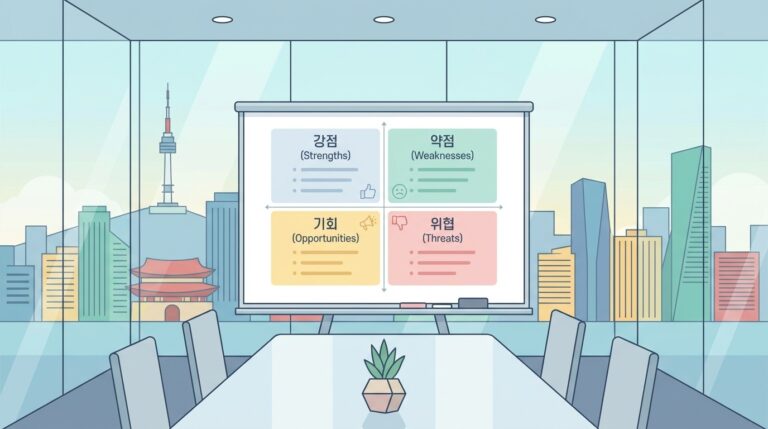
Phase 1: 공감 (Story-driven Opening)
안녕하세요! 매일한글 에디터입니다.
Picture this: You are seated in a sunlit, glass-walled conference room on the 18th floor of a high-rise in Teheran-ro, Gangnam—the buzzing corporate heart of Seoul. Across the sleek oak table sits Team Leader Min, holding a lukewarm iced Americano, listening to your presentation on launching a new wellness beverage brand. You have your PowerPoint slides meticulously prepared with the classic four-quadrant SWOT matrix. Confidently, you look up and say: “우리는 약점이 많아서 위험합니다 (We have many weaknesses, so it is dangerous).”
Suddenly, the subtle hum of the projector feels deafening. Team Leader Min blinks, adjusts his glasses, and a faint, hesitant smile crosses his face. He gently clears his throat. Did you make a grammatical mistake? Technically, no. But in a Korean corporate setting, blunt statements like that sound alarming, unpolished, and frankly amateur. In the high-stakes world of Korean business, corporate professionals do not simply state weaknesses; they frame them through sophisticated strategic lenses: “약점을 신속히 보완하여 위기 요인을 기회로 전환해야 합니다 (We must swiftly address weaknesses to convert risk factors into strategic opportunities).”
If you have ever felt your heart race during a strategy meeting, struggling to bridge the gap between intermediate textbook Korean and the high-level persuasive rhetoric demanded in Seoul boardrooms, you are not alone. Our team at Daily Hangul has coached hundreds of international professionals, brand managers, and agency founders who face this exact hurdle. Mastering C1-level business discourse is not merely about accumulating difficult Sino-Korean vocabulary (한자어); it is about mastering the cultural art of nuance, consensus-building (합의), and assertive elegance. In this comprehensive guide, we will transform how you present marketing strategies and SWOT analyses so you command the room with natural authority.
Phase 2: 핵심 표현 3선 심층 분석
1. 강점을 극대화하고 약점을 보완하다
- Pronunciation: [Gang-jeom-eul geuk-dae-hwa-ha-go yak-jeom-eul bo-wan-ha-da] (Pronounce geuk like the guttural vowel in cook combined with a crisp, non-aspirated ‘k’, and bo-wan smoothly like the English word bow followed by one).
- Meaning: Literal: Maximize strengths and supplement weaknesses. / Strategic Nuance: To leverage our unique competitive advantages while systematically mitigating vulnerabilities.
- K-Culture Moment: Reminiscent of a high-pressure pitch scene in the drama Start-Up (스타트업), where Dal-mi defends her Samsan Tech business plan before cynical Silicon Valley-style venture capitalists.
- Editor’s Insight: This is the bread and butter of executive summaries. Using the Sino-Korean verbal noun 극대화하다 (to maximize) and 보완하다 (to compensate/supplement) immediately elevates your pitch from amateur school-project level to seasoned C-suite strategist.
- Situation Spectrum: Casual 🚫 | Semi-formal ⚠️ | Formal ✅
- 🤔 Think About It: In English, we often say “fix our flaws.” Why does Korean corporate culture prefer the gentler, constructive verb 보완하다 (supplement/complement) rather than 고치다 (repair)? What does this reveal about Korean workplace face-saving (체면)?
2. 위기 요인을 기회로 전환하는 돌파구를 마련하다
- Pronunciation: [Wi-gi yo-in-eul gi-hwe-ro jeon-hwan-ha-neun dol-pa-gu-reul ma-ryeon-ha-da] (Think of dol as the sturdy thud of a stone, and pa-gu popping crisply like the English syllable pah-goo).
- Meaning: Literal: Prepare a breakthrough that converts crisis factors into opportunities. / Strategic Nuance: Formulate a resilient countermeasure that turns macro threats into our biggest strategic upside.
- K-Culture Moment: Echoing the decisive crisis management conferences in Queen of Tears (눈물의 여왕), when executives analyze hostile acquisitions and pivot their entire retail portfolio under extreme duress.
- Editor’s Insight: In Korean strategic analysis, the word 위기 (crisis/threat) is deeply bound to the philosophical concept that every danger contains the seed of an opportunity (기회). The metaphorical noun 돌파구 (breakthrough/exit route) communicates forward momentum and decisive leadership.
- Situation Spectrum: Casual 🚫 | Semi-formal ⚠️ | Formal ✅
- 🤔 Think About It: Compare how Western boardrooms celebrate disruptive “radical pivots” versus how Korean organizations value structured, calculated breakthroughs (돌파구 마련). How does the language reflect this sense of shared responsibility?
3. 선제적 대응 전략을 통해 시장 점유율을 확보하다
- Pronunciation: [Seon-je-jeok dae-eung jeon-ryak-eul tong-hae si-jang jeom-yu-yul-eul hwak-bo-ha-da] (The double consonant in hwak snaps shut at the back of your throat like the click of a briefcase latch).
- Meaning: Literal: Secure market share through proactive response strategies. / Strategic Nuance: To preemptively stake out market dominance before competitors can respond to incoming industry trends.
- K-Culture Moment: Recall the boardroom battles in Search: WWW (검색어를 입력하세요 WWW), where rival web portal directors clash over market share metrics and algorithmic dominance.
- Editor’s Insight: 선제적 (preemptive/proactive) is a potent buzzword in contemporary Korean corporate planning. Coupling it with 점유율을 확보하다 (capture/secure market share) proves you are looking ahead at trend cycles rather than merely reacting to current losses.
- Situation Spectrum: Casual 🚫 | Semi-formal ⚠️ | Formal ✅
- 🤔 Think About It: How does phrasing action as 대응 (response/counter-action) project agility without sounding reckless to conservative decision-makers?
Phase 3: 교과서 한국어 vs 진짜 한국어
Situation 1: Analyzing Intense Competitor Threats (외부 위협 분석)
- 📖 교과서 한국어: 지금 경쟁 회사가 많아서 물건을 팔기 어렵습니다. (Jigeum gyeongjaeng hoesaga manaseo mulgeon-eul palgi eoryeopseumnida. / Right now, there are many competitor companies, so selling goods is difficult.)
- 🗣️ 진짜 한국어: 후발 주자들의 공세가 거세지는 상황인 만큼, 당사만의 독보적인 가치를 강조하지 않으면 출혈 경쟁으로 번질 위험이 큽니다. (Hubal jujadeur-ui gongsega geosejineun sanghwang-in mankeum, dangsamaneui dokbojeogin gachireul gangjohaji aneumyeon chulhyeol gyeongjaeng-euro beonjil wiheomi keumnida. / As late entrants launch an aggressive offensive, unless we emphasize our unrivaled value proposition, we risk slipping into a ruinous price war.)
- 💡 왜 다를까? Textbook Korean sounds overly simplistic and defeatist. Real C1-level business Korean employs industry-standard metaphors like 후발 주자 (latecomer competitors) and 출혈 경쟁 (cutthroat/bleeding competition) to describe market conditions objectively and analytically.
Situation 2: Proposing a Niche Opportunity Strategy (기회 요인 활용)
- 📖 교과서 한국어: 젊은 사람들이 좋아하니까 신제품을 빨리 만듭시다. (Jeolmeun saramdeuri joahannikka sinjepum-eul ppalli mandeupsida. / Young people like it, so let’s quickly make a new product.)
- 🗣️ 진짜 한국어: 2030 세대의 소비 트렌드를 반영하여, 틈새시장을 겨냥한 파일럿 프로젝트로 초기 반응을 테스트하는 쪽으로 가닥을 잡아야 합니다. (I-gong-sam-gong sedae-ui sobi teurendeureul banyeonghayeo, teumsaesijang-eul gyeonanghan paireot peurojekteuro chogi baneung-eul teseuteuhaneun jjogeuro gadaegeul jabaya hamnida. / Reflecting the consumption trends of the 2030 demographic, we should settle on running a targeted pilot project to gauge initial market sentiment.)
- 💡 왜 다를까? Professional Korean pitchmen never rely on vague terms like 젊은 사람들 (young people); they use demographic markers such as 2030 세대 (the 20s and 30s generation). Furthermore, the idiomatic expression 가닥을 잡다 (to establish direction/bring order to thoughts) signifies collaborative consensus rather than an impulsive executive whim.
Phase 4: K-Culture 딥다이브 & 비언어적 매너
4-1. 눈치 (Nunchi) & Boardroom Body Language
When delivering a SWOT analysis in Korea, how you say it is just as vital as what you say.
* The Softened Gaze (시선 처리): When presenting the “Weaknesses” (약점) and “Threats” (위협) quadrants, never stare unblinkingly at your superiors, as this can feel confrontational. Angle your body 45 degrees toward the projection screen. Refer to the data on the slide with an open palm—never point with an index finger or the tip of a pen.
* The Cushion Pause (완충 어조): Before presenting a glaring company vulnerability, apply corporate Nunchi by taking a microscopic pause, tilting your head slightly, and prefacing with softeners like “주지하시다시피…” (As you are well aware…) or “우려하시는 바와 같이…” (As concerns have been raised…). This acknowledges leadership’s existing foresight before revealing the data.
4-2. Cultural Code Analysis: The “Pali-Pali” Trend Cycle & Seongsu-dong Pop-up Culture
Modern Korean marketing strategy lives in a state of hyper-velocity. In trendy Seoul districts like Seongsu-dong (성수동) or Hannam-dong (한남동), pop-up stores (팝업스토어) appear, achieve viral status on Instagram, and vanish within two weeks. Because consumer trends shift at breakneck speed, Korean marketing directors expect SWOT analyses to address immediate agility (기민성). A strategy formulated over three months might already be outdated upon launch. When proposing opportunities in Korean firms, framing your action around rapid validation (선제적 검증) demonstrates that you understand the relentless tempo of dynamic Korean consumer culture.
Phase 5: 실전 롤플레이 시나리오
Setting: Conference Room B at a prestigious digital branding agency in Yeouido, Seoul. Team Leader Min (민 팀장님)—known for his razor-sharp analytical mind and zero-tolerance policy for vague buzzwords—is reviewing your quarterly strategy deck.
- 민 팀장: 이번 분기 뷰티 브랜드 론칭 건, SWOT 분석 결과는 어떻게 나왔습니까? (Ibeon bungi byuti beuraendeu ronching geon, SWOT bunseok gyeolgwaneun eotteoke nawasseumnikka? / How did the SWOT analysis turn out for this quarter’s beauty brand launch?)
🎭 행동 지문: 태블릿 화면을 넘기며 날카로운 눈빛으로 발표자를 응시한다. -
당신 (You): 네, 팀장님. 우선 내부 분석 결과, 당사의 독자적인 유기농 원료 배합 기술이 독보적인 강점으로 도출되었습니다. (Ne, timjangnim. Useon naebu bunseok gyeolgwa, dangsaui dokjajeogin yuginong wollyo baehap gisuri dokbojeogin gangjeomeuro dochuldoe-eosseumnida. / Yes, Team Leader Min. First, as a result of our internal analysis, our proprietary organic ingredient blending technology emerged as our distinct strength.)
🎭 행동 지문: 양손으로 프레젠터 포인터를 쥐고 슬라이드의 강점 도표를 정중히 가리킨다. -
민 팀장: 기술력은 인정하지만, 우리 브랜드는 인지도가 바닥이지 않습니까? 약점 보완책이 없으면 시장 진입이 불가능할 텐데요. (Gisullyeog-eun injeonghajiman, uri beuraendeuneun injidoga badag-iji anseumnikka? Yakjeom bowanchae-gi eopseumyeon sijang jin-ibi bulganeunghal tendeyo. / I grant you the tech, but isn’t our brand awareness practically rock bottom? Without a plan to remedy this weakness, market entry will be impossible.)
🎭 행동 지문: 턱을 괴고 안경을 살짝 고쳐 쓰며 한숨을 삼킨다. -
당신 (You): 정확한 지적이십니다. 낮은 브랜드 인지도를 보완하기 위해, 론칭 초기에는 메가 인플루언서 협업을 통해 신뢰도를 조기에 확보하고자 합니다. (Jeonghwakhan jijeog-isimnida. Najeun beuraendeu injidoreul bowanhagi wihae, ronching chogieneun mega impeullu-eonseo hyeob-eob-eul tonghae sinroedoreul jogie hwakbohagoja hamnida. / That is an exact critique. To offset our low brand awareness, we intend to establish credibility early on through strategic collaborations with mega-influencers.)
🎭 행동 지문: 차분하게 고개를 끄덕인 뒤, 다음 장의 인플루언서 매트릭스 슬라이드를 띄운다. -
민 팀장: 그렇다면 외부 환경은 어떻습니까? 지금 K-뷰티 시장은 이미 레드오션이고, 대기업들의 가격 할인 공세가 심각합니다. (Geureotamyeon oebu hwan-gyeong-eun eotteoseumnikka? Jigeum K-byuti sijang-eun imi redeu-osyeon-igo, daegieopdeur-ui gagyeok harin gongsega simgakhamnida. / What about the external environment then? The K-beauty market is already a red ocean, and discount offensives from conglomerates are severe.)
🎭 행동 지문: 팔짱을 끼며 의자 등받이에 기대어 방어적인 태세를 취한다. -
당신 (You): 네, 위협 요인이 실재하는 것은 사실입니다. 하지만 클린 뷰티 트렌드 확산이라는 기회 요인을 레버리지하여 프리미엄 틈새시장을 공략할 계획입니다. (Ne, wiheop yo-ini siljaehaneun geoseun sasirimnida. Hajiman keullin byuti teurendeu hwaksan-iraneun gihwoe yo-in-eul rebeorijihayeo peurimieom teumsaesijang-eul gongryeokhal gyehoegimnida. / Indeed, the threat factors are very real. However, we plan to target a premium niche by leveraging the opportunity factor of the expanding clean beauty trend.)
🎭 행동 지문: 팀장님과 눈을 부드럽게 맞추며 확신에 찬 어조로 미소를 짓는다. -
민 팀장: 흠, 대기업과의 정면 대결을 피하고 가치 소비자를 타깃팅하겠다는 뜻이군요. (Heum, daegieopgwaui jeongmyeon daegyeor-eul pihago gachi sobijareul tagittinghagetdaneun tteusi-gunyo. / Hmm, so you mean to avoid head-on clashes with conglomerates and target conscious consumers instead.)
🎭 행동 지문: 고개를 천천히 끄덕이며 펜으로 책상 위 메모장에 밑줄을 긋는다. -
당신 (You): 맞습니다. 결과적으로 강점을 극대화하고 외부 위협을 상쇄하는 선제적 포지셔닝 전략으로 가닥을 잡았습니다. (Matseumnida. Gyeolgwajeog-euro gangjeom-eul geukdaehwahago oebu wiheob-eul sangswaehaneun seonjejeok pojisyeoning jeollyag-euro gadaeg-eul jabasseumnida. / Precisely. In conclusion, we have set our course on a preemptive positioning strategy that maximizes strengths while neutralizing external threats.)
🎭 행동 지문: 양손을 가지런히 모으고 결연한 표정으로 발표를 마무리한다.
🔀 인터랙티브 분기점 (Branching Decision Point)
At this critical juncture, Team Leader Min asks: “예산이 빠듯한 상황인데, 마케팅 집행 순서를 어떻게 잡으실 겁니까? (Budget is tight. What is your priority order for marketing execution?)” How do you respond?
- Option A: “일단 돈이 없으니까 SNS 광고부터 조금씩 돌려보겠습니다.” (Since we lack funds, let’s just run minor SNS ads for now.)
- Outcome (Bad 🚫): Sounds passive and unprepared. It demonstrates a lack of strategic prioritization and causes leadership to doubt your commercial acumen.
- Option B: “선택과 집중 전략을 적용하여, 브랜드 핵심 메시지를 전달할 단일 팝업스토어와 타깃 숏폼 콘텐츠에 예산을 우선 집중하겠습니다.” (Applying a strategy of selection and concentration, we will prioritize our budget on a single flagship pop-up and hyper-targeted short-form content that conveys our core brand message.)
- Outcome (Best ✅): Flawless corporate Korean. Using the power phrase 선택과 집중 (selection and focus) reassures management that scarce resources will be concentrated on high-ROI touchpoints.
- Option C: “경쟁사들도 다 마케팅을 하니까 우리도 일단 인플루언서 섭외에 전액을 투자해야 합니다.” (Since all competitors market heavily, we should also invest the entire sum into influencer outreach immediately.)
- Outcome (Risk ⚠️): Overly reactive and reckless. Betting the full budget on a single channel without risk diversification will trigger alarm bells for any risk-conscious Korean team lead.
Phase 6: 10초 감정 섀도잉 드릴 (Shadowing Drill)
Practice these high-frequency strategic lines out loud. Pay strict attention to the breath pauses (/) and embody the indicated business demeanor.
[💼 단호하고 자신감 넘치게 / Firm & Confident]
“당사의 독자적인 기술력이라는 / 강점을 극대화하여, / 시장 점유율을 / 선제적으로 확보하겠습니다.”
(Dangsa-ui dokjajeogin gisullyeog-iraneun / gangjeom-eul geukdaehwahayeo, / sijang jeomyuyur-eul / seonjejeog-euro hwakbohagess-eumnida.)-
[🧐 신중하고 분석적으로 / Deliberate & Analytical]
“단순한 가격 경쟁을 지양하고, / 위기 요인을 기회로 전환할 / 전략적 돌파구를 마련해야 합니다.”
(Dansunhan gagyeok gyeongjaeng-eul jiyanghago, / wigi yoin-eul gihwoe-ro jeonhwanhal / jeollyakjeok dolpagureul maryeonhaeya hamnida.) -
[🤝 정중하게 합의를 이끌어내며 / Diplomatic & Consensus-Building]
“팀장님께서 우려하시는 약점 요인은 / 철저한 데이터 검증을 통해 / 보완하는 쪽으로 / 가닥을 잡았습니다.”
(Timjangnimkkeseo uryeohasineun yakjeom yoineun / cheoljeohan de-iteo geomjeung-eul tonghae / bowanhaneun jjogeuro / gadaegeul jabasseumnida.)
Phase 7: K-Culture 미니 사전
-
틈새시장 [Teum-sae-si-jang] (Niche Market)
Literal: Gap-in-the-wall market.
Usage: Refers to an overlooked market segment. When your SWOT matrix reveals heavy conglomerate rivalry in mainstream channels, Korean strategists will invariably advocate for 틈새시장 공략 (penetrating niche markets). -
가닥을 잡다 [Ga-dag-eul Jap-da] (To establish direction / take shape)
Literal: To hold a strand of thread.
Usage: Originating from traditional textile weaving where untangling tangled threads brings order. In meetings, saying “방향성의 가닥을 잡았습니다” means you have organized complex variables into a unified roadmap. -
출혈 경쟁 [Chul-hyeol Gyeong-jaeng] (Cutthroat/Bleeding Price War)
Literal: Hemorrhage competition.
Usage: Used to characterize extreme price-slashing tactics that drain company margins. Essential when presenting external threats (위협 요인) to justify avoiding destructive discount battles. -
선택과 집중 [Seon-taek-gwa Jip-jung] (Selection and Focus)
Literal: Choice and concentration.
Usage: Korea’s quintessential strategic mantra. Whenever resources are constrained or the market is fiercely contested, executives repeat this phrase to justify eliminating secondary features in favor of core strengths.
Phase 8: 비즈니스 출장자를 위한 생존 키트
Corporate Meeting Survival Expressions TOP 3
- “회의 자료 공유해 드리겠습니다.”
[Hwoei-ui jaryo gong-yu-hae deu-ri-get-seum-ni-da]
(Pro Tip: Announce this while distributing printed handouts with both hands or screensharing your presentation slides.) - “추가적인 데이터는 즉시 보완하여 보고드리겠습니다.”
[Chu-ga-jeo-gin de-i-teo-neun jeuk-si bo-wan-ha-yeo bo-go-deu-ri-get-seum-ni-da]
(Pro Tip: The ultimate face-saving line when an executive asks for an obscure metric you do not have on hand.) - “팀장님 말씀 취지에 적극 공감합니다.”
[Tim-jang-nim mal-ssum chwi-ji-e jeok-geuk gong-gam-ham-ni-da]
(Pro Tip: Use this to validate your manager’s critique before presenting a counter-perspective.)
Editor’s Business Travel Note
Navigating business meetings in Seoul requires punctuality and spatial agility. Google Maps offers limited pedestrian pathfinding in South Korea due to national security mapping regulations; therefore, ensure you download local navigation tools before landing. We strongly suggest checking the 네이버 지도 앱 다운로드 page to master accurate door-to-door transit times between the Gangnam tech corridor and Yeouido finance hubs. Furthermore, remember that business cards (명함) are still treated as extensions of personal honor in Korea: always accept them with both hands, place them neatly on the desk during the meeting in alignment with where each person sits, and never write notes on them in front of their owner.
Phase 9: “한 발 더 깊이” (생각 질문)
In Western corporate rhetoric, debate is frequently seen as a clash of individual intellects—a crucible where the most forceful idea triumphs through vigorous argumentation. In contrast, corporate Korean strategic discourse is anchored in relational harmony and collective ownership (공동체 의식). When a Korean team formulates a SWOT analysis, they are not merely categorizing internal and external data points; they are carefully calibrating inter-departmental pride, executive sensibilities, and company-wide harmony. To describe a failure as an irreparable flaw (결함) fractures unity, whereas calling it an area requiring strategic replenishment (보완 과제) invites collective collaboration.
💬 Your Turn: In your home country’s business culture, how do you politely tell a supervisor that their current strategy is vulnerable to competitor attacks? Share your language’s equivalent in the comments below, and let’s dissect how to translate that into natural, culturally calibrated Korean!
Phase 10: FAQ & 흔한 실수 (FAQ Schema)
Q: SWOT 분석을 한국어로 발표할 때 약어(SWOT)를 그대로 읽어도 되나요?
A: Yes, Korean corporations universally understand “스왓 분석” (Seu-wat bun-seok). However, when breaking down each quadrant on your slides, senior directors expect you to use professional Sino-Korean headings: 강점 (Strengths), 약점 (Weaknesses), 기회 (Opportunities), and 위협 (Threats) rather than English labels.
Q: 비즈니스 미팅에서 ‘제 생각에는’이라는 표현을 써도 되나요?
A: While grammatically correct, using “제 생각에는…” (In my opinion…) repeatedly at the C1 level can sound subjective and informal. Instead, ground your statements in empirical rigor by using phrases like “데이터 분석 결과에 따르면…” (According to data analysis…) or “시장 동향을 미루어 볼 때…” (Judging by market trends…).
Q: 동료나 부하 직원의 의견에 반대할 때는 어떤 완충 표현이 좋은가요?
A: Avoid saying “틀렸습니다” (You are wrong) or “아닙니다” (No). Instead, use diplomatic bridging statements such as “좋은 인사이트입니다만, 리스크 관리 차원에서 한 가지 검토할 사항이 있습니다” (That is a great insight, however from a risk management standpoint there is one aspect we must examine).
🚨 흔한 실수 (Common Mistakes) 경고판
- Mistake: Saying “우리 회사는 나쁜 점이 많습니다.” (Our company has many bad things.)
Correct Action: Use “당사의 현행 포트폴리오상 보완해야 할 약점 요인이 존재합니다.” (There exist vulnerability factors in our current portfolio that require systematic compensation.) - Mistake: Overusing the passive “기회가 생겼습니다.” (An opportunity popped up.)
Correct Action: Treat opportunities actively: “시장 변화에 따른 기회 요인을 선제적으로 포착했습니다.” (We have proactively captured an opportunity factor emerging from market shifts.) - Mistake: Using aggressive imperatives with superiors like “이렇게 결정하십시오.” (Decide this way.)
Correct Action: Phrase strategic conclusions as consultative proposals: “이러한 방향으로 가닥을 잡는 방안을 제안드리고자 합니다.” (We would like to propose settling our direction along these lines.)
Phase 11: 액션 미션 & 참여 유도
Take your strategic Korean off the screen and into muscle memory with this three-tiered challenge:
- 🥉 Bronze Mission (Solo Practice): Pick your favorite consumer product (e.g., your smartphone or favorite coffee brand). On a sheet of paper, list one 강점 and one 약점 using the phrasing “[Brand]의 강점은 ~이며, 보완해야 할 점은 ~입니다.” Record yourself speaking this in under 30 seconds.
- 🥈 Silver Mission (Community Feedback): Share one SWOT sentence analyzing your favorite K-pop agency (e.g., HYBE or SM) in the comment section below using the phrase “위기 요인을 기회로 전환하다”.
- 🥇 Gold Mission (Real-World Application): In your next real-life Korean work standup or Korean language exchange session, use the phrase “~쪽으로 가닥을 잡았습니다” when summarizing your project’s current progress.
🎮 K-Culture Mission: Watch Episode 1 or 2 of the office drama Misaeng: Incomplete Life (미생) or Search: WWW (검색어를 입력하세요 WWW). Jot down every time characters use the words 대응 (response), 돌파구 (breakthrough), or 리스크 (risk). You will be amazed at how frequently these strategic concepts dictate the drama’s tension!
Phase 12: 인터랙티브 퀴즈 챌린지
Test your mastery before you enter your next presentation!
1. 상황 판단 퀴즈 (Contextual Judgment)
You are presenting your marketing strategy to the executive board. A senior director expresses deep anxiety regarding an aggressive competitor’s massive price cuts. Which response reflects the most polished C1 strategic Korean?
* (A) “가격이 너무 싸서 우리도 가격을 바로 내려야 합니다.”
* (B) “출혈 경쟁에 휩쓸리기보다는, 당사만의 차별화된 강점을 극대화하는 브랜딩 전략으로 대응해야 합니다.”
* (C) “경쟁사는 원래 그런 곳이니 신경 쓰지 말고 우리 것만 만듭시다.”
👉 정답 및 해설 확인하기 (Click to reveal answer)
정답: (B)
해설: (B) demonstrates advanced strategic vision. It uses industry terminology (출혈 경쟁, 차별화된 강점 극대화, 대응하다) to calmly acknowledge the threat while proposing a rational brand-building alternative. Option (A) is reactive and causes panic, while (C) sounds dismissive, unprofessional, and culturally careless.
2. 빈칸 채우기 퀴즈 (Fill-in-the-Blank)
Complete the corporate strategic statement below with the most natural pair of Sino-Korean verbs:
* “금번 프로젝트의 핵심은 내부적 ( )을 극대화하고, 외부적 ( )을 기회로 전환하는 데 있습니다.”
👉 정답 및 해설 확인하기 (Click to reveal answer)
정답: 강점 / 위협 (또는 위기 요인)
해설: The phrase 강점을 극대화하다 (maximize strengths) pairs naturally with converting external 위협 (threats) or 위기 요인 (crisis factors) into market opportunities.
3. 문화 상식 True/False (Cultural Etiquette)
In a formal Korean marketing pitch, pointing directly at your slide deck or at the CEO with your pointer finger is considered a confident, assertive Western-style leadership cue that will be praised by Korean executives.
* (True / False)
👉 정답 및 해설 확인하기 (Click to reveal answer)
정답: False
해설: Pointing with an index finger at individuals or presentation screens during formal Korean presentations is perceived as aggressive, didactic, and disrespectful. Presenters should always gesture toward the screen or documents using an open palm with fingers neatly grouped together.







