

Phase 1: Empathy & Storytelling Opening
안녕하세요! 매일한글 에디터입니다.
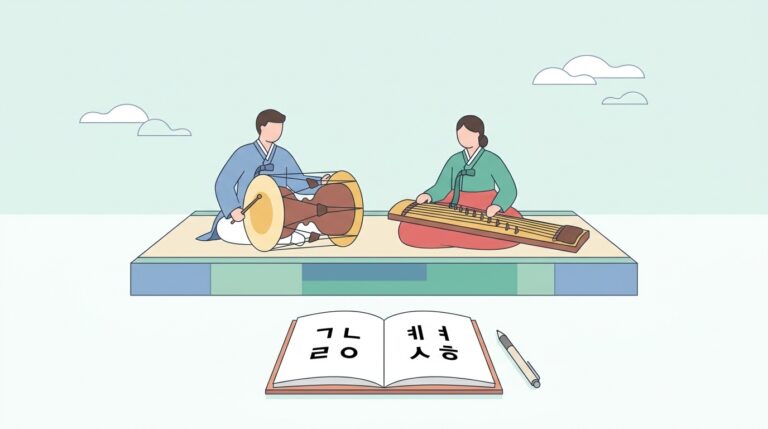
Imagine this: you’ve finally snagged a ticket to an intimate, atmospheric performance of traditional Korean music—Gugak (국악)—at the National Gugak Center in Seoul. The stage lights dim. A master musician in pristine white hanbok sits with a 12-string gayageum, plucking notes that resonate right into your bones. Suddenly, an old gentleman sitting two rows ahead shouts enthusiastically: “Eolssigu!” A beat later, someone from the balcony chimes in: “Jota!”
Your heart skips a beat. In Western classical concerts or Broadway theaters, shouting during a performance gets you escorted out by an usher with a flashlight. You clutch your program, frozen in silence, wondering: Is that an interruption? Is it an applause cue? Can I join in, or will I ruin the sacred artistic mood?
If you’ve ever felt that exact awkward freeze, you are not alone! Over the past ten years of coaching intermediate learners, I’ve heard this story countless times. Traditional Korean music is rarely a passive, “sit still and hold your breath” affair. It is an interactive, communal dialogue fueled by spontaneous joy (heung) and deep emotional release. In this guide, tailored specifically for your B2-level journey, you’ll master authentic audience interjections (chuimsae), decipher subtle performance dynamics, and step boldly into the living heartbeat of Korean performing arts.
Phase 2: Core Expressions Deep Dive
1. 얼씨구, 좋다! (Eolssigu, jota!)
- Pronunciation: [Eol-ssi-gu, jo-ta] (Think of ‘Eol-ssi’ like saying ‘all-see’ with a punchy bounce, followed by ‘gu’, and ‘jo-ta’ sounds like ‘jaw-tah’.)
- Meaning: Literal: “Look at that, it’s good!” / Nuanced: “Bravo! Keep that groove going! That’s the spirit!”
- K-Culture Moment: In the period drama Jeongnyeon: The Star Is Born (정년이) or when watching a classic pansori epic like Chunhyangga, the drummer (gosu) and the audience yell this out whenever the singer finishes an intricate vocal run or lands a soaring high note.
- Editor’s Insight: Eolssigu is a rhythmic filler word, while jota provides the direct validation. You never shout them over the singer’s delicate verses; instead, you drop them right into the natural pauses of the rhythmic cycle (jangdan). It fuels the performer’s adrenaline.
- Situation Spectrum: Casual ✅ | Semi-formal ✅ | Formal ⚠️ (Standard concert halls welcome it, but never shout it at a somber ancestral ritual like Jongmyo Jeryeak!)
- 🤔 Think About It: In many Western traditions, audiences remain dead silent until the piece ends. Why do you think Korean tradition views audience vocalization as an essential co-creation of the artwork?
2. 흥이 난다 (Heungi nanda)
- Pronunciation: [Heung-i nan-da] (Pronounce ‘Heung’ by pushing a low ‘hung’ sound upward through the nose, followed by ‘ee nan-dah’.)
- Meaning: Literal: “Joy/groove is emerging.” / Nuanced: “I’m really getting into the groove; the vibe is infectious!”
- K-Culture Moment: You’ll hear this on variety shows like Hangout with Yoo whenever traditional drums or samulnori brass gongs (kkwaenggwari) build tempo, causing everyone around to start unconsciously bouncing their shoulders.
- Editor’s Insight: Heung is not just standard happiness (haengbok); it is a collective, irrepressible kinetic euphoria. Saying “흥이 난다! (Heungi nanda!)” signals that you aren’t just an observer—you are actively catching the musical fever.
- Situation Spectrum: Casual ✅ | Semi-formal ✅ | Formal 🚫
- 🤔 Think About It: How does your native language describe the physical sensation of music moving through you? Does your culture have a standalone concept like heung?
3. 가슴을 울리다 (Gaseumeul ullida)
- Pronunciation: [Ga-seu-meul ul-li-da] (Pronounce ‘Gaseum’ like ‘gah-seum’, and ‘ullida’ like ‘wool-lee-dah’.)
- Meaning: Literal: “To make the chest/heart ring/resonate.” / Nuanced: “To touch deeply; to stir one’s soul with profound emotional gravity.”
- K-Culture Moment: Film critics and viewers frequently use this phrase when discussing the iconic pansori soundtrack of the masterpiece film Seopyeonje (서편제), particularly when traditional vocalists channel ancestral longing and sorrow (han).
- Editor’s Insight: Gugak instruments, especially the bass tones of the barrel drum (buk) and the deep rasp of the haegeum (two-string fiddle), vibrate physically inside your ribcage. This expression bridges physical acoustic resonance with emotional catharsis.
- Situation Spectrum: Casual ✅ | Semi-formal ✅ | Formal ✅
- 🤔 Think About It: Notice the metaphor: in Korean, deep emotions “ring” or “vibrate” (ullida) like a heavy temple bell, rather than simply “hitting” or “touching” the heart.
Phase 3: Textbook Korean vs. Real Korean
Scenario 1: Complimenting the master performer after a solo piece
- 📖 교과서 한국어 (Textbook):
연주가 정말 아름다웠고 감동적이었습니다.
(Yeonjuga jeongmal areumdawotgo gamdongjeogieotseumnida. / The performance was very beautiful and touching.) - 🗣️ 진짜 한국어 (Real-life B2):
선율이 아주 깊고 가슴을 울리네요. 진한 여운이 남아요.
(Seonyuri aju gipgo gaseumeul ullineyo. Jinhan yeouni namayo. / The melody was profoundly deep and stirred my soul. The lingering resonance is so powerful.) - 💡 왜 다를까? (Why the difference?):
Intermediate learners frequently overuse general adjectives like areumdapda (beautiful). True Korean art connoisseurs speak in terms of gipi (depth) and yeoun (the lingering emotional aftertaste after the sound fades away).
Scenario 2: Reacting to an upbeat traditional percussion ensemble (Samulnori)
- 📖 교과서 한국어 (Textbook):
음악이 너무 신나고 박수가 치고 싶습니다.
(Eumagi neomu sinnago baksuga chigo sipseumnida. / The music is very exciting and I want to clap.) - 🗣️ 진짜 한국어 (Real-life B2):
어깨가 절로 들썩거릴 정도로 신명이 나네요!
(Eokkaega jeollo deulsseokgeoril jeongdoro sinmyeongi naneyo! / My shoulders are bouncing on their own—the collective groove is exhilarating!) - 💡 왜 다를까? (Why the difference?):
Native speakers describe physical somatic responses (eokkaega deulsseokgeorida – shoulders bobbing up and down) and employ cultural terms like sinmyeong (ecstatic shared joy) instead of plain excitement.
Phase 4: K-Culture Deep Dive & Non-Verbal Manners
4-1. 눈치 (Nunchi) & Gestures in Gugak Venues
Attending a traditional concert requires a unique calibration of your nunchi (situational awareness):
1. The Shoulder Shrug (어깨춤 – Eokkaechum): You do not pump your fists or jump in your seat. Instead, when the tempo picks up, relax your neck and subtly lift and drop your shoulders in sync with the downbeat (deong). This non-verbal cue signals to surrounding Koreans that you understand the rhythm.
2. Timing the Shout (추임새의 타이밍): The golden rule of chuimsae (audience shouting) is: Never shout while the singer is delivering rapid-fire lyrical storytelling. Wait for the performer to sustain a long, soaring note, or shout right after they pause to let the drummer (gosu) fill the space. A well-placed “Jota!” during a breath gives the singer energy; a premature shout disrupts their cadence.
3. Clapping on the Triplets: Unlike Western pop music which leans on a 4/4 backbeat (beats 2 and 4), most traditional Korean rhythms (gutgeori, semachi) operate in undulating 3-beat groupings (12/8 time). Clap with a rolling, wave-like sway rather than rigid, march-like slaps.
4-2. Cultural Codes: The Dance Between Han (한) and Heung (흥)
To truly savor Gugak, you must grasp the dual engine of Korean traditional aesthetics: 한 (Han) and 흥 (Heung). Han represents sorrow, grief, and long-endured historical hardship. Heung is the vibrant, irrepressible spark of joy that breaks through that grief.
Modern K-pop idols regularly tap into this aesthetic—consider Stray Kids’ Thunderous (소리꾼) or BTS’s IDOL, which feature traditional samulnori brass and chuimsae shouts. When you listen to Gugak, you witness Han transforming into Heung right before your eyes. Understanding this emotional arc turns a quaint tourist outing into a profound spiritual experience.
Phase 5: Real-Life Roleplay Scenario
Setting: Seoul Donhwamun Traditional Theater near Changdeokgung. You are seated next to Harin, an experienced Gugak enthusiast who noticed you eyeing the pansori performance with fascinated curiosity.
- Harin: 오늘 소리꾼 성량이 대단하지 않아요? 장단도 기가 막히고요.
(Oneul sorikkun seongnyangi daedanhaji anayo? Jangdando giga makgigoyo.)
🎭 Leaning slightly toward you with admiring eyes after an intense vocal crescendo.
“Isn’t the vocalist’s vocal projection incredible today? And the rhythm is sensational, too.” -
You (Option branch ahead!): [See choices below]
-
Harin: 맞아요! 북소리에 가슴이 쿵쾅거려요. 저기, 다음 대목에선 같이 소리 질러 볼래요?
(Majayo! Buksorie gaseumi kungkwanggeoryeoyo. Jeogi, daeum daemogeseon gachi sori jilleo bollaeyo?)
🎭 Whispering playfully behind her program notebook.
“Right?! The barrel drum makes my heart pound. Hey, want to shout together during the next passage?” -
You: 저도 해보고 싶은데, 타이밍을 놓칠까 봐 조금 긴장돼요.
(Jeodo haebogo sipeunde, taimingeul notchilkka bwa jogeum ginjangdwaeyo.)
🎭 Chuckling modestly while keeping an eye on the drummer’s wooden stick.
“I really want to, but I’m slightly nervous I’ll miss the exact timing.” -
Harin: 걱정 마세요! 고수가 ‘얼씨구’ 하면 반박자 쉬고 ‘좋다!’ 하고 얹으면 돼요.
(Geokjeong maseyo! Gosuga ‘eolssigu’ hamyeon banbakja swigo ‘jota!’ hago eonjeomyeon dwaeyo.)
🎭 Guiding you with a subtle nod on the downbeat.
“Don’t worry! When the drummer says ‘Eolssigu’, just pause for a half-beat and lay down a ‘Jota!’.” -
You: 아, 드럼 비트 사이에 끼어드는 거군요! 이제 감이 좀 와요.
(A, deureom biteu saie kkieodeuneun geogunyo! Ije gami jom wayo.)
🎭 Smiling with newfound confidence as the singer takes a deep breath.
“Ah, so you slide into the pocket between drum beats! I’m getting the hang of it now.” -
Harin: 바로 그거예요! 자, 소리꾼 목소리 올라갑니다. 준비…
(Baro geugeoyeyo! Ja, sorikkun moksori ollagamnida. Junbi…)
🎭 Tapping her fingers rhythmically against her knee as tension mounts.
“That’s it! Look, the singer’s voice is peaking. Get ready…” -
You: (소리꾼이 긴 고음을 꺾자마자) 얼씨구, 잘한다!
([Sorikkuni gin goeumeul kkeokjamaja] Eolssigu, jalhanda!)
🎭 Exclaiming clearly with open palms resting on knees in genuine admiration.
“(Right as the vocalist bends the sustained high note) Eolssigu, brilliant!” -
Harin: 나이스! 호흡 완벽했어요!
(Naiseu! Hoheup wanbyeokhaesseoyo!)
🎭 Giving you a subtle thumbs-up under the seat divider.
“Nice! Your breath and timing were impeccable!”
🔀 Interactive Choice Point
What should you reply to Harin in Turn 2 when she praises the singer’s projection?
* Choice A: “전통 예술은 지루하다고 생각했는데, 완전히 오산이었네요. 흥이 제대로 나요!” (Best: Shows self-awareness, intermediate vocabulary ‘오산’ [miscalculation], and natural cultural enthusiasm.)
* Choice B: “너무 시끄러워서 귀가 아파요. 조용히 감상하고 싶어요.” (Bad: Highly offensive to both the performer and your seatmate; disregards the communicative nature of Pansori.)
* Choice C: “네, 저 가수 노래 아주 잘해요. 발음이 정확해요.” (Risk: A bit elementary and dry for B2; evaluates a master traditional storyteller as if grading a beginner language test.)
Phase 6: 10-Second Emotional Shadowing Drill
Train your intonation and breath control with these rhythmic Gugak reactions. Focus on the pauses (/) and emotional cues:
[😊 감탄하며 진심 어린 찬사를 보낼 때 / Admiration & Praise]
“선율이 / 정말 깊고 / 가슴을 찡하게 / 울리네요.”
(Seonyuri / jeongmal gipgo / gaseumeul jjinghage / ullineyo.)-
[🔥 흥이 폭발하여 자연스럽게 추임새를 넣을 때 / High Energy & Spontaneous Groove]
“얼씨구! / 지화자, / 좋다! / 한 번 더 / 가보자!”
(Eolssigu! / Jihwaja, / jota! / Han beon deo / gaboja!) -
[😌 깊은 여운을 음미하며 조용히 공감할 때 / Quiet Soulful Reflection]
“애절한 소리 끝에 / 묘한 신명이 / 피어오르는 게 / 참 매력적이에요.”
(Aejeolhan sori kkeute / myohan sinmyeongi / pieooreuneun ge / cham maeryeokjeogieyo.)
Phase 7: K-Culture Mini Dictionary
- 추임새 (Chuimsae) | Audience / Drummer Exclamations
- The vocal encouragements (Eolssigu, Jota, Geureochi) given during traditional performances. In modern Korean corporate culture, someone who frequently agrees and hypes up colleagues in meetings is said to “추임새를 잘 넣는다” (give great supportive reactions).
- 장단 (Jangdan) | Traditional Rhythmic Cycle
- The structural heartbeat of Korean music played on the hourglass drum (janggu) or barrel drum (buk). Unlike rigid western meters, jangdan stretches and breathes with human breath.
- 신명 (Sinmyeong) | Ecstatic Communal Joy
- A state of shared, transcendent exuberance where the boundary between spectator and artist dissolves.
- 소리꾼 (Sorikkun) | Traditional Pansori Master Singer
- Distinct from a modern commercial singer (gasu), a sorikkun is simultaneously an actor, vocalist, rhythmic technician, and oral historian.
Phase 8: Traveler’s Survival Kit
Top 3 Survival Phrases for Gugak Theaters
- “자막 안내 화면은 어디에 있나요?”
(Jamak annae hwamyeoneun eodie innayo? / Where is the subtitle display screen?)- Pro Tip: Classical pansori uses archaic Sino-Korean and southern dialect idioms. Most major performance halls provide small personal LCD screens with English and modern Korean subtitles!
- “현장 예매 좌석 남아 있나요?”
(Hyeonjang yemae jwaseok nama innayo? / Are there any on-site walk-in tickets left?)- Pro Tip: Weekend shows at Seoul Donhwamun Traditional Theater sell out quickly, but walk-in cancelation tickets often open 30 minutes before showtime.
- “공연 끝나고 악기 체험해 볼 수 있나요?”
(Gongyeon kkeunnago akgi cheheomhae bol su innayo? / Can we try the instruments after the show?)- Pro Tip: Outdoor and matinee shows frequently host free 10-minute janggu drumming workshops right by the stage.
Editor’s Travel Note
- Ticketing & Navigation: For foreigners booking tickets without a domestic Korean resident registration card, navigate to the [Interpark Ticket Global performance reservation portal] rather than the domestic portal. Download the [Naver Map navigation application] to easily locate the National Gugak Center in Seocho-dong, as Google Maps offers limited walking transit routes in Korea.
- Venue Etiquette: Traditional open-floor seating (ondol or low floor cushions) often requires removing your shoes. Always check your socks for holes before leaving your hotel!
Phase 9: “One Step Deeper” (Reflective Prompt)
In Western classical music venues, architectural design and social convention prioritize acoustic isolation and absolute audience silence; coughing can draw irritated glares. Conversely, Korean traditional performance spaces—historically staged in open village courtyards called Madang (마당)—view the performance as incomplete without the audience’s real-time vocal feedback (chuimsae). The barrier between artist and spectator is deliberately porous. This reflects a fundamental Korean philosophical principle: art is not a solitary monument created for passive worship, but a communal ritual where joy and sorrow are processed together.
💬 Your Turn: Have you ever experienced a live show where the audience was expected to speak up and participate? How did that dynamic change your connection to the performer? Let’s discuss in the comments below! (댓글로 여러분의 경험을 공유해 주세요!)
Phase 10: FAQ & Common Mistakes
Q: Can I shout ‘Eolssigu’ during any traditional Korean performance?
A: Not all of them! You should freely use chuimsae during Pansori, Minyo (folk songs), Samulnori (percussion), and Sanjo (solo instrument improvisation). However, during solemn court rituals such as Jongmyo Jeryeak (ancestral royal ritual music) or slow court banquet music (Jeongak), silence is expected.
Q: What is the single safest phrase to shout if I get nervous?
A: “좋다!” (Jota!). It is short, punchy, universally positive, and difficult to mispronounce. When you feel a musical climax, shout “Jota!” with deep vocal resonance.
Q: Can I wear modern casual clothes to a traditional Gugak hall?
A: Absolutely. While performers wear exquisite hanbok, spectators dress in comfortable smart-casual clothing. Just avoid noisy outerwear (like crinkly windbreakers) that might rustle during quiet, delicate solo passages.
🚨 Common Mistakes Warning Board
- Mistake: Shouting “Bravo!” or whistling at the climax.
- Correct Action: Whistling can sometimes be interpreted as heckling in traditional Korean settings. Stick to “좋다!” (Jota!), “얼씨구!” (Eolssigu!), or “잘한다!” (Jalhanda!).
- Mistake: Clapping only when the entire long song is finished.
- Correct Action: In Gugak, spontaneous mid-song applause following a dazzling instrumental flourish or soaring vocal leap is warmly encouraged.
- Mistake: Confusing the tempo of the downbeat.
- Correct Action: Resist the urge to rush the beat! Korean rhythms breathe with a relaxed triplet pulse. When in doubt, watch the drummer’s head nod.
Phase 11: Action Missions & Engagement
- 🥉 Bronze Mission (Solo Practice): Stand before a mirror, tap out a 3-count rhythm on your thigh (1, 2, 3… 1, 2, 3…), and practice saying “얼씨구!” on the pause with an open, confident smile.
- 🥈 Silver Mission (Social Sharing): Watch a YouTube video of a traditional gayageum sanjo or modern crossover performance (like AUX or Leenalchi). Leave a Korean comment using our phrase: “선율이 깊고 가슴을 울리네요! 흥이 납니다!”
- 🥇 Gold Mission (Real Life): Visit a traditional performing arts hall on your next trip to Korea. Deliver at least two timely chuimsae reactions during the live performance!
🎮 K-Culture Mission: Watch an episode of the historical drama Jeongnyeon: The Star Is Born or the movie Seopyeonje. Can you spot the exact moments the audience or the drummer (gosu) shouts “Jota!”? Note down what the vocalist was doing right before the shout.
Phase 12: Interactive Quiz Challenge
Test your real-world performance instincts! Click the toggles below to verify your answers.
1. Situational Judgment
You are sitting in the front row watching an intense pansori performance. The singer is currently whispering a very fast, narrative dialogue passage (aniri) explaining a character’s journey. What should you do?
* A) Shout “얼씨구!” as loudly as possible to encourage them.
* B) Remain quiet, listen attentively, and prepare your chuimsae for the upcoming melodic singing (sori).
* C) Start clapping loudly along with the beat.
👉 Click to reveal Answer & Explanation
Correct Answer: B
Explanation: The storytelling part (aniri) relies on verbal comprehension. Shouting or clapping over the speech drowns out the lyrics for other audience members. Save your enthusiastic chuimsae for the end of the phrase or when the singing (sori) ramps up!
2. Fill-in-the-Blank
Complete the natural Korean praise for a moving performance:
“악기 소리가 참 깊어서 제 ________을/를 울렸어요. (The instrument sound was so profound that it touched/resonated in my chest.)”
👉 Click to reveal Answer & Explanation
Correct Answer: 가슴 (Gaseum)
Explanation: The full idiom is 가슴을 울리다 (to strike/resonate deep within one’s chest/heart).
3. True / False Cultural Etiquette Quiz
True or False: In Korean traditional music, shouting compliments during the performance is considered rude and disruptive, just like in Western classical music concerts.
👉 Click to reveal Answer & Explanation
Correct Answer: False!
Explanation: Active audience participation (chuimsae) is an indispensable component of Korean folk performing arts. It transforms the show into a shared communal creation!







