

Cracking the Hongdae Tarot Code: How to Interpret Fortune-Telling Korean Like a Native
Phase 1: Empathy (Story-Driven Opening)
안녕하세요! 매일한글 에디터입니다.
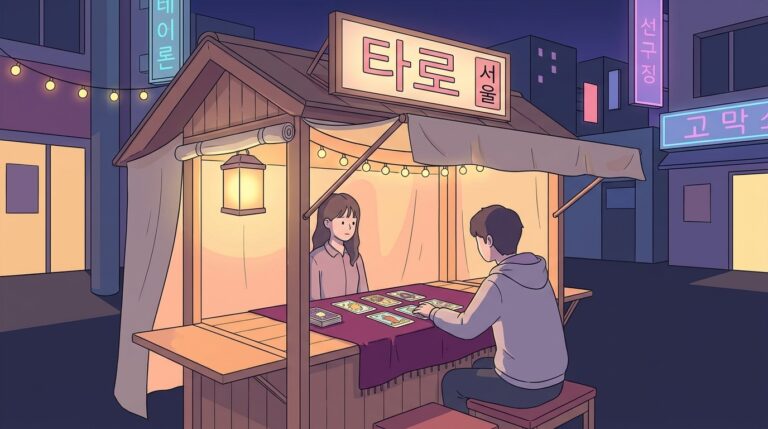
Picture this: It is a crisp Friday evening in Seoul. Neon signs reflect off the wet asphalt of Hongdae’s bustling walking streets, and nestled between trendy cosmetic boutiques and street food carts, you spot a row of cozy vinyl tents with vibrant banners announcing 타로 & 사주 (Tarot & Saju). You pull aside the thick winter curtain, stepping into an intimate space scented with sandalwood incense and gentle heater hums. Across a purple velvet table, a perceptive reader wearing silver rings looks up and smiles warmly.
“취업운 보러 오셨어요, 아니면 연애운? (Are you here for job fortune or love fortune?)”
You eagerly shuffle and draw three cards, hoping to ask about your dating life. But when the master reveals the cards, they furrow their brows and murmur: “어머, 카드가 좀 세게 나왔네… 그래도 마음먹기에 달렸어요.”
Suddenly, your mind freezes. What does it mean when a card comes out “strong” (세게 나오다)? Are they telling you disaster is imminent, or is it just a temporary bump? Why are they talking about “eating your heart” (마음먹기)?
Tarot and fortune-telling in Korea are not just ancient superstitions—they are the modern Seoulite’s favorite pop-up therapy session. However, the Korean used in these cozy booths is packed with metaphorical idioms, soft hedges, and psychological nuance that standard textbooks never teach. This guide is crafted directly from intermediate learners’ real-life field experiences, designed to help you navigate Hongdae and Gangnam tarot tents with zero hesitation and 100% confidence!
Phase 2: Core 3 Expressions Deep Dive
Here are the top three expressions you will hear in virtually every Korean tarot consultation.
1. 카드가 좀 세게 나왔어요. (Kadeuga jom sege nawasseoyo.)
- Pronunciation: [Ka-deu-ga jom se-ge na-wa-sseo-yo] (Think: “Card-gah johm seh-geh nah-wah-ssuh-yo”)
- Meaning:
- Literal: “The cards came out a bit strongly.”
- Real Nuance: “The cards look pretty intense / harsh / challenging.”
- K-Culture Moment: You will see this constantly in reality dating shows like Transit Love (환승연애) or Heart Signal whenever the cast members visit a fortune teller before a decisive date and pull the “Tower” or “Three of Swords” card.
- Editor’s Insight: Koreans avoid saying blunt negatives like “This card means disaster” (이 카드는 재앙입니다). Instead, they soften the blow by using the adverb 세게 (powerfully/intensely) alongside 좀 (a little/somewhat). It indicates that heavy emotional baggage or conflict is at play without sentencing you to doom.
- Situation Spectrum: Casual (✅ 친구끼리) | Semi-formal (✅ 점술 상담) | Formal (⚠️ 격식 있는 발표)
- 🤔 Think About It: In English, we often say “You pulled a terrible card.” Why do you think Korean culture prefers personifying the card as “coming out intense” rather than labeling your fate as definitively bad?
2. 흐름이 나쁘지 않아요. (Heureumi nappeuji anayo.)
- Pronunciation: [Heu-reu-mi na-ppeu-ji a-na-yo] (Think: “Heu-reu-mee nah-poh-jee ah-nah-yo”—like a smooth river current)
- Meaning:
- Literal: “The flow is not bad.”
- Real Nuance: “The overall trend/energy looks quite promising.”
- K-Culture Moment: In K-Dramas like Business Proposal, when an ambitious lead consults a fortune teller about a risky business venture or a new relationship, the reader squintingly reassures them with this exact phrase.
- Editor’s Insight: Koreans love the concept of 흐름 (flow/current). Life, luck, and conversation are all perceived as moving water. Saying something is “not bad” (나쁘지 않다) is a classic Korean double negative that acts as an optimistic affirmation with an air of humble restraint.
- Situation Spectrum: Casual (✅) | Semi-formal (✅) | Formal (✅ 비즈니스 기획 회의)
- 🤔 Think About It: Do you describe your life events as static individual moments, or as an evolving “flow”? How does viewing fortune as a current change your perspective on setbacks?
3. 마음먹기에 달렸어요. (Maeummokgie dallyeosseoyo.)
- Pronunciation: [Ma-eum-meok-gi-e dal-lyeo-sseo-yo] (Think: “Mah-eum-muck-gee-eh dahl-lyuh-ssuh-yo”)
- Meaning:
- Literal: “It hangs on how you eat your mind.”
- Real Nuance: “It all depends on your mindset and resolve.”
- K-Culture Moment: Heard repeatedly in youth coming-of-age dramas (like Twenty-Five Twenty-One), where mentors encourage struggling athletes or dreamers right before their make-or-break moment.
- Editor’s Insight: In Korean, resolving to do something is called 마음을 먹다 (literally, to “consume/ingest your mind”). When combined with ~에 달리다 (to depend on / to hang upon), it shifts the ultimate power of destiny back into your hands. A tarot master might read bad cards, but they will almost always conclude with this empowering phrase!
- Situation Spectrum: Casual (✅) | Semi-formal (✅) | Formal (✅)
- 🤔 Think About It: Notice the culinary connection to the soul: in Korean, you “eat your mind” to make a decision, “eat a scare” (겁을 먹다) to feel afraid, and “eat an age” (나이를 먹다) to get older!
Phase 3: Textbook Korean vs Real Korean
Level up your conversational realism by swapping out robotic textbook Korean for colloquial phrasing.
Situation 1: Asking if your future love life will improve
- 📖 교과서 한국어 (Textbook):
- 저의 미래 연애운은 좋습니까? (Jeoui mirae yeonaeuneun joseumnikka? / Is my future love fortune good?)
- 🗣️ 진짜 한국어 (Real-life Native):
- 올해 연애운 좀 슬슬 풀릴까요? (Olhae yeonaeun jom seulseul pullilkkayo? / Will my romantic luck gradually start unlocking this year?)
- 💡 왜 다를까? (Cultural Insight): In everyday Korean, fortunes do not merely exist as “good” or “bad.” Fortunes 풀리다 (untangle / open up like a knot). Using 슬슬 (gradually / smoothly) makes your inquiry sound warm, expressive, and deeply native.
Situation 2: Reacting when the reader nails your exact situation
- 📖 교과서 한국어 (Textbook):
- 당신의 점괘는 대단히 정확합니다. (Dangsinui jeomgwaeneun daedanhi jeonghwakhamnida. / Your divination result is exceedingly accurate.)
- 🗣️ 진짜 한국어 (Real-life Native):
- 와, 소름… 완전 제 얘기인데요? (Wa, soreum… wanjeon je yaegi-inde-yo? / Whoa, goosebumps… That is literally 100% my story!)
- 💡 왜 다를까? (Cultural Insight): Koreans rarely praise an intuitive reading with dry adjectives like “accurate.” Expressing visceral body reactions—like saying 소름 (short for 소름 돋다, getting goosebumps)—signals emotional resonance and builds instant camaraderie with the reader.
Phase 4: K-Culture Deep Dive & Non-Verbal Manners
4-1. 눈치 (Nunchi) & Physical Etiquette in the Tarot Booth
- The Left-Hand Rule: When a tarot master spreads the deck across the velvet runner and says, “세 장 골라보세요” (Pick three cards), use your left hand. In Korean esoteric tradition, the left hand connects directly to intuition and heart sincerity, while the right hand represents logic and calculation.
- No Flipping On Your Own: Never flip the cards face-up yourself! Simply slide the chosen cards slightly forward toward the center or place them atop each other as requested. Flipping them yourself is considered hasty and disrupts the reader’s ritual pacing.
- Two-Handed Cash Exchange: Even in our digital era, many street tarot tents prefer cash or simple mobile transfers. When handing over the 복채 (consultation fee), always use both hands or support your right wrist with your left hand as a sign of mutual respect.
4-2. The Cultural Phenomenon: Tarot as Micro-Counseling
In South Korea, stepping into a tarot booth is rarely about dogmatic superstition. For young Koreans surviving high-stress academy cycles, competitive hiring seasons, and hyper-demanding dating customs, tarot booths serve as an accessible, non-judgmental 마음 치유 (heart-healing) space. Rather than a fortune teller dictating an unchangeable fate, a Korean tarot reader acts as an empathetic sounding board who validates your recent heartaches and nudges you toward positive resolve.
Phase 5: Real-Life Roleplay Scenario
Setting: You are inside 별빛 타로 (Starlight Tarot), an intimate wooden booth off the main street of Yeonnam-dong. Master Dami, an observant reader with soothing eyes and a warm smile, welcomes you.
- Reader (You): 안녕하세요! 타로 처음 보는데, 취업운 좀 볼 수 있을까요?
(Annyeonghaseyo! Taro cheoeum boneunde, chwieobun jom bol su isseulkkayo?)
“Hello! It’s my first time trying tarot; could I check my job prospects?”
🎭 두 손을 모으고 살짝 긴장한 표정으로 묻는다. -
Master Dami: 어서 오세요! 편하게 앉으세요. 최근에 서류나 면접 때문에 마음고생 심하셨죠?
(Eoseo oseyo! Pyeonhage anjeuseyo. Choegeune seoryuna myeonjeop ttaemune maeumgosaeng simhasyeotjyo?)
“Welcome! Make yourself comfortable. You’ve had quite a lot of heartache recently over resumes or interviews, haven’t you?”
🎭 부드러운 미소로 눈을 맞추며 카드를 촤르륵 셔플한다. -
Reader (You): 네, 맞아요. 어떻게 아셨어요? 계속 떨어져서 자신감이 많이 떨어졌어요.
(Ne, majayo. Eotteoke asyeosseoyo? Gyesok tteoreojyeoseo jasingami mani tteoreojyeosseoyo.)
“Yes, exactly. How did you know? I kept failing, so my confidence took a big hit.”
🎭 씁쓸하게 웃으며 고개를 끄덕인다. -
Master Dami: 왼손으로 가장 마음이 끌리는 카드 세 장만 신중하게 뽑아보실래요?
(Oenson-euro gajang maeumi kkeullineun kadeu se jangman sinjunghage ppobabosillaeyo?)
“Could you pick the three cards your heart is drawn to most, using your left hand?”
🎭 부채꼴 모양으로 벨벳 천 위에 카드를 넓게 펼쳐 보인다. -
Reader (You): 음… 이 세 장이요. 제발 좋은 결과 나왔으면 좋겠어요.
(Eum… i se jang-iyo. Jebal joeun gyeolgwa nawasseumyeon jokgesseoyo.)
“Hmm… these three. I really hope something good comes out.”
🎭 신중하게 왼손가락으로 세 장을 밀어 올린다. -
Master Dami: 초반 카드가 좀 세게 나왔지만, 마지막 카드는 대박인데요? 흐름이 나쁘지 않아요.
(Choban kadeuga jom sege nawatjiman, majimak kadeun daebaginde-yo? Heureumi nappeuji anayo.)
“The opening card came out a bit intense, but this last card is amazing! The overall flow is actually not bad at all.”
🎭 카드를 차례대로 뒤집으며 눈을 반짝인다. -
Reader (You): 정말요? 와, 다행이네요! 그럼 이번 하반기에는 좀 풀릴까요?
(Jeongmallyo? Wa, dahaeng-ine-yo! Geureom ibeon habanggieneun jom pullilkkayo?)
“Really? Wow, what a relief! So will things finally open up for me in the second half of the year?”
🎭 가슴을 쓸어내리며 안도한다. -
Master Dami: 네, 조급해하지 마세요. 결국 마음먹기에 달렸으니 흔들리지 말고 밀고 나가세요.
(Ne, jogeuphaehaji maseyo. Gyeolguk maeummokgie dallyeosseuni heundeulliji malgo milgo nagaseyo.)
“Yes, don’t rush. In the end, it all depends on your mindset, so don’t waver—push forward!”
🎭 격려하듯 따뜻한 눈빛으로 주먹을 쥐어 보인다.
🔀 Interactive Decision Point
How would you thank Master Dami and wrap up your reading smoothly?
- Option A: “선생님 말씀 들으니 마음이 진짜 놓여요. 복채 여기 있습니다!” (Seonsaengnim malsseum deureuni maeumi jinjja noyeoyo. Bokchae yeogi itseumnida!)
- Option B: “카드 점괘가 맞는지 안 맞는지 제가 나중에 확인해 볼게요.” (Kadeu jeomgwaega manneunji an manneunji jega najunge hwaginhae bolgeyo.)
- Option C: “미래를 완벽하게 예측해 주셔서 고마워요. 무조건 합격하겠네요!” (Miraereul wanbyeokhage yecheukhae jusyeoseo gomawoyo. Mujogeon hapgyeokhagenneyo!)
Feedback:
* Option A (Best Choice): 🌟 Courteous, emotionally mature, and deeply respectful. Addressing the reader respectfully as 선생님 (Teacher/Master) and expressing emotional relief (마음이 놓이다) creates the ultimate warm interaction!
* Option B (Bad Choice): ❌ Too skeptical and blunt. It sounds like you are interrogating their professional competence.
* Option C (Risky Choice): ⚠️ Dangerous over-dependence. In Korean culture, tarot provides guidance, not absolute guarantees. Claiming you will “unconditionally pass” misses the reader’s advice that your mindset matters most.
Phase 6: 10-Second Emotional Shadowing Drill
Practice reading these out loud with rhythm and authentic emotional cadence. Slash marks (/) indicate natural pause points.
[🥺 불안하고 떨리는 마음으로 / With nervous anticipation]- 제발 / 이번에는 / 좋은 결과가 나왔으면 좋겠어요.
(Jebal / ibeoneneun / joeun gyeolgwaga nawasseumyeon jokgesseoyo.) - “Please… / this time… / I really hope a good result comes out.”
- 제발 / 이번에는 / 좋은 결과가 나왔으면 좋겠어요.
[😲 전율을 느끼며 감탄하듯 / With pure awe and goosebumps]- 와, 소름… / 선생님, / 완전 제 속마음 들킨 것 같아요!
(Wa, soreum… / seonsaengnim, / wanjeon je sokmaeum deulkin geot gatayo!) - “Whoa, chills… / Master, / it feels like you totally read my secret thoughts!”
- 와, 소름… / 선생님, / 완전 제 속마음 들킨 것 같아요!
[✨ 안도하며 희망차게 / Relieved and filled with hope]- 흐름이 나쁘지 않다니 / 정말 다행이에요. / 마음 다잡고 해볼게요!
(Heureumi nappeuji antani / jeongmal dahaeng-ieyo. / Maeum dajapgo haebolgeyo!) - “Hearing the flow isn’t bad / is such a huge relief. / I’ll reset my mindset and give it my best!”
- 흐름이 나쁘지 않다니 / 정말 다행이에요. / 마음 다잡고 해볼게요!
Phase 7: K-Culture Mini Dictionary
- 사주 (Saju – Four Pillars of Destiny): Korean traditional astrology based on the year, month, day, and hour of birth. While Tarot looks at immediate 3–6 month vibes, Saju examines your lifetime destiny blueprint. Many booths offer both.
- 연애운 / 금전운 (Yeonae-un / Geumjeon-un): “Love Luck / Wealth Luck.” The two undisputed kings of fortune categories. If you want general career luck, ask for 취업운 (Employment luck) or 사업운 (Business luck).
- 찰떡같다 (Chaltteokgatda): Literally “sticky like glutinous rice cake.” Used figuratively to describe an uncannily accurate fortune reading (점괘가 찰떡같다) or great compatibility with a partner (궁합이 찰떡이다).
- 복채 (Bokchae): The traditional term for the fee paid to a fortune teller or diviner. The character 복 (Bok) means blessing or fortune—signifying that you are paying in exchange for receiving good fortune.
Phase 8: Traveler’s Survival Kit
Top 3 Survival Phrases for Hongdae Fortune Tents
- 연애운 위주로 보고 싶어요. (Yeonae-un wijuro bogo sipeoyo.)
- Meaning: “I’d like to look primarily at my love fortune.”
- Pro Tip: Use [Category] + 위주로 (focusing on…) to instantly direct the reading to your most pressing concern.
- 이 카드는 구체적으로 무슨 뜻인가요? (I kadeuneun guchejeogeuro museun tteusingayo?)
- Meaning: “What does this card mean specifically?”
- Pro Tip: When an ominous card like Death or the Devil appears, use this phrase to prompt the reader to unpack the constructive lessons behind the imagery.
- 계좌이체나 카드 결제도 되나요? (Gyejwa-ichena kadeu gyeoljedo doenayo?)
- Meaning: “Do you accept bank transfer or credit card?”
- Pro Tip: While brick-and-mortar tarot cafes take credit cards, small street vinyl booths often prefer Korean bank transfers or crisp cash.
Editor’s Travel Note
- Where to Go: Head to Hongdae’s Eoulmadang-ro (홍대 어울마당로) or the alleys near Yeonnam-dong Dongjin Market. Another prominent spot is the bustling fortune street behind Gangnam Station Exit 11.
- Essential Navigation: Download the 네이버 지도 앱 다운로드 to search “홍대 타로” and check real customer reviews and pricing beforehand. Sessions typically range from 10,000 to 30,000 KRW per question or theme.
Phase 9: “One Step Deeper” (Reflective Essay)
In modern Korean society, fortune-telling rarely operates as fatalistic dogma. Instead, it serves as a shared cultural ritual of collective empathy. When a tarot master examines your cards and tells you that 흐름이 나쁘지 않다 (the flow isn’t bad), they are subtly providing psychological shelter in a world that often demands perfection. The beauty of phrases like 마음먹기에 달렸어요 lies in their gentle paradox: destiny presents the card, but your human heart decides how to play it. In this sense, a tarot tent in Seoul is less of an occult sanctuary and more of a sanctuary for the weary spirit.
💬 Your Turn: Have you ever had your tarot cards read, or visited an authentic Korean fortune tent? Which fortune category—Love (연애운), Wealth (금전운), or Career (취업운)—would you ask about first? Share your thoughts in the comments below!
Phase 10: FAQ & Avoiding Misunderstandings
Q: Can I visit a Korean tarot tent even if my Korean isn’t fluent?
A: Absolutely! Many popular tarot booths in Hongdae, Myeongdong, and Itaewon have English signs or readers with basic conversational English. However, bringing the key vocabulary from this guide—like 흐름 (flow) and 연애운 (love luck)—will elevate your consultation to an authentic cultural exchange.
Q: What is the primary difference between 타로 (Tarot) and 사주 (Saju)?
A: 타로 (Tarot) examines short-term questions, fluctuating psychology, and immediate relationship dynamics (typically within 3 to 6 months). 사주 (Saju), on the other hand, analyzes your life’s innate cosmic architecture using your precise birth year, month, day, and time.
Q: Is it considered rude to ask questions during the card reading?
A: Not at all! Korean readers love active, engaged listeners. Reacting with phrases like “아, 진짜요?” (Oh, really?) or “그럼 이건 어떻게 해야 돼요?” (Then what should I do about this?) makes the session dynamic and personalized.
🚨 Common Mistakes Warning Board
- Calling the reader 아줌마 (Ajumma): 🚫 Never call a tarot reader 아줌마. Always address them politely as 선생님 (Seonsaengnim – Teacher/Master).
- Flipping the cards prematurely: 🚫 Never turn the cards over yourself unless the master explicitly says “뒤집어보세요” (Please flip them).
- Demanding 100% yes/no predictions: 🚫 Asking “Will I get married at 28, yes or no?” goes against the interpretive spirit of Korean tarot. Ask about tendencies and future flows instead!
Phase 11: Action Mission & Engagement
- 🥉 Bronze Level (Solo Practice): Stand before a mirror and practice saying: “선생님, 올해 제 연애운 흐름은 어때요?” with authentic inflection, pausing naturally after 선생님.
- 🥈 Silver Level (Social Sharing): Pull your own daily tarot card (or choose a digital one), snap a picture, and post it to Instagram or your study journal with the caption: “오늘의 카드! 흐름이 나쁘지 않네요. 마음먹기에 달렸어요 ✨”
- 🥇 Gold Level (Real-World Execution): Visit a Korean fortune tent in Seoul or practice in a Korean language exchange session, using at least two core phrases from Phase 2!
- 🎮 K-Culture Mission: Watch an episode of a Korean dating reality show (like Transit Love or I am Solo) where the cast visits a fortune teller. Listen carefully and see if you can catch the words 흐름, 세게, or 복채!
Phase 12: Interactive Quiz Challenge
Test your mastery of Korean fortune-telling language and etiquette!
- Situation Judgment: You sit before a tarot master in Hongdae. They lay out a fan of cards and ask you to pick three. What is the most culturally authentic way to select them?
- (A) Grab three cards quickly with both hands and immediately flip them face-up.
- (B) Use your left hand to gently slide three cards forward without flipping them.
- (C) Use your phone camera to scan the card backs first.
- Fill in the Blank: Fill in the missing word meaning “It depends on your mindset”:
- “결국 _________에 달렸어요.”
- (Hint: Ingesting your mind)
- True / False Culture Quiz: In Korean fortune-telling culture, if the reader says “카드가 좀 세게 나왔어요”, it means your fortune is hopelessly ruined and cannot be changed.
- (True / False)
👉 Click here to reveal the answers and explanations!
- Answer: (B)
- Explanation: In Korean fortune culture, using your left hand symbolizes drawing from intuition and heart sincerity. You should never flip the cards yourself; let the reader reveal them.
- Answer: 마음먹기 (Maeummokgi)
- Explanation: 마음을 먹다 (to consume one’s mind = to resolve/decide) turns into the noun clause 마음먹기에 달렸다 (it depends on your mindset/resolve).
- Answer: False
- Explanation: 세게 나오다 simply means the cards show intense friction, strong emotional waves, or steep challenges. It is an invitation to reflect and adjust your approach, not an unchangeable death sentence!
- Explanation: 세게 나오다 simply means the cards show intense friction, strong emotional waves, or steep challenges. It is an invitation to reflect and adjust your approach, not an unchangeable death sentence!







