

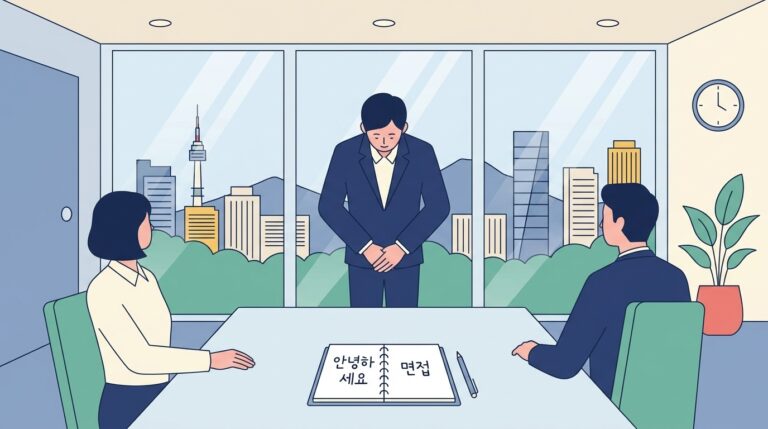
Master Your Korean Job Interview: How to State Your Career Ambitions Naturally
Phase 1: 공감 (Story-driven Opening)
안녕하세요! 매일한글 에디터입니다.
Have you ever watched the iconic drama Misaeng (미생) and felt your heart race during those intense interview scenes? Picture this: You are sitting straight in a bright glass room overlooking Tehran-ro in Gangnam. The lead interviewer glances over your resume, looks up, and asks: “우리 회사에 입사해서 어떤 인재가 되고 싶습니까?” (What kind of talent do you want to become after joining our company?). Your throat tightens. In your native language, you would say, “I want to lead big projects, challenge myself, and change the company!” But how do you say that in Korean without sounding arrogant, self-centered, or inappropriately aggressive?
Many intermediate learners stumble here. In Korea, stating your “포부” (ambition/aspirations) requires a delicate balance between personal drive and team harmony. Using textbook phrases like “열심히 하겠습니다” (I will work hard) sounds like an elementary school student, while overly direct Western-style bragging can signal poor cultural compatibility. This guide is crafted directly from real mock interview feedback with international job seekers in Seoul. By the end of this lesson, you will possess the exact phrasing, polite cadence, and cultural nuance needed to showcase your ambition like an authentic, highly employable bilingual professional.
Phase 2: 핵심 표현 3선 심층 분석 (Top 3 Core Expressions)
1. 회사와 함께 성장하는 인재가 되겠습니다.
- Pronunciation: [Hwesawa hamkke seongjanghaneun injaega doegetseumnida] (Sounds like: Hwe-sah-wa hahm-kkay sung-jahng-hah-noon in-jae-gah dway-get-soom-nee-dah)
- Meaning: “I will become an asset who grows together with the company.”
- K-Culture Moment: Often heard in the climax of job-hunting dramas like Start-Up or Radiant Office, where the applicant proves they value long-term loyalty over job-hopping.
- Editor’s Insight: In Korean corporate culture, “growth” (성장) is rarely seen as purely solo. Combining “together” (함께) with “talent/asset” (인재) creates an immediate sense of organizational alignment and teamwork.
- Situation Spectrum: Casual 🚫 | Semi-formal ⚠️ | Formal ✅
- 🤔 Think About It: Why does Korean corporate culture prioritize mutual growth (동반 성장) over individual rockstars? How does this reflect the traditional collectivist mindset compared to your home country?
2. 제 경험과 역량을 발휘하여 기여하고 싶습니다.
- Pronunciation: [Je gyeongheomgwa yeongnyang-eul balhwi-hayeo giyeohago sipseumnida] (Sounds like: Jae gyung-huhm-gwa young-nyahng-ool bahl-hwee-hah-yuh gee-yuh-hah-go sheep-soom-nee-dah)
- Meaning: “I wish to contribute by demonstrating my experience and core competencies.”
- K-Culture Moment: Used by experienced hires in business melodramas like Search: WWW when negotiating project roles with executives.
- Editor’s Insight: Notice the verb “기여하다” (to contribute). Rather than simply saying “I want to do this job,” you frame your value around what you give back to the team.
- Situation Spectrum: Casual 🚫 | Semi-formal ⚠️ | Formal ✅
- 🤔 Think About It: Notice the humble positioning of “제” (my, humble form) alongside the confident noun “역량” (competency). How does Korean balance humility and self-confidence in a single breath?
3. 부족한 점은 빠르게 배우고 채워 나가겠습니다.
- Pronunciation: [Bujokhan jeom-eun ppareuge baeugo chaewo nagagetseumnida] (Sounds like: Boo-johk-hahn juhm-oon pah-roo-gay bae-oo-go chae-woh nah-gah-get-soom-nee-dah)
- Meaning: “I will learn quickly and proactively fill in any shortcomings.”
- K-Culture Moment: A staple line delivered by rookie characters who win over skeptical senior managers through grit and self-awareness.
- Editor’s Insight: Admitting a gap (“부족한 점”) in an interview isn’t weakness in Korea; pairing it with “채워 나가다” (to steadily fill in) displays coachability (학습 태도), which Korean interviewers value tremendously.
- Situation Spectrum: Casual 🚫 | Semi-formal ⚠️ | Formal ✅
- 🤔 Think About It: Is acknowledging your weaknesses in an interview acceptable in your country, or is it seen as risky? Why is coachability viewed so positively in Korea?
Phase 3: 교과서 한국어 vs 진짜 한국어 (Textbook vs. Real-Life Korean)
Situation 1: Expressing readiness to execute tasks
- 📖 교과서 한국어: 열심히 일해서 좋은 결과를 내겠습니다. (Yeolsimhi ilhaeseo joeun gyeolgwareul naegetseumnida. – I will work hard and produce good results.)
- 🗣️ 진짜 한국어: 실무에 빠르게 적응하여 일인분 이상을 해내는 팀원이 되겠습니다. (Silmue ppareuge jeogeunghayeo ilinbun isangeul haenaeneun timwoni doegetseumnida. – I will adapt to practical duties quickly and become a teammate who handles more than my fair share.)
- 💡 왜 다를까?: “열심히” is too vague and sounds child-like. Native corporate speakers use “일인분을 하다” (literally: to handle a 1-person portion / carry one’s own weight) to demonstrate practical workplace awareness.
Situation 2: Stating personal career goals
- 📖 교과서 한국어: 이 회사에서 높은 자리에 올라가고 싶습니다. (I hoesahaeseo nopeun jarie ollagago sipseumnida. – I want to rise to a high position in this company.)
- 🗣️ 진짜 한국어: 실무 역량을 다져 장기적으로 팀의 핵심 인재로 자리매김하고 싶습니다. (Silmu yeongnyangeul dajyeo janggijeogeuro timui haeksim injaero jarimaegimhago sipseumnida. – I want to solidify my hands-on skills and establish myself as a core asset to the team over the long run.)
- 💡 왜 다를까?: Expressing ambition as merely gaining a “high title” (높은 자리) sounds careerist. Korean hiring managers favor candidates who focus on building capability (“역량을 다지다”) and establishing trust (“자리매김하다”).
Phase 4: K-Culture 딥다이브 & 비언어적 매너 (Culture Deep Dive & Non-Verbal Manners)
4-1. 눈치 (Nunchi) & Body Language in Korean Interviews
- Posture and Eyes: Keep your spine straight, resting both hands lightly clasped or flat on your upper thighs. Avoid staring unblinkingly into the interviewer’s pupils; instead, distribute your gaze between the bridge of their nose and their collarbone.
- The Entry & Exit Bow: When your name is called, stand by the chair, make eye contact, offer a clean 30-degree bow (인사), and wait until you are invited to sit (“앉으세요”).
- Subtle Head Nods: While the interviewer is framing questions, nod subtly (끄덕임) every few sentences to demonstrate active listening and respectful attentiveness.
4-2. Cultural Code Analysis: The Spirit of “미생” (Incomplete Life)
In Korean corporate philosophy, an entry-level worker is often referred to as a “미생” (an incomplete stone in the game of Go). You are not expected to be a completed master on day one. Rather, interviewers look for “성실성” (diligence) and “소통 능력” (communication skills). Demonstrating an eagerness to merge with the collective stream will always earn higher marks than boasting about solo brilliance.
Phase 5: 실전 롤플레이 시나리오 (Interactive Roleplay Scenario)
Setting: A glass-walled meeting room in a stylish tech company in Pangyo Techno Valley. Rain taps against the window.
Character: Team Lead Park (박 팀장), a sharp, mid-30s interviewer wearing a dark navy knit and wire-rim glasses.
- 박 팀장: 지원자님, 우리 마케팅팀에 들어오시면 구체적으로 어떤 포부를 펼치고 싶으신가요?
(Jiwonjanim, uri maketingtime deureoosimyeon guchejeogeuro eotteon pobureul pyeolchigo sipeusingayo?)
“Applicant, once you join our marketing team, what specific aspirations do you wish to pursue?”
🎭[Looking up from the resume tablet with an observant, curious gaze] -
지원자 (You): 네, 저는 글로벌 시장에서 우리 서비스의 인지도를 넓히는 데 기여하고 싶습니다.
(Ne, jeoneun geulleobeol sijang-eseo uri seobiseu-ui injidoreul neolpineun de giyeohago sipseumnida.)
“Yes, I want to contribute to expanding our service’s global market recognition.”
🎭[Sitting upright, speaking with calm conviction and warm eye contact] -
박 팀장: 글로벌 마케팅은 변수가 많고 초반엔 단순 데이터 정리 업무도 많을 텐데요.
(Geulleobeol maketing-eun byeonsuga manko choban-en dansun deiteo jeongni eommudo maneul tendeyo.)
“Global marketing involves many variables, and initially, there will be lots of simple data sorting tasks.”
🎭[Leaning back slightly, testing your resilience and realistic expectations] -
지원자 (You): 작은 업무라도 현장 감각을 익히는 귀한 배움의 과정이라고 생각합니다.
(Jageun eommurado hyeonjang gamgageul ikineun gwihan baeumui gwajeong-irago saenggakhamnida.)
“Even small tasks are a precious learning process to cultivate on-the-ground intuition.”
🎭[Nodding softly with a polite, reassuring smile] -
박 팀장: 태도가 참 긍정적이시네요. 그렇다면 3년 뒤 본인의 모습은 어떨 것 같습니까?
(Taedoga cham geungjeongjeogisineyo. Geureotdamyeon samnyeon dwi boninui moseubeun eotteol geot gateumnikka?)
“Your attitude is very positive. Then, what do you envision yourself looking like in three years?”
🎭[Taking off glasses, leaning forward with genuine interest] -
지원자 (You): 3년 뒤에는 팀의 데이터 기반 의사결정을 주도하는 실무 전문가로 성장하고 싶습니다.
(Samnyeon dwi-eneun timui deiteo giban uisagyeoljeong-eul judohaneun silmu jeonmungaro seongjanghago sipseumnida.)
“In three years, I want to grow into a hands-on expert who leads our team’s data-driven decision-making.”
🎭[Speaking with clear, unhurried articulation] -
박 팀장: 마지막으로 우리 팀에 꼭 남기고 싶은 다짐 한마디가 있다면요?
(Majimageuro uri time kkok namgigo sipeun dajim hanmadiga itdamyeonyo?)
“Lastly, do you have any final word of commitment you would like to leave with our team?”
🎭[Folding hands together, awaiting your closing statement] -
지원자 (You): (Make your choice below!)
🎭[Deep breath, delivering your final resolution]
🔀 인터랙티브 분기점 (Choose Your Closing Line)
- Option A: “제가 최고니까 믿고 뽑아주시면 혼자서 다 증명해 보이겠습니다!”
- Option B: “배우는 자세로 시작하여, 언제나 믿고 일을 맡길 수 있는 든든한 팀원이 되겠습니다.”
- Option C: “합격만 시켜주시면 뭐든지 시키는 대로 무조건 열심히 하겠습니다!”
Selection Feedback:
* Option A [Bad ❌]: Sounding like a lone wolf (“혼자서 다 증명”). In a Korean corporate interview, hyper-individualism is flagged as a communication risk.
* Option B [Best 🏆]: Balanced, mature, and professional. Combining “배우는 자세” (willingness to learn) with “든든한 팀원” (dependable teammate) is the gold standard.
* Option C [Risk ⚠️]: Cliché and passive. Saying “I will do whatever you tell me” shows high dedication but lacks strategic maturity for a B1-level interview.
Phase 6: 10초 감정 섀도잉 드릴 (10-Second Emotional Shadowing Drill)
Sentence 1:
[😊 Confident & Determined]
회사와 함께 / 성장하는 / 인재가 되겠습니다.
(Hwesawa hamkke / seongjanghaneun / injaega doegetseumnida.)
Pause cleanly at slashes. Keep your ending tone stable, dropping firmly on “-다.”
Sentence 2:
[🤝 Humble yet Eager]
부족한 점은 / 빠르게 배우고 / 채워 나가겠습니다.
(Bujokhan jeomeun / ppareuge baeugo / chaewo nagagetseumnida.)
Drop pitch slightly on “부족한 점은” to indicate humility, then raise your pace and energy through “채워 나가겠습니다.”
Sentence 3:
[🌟 Visionary & Professional]
팀의 핵심 인재로 / 자리매김하고 싶습니다.
(Timui haeksim injaero / jarimaegimhago sipseumnida.)
Emphasize “핵심 인재” (core talent) with clear resonance.
Phase 7: K-Culture 미니 사전 (Mini Dictionary: 4 Essential Keywords)
- 포부 (Pobu): Aspirations / Grand Ambitions.
Used in formal interview prompts like “입사 후 포부” (post-joining aspirations). It implies forward-looking purpose rather than basic tasks. - 인재 (Injae): Talented Asset / Key Person.
Refers to valuable human resources within an organization. Companies describe their recruitment ideals through “인재상” (the ideal talent profile). - 역량 (Yeongnyang): Competency / Practical Capacity.
Goes beyond raw skill; it refers to the proven capability to execute work effectively. Essential for resumes and interviews. - 기여도 (Giyeodo): Degree of Contribution.
Often discussed during evaluations and self-introductions, emphasizing tangible value added to the collective.
Phase 8: 여행자 & 직장인을 위한 생존 키트 (Survival Kit for Expats & Job Seekers)
Survival Expressions TOP 3
- 면접 보러 왔습니다. (Myeonjeop boreo watseumnida. – I have arrived for my interview.)
Pro Tip: Deliver this calmly to the front-desk security guard or HR receptionist with a slight bow. - 잠시 생각할 시간을 주시겠습니까? (Jamsi saenggakhal siganeul jusigetseumnikka? – Could you give me a moment to think?)
Pro Tip: If an unexpected question throws you off, use this polite phrase instead of stammering “어… 음…”. - 경청해 주셔서 감사합니다. (Gyeongcheonghae jusyeoseo gamsahamnida. – Thank you very much for listening attentively.)
Pro Tip: Deliver this closing line right before rising from your seat after the interview finishes.
Editor’s Travel & Living Note
If you are commuting for interviews in Seoul, make sure to install the Naver Map app download to calculate real-time walking and subway transfer intervals, as arriving 15 minutes early is non-negotiable. To prepare resumes and track recruitment updates for bilingual positions, explore the Wanted job platform app for verified Korean corporate job descriptions.
Phase 9: “한 발 더 깊이” (Cultural Essay)
In many Western workplaces, independence and singular achievement are celebrated as primary leadership qualities. However, the Korean corporate ethos is anchored in “동반 성장” (mutual growth) and “조화” (harmony). When a candidate says, “회사와 함께 성장하겠습니다” (I will grow with the company), they are entering a social contract. They demonstrate an understanding that an individual’s success is intertwined with the collective journey of the team.
💬 Your Turn: In your culture, what is considered the most admirable quality in an interview—bold confidence or team-first humility? Drop your thoughts in the comments below!
Phase 10: FAQ & 오해 방지 (FAQ Schema & Mistake Alert)
Q: Should I use “-습니다/습니까” (Hasipsio-che) or “-아/어요” (Haeyo-che) during the interview?
A: Always default to the highest formal register, 하십시오체 (-습니다/-ㅂ니다), for your primary answers and formal ambitions. You may occasionally blend in respectful 해요체 when sharing narrative anecdotes, but ending your main ambitions with “-겠습니다” conveys utmost professional integrity.
Q: Can I talk about my dream of starting my own startup in the future?
A: Be very cautious. Korean interviewers invest heavy training into entry-level and intermediate hires. Stating that you plan to leave after two years to launch your own business often signals low organizational commitment. Frame your ambition around becoming a domain leader within the company first.
Q: What if I don’t understand the interviewer’s Korean question?
A: Never guess or nod blindly. Politely say: “죄송하지만, 다시 한 번 말씀해 주시겠습니까?” (Excuse me, but could you please repeat that one more time?). Asking for clarification shows composure and attention to detail.
🚨 Common Mistakes Warning Board
- ❌ Mistake 1: Saying “열심히 하겠습니다!” repeatedly.
👉 Correct Action: Replace with concrete outcomes: “주어진 실무를 빠르게 익혀 팀에 보탬이 되겠습니다.” - ❌ Mistake 2: Using informal first-person “나” (na) or “내가” (naega).
👉 Correct Action: Always refer to yourself as “저” (jeo) or “제가” (jega) in formal settings. - ❌ Mistake 3: Slouching or making aggressive continuous eye contact without nodding.
👉 Correct Action: Sit tall, rest hands calmly, and nod moderately to show active alignment.
Phase 11: 액션 미션 & 참여 유도 (Action Missions)
- Bronze Mission (Solo Practice): Record yourself on your smartphone voice memo reciting Expression #1: “회사와 함께 성장하는 인재가 되겠습니다.” Focus on maintaining a steady tone without trailing off at the end.
- Silver Mission (Social Challenge): Write your own 1-sentence career ambition in Korean and post it in the comment section or share it on Instagram with the hashtag #DailyHangulCareer.
- Gold Mission (Real-Life Application): Watch an episode of a Korean business drama (such as Misaeng or Start-Up) and transcribe one line where a character states their resolution or ambition to a superior.
- 🎮 K-Culture Mission: Search YouTube for “신입사원 면접 1분 자기소개” (Rookie employee 1-minute self-introduction) and spot how many times the word “역량” or “기여” appears!
Phase 12: 인터랙티브 퀴즈 챌린지 (Interactive Quiz Challenge)
- Situational Judgment: You are asked what you will do if assigned menial tasks during your first few months. Which response is best?
- A) “저는 고급 인재라서 단순 업무는 안 맞습니다.”
- B) “기본적인 실무부터 차근차근 배워 팀의 기반을 튼튼히 하겠습니다.”
- C) “어쩔 수 없이 그냥 하겠습니다.”
- Fill-in-the-Blank: Fill in the missing honorific word to make a professional ambition sentence:
“제 경험과 역량을 발휘하여 팀의 목표 달성에 (______) 싶습니다.” (Meaning: contribute) -
True / False Culture Quiz: True or False? In a Korean interview, openly acknowledging your learning curve while promising proactive improvement is viewed positively as coachability.
👉 Click to reveal answers & explanations!
-
Answer: B
Explanation: Demonstrating a step-by-step learning attitude (“차근차근 배워”) shows solid work ethic and reliable adaptability. -
Answer: 기여하고 (Giyeohago)
Explanation: “기여하고 싶습니다” means “I want to contribute,” the quintessential phrase for ambitious yet service-oriented candidates. -
Answer: True
Explanation: True! Unlike cultures where any admitted weakness is seen as a flaw, Korean workplaces prize “배우는 자세” (an attitude eager to learn and improve).







