

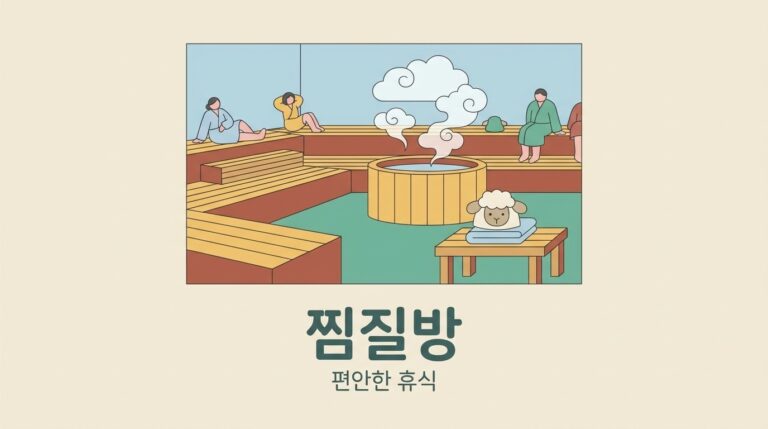
Why Do Koreans Say Hot Saunas Are Cool? The Secret of Siwonhada
Phase 1: Empathy (Story-driven Opening)
안녕하세요! 매일한글 에디터입니다. (Hello! I’m your Daily Hangul editor.)
Picture this: After walking 25,000 steps through the bustling alleys of Hongdae and Bukchon Hanok Village, your legs feel like solid stone. You decide to visit a traditional Korean bathhouse (Jjimjilbang). You strip down, rinse off, and walk over to a wooden tub filled with steaming, fragrant water. The digital thermometer on the wall reads a scorching 42°C (108°F).
Right across from you, an older Korean gentleman sinks up to his neck in the bubbling hot water. He closes his eyes, lets out a long, blissful exhale, and mutters with a heavenly grin:
“어우, 시원하다!” (Eou, siwonhada!)
You quickly recall your beginner Korean flashcards: siwonhada means “cool” or “refreshing.” Relieved, you step eagerly into the tub—only to pull your foot right out because the water feels boiling hot!
Wait, did he just say this scalding water is cool? Is this a bathhouse prank?
Don’t worry, you haven’t lost your mind. Over 90% of Korean learners stumble over this exact “sauna paradox.” In Korean culture, siwonhada carries a deep physical and emotional meaning that dictionaries often fail to capture. Based on countless hours of real feedback from our Daily Hangul learners, this guide will unlock how to use this magic word so you can soak, sweat, and relax like a true local.
Phase 2: Core 3 Expressions In-Depth
1. 어우, 시원하다! (Eou, siwonhada!)
- Pronunciation: Uh-oo, see-won-ha-da! (Start with an involuntary sigh like ‘uhhh’, then flow into ‘see-one-ha-da’).
- Meaning: Literal: “Oh, it’s cool!” | Real Nuance: “Ahhh, what an incredible relief! All the tension in my body is melting away.”
- K-Culture Moment: You will hear this in almost every Korean drama when characters submerge into a bath or take the very first sip of piping hot soybean sprout soup (kongnamul-guk) to cure a hangover.
- Editor’s Insight: Siwonhada doesn’t describe the thermometer temperature; it describes the sensation of physical unblocking. When scalding water opens up your tight muscles and makes you exhale, that inner breath of fresh air is siwon.
- Situation Spectrum: Casual: ✅ | Semi-formal: ⚠️ (Add -요: 시원해요) | Formal: 🚫
- 🤔 Think About It: In English, we say a hot bath “warms my bones.” Why do you think Korean society conceptualizes the release of stress and trapped body heat as “cool and clearing”?
2. 피로가 싹 풀려요. (Piroga ssak pullyeoyo.)
- Pronunciation: Pee-ro-ga ssak pool-lyuh-yo. (Emphasize the sharp, snappy ‘ssak’ sound like a knife slicing through paper!).
- Meaning: Literal: “Fatigue unties in a clean sweep.” | Real Nuance: “All my exhaustion just completely melted away!”
- K-Culture Moment: Stepping out of a 75°C pine charcoal kiln sauna room and lying down on the cool wooden floor while sporting a cute towel shaped like sheep horns.
- Editor’s Insight: Ssak (싹) is a vibrant onomatopoeic word that means cleanly, completely, or without a trace. Pairing it with pullida (to untie) paints a visual picture of knots in your shoulders coming undone.
- Situation Spectrum: Casual: ✅ (피로가 싹 풀려) | Semi-formal: ✅ | Formal: ✅ (피로가 싹 풀립니다)
- 🤔 Think About It: Koreans describe fatigue as a tight knot that needs to be “untied” (pullyeoyo). In your mother tongue, do you “carry,” “break,” or “melt” your fatigue?
3. 몸이 노곤노곤해요. (Momi nogon-nogonhaeyo.)
- Pronunciation: Mom-ee no-gon-no-gon-hae-yo. (Say it with a soft, gentle rhythm, as if singing a sleepy lullaby).
- Meaning: Literal: “Body is nogon-nogon.” | Real Nuance: “My whole body feels delightfully soft, heavy, and drowsy.”
- K-Culture Moment: Resting in the communal ondol-heated sleeping hall after two hours of alternating between hot tubs and cold plunge pools.
- Editor’s Insight: Nogon-nogon is the blissful, lazy sensation right before a warm afternoon nap. It’s not an unpleasant exhaustion; it’s the good kind of tiredness after a luxury spa treatment.
- Situation Spectrum: Casual: ✅ | Semi-formal: ✅ | Formal: ⚠️
- 🤔 Think About It: Notice the duplication in nogon-nogon. Korean uses paired rhyming words to mimic texture and physical sensation. What cozy sensory words exist in your language?
Phase 3: Textbook Korean vs. Real Korean
Situation 1: Soaking inside the hot tub
- 📖 Textbook Korean:
물이 아주 따뜻해서 기분이 좋습니다.
(Muri aju ttatteut-haeseo gibuni joeusseumnida.)
“Because the water is very warm, my mood is good.” - 🗣️ Real Korean:
와, 진짜 시원하다~
(Wa, jinjja siwonhada~)
“Whoa, this feels so relieving!” - 💡 Why is it different? Textbook phrases focus on factual, descriptive statements. Native Koreans lean into intuitive, sensory sighs (wa, jinjja, siwonhada) to express emotional release.
Situation 2: Sweating out toxins in the steam room
- 📖 Textbook Korean:
사우나를 마쳐서 피로가 회복되었습니다.
(Saunareul machyeoseo piroga hoebok-doeeotseumnida.)
“Having completed the sauna, fatigue has been recovered.” - 🗣️ Real Korean:
개운하다! 땀 빼니까 살 것 같아.
(Gaeunhada! Ttam ppaenikka sal geot gata.)
“So fresh! Sweating it out brought me back to life.” - 💡 Why is it different? Nobody talks like a medical brochure in a spa. Gaeunhada expresses the clean lightness of your skin, while sal geot gata (“feels like I’ll live”) is the everyday idiom for instant revival.
Phase 4: K-Culture Deep-Dive & Non-Verbal Manners
4-1. Nunchi (눈치) & Bathhouse Body Language
- The Signature Exhale: When saying 시원하다, do not yell it abruptly. Native speakers close their eyes, let their chin dip slightly, drop their shoulders completely, and let the word escape alongside a warm breath of steam: “Eou… siwonhada…”
- Eye Contact Etiquette: Inside the gender-segregated wet bath areas (mokyoktang), avoid making direct eye contact with strangers while walking between tubs. Keep your gaze neutral, respectful, and slightly lowered. Once you are seated in the tub, gazing upward toward the ceiling or resting with your eyes shut is standard bathhouse nunchi.
- The Modesty Towel: When moving between pools, hold your small complimentary towel in front of your midsection with both hands. Never place your towel directly into the communal bathwater; fold it neatly and balance it on top of your head!
4-2. Cultural Code: The Healing Holy Trinity
A Korean Jjimjilbang is not merely a place to bathe—it is a communal living room and culinary playground. After alternating between the 40°C warm bath (ontang) and the 15°C cold plunge (naengtang), locals head to the common lounging area in their matching spa pajamas (jjimjilbok).
Here, you must try the legendary Sikhye & Baked Egg Combo. The eggs (maekbanseok gyeran) are slow-baked on germanium stones until their whites turn savory, nutty brown. As seen in classic dramas like Crash Landing on You and My Name is Kim Sam-soon, friends playfully crack the hard-boiled eggs against each other’s foreheads before quenching their thirst with sweet, frosty malted rice drink (sikhye).
Phase 5: Real-Life Roleplay Scenario
Setting: Yongsan Traditional Herbal Jjimjilbang. You and your Korean friend Minho are standing beside a deep green Mugwort tub (ssuktang) emitting aromatic herbal steam.
- Minho: 여기 쑥탕 진짜 좋아. 먼저 들어가 볼래?
(Yeogi ssuktang jinjja joa. Meonjeo deureoga bollae?)
“This mugwort bath is fantastic. Do you want to step in first?”
🎭 [Points toward the steaming herbal tub with an encouraging smile] -
You: 물 온도가 41도예요? 조금 뜨거울 것 같아요.
(Mul ondoga sasi-il-doyeyo? Jogeum tteugeoul geot gatayo.)
“The water is 41 degrees? I think it might be a bit too hot.”
🎭 [Dips one toe cautiously into the water, eyes widening in panic] -
Minho: 천천히 들어가 봐. 처음엔 뜨거운데 금방 시원해져.
(Cheoncheonhi deureoga bwa. Cheoeumen tteugeounde geumbang siwonhaejeo.)
“Step in slowly. It feels hot at first, but it quickly turns refreshing.”
🎭 [Glides smoothly into the water up to his collarbones, sighing in peace] -
You: 어… 잠깐만요, 어우! 뜨거워요!
(Eo… jamkkanmanyo, eou! Tteugeowoyo!)
“Uh… wait a second, ouch! It’s burning!”
🎭 [Clenches the ceramic rim of the tub, shoulders stiff as a board] -
Minho: 숨을 길게 후 내쉬어 봐. 어깨에 힘 빼고!
(Sumeul gilge huu naeswieo bwa. Eokkaee him ppaego!)
“Take a long exhale. Drop all that tension from your shoulders!”
🎭 [Demonstrates a slow exhale, patting the surface of the herbal water] -
You: 후우… 어? 진짜 몸이 풀리네요. 어우, 시원하다!
(Huu… eo? Jinjja momi pullineyo. Eou, siwonhada!)
“Whew… oh? My body is really relaxing. Ahhh, so refreshing!”
🎭 [Shoulders drop completely as a peaceful grin spreads across your face] -
Minho: 그렇지! 이제 한국인 다 됐네! 피로가 싹 풀리지?
(Geureochi! Ije hangukin da dwaenne! Piroga ssak pulliji?)
“That’s it! You’re practically Korean now! Exhaustion completely gone, right?”
🎭 [Chuckles warmly and flashes an underwater thumbs-up] -
You: 네! 땀 싹 빼고 시원한 식혜 마시러 가요!
(Ne! Ttam ssak ppaego siwonhan sik-hye masireo gayo!)
“Yes! Let’s sweat it all out and go grab ice-cold sikhye!”
🎭 [Leans head back against the smooth cedar ledge, fully converted]
🔀 Interactive Choice Point: How will you reply to Minho?
- Choice A: 차가운 물 더 주세요! (Chagaun mul deo juseyo! – Please give me more cold water!)
Feedback: [Bad] This sounds like you are ordering drinks at a café, confusing your friend while sitting inside a hot tub. - Choice B: 어우, 시원하다! 피로가 싹 풀려요. (Eou, siwonhada! Piroga ssak pullyeoyo. – Ahhh, so refreshing! My fatigue is wiped clean.)
Feedback: [Best] 100 out of 100! You nailed the emotional sigh and the colloquial vocabulary. Minho will be amazed by your natural Korean. - Choice C: 뜨거워서 죽을 것 같아요! (Tteugeowoseo jugeot geot gatayo! – It’s so hot I feel like dying!)
Feedback: [Risk] Dramatically funny, but elders nearby might turn their heads thinking you are suffering a medical crisis.
Phase 6: 10-Second Emotional Shadowing Drill
Practice these three lines aloud. Pay close attention to the pause slashes (/) and adopt the indicated emotional state before speaking!
[😮 살짝 뜨겁지만 긴장이 스르륵 풀리며]
어우… / 진짜 / 시원하다~
(Eou… / jinjja / siwonhada~)
“Ahhh… it’s genuinely so refreshing~”-
[✨ 온몸이 깃털처럼 가벼워진 목소리로]
피로가 / 싹 / 풀려요!
(Piroga / ssak / pullyeoyo!)
“My fatigue is completely wiped clean!” -
[😴 따뜻한 온돌방에 누워 나른하게 졸린 어조로]
몸이 / 노곤노곤해요…
(Momi / nogon-nogonhaeyo…)
“My body feels so pleasantly sleepy and loose…”
Phase 7: K-Culture Mini Dictionary
- 찜질방 (Jjimjilbang): A 24-hour communal Korean bathhouse and leisure complex equipped with kiln saunas, warm massage tubs, entertainment rooms, and heated ondol sleeping mats.
- 식혜 (Sikhye): A traditional sweet beverage made from fermented malt and cooked rice, served ice-cold with sweet rice grains floating on top. The quintessential sauna treat.
- 맥반석 계란 (Maekbanseok gyeran): Mineral-baked eggs cooked for hours in high-heat stone kilns, featuring a signature smoky aroma and chewy brown egg whites.
- 양머리 (Yangmeori): The iconic “sheep head” style of folding a standard cotton hand towel into two cylindrical buns on either side, worn like a cap inside the sauna.
Phase 8: Traveler’s Survival Kit
Top 3 Survival Phrases
- 1. 수건 더 주실 수 있나요? (Su-geon deo jusil su innayo?)
“Could I get an extra towel, please?”
Pro Tip: At the reception desk, men are often provided unlimited towels inside the locker room, while women receive two small towels at check-in due to bathhouse tradition. Memorize this phrase if you need a fresh one! - 2. 식혜 하나랑 계란 세 개 주세요. (Sik-hye hanarang gyeran se gae juseyo.)
“One sweet rice drink and three baked eggs, please.”
Pro Tip: You don’t need cash inside the sauna! Simply tap your digital wristband key at the snack counter and settle the balance when you exit. - 3. 온탕이 어디예요? (Ontangi eodiyeyo?)
“Where is the warm/hot bath?”
Pro Tip: Look at the signs: 온탕 (ontang, 38–41°C) is ideal for beginners, 열탕 (yeoltang, 42–45°C) is for hardcore sauna masters, and 냉탕 (naengtang, 15–20°C) is the cold plunge.
Editor’s Travel Note
Before picking a bathhouse, verify opening hours, amenities, and foreigner-friendliness by searching through [Naver Map app download for Korean travel navigation]. Many facilities close their wet tubs for deep cleaning between 1:00 AM and 4:00 AM, so checking user reviews beforehand will save your midnight sauna plans!
Phase 9: A Step Deeper (Reflection Question)
In traditional Korean medicine (Hanuihak), sickness and fatigue are viewed as blocked flow of Qi (vital energy) and stagnant bodily heat. When you sit in hot herbal water or sweat inside a clay dome, your pores open, blood flows smoothly, and internal trapped heat escapes to the surface. That intense physical breakthrough makes the body feel clean, airy, and light. To the Korean mind, this liberating sensation is the very definition of siwonhada.
💬 Your Turn: Does your native language have a word that describes experiencing relief through heat? What do you say when you drink a hot soup on a freezing winter day? Share your language and thoughts in the comments below!
Phase 10: FAQ & Avoiding Misunderstandings
Q: Can I use “시원하다” for cold iced drinks as well?
A: Yes! Siwonhada functions both literally and figuratively. You can use it when drinking an ice-cold Americano on a humid July afternoon, feeling an autumn breeze, or soaking in a hot herbal tub.
Q: What is the difference between “시원하다” (siwonhada) and “개운하다” (gaeunhada)?
A: Siwonhada captures the ongoing relief while experiencing the heat or soup. Gaeunhada describes the final cleansed feeling after you have showered, dried off, and stepped outside with fresh clothes on.
Q: Is it considered rude to say “어우, 시원하다” in informal speech around elders in the bath?
A: Not at all! Exclaiming “어우, 시원하다~” as an involuntary sigh to yourself is universally understood as pure human relief. However, if an older person strikes up a conversation asking how the water feels, politely respond in polite form: “네, 정말 시원해요!” (Ne, jeongmal siwonhaeyo!).
🚨 Common Mistakes Alert
- Calling hot bathwater “차가워요” (Chagawoyo): Learners often think: Since they said siwonhada, it must mean cold! No! If the tub is hot, do not say chagawoyo (cold). Say siwonhaeyo (relieving) or tteugeowoyo (hot).
- Wearing a bathing suit into the wet bath area: Unless you are in a mixed-gender swimming zone, swimwear is strictly prohibited in the bathing pools. Wash thoroughly with soap at the shower stalls before stepping into any communal tub.
- Jumping straight into the 냉탕 (Naengtang – Cold tub): Shocking your heart after hot saunas can be dangerous. Always splash cold water over your feet and arms first before stepping in.
Phase 11: Action Mission & Participation
- 🥉 Bronze Mission (Solo Practice): Brew a cup of hot tea or warm broth. Take a hot sip, drop your shoulders, and say out loud with an exhale: “어우, 시원하다~”.
- 🥈 Silver Mission (Social Share): Snap a photo of your favorite warm comfort food or bath setup. Post it to your social media stories with the tag
#DailyHanguland the caption: “피로가 싹 풀려요!”. - 🥇 Gold Mission (Real World): Visit a local Korean restaurant or Jjimjilbang. Order a hot stew (jjigae) or enter the warm bath, and use “시원하다” naturally in real life!
- 🎮 K-Culture Mission: Watch a popular Korean variety show like I Live Alone or Running Man. Catch the exact moment a cast member takes a hot bite of ramyeon or enters a sauna and screams “시원하다!”.
Phase 12: Interactive Quiz Challenge
Test what you’ve learned before your next bathhouse adventure!
Question 1 (Scenario Judgment)
You step into a 41°C herbal bath in Seoul. What is the most natural, native way to express how relieving the heat feels?
A) 너무 차가워요! (Neomu chagawoyo!)
B) 어우, 시원하다! (Eou, siwonhada!)
C) 물이 얼음 같아요. (Muri eoreum gatayo.)
Question 2 (Fill-in-the-Blank)
사우나에서 땀을 빼니까 피로가 [ ] 풀려요! (All my fatigue untied completely in a clean sweep!)
(Hint: The snappy sound like a clean knife cut!)
Question 3 (True or False Cultural Fact)
Koreans only use the word 시원하다 when the physical ambient temperature is cold or below freezing. (True / False)
👉 Click here to reveal the answers and explanations!
- Q1 Answer: B) 어우, 시원하다!
Explanation: A and C describe physical cold or ice, which makes no sense in a 41°C hot tub! B captures the classic Korean exclamation of deep physical relaxation. - Q2 Answer: 싹 (ssak)
Explanation: Piroga ssak pullyeoyo is the go-to native phrase for fatigue vanishing without a trace. - Q3 Answer: False!
Explanation: Siwonhada is celebrated precisely because it describes relief from hot soup, hot saunas, and tension, as well as chilled iced drinks!






