

Mastering Hanok Living: The Science and Soul of Korean Ondol Heating
Phase 1: Empathy (스토리 몰입형 오프닝)
안녕하세요! 매일한글 에디터입니다.
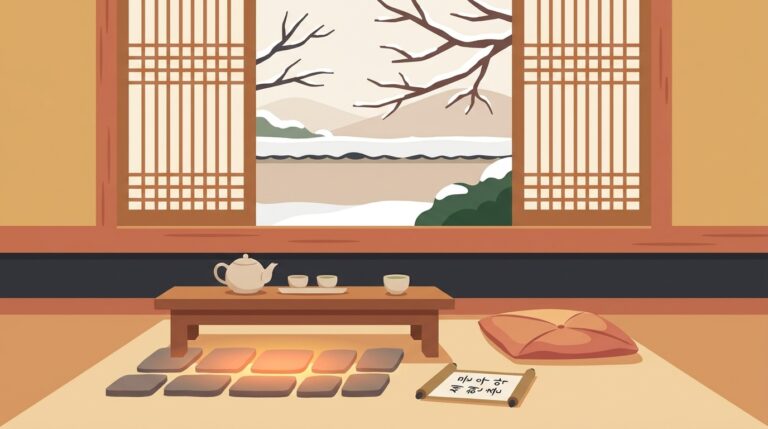
Picture this: It is a crisp January evening in Bukchon Hanok Village. The temperature outside hovers well below freezing, and the paper-pasted changhoji (mulberry paper) windows rustle softly in the biting Seoul wind. You step off the cold timber veranda (daecheongmaru) and step inside the guestroom. You anticipate the dry, suffocating blast of an overhead HVAC unit common in Western hotels. Instead, you are met with refreshing, pristine air above, while the oiled floor beneath your woolen socks emanates a profound, soothing heat that instantly unravels the knots in your frozen spine.
Many advanced Korean learners hit an expressive wall here. While beginners simply exclaim, “방이 따뜻해요! (The room is warm!)”, a C1 speaker recognizes that Ondol (온돌)—Korea’s ancient underfloor radiant heating system—is not merely about temperature; it is an architectural philosophy of thermodynamics, communal care, and bodily balance. How do you describe that hypnotic sensation of melting into the floor? How do you negotiate room drafts gracefully without offending your Hanok host? Based on hundreds of discussions with global learners staying in traditional homestays, this guide equips you with the sophisticated lexicon and scientific nuance needed to discuss traditional Korean architecture like an articulate local.
Phase 2: 핵심 표현 3선 심층 분석
1. 구들장을 지지다 (Gudeuljang-eul jijida)
- Pronunciation: [Gu-deul-jang-eul ji-ji-da] (Think of ‘goo-deul’ like a warm ‘good’ cuddle, and ‘jiji’ like the gentle sizzle of bacon on a skillet)
- Meaning: Literally “to sear/griddle the floor stone,” but idiomatically used to describe lying flat on a intensely heated floor to bake away fatigue or a cold.
- K-Culture Moment: In the nostalgic drama Reply 1988, exhausted parents sink onto the warmest patch of the linoleum floor with a heavy quilt, sighing with cathartic relief after a freezing winter commute.
- Editor’s Insight: At the C1 level, notice how the verb
지지다(to sear/simmer) is playfully borrowed from culinary arts. Koreans perceive bone-deep relief not from breathing hot air, but from direct conductive heat transmuting into tense muscles.- Situation Spectrum: Casual (✅) / Semi-formal (✅) / Formal (⚠️ – rephrase as
온돌 바닥에서 피로를 풀다in academic contexts)- 🤔 Think About It: Why does your culture favor heating the surrounding ambient air rather than the physical floor beneath your feet? How does physical contact with the floor change domestic intimacy?
2. 외풍을 차단하다 (Oepung-eul chadanhada) / 외풍이 세다 (Oepung-i seda)
- Pronunciation: [Oe-pung-eul cha-dan-ha-da] (Rhymes roughly with ‘way-poong’, snapping cleanly on the voiceless ‘p’)
- Meaning: Literally “to block outdoor wind,” specifically referring to cold air drafts that seep through traditional timber joints and paper lattices.
- K-Culture Moment: In historical sageuk dramas like The Red Sleeve, court maidens carefully layer silk curtains (bopung) along the sliding doors to seal off the biting draft during harsh palace winters.
- Editor’s Insight: Oepung (or colloquially chambaram-i deulda) is the natural companion to Ondol. Hanok rooms deliberately maintain cooler upper air while heating the base, reflecting the Eastern medicine principle of 두한족열 (head cool, feet warm). Discussing oepung with your host signals that you truly grasp Hanok climate dynamics.
- Situation Spectrum: Casual (✅) / Semi-formal (✅) / Formal (✅)
- 🤔 Think About It: In English, we call this a “draft.” Does treating cold air leakage as an inevitable architectural counterpart change how people dress indoors?
3. 은은한 온기가 감돌다 (Eun-eun-han on-gi-ga gam-dol-da)
- Pronunciation: [Eun-eun-han on-gi-ga gam-dol-da] (Soft, resonant nasal vowels that mimic lingering warmth)
- Meaning: “A subtle, gentle warmth permeates the atmosphere.”
- K-Culture Moment: Used by documentary narrators exploring cultural heritage sites or architectural restorers admiring the thermal retention of clay masonry in Gangwon-do Hanoks.
- Editor’s Insight:
은은하다denotes qualities that are delicately diffused without being overbearing (scents, light, or heat). Combined with온기(radiant warmth) and감돌다(to hover/linger), this phrase elevates your descriptive vocabulary far past basic adjectives.- Situation Spectrum: Casual (⚠️ – sounds somewhat poetic) / Semi-formal (✅) / Formal (✅)
- 🤔 Think About It: Compare the English concept of “stuffy room heat” to the Korean aesthetic appreciation for residual, non-mechanical warmth.
Phase 3: 교과서 한국어 vs 진짜 한국어
Situation 1: Expressing that the floor is wonderfully therapeutic
- 📖 교과서 한국어 (Textbook): 바닥이 매우 따뜻해서 피로가 풀립니다. (Badag-i maeu ttatteuthaeseo piroga pullimnida. / The floor is very warm, so my fatigue is relieved.)
- 🗣️ 진짜 한국어 (Real Korean): 바닥이 뜨끈뜨끈해서 몸이 사르르 녹네요. (Badag-i tteukkeun-tteukkeunhaeseo mom-i sareureu nongneyo. / The floor is piping hot; my entire body is just melting away.)
- 💡 왜 다를까?: Native speakers favor sensory mimetic words (의태어/의성어) like
뜨끈뜨끈하다(deep conductive warmth) and사르르(smoothly dissolving tension) over dry Latinate-style causal sentences.
Situation 2: Informing the Hanok host that the floor is scorchingly hot
- 📖 교과서 한국어 (Textbook): 방 온도가 너무 높으니 보일러를 조절해 주십시오. (Bang ondoga neomu nopeuni boilleoreul jojeolhae jusipsio. / The room temperature is too high, so please adjust the boiler.)
- 🗣️ 진짜 한국어 (Real Korean): 아랫목이 거의 불바다 수준이라 살짝만 낮춰주셔도 될 것 같아요! (Araenmogi geoui bulbada sujun-ira saljjakman natchwojusyeodo doel geot gat-ayo! / The warmest floor spot is practically a sea of fire; I think it’d be great if we dialed it down just a notch!)
- 💡 왜 다를까?: Politeness in Korea often utilizes hyperbolic, humorous understatement (
불바다 수준,살짝만). Direct imperative commands to an elder host can sound jarringly transactional.
Phase 4: K-Culture 딥다이브 & 비언어적 매너
4-1. 눈치 (Nunchi) & Spatial Etiquette: The Sacred Floor Hierarchy
In an authentic Hanok, the floor is not a neutral plane; it has a thermal geography. The section closest to the furnace (agungi) is called the 아랫목 (Araenmok)—the hottest, most prestigious zone. The area farthest away, near the drafty outer screen, is the 윗목 (Winmok).
* The Nunchi Move: Never immediately sprawl across the Araenmok. When visiting an elder or hosting a gathering, always yield the Araenmok to the eldest person or honored guest. Sit modesty on the Winmok first until invited to warm yourself closer.
* Physical Mannerism: When entering a heated room, avoid stomping down on the heated floorstones (gudeuljang). Gently press the flat of your palms onto the floor upon sitting, giving an appreciative nod while acknowledging the warmth: “온기가 아주 깊네요.” (The warmth runs very deep.)
4-2. Cultural Code Analysis: 두한족열 (頭寒足熱) & Floor Culture
Western climate control primarily regulates ambient air volume (convection). Ondol, however, relies on radiant conduction (전도) and slow thermal radiation (복사). This architecture mirrors the traditional East Asian medical tenet: 두한족열 (Keep the head cool and the feet warm). Heating from the ground prevents cerebral fatigue, optimizes blood circulation, and allows Hanok dwellers to breathe crisp winter air while staying cozy under a heavy padded som-ibul (cotton quilt). This ancient thermal logic explains why modern Korean apartments still mandate radiant floor heating pipes rather than forced-air radiators.
Phase 5: 실전 롤플레이 시나리오
Setting: A biting sub-zero dusk at an authentic Hanok guesthouse in Gangneung. You are speaking with Master Kim (김 명장), a master carpenter and guesthouse proprietor who stokes the clay furnace by hand.
- Master Kim: 날이 매섭게 차가운데, 먼 길 오시느라 고생 많으셨습니다. 얼른 방으로 드시지요.
(Nari maeseopge chagawunde, meon gil osineura gosaeng maneusyeotseumnida. Eolleun bangeuro deusijiyo.)
“The weather is biting cold; you went through a lot traveling this far. Hurry inside the room.”
🎭 [Hands you hot barley tea while checking the furnace flue] -
Learner: 배려해 주신 덕분에 방에 들어서자마자 훈훈한 온기가 온몸을 감싸네요.
(Baeryeohae jusin deokbune bange deureoseojamaja hunhunhan on-giga onmomeul gamssaneyo.)
“Thanks to your hospitality, the moment I stepped inside, this cozy warmth completely wrapped around me.”
🎭 [Slips off shoes, palms touching the floor respectfully] -
Master Kim: 장작을 넉넉히 땠더니 아랫목이 제법 달아올랐을 겁니다. 발부터 좀 녹이세요.
(Jangjageul neongneokhi ttaetdeoni araenmogi jeobeop daraollasseul geomnida. Balbuteo jom nogiseyo.)
“I stoked plenty of firewood, so the Araenmok must have heated up quite a bit. Warm your feet first.”
🎭 [Points toward the deep yellow oiled floor near the partition] -
Learner: 어르신, 제가 아랫목을 차지하기엔 송구스러우니 어르신께서 이쪽에 앉으시지요.
(Eoreusin, jega araenmogeul chajihagien song-guseureouni eoreusinkkeseo ijjoge anjeusijiyo.)
“Sir, it would be improper for me to take the warmest spot; please, sit here yourself.”
🎭 [Gently gestures toward the heated quilt with two hands] -
Master Kim: 하하! 젊은 분이 한옥 예법을 이리 잘 아실까. 손님이 상전이니 편히 누워 구들장 좀 지지세요.
(Haha! Jeolmeun buni han-ok yebeobeul iri jal asilkka. Sonnim-i sangjeon-ini pyeonhi nuwo gudeuljang jom jijiseyo.)
“Haha! How does a young person understand Hanok etiquette so well? The guest is king, so lie down comfortably and bake your back on the floorstones.”
🎭 [Chuckles warmly and slides a floor pillow toward you] -
Learner: 그럼 호의를 감사히 받겠습니다. 공기는 상쾌한데 바닥이 뜨끈해서 두한족열이 절로 실감 납니다.
(Geureom houireul gamsahi batgetseumnida. Gong-gineun sangkwaehande badag-i tteukkeunhaeseo duhanjogyeori jeollo silgam namnida.)
“Then I will gratefully accept your kindness. The air is crisp while the floor is toasty—I truly experience ‘cool head, warm feet.'”
🎭 [Smoothly folds legs and takes a seat on the padded cushion] -
Master Kim: 밤중에 혹시 외풍이 들거든 병풍을 치시고, 문풍지 소리가 거슬리면 언제든 부르세요.
(Bamjunge hoksi oepung-i deulgeodeun byeongpungeul chisigo, munpungji soriga geoseullimyeon eonjedeun bureuseyo.)
“If a draft seeps in during the night, unfold the standing folding screen; call me anytime if the paper window whistles.”
🎭 [Demonstrates adjusting the folding draft barrier] -
Learner: 네, 세심하게 챙겨주셔서 올겨울 추위는 잊고 푹 쉴 수 있겠습니다.
(Ne, sesimhage chaenggyeojusyeoseo olgyeoul chuwineun itgo puk swil su itgetseumnida.)
“Yes, thank you for your thoughtful care; I’ll be able to rest deeply, forgetting all of this winter’s cold.”
🎭 [Bows upper body in polite gratitude]
🔀 인터랙티브 분기점 (Interactive Choice)
The night deepens. By 2:00 AM, the firewood has burned down to glowing embers, and the center of the floor is scorching hot, almost singeing your blanket. What do you do?
- Option A: Kick the quilt off completely, throw open the paper lattice door (changhoji), and turn on the wall fan.
- Outcome (Bad 🚫): You break the room’s thermal balance instantly, invite severe freezing drafts (oepung), and risk puncturing the delicate mulberry paper screen with sudden drafts.
- Option B: Slip a spare floor mat (yo) beneath your quilt, gently shift yourself toward the cooler Winmok (윗목), and allow the natural convection to equalize.
- Outcome (Best ⭐): Authentic Korean floor mastery! You intuitively utilize the room’s temperature gradient without bothering your sleeping host.
- Option C: Walk out to the backyard in the middle of the night and pour a bucket of water into the Agungi (furnace) to extinguish the firewood.
- Outcome (Risk ⚠️): Catastrophic! Rapid thermal shock cracks the ancient clay chimney and subterranean stone flues (gudeul), causing carbon monoxide risks and permanent structural damage.
Phase 6: 10초 감정 섀도잉 드릴
Practice the subtle pitch transitions and emotional resonance. Pay attention to pauses marked with /.
[😌 온몸의 긴장이 풀리며 나른하게]
“바닥에 등을 대자마자 / 하루 종일 쌓였던 피로가 / 눈 녹듯 싹 사라지네요.”
(Badage deungeul daejamaja / haru jong-il ssayeotdeon piroga / nun nokdeut ssak sarajineyo.)
“The moment my back meets the floor / all the fatigue gathered throughout the day / melts away cleanly like snow.”-
[😲 놀라움과 감탄이 섞인 어조로]
“이게 바로 말로만 듣던 온돌인가요? / 공기는 탁하지 않은데 / 온기는 뼛속까지 스며들어요.”
(Ige baro malloman deutdeon ondol-in-gayo? / Gong-gineun takhaji aneunde / on-gineun ppyeotsokkkaji seomyeodeureoyo.)
“Is this the Ondol I’ve heard so much about? / The air isn’t stuffy at all / yet the warmth permeates straight into my bones.” -
[🥶 살짝 떨리는 목소리로 정중하게 부탁할 때]
“어르신, / 밤풍경은 참 운치 있는데 / 문틈으로 외풍이 살짝 들어오는 것 같아요.”
(Eoreusin, / bampunggyeong-eun cham unchi inneunde / munteumeuro oepung-i saljjak deureo-oneun geot gat-ayo.)
“Sir, / the night view is undeniably scenic / but there seems to be a tiny draft coming through the door seams.”
Phase 7: K-Culture 미니 사전
- 아궁이 (Agungi): The traditional dual-purpose firebox furnace built below room level. It burns timber or dried chaff to boil domestic cauldron water while funneling hot smoke horizontally under the floor.
- 구들장 (Gudeuljang): Flat, schistose granitic heat-retaining floorstones. Positioned horizontally over flue pathways, they store immense caloric energy and release radiant heat across 12–24 hours.
- 개자리 (Gaejari): The subterranean aerodynamic drop-pit located near the chimney base. It obstructs backdrafts, slows smoke velocity for maximum thermal transfer, and traps fly ash.
- 두한족열 (Duhanjogyeol): An essential wellness principle drawn from traditional medicine: maintaining coolness at the head while keeping the feet warm promotes vital energy (qi) flow and metabolic harmony.
Phase 8: 여행자를 위한 생존 키트
Survival Expressions TOP 3
- “아랫목 온도가 너무 센데 요 한 장 더 깔아도 될까요?”
(Araenmok ondoga neomu sende yo han jang deo kkarado doelkkayo?)
Pro Tip: If the floorstones are scorching hot, ask for an extra under-quilt (yo) rather than opening windows into freezing sub-zero air. - “창호지에 구멍이 나지 않도록 조심히 여닫겠습니다.”
(Changhojie gumeong-i naji antorok josimhi yeodatgetseumnida.)
Pro Tip: Hanok doors use delicate handmade mulberry paper. Reassuring your host that you will slide doors gently demonstrates top-tier travel maturity. - “외풍 차단용 덧문은 어떻게 걸어 잠그나요?”
(Oepung chadanyong deonmuneun eotteoke georeo jamgeunayo?)
Pro Tip: Hanoks feature double or triple nested lattice doors. Asking how to latch the outer barrier keeps drafts out overnight.
Editor’s Travel Note
When booking rural stays in Gangneung or Jeonju, check modern reviews on the 네이버 지도 앱 다운로드 page to confirm whether a Hanok uses genuine wood-fired gudeul heating or retrofitted electric boiler mats. If staying in a modern apartment inspired by Ondol, look for the wall controller with 난방수 온도 (water loop temperature) vs 실내온도 (ambient room air sensor). In drafty rooms, setting it to water temperature (난방수) keeps your floor consistently toasty without over-firing the boiler!
Phase 9: “한 발 더 깊이” (생각 질문)
Traditional Western living historically elevated human activity away from the earth—upon raised beds, cushioned dining chairs, and elevated thrones. Conversely, the Korean Ondol pulled an entire civilization directly toward the polished floor, anchoring a sedentary culture (좌식 문화) defined by mutual ground-level connection. Within a single shared room, positioning an elder at the Araenmok and sharing one broad ibul (quilt) fostered an enduring collective consciousness where physical comfort was perpetually redistributed.
💬 Your Turn: How has the heating technology of your home country shaped your interior furniture design, posture, and family communication habits? Share your perspective in the comments below!
Phase 10: FAQ & 흔한 실수 방지 (FAQ Schema)
Q: Isn’t sleeping on a rock-hard Hanok floor terrible for your spine?
A: Quite the contrary when done correctly! The flat surface promotes spinal realignment, and the penetrating infrared conduction softens deep lumbar muscle spasms. However, you must always lay down a cushioned cotton mattress (yo) over the heated surface to cushion pressure points.
Q: Can carbon monoxide from the firebox enter the living quarters?
A: Traditional builders seal the flue path with layers of red clay, straw, and oiled mulberry paper (hanji) to hermetically isolate smoke from living spaces. In heritage stays, flues are meticulously inspected. Modern Hanoks frequently use water-pipe hydronic Ondol systems, completely eliminating combustion gas risks.
Q: Why do Koreans keep windows closed when modern HVAC units circulate fresher air?
A: Ondol does not recirculate indoor air; it radiates static heat. Opening windows indiscriminately during winter creates dramatic temperature shears that undermine the Duhanjogyeol balance and waste the thermal reserve embedded inside the gudeuljang.
🚨 흔한 실수 (Common Mistakes) 경고판
- Mistake: Stepping onto a Hanok’s timber porch (maru) while wearing outdoor footwear.
- Correct Action: Always remove shoes at the exterior stone step (diddimdol), pointing your shoe toes outward away from the house.
- Mistake: Placing heavy vinyl luggage directly on the scorching Araenmok floor.
- Correct Action: Hot stones can melt synthetic luggage fabrics and ruin traditional linseed-oil floor lacquer. Place baggage near the colder Winmok.
- Mistake: Assuming the room is cold because the ambient air feels crisp upon first entering.
- Correct Action: Sit down and wait 5 minutes. Conductive heat warms the body through contact rather than room air inflation.
Phase 11: 액션 미션 & 참여 유도
- 🥉 Bronze Level: Record yourself speaking the phrase
뜨끈뜨끈한 아랫목에서 구들장을 지지고 싶어요with the correct natural pauses and pitch intonation. - 🥈 Silver Level: On your next visit to a Korean bathhouse (Jjimjilbang) or Hanok stay, post a floor-level photo with the Korean caption:
두한족열 실천 중! 은은한 온기가 감도네요. - 🥇 Gold Level: Strike up a 3-minute conversation with a Hanok owner or elderly host, using terms like
아랫목,외풍, and온기to discuss the room’s traditional atmosphere. - 🎮 K-Culture Mission: Watch Episode 2 of Reply 1988 or a historical K-drama like Mr. Sunshine. Spot the scene where characters scramble to sit on the Araenmok and note how the quilt is shared!
Phase 12: 인터랙티브 퀴즈 챌린지
Q1. Situational Judgment: You are visiting your Korean partner’s grandparents at their traditional provincial home. The grandmother offers you a seat closest to the heated inner wall (Araenmok). What is the most culturally astute response?
* A) Jump right in immediately and lie flat on your back to take a nap.
* B) Refuse adamantly five times, insisting that the room is far too hot.
* C) Modestly decline once while offering the spot back to the grandmother, before graciously accepting when she insists.
Q2. Fill in the Blank: Hanok heating maintains crisp head air and toasty feet, adhering to the traditional wellness concept of ________ (한글 4자).
Q3. True or False: Gudeuljang heating stones are designed to quickly boil the ambient air via forced air circulation.
🔍 정답 및 해설 확인하기 (Click to reveal answers)
- Q1 Answer: C — In Korean social dynamics, immediate acceptance can appear presumptuous, while outright obstinate refusal insults the host’s hospitality. Declining politely once while prioritizing the elder displays impeccable nunchi.
- Q2 Answer: 두한족열 (Duhanjogyeol) — Keep the head cool and feet warm.
- Q3 Answer: False — Gudeuljang transfers thermal energy through conduction and long-wave radiant heat, deliberately keeping room air still, fresh, and unagitated.







