

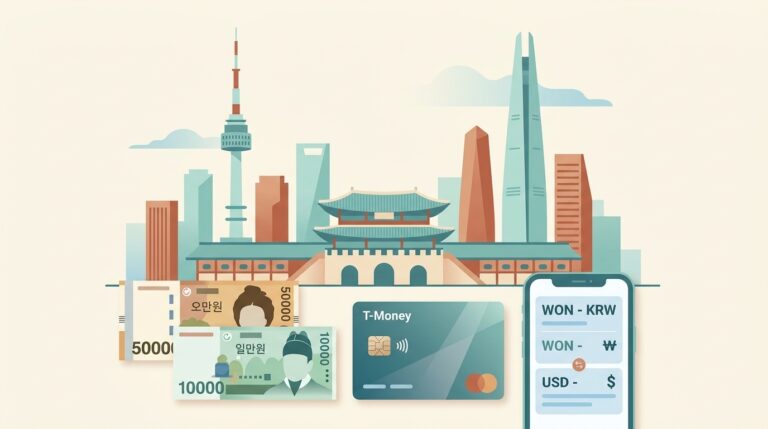
안녕하세요! 매일한글 에디터입니다.
Imagine this: You have just landed at Incheon International Airport. The crisp air of Seoul welcomes you, neon signage flickers in the distance, and your itinerary is bursting with Michelin-guide hanok restaurants in Bukchon and boutique popup stores in Seongsu-dong. But before the adventure begins, you hit the classic international traveler’s crossroads: money. Do you walk straight to the commercial bank booths at Arrival Hall B, or do you take out your smartphone to flash that digital “90% 환율 우대 (90% preferential exchange discount)” coupon? And wait—what about that sleek Travel Wallet (트래블월렛) multi-currency card nestled in your passport holder? Can you truly tap it everywhere from high-speed KTX kiosks to tiny street stalls in Euljiro without carrying a single paper bill?
If you have ever felt paralyzed trying to decipher financial Korean terms like hwanyul udae (환율 우대) or navigating the high-tech, cashless landscape of modern Seoul, you are not alone. Even C-level Korean speakers stumble when sudden banking jargon meets rapid-fire bank teller customer service. In this masterclass guide, built upon authentic feedback from hundreds of advanced travelers and expats, we are bridging native linguistic intuition with real-world financial strategy. By the end of this read, you won’t just convert currency—you will maneuver through Korea’s ultra-digital financial ecosystem with the poise, wit, and linguistic precision of a seasoned local.
Phase 2: Core Expressions Deep Dive
1. 환율 우대 90% 쿠폰 적용해 주세요. (Hwanyul udae gusip-peosenteu kupon jeok-yonghae juseyo.)
- Pronunciation: [Hwan-yul oo-dae goo-ship-peo-sen-teu koo-pon jeok-yong-hae joo-seh-yo] (Think: “Hwan” like wand without ‘d’, “Udae” sounding like ‘oo-deh’)
- Meaning: Literal: “Please apply the 90% currency exchange preferential coupon.” / Nuance: “I am presenting the maximum standard fee discount coupon; please calculate my final conversion rate accordingly.”
- K-Culture Moment: Commonly heard at airport bank booths (Hana Bank, Woori Bank, Shinhan Bank) or Myeongdong primary exchange counters where savvy foreign travelers and Korean backpackers optimize their travel funds down to the last decimal.
- Editor’s Insight: In Korean financial parlance, udae (우대 / 優待) means “preferential treatment” or “courtesy.” Crucially, “90% exchange discount” does not mean you get 90% off the total currency value! It means a 90% waiver on the bank’s currency conversion margin (스프레드, spread). Using the verb jeok-yonghada (적용하다 – to apply) elevates your request to natural, sophisticated adult Korean.
- Situation Spectrum: Casual: 🚫 | Semi-formal: ⚠️ | Formal: ✅
- 🤔 Think About It: Notice how Korean utilizes Chinese-character rooted nouns (hanja) like udae (우대) rather than conversational words like hal-in (할인 / discount) in banking contexts. How does your native language demarcate commercial transactions from routine retail discounts?
2. 트래블월렛 카드로 원화 충전해서 현장 결제할게요. (Teuraebeul-wollet kadeuro wonhwa chungjeonhaeseo hyeonjang gyeoljehalgeyo.)
- Pronunciation: [Teu-rae-beul-wol-let kah-deu-ro won-hwa choong-jeon-hae-seo hyeon-jang gyeol-jeh-hal-geh-yo] (Connect ‘won’ and ‘hwa’ smoothly; ‘chungjeon’ sounds like ‘choong-jeon’)
- Meaning: Literal: “I will recharge KRW using my Travel Wallet card and pay on-site.” / Nuance: “I am paying with a digital pre-loaded local card right now, so no cash or foreign transaction fee is involved.”
- K-Culture Moment: Used at boutique concept stores in Hannam-dong, modern exhibition cafes, or pop-up stores where staff might look confused if you pull out an overseas physical credit card that triggers slow authorization.
- Editor’s Insight: Chungjeon (충전) literally means “charging/recharging” (like a battery), but in modern Korean fintech, it is the standard term for topping up a stored-value debit/prepaid ledger. Pairing it with hyeonjang gyeolje (현장 결제 – on-site payment) clarifies to the merchant that your transaction operates identically to an instant local domestic card payment.
- Situation Spectrum: Casual: ⚠️ | Semi-formal: ✅ | Formal: ✅
- 🤔 Think About It: In Korea, pre-loaded fintech balances feel culturally identical to liquid cash. Does your country embrace prepaid multi-currency cards seamlessly, or is physical cash still crowned king?
3. 현찰 살 때 스프레드 우대율이 어떻게 되나요? (Hyeonchal sal ttae seupeuredeu udaeyuri eotteoke doenayo?)
- Pronunciation: [Hyeon-chal sal ttae seu-peu-reh-deu oo-dae-yoo-ri eo-tteo-keh dweh-nah-yo] (Glide through ‘seupeuredeu’ quickly without emphasizing the flat vowels)
- Meaning: Literal: “When buying cash notes, what is the spread preferential rate?” / Nuance: “What is the exact margin discount you are offering on foreign paper currency cash purchases today?”
- K-Culture Moment: The hallmark phrase of high-net-worth travelers or professional Korean expats negotiating bulk currency exchanges at head-quarter bank branches in Euljiro or specialized currency exchange windows.
- Editor’s Insight: Hyeonchal sal ttae (현찰 살 때) designates the exact spot cash rate (as opposed to remittances, song-geum, or traveler’s checks). Inquiring directly about the spread udaeyul instantly signals to the teller that you possess sophisticated financial literacy and cannot be bamboozled by surface-level exchange boards.
- Situation Spectrum: Casual: 🚫 | Semi-formal: ⚠️ | Formal: ✅
- 🤔 Think About It: Native speakers frequently embed English loanwords into professional vernacular (e.g., spread, limit). Does borrowing financial loanwords feel prestigious or pragmatic in your home culture?
Phase 3: Textbook Korean vs. Real Korean
Scenario 1: Inquiring about applying an exchange coupon at the teller
- 📖 교과서 한국어 (Textbook Style):
“이 할인 쿠폰을 사용하면 환율을 깎아 줍니까?”
(I hal-in ku-pon-eul sa-yong-ha-myeon hwan-yul-eul kka-kka jup-ni-kka? / If I use this discount coupon, will you cut down the exchange rate?) - 🗣️ 진짜 한국어 (Native C2 Style):
“모바일 90% 우대 쿠폰 보여드리면 고시 환율에서 바로 차감 적용되나요?”
(Mo-ba-il gu-sip-peo-sen-teu u-dae ku-pon bo-yeo-deu-ri-myeon go-si hwan-yul-e-seo ba-ro cha-gam jeok-yong-doe-na-yo? / If I present this mobile 90% preferential coupon, is it deducted and applied directly from the posted base exchange rate?) - 💡 왜 다를까? (Cultural & Linguistic Insight):
The textbook verb kkakda (깎다 – to cut/slash prices) sounds unrefined and slightly abrasive in an institutional banking environment. Native speakers employ precision nouns such as gosi hwanyul (고시 환율 – official posted exchange rate) and chagam jeok-yong (차감 적용 – deduction and application) to preserve institutional decorum.
Scenario 2: Asking if a small shop or market stall takes a digital travel card
- 📖 교과서 한국어 (Textbook Style):
“외국 신용카드로 결제할 수 있습니까? 아니면 현금만 됩니까?”
(Oe-guk sin-yong-ka-deu-ro gyeol-je-hal su it-seum-ni-kka? A-ni-myeon hyeon-geum-man doem-ni-kka? / Can I pay with a foreign credit card? Or only cash?) - 🗣️ 진짜 한국어 (Native C2 Style):
“사장님, 트래블월렛 IC칩 결제 들어가나요, 아니면 계좌이체나 현금으로 긁을까요?”
(Sa-jang-nim, teuraebeul-wollet a-i-ssi-chip gyeolje deureoganayo, animyeon gyejwai-chena hyeon-geumeuro geulgeulkkayo? / Boss, does the Travel Wallet IC chip payment go through here, or should I do a direct bank transfer or use cash?) - 💡 왜 다를까? (Cultural & Linguistic Insight):
Saying “foreign credit card” often triggers hesitation from shopkeepers worried about terminal errors or exorbitant merchant fees. Framing your question around IC-chip gyeolje (domestic IC card processing) reassures them it runs through local POS terminals just like a domestic debit card.
Phase 4: K-Culture Deep Dive & Non-Verbal Manners
4-1. 눈치 (Nunchi) & Spatial Etiquette at the Counter
Navigating currency exchanges and transactions in Korea requires keen spatial and non-verbal awareness:
1. Screen Preparation: When redeeming an airport or banking app coupon (e.g., Toss, Shinhan Sol, or KEB Hana exchange coupons), open the barcode or QR code before stepping in front of the counter. Maximize your screen brightness so the barcode scanner reads it instantly through the thick acrylic safety partition.
2. The Two-Handed Handover: Always present your passport, cash, or physical card using both hands—or supporting your right forearm lightly with your left hand (yangson yejeol). Tossing a passport onto the marble counter or sliding cash with one hand is seen as dismissive.
3. Verbal Confirmation of Receipt: As the teller counts paper bills via the digital counter (gyesu-gi), maintain polite eye contact, nod subtly to acknowledge the digital counter display, and wait until the teller counts the notes once more before putting them into your wallet.
4-2. Cultural Code Analysis: The Hyper-Fintech “Cashless Peninsula”
Korea is rapidly marching toward an entirely cashless society. Over 80% of daily transactions occur digitally via Samsung Pay, Naver Pay, Toss, and prepaid IC-integrated cards. In trendy districts like Seongsu, Euljiro, or Yeouido, many cafes boast signs that read “Hyungeum eomneun maejang” (현금 없는 매장 – Cashless Store).
However, a fascinating cultural duality persists: traditional wet markets (e.g., Gwangjang Market or Tongin Market) and select underground subway shopping malls still appreciate cash or direct domestic account transfers (gyejwa-iche). This is where having a balanced strategy—holding a modest amount of physical cash exchanged via a 90% preferential coupon alongside an activated Travel Wallet card—transforms your travel experience from stressful to effortless.
Phase 5: Real-Life Roleplay Scenario
Setting & Characters
- Location: Incheon International Airport Terminal 1, Arrival Hall B – Hana Bank Foreign Exchange Desk.
- Characters:
- Bank Teller Kim Eun-ji (김은지 계장): Sharp, polite, incredibly efficient, dressed in a crisp navy bank uniform.
- Learner (Traveler): A financially savvy visitor determined to secure the best rates before hopping on the AREX express train.
[Dialogue]
1. 김은지 계장: 어서 오세요, 손님. 환전 도와드릴까요?
   (Eoseo oseyo, sonnim. Hwanjeon dowadeurilkkayo?)
   "Welcome, customer. May I assist you with your currency exchange?"
   🎭 행동 지문: [미소를 지으며 두 손을 모으고 정중히 고개를 숙인다.]

2. 학습자: 네, 미국 달러 500불 원화로 바꾸려고 하는데요.
   (Ne, miguk dalleo obaek-bul wonhwaro bakkuryeogo haneundeyo.)
   "Yes, I would like to exchange 500 US Dollars into Korean Won."
   🎭 행동 지문: [여권과 달러 지폐 봉투를 두 손으로 창구 트레이에 정갈하게 올려놓는다.]

3. 학습자: 혹시 이 모바일 90% 환율 우대 쿠폰 지금 적용 가능한가요?
   (Hoksi i mobail gusip-peosenteu hwanyul udae kupon jigeum jeokyong ganeunghangayo?)
   "By any chance, can I apply this mobile 90% preferential exchange coupon right now?"
   🎭 행동 지문: [스마트폰 화면 밝기를 최대로 올린 뒤 바코드를 창구 유리창 쪽으로 향해 보여준다.]

4. 김은지 계장: 아, 네! 주요 통화인 달러, 엔, 유로는 90% 스프레드 우대 바로 적용됩니다.
   (A, ne! Juyo tonghwain dalleo, en, yuroneun gusip-peosenteu seupeuredeu udae baro jeokyongdoemnida.)
   "Ah, yes! For major currencies like USD, JPY, and EUR, the 90% spread discount is applied immediately."
   🎭 행동 지문: [바코드 리더기로 화면을 스캔한 뒤 키보드를 신속하게 두드린다.]

5. 김은지 계장: 오늘 기준 고시 환율에서 우대 적용하셔서 총 66만 2천 원 지급되실 텐데요, 권종은 어떻게 맞춰드릴까요?
   (Oneul gijun gosi hwanyureseo udae jeokyonghasyeoseo chong yuksimnyuk-man i-cheon won jigeupdoesil tendeyo, gwonjongeun eotteoke matchwodeurilkkayo?)
   "Applying the discount to today's base rate, you will receive a total of 662,000 KRW. How would you like the denominations split?"
   🎭 행동 지문: [모니터의 최종 환산 금액을 손끝으로 가리키며 확인시켜 준다.]

6. 학습자: 오만 원권 열 장이랑, 나머지는 전부 만 원권이랑 천 원짜리로 섞어주세요.
   (Oman-won-gwon yeol jang-irang, nameojineun jeonbu man-won-gwon-irang cheon-won-jjariro seok-eo-juseyo.)
   "Please give me ten 50,000-won bills, and mix the rest into 10,000-won and 1,000-won bills."
   🎭 행동 지문: [차분하고 명확한 억양으로 고개를 끄덕이며 요청한다.]

7. 김은지 계장: 네, 요청하신 권종별로 오만 원권 열 장, 만 원권 열여섯 장, 천 원권 두 장 맞으십니다. 영수증 챙겨드릴게요.
   (Ne, yocheonghasin gwonjongbyeollo oman-won-gwon yeol jang, man-won-gwon yeolyeoseot jang, cheon-won-gwon du jang majeusimnida. Yeongsujeung chaeng-gyeodeurilgeyo.)
   "Certainly. As requested: ten 50,000-won notes, sixteen 10,000-won notes, and two 1,000-won notes. Let me include your receipt."
   🎭 행동 지문: [지폐 계수기에 돈을 통과시켜 촤르륵 소리를 낸 뒤, 봉투에 담아 두 손으로 전달한다.]

8. 학습자: 완벽하네요. 교통카드 충전하러 바로 갈게요. 감사합니다!
   (Wanbyeokaneyo. Gyotongkadeu chungjeonhareo baro galgeyo. Gamsahamnida!)
   "Perfect. I'll head right over to load up my transit card. Thank you!"
   🎭 행동 지문: [봉투와 여권을 공손히 받아 챙기며 가볍게 목례한다.]
🔀 Interactive Decision Point
After leaving the bank counter, you walk to the subway gate and notice a trendy automated kiosk selling specialized transit/prepaid hybrid cards. You want to know if you can charge it directly using your foreign Travel Wallet card. How do you address the station helper standing nearby?
- Choice A: “저기요, 이거 외국 카드로 돈 충전돼요, 아니면 현금만 먹어요?” (Jeogiyo, igeo oeguk kadeuro don chungjeondwaeyo, animyeon hyeon-geumman meogeoyo?)
- Choice B: “실례합니다. 이 무인 발권기에서 트래블월렛 카드로 원화 충전 결제가 지원되나요?” (Sillyehamnida. I mu-in bal-gwongieseo teuraebeul-wollet kadeuro wonhwa chungjeon gyeoljega jiwondoenayo?)
- Choice C: “이 기계 카드 안 되면 저기 편의점 가서 환불해 달라고 해야 하나요?” (I gigye kadeu an doemyeon jeogi pyeon-uijeom gaseo hwanbulhae dallago haeya hanayo?)
Detailed Outcome & Feedback
- Choice A (Risk / Overly Informal): While understandable, “돈 충전돼요” and “현금만 먹어요” (Does it eat only cash?) sound excessively colloquial and blunt toward an airport station official. It risks coming across as impolite.
- Choice B (Best / Native C2 Pragmatics): Flawless! “실례합니다” opens with respectful distance, “무인 발권기” (unmanned ticketing kiosk) demonstrates advanced vocabulary, and asking whether “원화 충전 결제가 지원되나요” (is KRW top-up payment supported) pinpoints your technical query perfectly.
- Choice C (Bad / Illogical): Jumping straight to asking about a convenience store refund before even testing the kiosk or asking about card compatibility sounds confused and overly reactive.
Phase 6: 10-Second Emotion Shadowing Drill
Mastering native speech rhythm requires locking onto emotional resonance and intonation breaks (/). Repeat these three drills out loud:
- [🧐 꼼꼼하고 프로페셔널하게 – Analytical & Composed]
“모바일 90% 우대 쿠폰 / 적용 부탁드리고요, / 환전 수수료 내역은 / 영수증에 따로 찍혀 나오나요?”
(Mo-ba-il gu-sip-peo-sen-teu u-dae ku-pon / jeok-yong bu-tak-deu-ri-go-yo, / hwan-jeon su-su-ryo nae-yeok-eun / yeong-su-jeung-e tta-ro jjik-hyeo na-o-na-yo?) -
[💡 안도하며 자연스럽게 – Reassured & Smooth]
“트래블월렛에 원화 미리 충전해 뒀으니까, / 이제 번거롭게 현금 안 들고 다녀도 / 웬만한 덴 다 긁히겠네요!”
(Teu-rae-beul-wol-let-e won-hwa mi-ri chung-jeon-hae dwo-sseu-ni-kka, / i-je beon-geo-rop-ge hyeon-geum an deul-go da-nyeo-do / wen-man-han den da geul-ki-gen-ne-yo!) -
[😊 상냥하고 똑 부러지게 – Courteous & Sharp]
“오만 원권 열 장하고요, / 나머지는 소액 결제용으로 / 만 원짜리랑 천 원짜리 골고루 섞어주세요.”
(O-man-won-gwon yeol jang-ha-go-yo, / na-meo-ji-neun so-aek gyeol-je-yong-eu-ro / man-won-jja-ri-rang cheon-won-jja-ri gol-go-ru seok-eo-joo-seh-yo.)
Phase 7: K-Culture Mini Dictionary
- 환전 수수료 (Hwan-jeon su-su-ryo) | Currency Conversion Margin / Fee
- The spread margin levied by institutions between the benchmark interbank rate and consumer buy/sell rates. In Korea, commercials boast discounts specifically on this line item.
- 우대율 (U-dae-yul) | Preferential Discount Rate Percentage
- Expressed typically from 30% up to 90% (or even 100% on fintech apps). A “90% 우대” means the institution waives 90% of its profit margin on that transaction.
- 원화 결제 차단 (Won-hwa gyeol-je cha-dan) | DCC (Dynamic Currency Conversion) Block
- Essential setting for overseas cards. If you pay in local currency abroad, paying in KRW via an overseas card adds a 3-8% double-conversion fee. Local cardholders activate this feature to mandate pure local-currency settlement.
- 잔돈 환불 (Jan-don hwan-bul) | Refunding Remaining Balance
- The act of withdrawing surplus KRW back into your foreign domestic bank account via a multi-currency travel app after your trip concludes, often with 0% re-exchange fees.
Phase 8: Traveler’s Survival Kit
Top 3 Survival Expressions
- “트래블월렛 교통카드 기능 되나요?” (Teuraebeul-wollet gyotongkadeu gineung doenayo?)
- Pro Tip: While Travel Wallet supports transit payments, it must feature the physical contactless chip (PayOn wave mark) and be activated prior to boarding Seoul subways and buses.
- “영수증에 적용 환율이랑 수수료 표시해 주세요.” (Yeongsujeunge jeokyong hwanyurirang susuryo pyosihae juseyo.)
- Pro Tip: Useful for tracking business expenses and verifying that your 90% discount coupon was formally honored on the printed slip.
- “잔돈은 5천 원권 말고 1천 원짜리로 주실 수 있나요?” (Jandoneun o-cheon-won-gwon malgo il-cheon-won-jjariro jusil su innayo?)
- Pro Tip: Seoul’s vintage vending machines, street food stalls, and automated laundromats frequently accept 1,000 KRW bills but reject 5,000 KRW or 50,000 KRW notes.
Editor’s Travel Note: Frictionless Payments in Seoul
- App Installation Guide: Make sure to complete your identity verification on the [트래블월렛 모바일 앱 공식 다운로드 페이지] before leaving your home country. Once in Korea, foreign SMS verifications can fail without roaming!
- Transit & Backup Solutions: Always carry one physical backup transport card. You can purchase and recharge a standard T-Money card or WOWPASS at any convenience store (CU, GS25, 7-Eleven). If a kiosk rejects an overseas card, use your cash reserve obtained with that 90% coupon!
- Digital Map Integration: Check merchant card acceptance effortlessly by bookmarking venues via the [네이버 지도 앱 다운로드 및 길찾기 가이드]. High-end dining and franchise shops rarely reject digital cards, but traditional stall merchants listed with “현금 결제 권장” (cash payment recommended) merit carrying at least 30,000 KRW in paper bills.
Phase 9: “한 발 더 깊이” (One Step Deeper)
Korea’s obsession with financial transparency and contactless fintech is fundamentally tied to the national ethos of Ppalli-Ppalli (빨리빨리 – quick, efficient pace) intertwined with post-IMF financial reforms. In the late 1990s, the Korean government instituted sweeping tax incentives for card expenditures and cash receipts (hyeon-geum yeong-su-jeung) to ensure radical fiscal transparency. Today, paper cash can almost feel like friction in a culture calibrated toward two-second smartphone tap transactions. Yet, asking thoughtful questions about exchange spreads and handling banknotes with two hands showcases an uncommon reverence for mutual courtesy that automated terminals can never replace.
💬 Your Turn: What is your personal travel money philosophy? Do you prefer the tactile security of crisp local cash folded in your wallet, or do you fly 100% digital with multi-currency fintech cards? Share your experience in the comments below!
Phase 10: FAQ & Avoiding Misunderstandings
Q: Does a “90% 환율 우대 (90% Preferential Rate)” coupon apply to all foreign currencies at airport bank branches?
A: No. In almost all South Korean commercial banks, the maximum 90% spread discount strictly applies to major reserve currencies: USD (US Dollar), JPY (Japanese Yen), and EUR (Euro). Secondary currencies like AUD, CAD, GBP, or SGD usually qualify for between 30% and 60% fee discounts.
Q: Can I use Travel Wallet directly on the Seoul Subway without buying a separate T-Money card?
A: Yes, provided your physical Travel Wallet card has the PayOn contactless transit logo printed on the back. Simply tap the card directly against the subway turnstile sensor. However, keep in mind that unlike prepaid T-Money, transit charges are billed through an automated post-paid cycle (hu-bul gyotong) linked to your balance.
Q: What should I do if a traditional market stall owner doesn’t accept my Travel Wallet card?
A: Traditional open-air markets like Namdaemun or Gwangjang Market may have minimum card purchase thresholds or lack wireless POS terminals at temporary pushcarts. Simply say: “사장님, 현금으로 계산할게요. 영수증은 안 주셔도 돼요.” (Boss, I will pay with cash. You don’t need to give me a receipt.)
🚨 흔한 실수 (Common Mistakes) Warning Board
- Mistake: Handing the bank teller a screenshot of a 90% coupon that has expired or does not show the bank affiliate name.
- Correct Action: Open the live banking or affiliate app (e.g., Creatrip, Klook, Toss, Shinhan Sol) and present the active barcode showing today’s validity date.
- Mistake: Leaving dynamic currency conversion (DCC) enabled when paying with an overseas-issued multi-currency card at Korean department stores.
- Correct Action: Always select “KRW (원화)” when the POS terminal prompts currency selection. Choosing your home currency incurs unnecessary double-conversion spreads.
- Mistake: Exchanging all your money at the very first airport arrivals booth without checking whether mobile branch pickups (hwanjeon jumeoni) offer better spreads.
- Correct Action: If you need immediate cash for transport, exchange a modest amount (e.g., $50-$100) at the airport with a coupon, and utilize Travel Wallet or Myeongdong exchange kiosks for the remainder.
Phase 11: Action Mission & Engagement
- 🥉 Bronze Mission (Solo Shadowing): Stand before your mirror with your smartphone and passport in both hands. Deliver Phase 5 Dialogue Line #3 smoothly: “혹시 이 모바일 90% 환율 우대 쿠폰 지금 적용 가능한가요?” without pausing or glancing at notes.
- 🥈 Silver Mission (Community Check): Log onto your social media or language exchange group and post a 2-sentence summary comparing Korea’s cashless culture with your country’s cash customs using the words hwanyul udae (환율 우대) and chungjeon (충전).
- 🥇 Gold Mission (Real-World Test): On your next trip to Korea, initiate your currency exchange at the airport or bank counter entirely in Korean. Request denomination splits (gwonjong matchugi) without reverting to English!
- 🎮 K-Culture Mission: Watch an episode of the Korean travel-reality show Welcome, First Time in Korea? (어서와~ 한국은 처음이지?). Observe the foreign guests’ expressions when they encounter Seoul’s card terminals and subway recharge machines—spot how locals assist them with chungjeon!
Phase 12: Interactive Quiz Challenge
Test your mastery of Korean travel finance and C2 communication nuances!
- [Situation Judgment] You are exchanging USD at an airport counter. You want to ask for mostly 50,000-won notes with just a few small bills. Which sentence is most natural?
- (a) 오만 원권 많이 주시고, 나머지는 알아서 주세요.
- (b) 오만 원권 위주로 맞춰주시고, 만 원짜리 몇 장만 섞어주세요.
- (c) 돈을 큰 것만 주시고 작은 돈은 버려주세요.
- [Fill in the Blanks] Complete the phrase using authentic financial terms:
“공항 환전소는 시중 은행보다 ( )가 넓기 때문에, 모바일 90% ( ) 쿠폰을 반드시 제시해야 손해를 안 봅니다.”- Word choices: 스프레드 (spread) / 환율 우대 (preferential rate)
- [True / False Cultural Check] In South Korea, paying for a 2,500 KRW convenience store coffee with a multi-currency IC card like Travel Wallet is considered impolite because the amount is too small.
- (True / False)
Reveal Answers & In-Depth Explanations
- Answer: (b)
- Explanation: (b) “오만 원권 위주로 맞춰주시고, 만 원짜리 몇 장만 섞어주세요” balances professional register (gwonjong matchugi) with refined conversational elegance. Option (a) is slightly too casual (al-aseo juseyo), and option (c) is nonsensical/rude.
- Answer: 스프레드 (Spread) / 환율 우대 (Preferential Rate)
- Sentence: “공항 환전소는 시중 은행보다 스프레드가 넓기 때문에, 모바일 90% 환율 우대 쿠폰을 반드시 제시해야 손해를 안 봅니다.”
- Explanation: Airport branches typically carry wider margins (spread), making preferential discount coupons crucial to avoid paying heavy markups.
- Answer: False
- Explanation: South Korean convenience stores process micro-transactions under 1,000 KRW via cards hundreds of times daily. There is zero stigma or awkwardness in tapping a card for small items!
- Explanation: South Korean convenience stores process micro-transactions under 1,000 KRW via cards hundreds of times daily. There is zero stigma or awkwardness in tapping a card for small items!







