

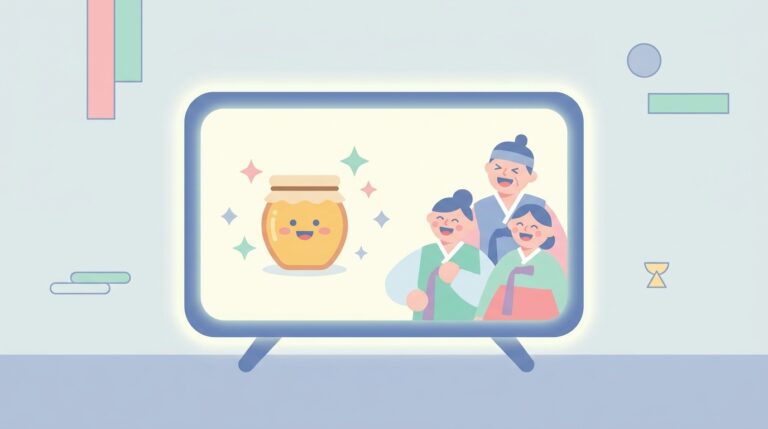
Crack the Code of Korean Variety Shows: What Does 꿀잼 (Honey Jam) Really Mean?
Phase 1: Empathy (Story-Driven Opening)
안녕하세요! (Annyeonghaseyo!) I’m your Daily Hangul editor, your trusted Korean culture navigator and language bestie.
Picture this: You are curled up on your sofa on a Friday night, watching a hilarious episode of Running Man or your favorite K-pop group’s reality show on YouTube. The cast members are rolling on the floor laughing, and suddenly bold, colorful neon letters flash across the bottom of the screen: “완전 꿀잼!”
You pause the video. You open your standard translation app. 꿀 (Gkul) means honey. 잼 (Jaem) means fruit jam. “Total honey jam”? Are they making breakfast sandwiches on a game show? You shake your head, feeling a little left out of the joke.
Every single beginner faces this exact moment. Traditional textbooks teach you to politely say, “이것은 재미있습니다 (Igeoseun jaemi-itseumnida – This is interesting).” But nobody on television, and certainly none of your Korean friends at a board game cafe, speaks like that! This guide is crafted directly from our classroom coaching sessions with hundreds of A1 beginners. By the time you finish reading, you will not only decode the most beloved variety show slang in Korea, but you’ll also be able to react naturally just like a native speaker.
Phase 2: Core 3 Expressions Breakdown
1. 꿀잼 (Kkul-jaem)
- Pronunciation: [Kkul-jaem] (Sounds like cool with a hard ‘k’ click, followed by gem as in gemstone)
- Meaning: Literal: “Honey Jam” | Real Nuance: “Super fun,” “Absolute blast,” or “Extremely entertaining.”
- K-Culture Moment: Seen as animated, glowing text on variety shows like Infinite Challenge or Knowing Bros whenever a comedy skit makes everyone erupt into laughter.
- Editor’s Insight: Koreans love the word 꿀 (kkul – honey) as a prefix for anything sweet, effortless, or top-tier (like 꿀팁 – honey tip/pro tip). Pairing it with the first syllable of 재미 (jaemi – fun) creates an addictive slang word that has dominated Korean pop culture for over a decade.
- Situation Spectrum: Casual ✅ | Semi-formal ⚠️ (Only with close coworkers) | Formal 🚫 (Never in business meetings)
- 🤔 Think About It: In English, we use taste metaphors too, like calling a good moment “sweet.” Why do you think both cultures connect sweetness to happiness?
2. 노잼 (No-jaem)
- Pronunciation: [No-jaem] (Simply the English word No + jaem as in gemstone)
- Meaning: Literal: “No Fun” | Real Nuance: “Boring,” “Not funny at all,” or “Total buzzkill.”
- K-Culture Moment: When a cast member tells a terribly lame dad joke (아재개그 – Ajae gae-geu) and sound effects of cold autumn wind blowing play in the background.
- Editor’s Insight: Konglish (Korean + English) at its finest! Instead of the grammatically formal 재미없어요 (jaemieopseoyo), young Koreans simply say 노잼이에요 (nojaemieyo). It conveys lighthearted teasing rather than harsh criticism.
- Situation Spectrum: Casual ✅ | Semi-formal ⚠️ | Formal 🚫
- 🤔 Think About It: English borrows prefixes across languages too. How does blending English “No” with Korean “Jaem” make the critique feel less heavy?
3. 핵꿀잼 (Haek-kkul-jaem)
- Pronunciation: [Haek-kkul-jaem] (Sounds like heck + cool-gem)
- Meaning: Literal: “Nuclear Honey Jam” | Real Nuance: “Insanely hilarious,” “Mind-blowingly fun.”
- K-Culture Moment: Used in YouTube thumbnails for viral clips of K-pop idols doing random dance play or messy cooking challenges.
- Editor’s Insight: 핵 (haek) means “nuclear.” When you add it in front of 꿀잼, you are multiplying the fun by ten. Reserve this for experiences that truly leave your stomach aching from laughter.
- Situation Spectrum: Casual ✅ | Semi-formal 🚫 | Formal 🚫
- 🤔 Think About It: Why do modern internet subcultures gravitate toward explosive, extreme descriptors to express positive excitement?
Phase 3: Textbook Korean vs. Real Korean
Situation 1: Talking about a new K-Drama
- 📖 교과서 한국어 (Textbook): 드라마가 매우 재미있습니다. (Deuramaga maeu jaemi-itseumnida. / The drama is very interesting.)
- 🗣️ 진짜 한국어 (Real-life): 이 드라마 진짜 꿀잼이에요! (I deurama jinjja kkuljaemieyo! / This drama is total honey-jam!)
- 💡 왜 다를까? (Why is it different?): Textbook Korean focuses on stiff formality markers (-ㅂ니다) suited for news broadcasts. In day-to-day conversation, friends use expressive slang attached to the polite ending -이에요 (-ieyo) to sound warm and relatable.
Situation 2: Reacting to a boring movie
- 📖 교과서 한국어 (Textbook): 영화가 재미가 없습니다. (Yeonghwaga jaemiga eopseumnida. / The movie has no fun.)
- 🗣️ 진짜 한국어 (Real-life): 영화 완전 노잼이었어요. (Yeonghwa wanjeon nojaemieosseoyo. / The movie was totally no-fun.)
- 💡 왜 다를까? (Why is it different?): Adding 완전 (wanjeon – totally) before 노잼 (no-jaem) turns a dry observation into an emotional, shared reaction among peers.
Phase 4: K-Culture Deep Dive & Non-Verbal Manners
4-1. 눈치 (Nunchi) & Gestures
When Koreans say something is 꿀잼 (kkul-jaem), words alone are never enough! Notice the body language on television:
* The Seal Clap (물개박수 – Mulgae baksu): Clapping both hands repeatedly in front of your chest while rocking your body back and forth.
* Table Slapping (테이블 치기): In casual dining setups or chicken-and-beer spots, cracking up laughing and gently slapping the table once or twice demonstrates genuine entertainment.
* Eye Contact & Nunchi: Never use 노잼 (no-jaem) toward an elder or your boss, even playfully, unless you share deep familiarity. Reading the room (눈치 – nunchi) will save you from accidental disrespect!
4-2. Culture Code: The “Subtitles Culture” (자막 문화)
Korean variety shows (예능 – Yeneung) are globally renowned for their dynamic on-screen typography. Unlike Western closed captions designed solely for hearing accessibility, Korean variety subtitles act as an extra character. Editors use 꿀잼, skull icons for 노잼, and comic-book style fonts to tell viewers how to feel, shaping everyday internet slang across the entire peninsula.
Phase 5: Real-World Roleplay Scenario
Setting: You are hanging out with your Korean friend, Minwoo, at a cozy cafe in Hongdae. Minwoo pulls out his smartphone to show you a funny trending video.
- Turn 1 (Minwoo): 이거 유튜브 쇼츠 봤어? (Igeo yutyubeu syocheu bwasseo?)
🎭 Hands phone over with an excited grin
“Did you see this YouTube Short?” -
Turn 2 (You): 아니, 아직 안 봤어. 뭔데? (Ani, ajik an bwasseo. Mweonde?)
🎭 Leaning forward with curious eyes
“No, not yet. What is it?” -
Turn 3 (Minwoo): 요즘 유행하는 챌린지인데, 봐봐. (Yojeum yuhaenghaneun chaellinji-inde, bwabwa.)
🎭 Presses play and watches your reaction closely
“It’s a trending challenge these days, check it out.” -
Turn 4 (You): ㅋㅋㅋ 진짜 웃기다! (Kkk jinjja utgida!)
🎭 Chuckling and doing a mini clap
“Hahaha, that’s really hilarious!” -
Turn 5 (Minwoo): 맞지? 완전 꿀잼이지? (Matji? Wanjeon kkuljaemiji?)
🎭 Nodding enthusiastically
“Right? Total honey-jam, isn’t it?” -
Turn 6 (You): 응, 인정! 완전 꿀잼이야. (Eung, injeong! Wanjeon kkuljaemiya.)
🎭 Laughing together warmly
“Yeah, agreed! Absolutely super fun.” -
Turn 7 (Minwoo): 어제 본 영화는 진짜 노잼이었는데, 이건 대박이다. (Eoje bon yeonghwaneun jinjja nojaemieonneunde, igeon daebagida.)
🎭 Rolling eyes thinking about the movie, then smiling
“The movie I watched yesterday was total no-jam, but this is awesome.” -
Turn 8 (You): 다행이다, 오늘 카페 데이트는 꿀잼이네! (Dahaeng-ida, oneul kape deiteuneun kkuljaemine!)
🎭 Clinking your iced Americano glass against his
“Glad to hear, our cafe hangout today is honey-jam!”
🔀 Interactive Branching Moment
After watching the video, Minwoo asks: “어때? 재미있어? (Eottae? Jaemi-isseo? / How was it? Fun?)” How do you respond?
- Option A: “완전 꿀잼이에요! 또 봐요!” (Wanjeon kkuljaemieyo! Tto bwayo! / Totally honey-jam! Let’s watch again!)
- 👉 Feedback: [BEST] Natural, lively, and shows high conversational engagement. Minwoo will love showing you more clips!
- Option B: “저는 그것에 대해 매우 흥미가 있습니다.” (Jeoneun geugeose daehae maeu heungmiga itseumnida.)
- 👉 Feedback: [BAD] Sounds like a robotic translation from an old encyclopedia. Creates awkward stiffness between friends.
- Option C: “노잼. 그만해.” (No-jaem. Geumanhae. / No fun. Stop it.)
- 👉 Feedback: [RISK] Unless delivered with a huge affectionate smile, blunt phrasing like this can hurt feelings.
Phase 6: 10-Second Emotion Shadowing Drill
Practice reading these out loud! The slashes (/) represent brief natural breath pauses.
[😊 Hyped & Bubbly]
이 예능 / 진짜 / 꿀잼이에요!
(I yeneung / jinjja / kkuljaemieyo!)
“This variety show / is really / honey-jam!”-
[😒 Playfully Teasing & Sarcastic]
아, 진짜? / 그 농담은 / 완전 노잼이야.
(A, jinjja? / Geu nongdameun / wanjeon nojaemiya.)
“Oh, really? / That joke / is totally no-jam.” -
[🤩 Jaw-Dropping Excitement]
대박! / 오늘 파티 / 완전 핵꿀잼이었어!
(Daebak! / Oneul pati / wanjeon haek-kkul-jaemieosseo!)
“Awesome! / Today’s party / was pure nuclear honey-jam!”
Phase 7: K-Culture Mini Dictionary
- 꿀잼 (Kkul-jaem) | Noun / Slang
Meaning: Extreme fun. Used in casual texting, social media comments, and entertainment reviews. - 노잼 (No-jaem) | Noun / Slang
Meaning: Zero fun, boring. Frequently combined with 시기의 노잼 to describe a slump or rut in life. - 핵꿀잼 (Haek-kkul-jaem) | Noun / Slang
Meaning: Nuclear-level fun. Used heavily in YouTube and TikTok titles to generate high click-through rates. - 잼민이 (Jaem-min-i) | Noun / Slang
Meaning: Elementary school kid (often playfully used for someone acting childish). Derived from 재미 (fun) + popular boy name 민이 (Min-i).
Phase 8: Traveler’s Survival Kit
Top 3 Survival Expressions
- 1. 이거 꿀잼이에요! (Igeo kkuljaemieyo!)
Pro Tip: Use this at an interactive tourist spot (like an arcade in Hongdae or a Hanbok photo booth) to compliment the staff. - 2. 혹시 재미있어요? (Hoksi jaemi-isseoyo?)
Pro Tip: The safe, polite way to ask a clerk if an attraction, museum, or pop-up store is worth entering. - 3. 한국 여행 완전 꿀잼이에요! (Hanguk yeohaeng wanjeon kkuljaemieyo!)
Pro Tip: Say this to guesthouse hosts or taxi drivers. It instantly melts any barrier!
Editor’s Travel Note
- Navigation: Skip foreign map apps that fail to update local footpaths. Make sure to complete the Naver Map navigation app download before landing at Incheon Airport.
- Communication: Everyone in Korea connects through messaging. Follow our KakaoTalk official chat guide to exchange contacts with friends you meet at language exchanges.
- Variety Destination: Want to experience true K-variety magic? Visit the MBC World broadcasting experience center or SBS Open Studios in Digital Media City (DMC), Mapo-gu, Seoul.
Phase 9: “One Step Deeper” (Critical Thinking)
In modern Korean culture, language moves at lightning speed due to rapid smartphone adoption and the unique habit of creating 줄임말 (Jurim-mal – shortened compound words). Words like 꿀잼 and 노잼 reflect a cultural desire for efficient, punchy emotional sharing (공감 – Gonggam). Koreans value collective mood over dry statements; telling someone an experience is “꿀잼” is an invitation to share joy together.
💬 Your Turn: What is your favorite slang word in your own native language for something that is “super fun”? Drop it in the comments below, and let’s find its closest Korean slang match!
Phase 10: FAQ & Avoiding Misunderstandings
Q: Can I use 꿀잼 with my Korean boss or university professor?
A: Definitely not! While 꿀잼 is not an offensive curse word, it is strictly informal internet slang. With elders, professors, or in professional interviews, stick to standard respectful Korean: “정말 유익하고 재미있었습니다 (Jeongmal yu-ikhago jaemi-isseotseumnida – It was truly informative and enjoyable).”
Q: Is 꿀잼 considered an actual dictionary word?
A: It is classified as an established neologism (신조어 – Sinjoeo). While it won’t appear in classical literature, it is officially recognized in modern open Korean dictionaries and used by major national broadcasting channels like KBS and tvN.
Q: What is the opposite of 꿀잼?
A: The direct antonym is 노잼 (No-jaem). If you want to say something is slightly boring, you can say “조금 노잼이에요 (Jogeum no-jaemieyo).”
🚨 Common Mistakes Alert (흔한 실수)
- Mistake: Saying 꿀잼이 alone without a predicate to strangers.
Correct Action: Always attach the polite copula: 꿀잼이에요 (Kkuljaemieyo) when speaking to people you aren’t close with. - Mistake: Pronouncing 꿀 with a soft English ‘k’ (Kool).
Correct Action: Tense your throat muscles. It’s a double consonant (ㄲ), producing a tight, popping [Kkul] sound. - Mistake: Using 노잼 aggressively when someone is genuinely presenting work.
Correct Action: Only use 노잼 for silly jokes, games, or media content—never to demean someone’s hard work!
Phase 11: Action Missions
- 🥉 Bronze Mission (Solo Practice): Stand in front of your mirror and practice saying: “이거 완전 꿀잼이에요!” 5 times with a bright smile and a seal clap.
- 🥈 Silver Mission (Social Media): Find a reel or video of your favorite K-pop bias on Instagram or TikTok and leave a comment: “진짜 꿀잼 ㅋㅋㅋ”.
- 🥇 Gold Mission (Real Life): Next time your Korean tutor or language exchange partner introduces a fun topic, react with: “오! 꿀잼각이에요! (Oh! It looks like total honey-jam!)”.
- 🎮 K-Culture Mission: Watch any 10-minute clip of Running Man on YouTube with Korean captions turned on. Spot how many times the syllable 잼 (jaem) appears on screen!
Phase 12: Interactive Quiz Challenge
Test your instincts below! Click the arrows to reveal the answers.
Question 1: Situation Check
You just finished an amazing roller coaster ride at Lotte World with your Korean exchange buddy. What is the most natural thing to say?
* A) 아주 흥미진진하였습니다.
* B) 와, 진짜 꿀잼이었어!
* C) 롤러코스터가 노잼입니다.
Click here to reveal the answer & explanation!
Correct Answer: B) 와, 진짜 꿀잼이었어! (Wa, jinjja kkuljaemieosseo!)
Explanation: Option A is unnaturally literary for an amusement park with a friend, and Option C means it was boring. Option B uses casual past tense (꿀잼이었어) perfectly to express thrill!
Question 2: Fill-in-the-Blank
Complete the dialogue:
A: “어제 그 영화 어땠어? (How was that movie yesterday?)”
B: “완전 별로였어. 너무 ______이었어. (It was awful. It was totally ______.)”
Click here to reveal the answer & explanation!
Correct Answer: 노잼 (No-jaem)
Explanation: Since person B stated the movie was awful (별로였어), the corresponding slang for boring/no-fun is 노잼.
Question 3: True or False (Culture Check)
True or False: You can write “이 프레젠테이션은 꿀잼입니다” on your formal PowerPoint slide during a business meeting with a client in Seoul.
Click here to reveal the answer & explanation!
Correct Answer: False!
Explanation: 꿀잼 is colloquial slang. In formal business environments, use 유익합니다 (Yu-ikhamnida – beneficial/informative) or 인상 깊습니다 (Insang gipseumnida – deeply impressive).







