Mastering Korean Pharmacy Prescriptions: How to Listen and Take Your Medicine Like a Local
Phase 1: Empathy & Immersion
안녕하세요! 매일한글 에디터입니다. (Hello! I’m your Daily Hangul editor.)
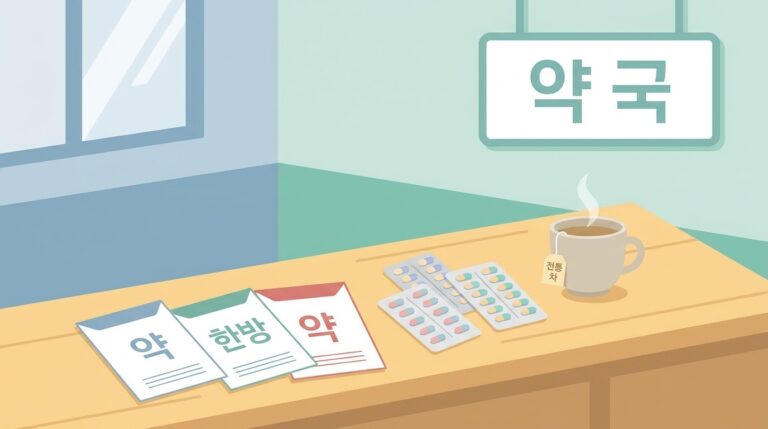
Picture this: You have just survived a sudden bout of seasonal flu while exploring Seoul. After navigating an ENT clinic (이비인후과), you step into the neighborhood pharmacy (약국) right next door. The automatic sliding door opens with a warm chime, and the comforting aroma of Korean herbal teas welcomes you. You hand your white paper prescription to the pharmacist behind the counter. A few minutes later, they return with a translucent envelope holding neat little rows of heat-sealed clear plastic pouches (약포지) filled with colorful pills. Then, at lightning speed, the pharmacist recites: “식후 삼십 분에 드시고요, 졸릴 수 있으니까 운전 조심하세요!” You nod politely, but your mind is racing: Wait, do I take all packets at once? Before meals or after? Did they say something about drowsiness?
If you watch K-dramas, you have definitely seen this scene. Think of Hospital Playlist where doctors tenderly look after recovering patients, or those heart-fluttering moments when the main lead runs out into the pouring rain to grab emergency cold medicine from an all-night pharmacy. But when you are the one standing at the counter with a pounding headache and a scratchy throat, listening to rapid-fire medical Korean can feel daunting.
Navigating healthcare in a foreign language is not just about memorizing vocabulary; it is about self-preservation and peace of mind. By mastering the exact listening cues, timing markers, and cultural expectations of Korean pharmacists, you will never have to guess your dosage or worry about side effects again. Designed with real feedback from intermediate learners living in Korea, this guide will turn pharmacy visits from a nerve-wracking ordeal into a smooth, empowering local experience.
Phase 2: Core Expressions Deep Dive
1. 식후 30분에 드세요 (Sik-hu sam-sip-bun-e deu-se-yo)
- Pronunciation: [Sik-hu sam-sip-bun-e deu-se-yo] (Think: “Seek-who sum-ship-boon-eh duh-say-yo” — rhyme sik with ‘seek’ and hu with ‘who’).
- Meaning: Literal: “Please ingest 30 minutes after a meal.” | Nuance: The classic, universal guideline for oral medicine in Korea, designed to protect your stomach lining from gastric irritation.
- K-Culture Moment: In modern workplace K-dramas, whenever an overworked salaryman is nursing a cold, a caring coworker inevitably slides a warm lunchbox and medicine packet across the desk while whispering: “밥 꼭 챙겨 먹고, 식후 30분에 약 먹어!” (Make sure to eat, and take your medicine 30 minutes after eating!).
- Editor’s Insight: While contemporary Korean clinical standards note that taking medicine right after a meal (식후 즉시) is completely acceptable to avoid forgetting, the phrase “식후 30분” remains deeply anchored in everyday Korean health vocabulary as a psychological safety buffer.
- Situation Spectrum: Casual: ⚠️ (Use ‘식후 30분에 먹어’) | Semi-formal: ✅ | Formal: ✅
- 🤔 Think About It: Notice how Korean medicine schedules revolve strictly around meal times (sik-sa) rather than arbitrary clock hours (e.g., “every 8 hours”). What does this reveal about the central role of warm meals in Korean wellness culture?
2. 졸릴 수 있으니 운전이나 기계 조작은 피하세요 (Jol-lil su iss-eu-ni un-jeon-i-na gi-gye jo-jak-eun pi-ha-se-yo)
- Pronunciation: [Jol-lil su iss-eu-ni un-jeon-i-na gi-gye jo-jak-eun pi-ha-se-yo] (Think: “Jole-leel soo ees-soo-nee oon-jeon-ee-nah gee-gyae jo-jahk-eun pee-ha-say-yo”).
- Meaning: Literal: “Because it may cause drowsiness, avoid driving or operating machinery.” | Nuance: The crucial safety warning given when prescriptions contain antihistamines, pain relief sedatives, or muscle relaxants.
- K-Culture Moment: The classic comedic trope in office dramas like Misaeng where a rookie employee catches a winter cold, downs their daytime medicine packet, and hilariously battles heavy eyelids during an intense presentation before the managing director.
- Editor’s Insight: If you have an important meeting, class, or road trip planned, this is your cue to advocate for yourself! You can immediately ask: “안 졸리는 약으로 바꿔주실 수 있나요?” (Could you switch it to a non-drowsy alternative?).
- Situation Spectrum: Casual: 🚫 | Semi-formal: ✅ | Formal: ✅
- 🤔 Think About It: In many Western countries, cautionary warnings are printed as tiny icons on the side of amber bottles. In Korea, pharmacists verbally explain this warning while tapping the pouch with a pen. How does verbal reinforcement demonstrate Korean customer care (jeong)?
3. 하루 세 번, 아침 점심 저녁으로 드세요 (Ha-ru se beon, a-chim jeom-sim jeo-nyeok-eu-ro deu-se-yo)
- Pronunciation: [Ha-ru se beon, a-chim jeom-sim jeo-nyeok-eu-ro deu-se-yo] (Think: “Hah-roo seh burn, ah-cheem jum-seem juh-nyuk-eu-roh duh-say-yo”).
- Meaning: Literal: “Take three times a day, for breakfast, lunch, and dinner.” | Nuance: The definitive rhythmic blueprint of Korean prescription schedules, neatly dividing your treatment across three daily meals.
- K-Culture Moment: Korean mothers packing care packages for their college students living in dorms, reciting this line like a rhythmic maternal spell.
- Editor’s Insight: What if you skip lunch or do intermittent fasting? Don’t skip your dose without asking! Pharmacists usually advise eating a light snack like a banana or bread before taking daytime medication to prevent an upset stomach.
- Situation Spectrum: Casual: ⚠️ (Use ‘하루 세 번, 챙겨 먹어’) | Semi-formal: ✅ | Formal: ✅
- 🤔 Think About It: Breaking the day into “아침, 점심, 저녁” aligns medical treatment directly with personal rhythm. How does organizing time around meals influence how you structure your daily routine?
Phase 3: Textbook Korean vs. Real Korean
Situation 1: Asking if the prescription makes you sleepy
- 📖 교과서 한국어 (Textbook): 이 의약품은 졸음을 유발합니까? (I ui-yak-pum-eun jor-eum-eul yu-bal-ham-ni-kka? / Does this pharmaceutical preparation induce somnolence?)
- 🗣️ 진짜 한국어 (Real Korean): 이 약 많이 졸려요? (I yak man-i jol-lyeo-yo? / Does this medicine make me really drowsy?)
- 💡 왜 다를까? (Why the difference?): Words like “의약품” (pharmaceutical product) and “유발하다” (induce/trigger) are formal Sino-Korean terms found in clinical literature and printed packaging. In real spoken Korean, native speakers rely on simple, punchy, and authentic conversational phrasing like “약” (medicine) and “졸리다” (to feel sleepy).
Situation 2: Checking whether to take it on an empty stomach
- 📖 교과서 한국어 (Textbook): 공복 시에 복용해야 합니까? (Gong-bok si-e bok-yong-hae-ya ham-ni-kka? / Should I ingest this during fasting periods?)
- 🗣️ 진짜 한국어 (Real Korean): 빈속에 먹어도 돼요? (Bin-sok-e meog-eo-do dwae-yo? / Can I take this on an empty stomach?)
- 💡 왜 다를까? (Why the difference?): While “공복” (empty stomach/fasting state) is printed on medical dosage envelopes, spoken Korean strongly favors the native Korean compound “빈속” (literally ‘empty inside’) paired with the natural verb “먹다” rather than the clinical “복용하다”.
Phase 4: K-Culture Deep Dive & Non-Verbal Manners
4-1. 눈치 (Nunchi) & Counter Etiquette
- Two-Handed Respect (두 손으로 받기): When the pharmacist passes you the medication envelope and returns your credit card, receive both items with both hands (or place your left hand gently supporting your right forearm). This shows deep mutual respect.
- Attentive Nodding & Verbal Back-Channeling: While the pharmacist runs through your dosage, do not stand completely silent. Maintain gentle eye contact and supply rhythmic nods paired with polite acknowledgments: “네~ 네~” (Ne~ ne~ / Yes, got it).
- The Envelope Highlight Scan: The pharmacist will often hold up your prescription envelope (약봉투) and circle timings or draw lines with a highlighter pen. Follow their pen tip with your eyes—this envelope contains your entire daily medical roadmap!
4-2. Culture Code Analysis
- The Genius of the “Yakpoji” (약포지 – Unit-Dose Packaging System): Unlike many Western countries where patients receive multiple brown plastic bottles and must count loose pills at home, South Korea relies almost exclusively on automated unit-dose packaging machines. All pills for one specific dose (e.g., breakfast or dinner) are sealed into a single, tearable translucent packet stamped with “아침” (Morning), “점심” (Lunch), or “저녁” (Dinner). It is the ultimate embodiment of Korean ppalli-ppalli (fast and efficient) culture combined with meticulous care.
- The Warm Tonic Culture: When you pick up a prescription or purchase over-the-counter flu remedies during cold months, neighborhood pharmacists often offer or recommend a small heated bottle of Ssanghwa-tang (쌍화탕 – traditional herbal restorative tonic) or vitamin drinks. It reflects Jeong (정)—the unspoken communal warmth and attentiveness woven into local Korean life.
Phase 5: Real-World Roleplay Scenario
Setting & Character Profile
- Setting: A warm, well-lit pharmacy in Mapo-gu, Seoul. Light rain taps against the display windows. A gentle scent of chamomile and herbal remedies fills the air.
- NPC: Pharmacist Park Min-seok (약사 박민석) — a 40-something pharmacist with half-rim glasses and a reassuring smile, famous for his patient and thorough explanations to international residents.
Dialogue
Turn 1
* 약사 박민석: 김민우 님, 처방약 나왔습니다. 이쪽으로 오세요. (Kim Min-woo nim, cheo-bang-yak na-wat-seum-ni-da. I-jjok-eu-ro o-se-yo. / Mr. Minwoo Kim, your prescription is ready. Please step over here.) 🎭 약봉투를 카운터에 가지런히 올려놓으며 미소를 짓는다
Turn 2
* 학습자 (민우): 네, 감사합니다. (Ne, gam-sa-ham-ni-da. / Yes, thank you.) 🎭 카운터 앞으로 다가가 두 손을 모으고 경청할 준비를 한다
Turn 3
* 약사 박민석: 총 3일 치 약이고요, 하루 세 번 식후 30분에 한 포씩 드시면 됩니다. (Chong sam-il chi yak-i-go-yo, ha-ru se beon sik-hu sam-sip-bun-e han po-ssik deu-si-myeon doem-ni-da. / This is a 3-day supply. Take one packet three times a day, 30 minutes after meals.) 🎭 약봉투 뒷면의 낱알 포장 하나를 손가락으로 가리킨다
Turn 4
* 학습자 (민우): 아, 식후 30분이요? 혹시 빈속에 먹으면 속이 쓰릴까요? (A, sik-hu sam-sip-bun-i-yo? Hok-si bin-sok-e meog-eu-myeon sog-i sseu-ril-kka-yo? / Ah, 30 minutes after eating? By any chance, will it upset my stomach if I take it empty?) 🎭 살짝 고개를 갸웃하며 진지하게 묻는다
Turn 5
* 약사 박민석: 네, 소염진통제가 들어있어서 빈속에 드시면 속이 쓰릴 수 있어요. 빵 한 조각이라도 꼭 드시고 드세요. (Ne, so-yeom-jin-tong-je-ga deul-eo-iss-eo-seo bin-sok-e deu-si-myeon sog-i sseu-ril su iss-eo-yo. Ppang han jo-gak-i-ra-do kkok deu-si-go deu-se-yo. / Yes, it contains anti-inflammatory painkillers, so taking it empty might cause heartburn. Even a slice of bread will do; please eat something first.) 🎭 형광펜으로 약봉투에 밑줄을 그으며 설명한다
Turn 6
* 학습자 (민우): 알겠습니다. 그리고 제가 오후에 운전해야 하는데, 많이 졸릴까요? (Al-get-seum-ni-da. Geu-ri-go je-ga o-hu-e un-jeon-hae-ya han-de, man-i jol-lil-kka-yo? / Understood. And I have to drive this afternoon—will it make me very drowsy?) 🎭 운전대를 잡는 시늉을 가볍게 하며 묻는다
Turn 7
* 약사 박민석: 감기약 성분 때문에 약간 나른할 수 있어요. 오늘 낮 약은 졸음 유발 성분을 뺐으니 괜찮지만, 그래도 졸리시면 꼭 쉬어가세요. (Gam-gi-yak seong-bun dtae-mun-e yak-gan na-reun-hal su iss-eo-yo. O-neul nat yak-eun jor-eum yu-bal seong-bun-eul ppaess-eu-ni gwaen-chan-chi-man, geu-rae-do jol-li-si-myeon kkok swi-eo-ga-se-yo. / The cold ingredients might make you a bit tired. Today’s afternoon packet has the drowsy ingredient removed so you should be okay, but please rest if you feel sleepy.) 🎭 낮 시간대 파우치를 톡톡 두드리며 안심시켜 준다
Turn 8
* 학습자 (민우): 세심하게 챙겨주셔서 정말 감사합니다! 조심해서 먹을게요. (Se-sim-ha-ge chaeng-gyeo-ju-syeo-seo jeong-mal gam-sa-ham-ni-da! Jo-sim-hae-seo meog-eul-ge-yo. / Thank you so much for your thorough care! I will take them carefully.) 🎭 두 손으로 약봉투를 공손히 받아 들고 목례한다
🔀 Interactive Decision Point
Situation: You accidentally forgot your morning dose, and it is already 2:30 PM. What do you do?
- Option A: “아침 약을 건너뛰었으니 점심 약과 함께 두 봉지를 한 번에 털어 넣는다.” (Take both the morning and afternoon packets together at once.)
- Option B: 약국에 전화해서 “아침 약을 깜빡했는데 지금이라도 한 포만 먹을까요?”라고 문의한다. (Call the pharmacy and ask: “I forgot my morning dose, should I take just one packet now?”)
- Option C: 아침 약을 거른 김에 복용 주기가 망가졌다고 생각해 밤까지 모든 약 복용을 중단한다. (Give up on today’s schedule and skip all remaining doses until nighttime.)
Feedback:
* Option A (Dangerous Risk ⚠️): Taking a double dose can overload your liver and trigger acute gastric distress. Never take two packets simultaneously unless expressly advised by a medical professional.
* Option B (Best Choice ✅): Outstanding B2-level communication! Calling the pharmacy displays practical autonomy and safeguards your health.
* Option C (Bad Choice 🚫): Abruptly dropping antibiotic or anti-inflammatory schedules allows lingering bacterial pathogens to develop tolerance and rebound.
Phase 6: 10-Second Emotion Shadowing Drill
Read these aloud while mirroring the emotional markers and rhythm breaks (/):
- [🥺 Worried & Inquiring / 조심스럽고 걱정스럽게]
저기요… / 이 약 먹으면 / 많이 졸려요? /
(Jeo-gi-yo… / i yak meog-eu-myeon / man-i jol-lyeo-yo? / Excuse me… if I take this medicine, does it make me very sleepy?) -
[😊 Relieved & Appreciative / 안도하며 밝게]
아, / 식후 30분이군요! / 꼼꼼히 설명해 주셔서 / 정말 감사합니다. /
(A, / sik-hu sam-sip-bun-i-gun-yo! / kkom-kkom-hi seol-myeong-hae ju-syeo-seo / jeong-mal gam-sa-ham-ni-da. / Ah, 30 minutes after eating! Thank you so much for explaining it thoroughly.) -
[🧐 Focused & Double-Checking / 똑 부러지게 확인하며]
혹시 / 위장약도 / 처방전에 / 같이 들어있나요? /
(Hok-si / wi-jang-yak-do / cheo-bang-jeon-e / gat-i deul-eo-iss-na-yo? / By any chance, is stomach-protecting medicine also included in the prescription?)
Phase 7: K-Culture Mini Dictionary
- 약포지 (Yak-po-ji) | Unit-Dose Sachet / Packet | The individual clear, sealed plastic packets dispensed in Korea. Each pouch holds all combined pills for a single mealtime, clearly stamped with “아침” (Morning), “점심” (Lunch), or “저녁” (Dinner).
- 식전 / 식후 (Sik-jeon / Sik-hu) | Before Meals / After Meals | Essential Sino-Korean dosage timing markers. 식전 (usually 30 minutes before food) is common for thyroid, anti-nausea, or stomach-coating medicines; 식후 (30 minutes after food) is standard for cold, pain, and antibiotic treatments.
- 속 쓰림 (Sok sseu-rim) | Stomach Irritation / Heartburn | An authentic Korean sensory phrase describing acidic stomach discomfort. If strong painkillers irritate your stomach, tell the pharmacist: “속이 너무 쓰려요” (My stomach burns/hurts).
- 복약 안내문 (Bok-yak an-nae-mun) | Medication Guide Printout | The itemized medical sheet printed directly on your prescription paper bag (약봉투), detailing drug appearances, active ingredients, primary benefits, and storage guidelines.
Phase 8: Survival Kit for Travelers
Top 3 Survival Expressions
- 하루에 몇 번 먹어야 하나요?
(Ha-ru-e myeot beon meog-eo-ya ha-na-yo? / How many times a day should I take this?)
Pro Tip: Use this while pointing at the dosage table on the back of the envelope if you get confused by fast spoken numbers. - 졸리지 않는 약으로 처방 가능한가요?
(Jol-li-ji an-neun yak-eu-ro cheo-bang ga-neung-han-ga-yo? / Is it possible to prescribe non-drowsy medicine?)
Pro Tip: Invaluable if you have to drive a rental car across Jeju Island or navigate busy subways during your vacation. - 물에 타서 먹나요, 그냥 삼키나요?
(Mul-e ta-seo meog-na-yo, geu-nyang sam-ki-na-yo? / Do I dissolve it in water or swallow it whole?)
Pro Tip: Essential when dealing with powder sachets (가루약) or dissolving chewable tablets.
Editor’s Travel Note
- Locating Late-Night Pharmacies: Most neighborhood pharmacies close around 7:00 PM. If an emergency strikes late at night, open the 네이버 지도 앱 다운로드 (Naver Map application) and search for “공공심야약국” (Public Late-Night Pharmacy) or look for “달빛어린이병원” (Moonlight Pediatric Clinics), which run partner pharmacies operating until midnight or 24/7.
- Payment & Insurance: International cards are universally accepted. Keep your paper prescription envelope (약봉투); it serves as an official legal tax receipt (진료비 영수증) necessary for filing travel insurance claims abroad!
Phase 9: One Step Deeper
In Korean society, physical wellness is seldom treated as a cold, isolated medical transaction. Rather, it exists as a natural extension of table culture and communal care. The quintessential Korean greeting “밥 먹었어요?” (Have you eaten?) transforms at the pharmacy counter into “식후 30분에 드세요” (Take it 30 minutes after your meal). Traditional Korean thought holds that medicine and food share the same origin (약식동원 – 藥食同源). Nourishing your stomach before administering chemical remedies demonstrates an enduring respect for biological balance over harsh, abrupt interventions.
💬 Your Turn: In your home country, are medications scheduled strictly by mechanical clock hours (e.g., “every 6 to 8 hours”) or coordinated with your meals? How does this influence the way you view staying healthy? Share your experiences in the comments below!
Phase 10: FAQ & Misconceptions
Q: Can I purchase prescription medication at a Korean pharmacy without seeing a doctor first?
A: No. Under South Korea’s strict healthcare separation policy (의약분업) implemented in 2000, pharmacies cannot dispense prescription-strength medicine without an official physical paper prescription (처방전) issued by a licensed medical clinic. Over-the-counter medications (일반의약품) like basic Tylenol, gentle digestive aids, and throat lozenges, however, can be purchased freely over the counter.
Q: What should I do if I misplace my physical prescription paper before going to the pharmacy?
A: You must return to the clinic where you were examined. Korean pharmacies legally cannot process digital smartphone photos or verbal explanations of prescriptions. The clinic can easily reprint your original paper prescription for a minimal paperwork fee.
Q: Why do Korean pharmacists seal all different pills together inside small tearable packets?
A: This automated system is known as “약포지” (unit-dose packaging). Instead of handing patients multiple bulky bottles where you have to calculate pills yourself, the automated dispenser measures and seals each exact dose chronologically. It dramatically reduces patient dosing errors and makes taking your medicine on the go remarkably convenient.
🚨 흔한 실수 (Common Mistakes) Warning Board
- Mistake: Tearing open all unit-dose packets and dumping all loose pills together into a weekly organizer.
- Correct Action: Keep each dose sealed inside its individual 약포지 packet until the exact second you take it. These heat-sealed sachets shield the medicine from humidity, light exposure, and contamination.
- Mistake: Washing down prescription pills with iced Americano, barley tea (보리차), or citrus juice.
- Correct Action: Always ingest Korean prescription medication with a full glass of lukewarm plain water (미온수). Caffeine and tannins directly interfere with antibiotic absorption and can trigger severe stomach irritation.
- Mistake: Halting your medication halfway through the course because you “feel all better.”
- Correct Action: Complete the full 3-day or 5-day cycle as prescribed. Stopping antibiotics or steroids midway invites resilient bacterial relapse.
Phase 11: Action Missions
- 🥉 Bronze Mission (Solo Shadowing): Stand in front of a mirror and practice asking out loud: “하루에 몇 번, 밥 먹고 먹어야 하나요?” three times with natural intonation.
- 🥈 Silver Mission (Social Share): Next time you receive a daily vitamin pack or visit a Korean pharmacy, take a photo and share it on Instagram or Threads tagging #DailyHangul with the caption: “식후 30분에 꼭 챙겨 드세요! 💊”.
- 🥇 Gold Mission (Real-World Execution): Next time you visit a Korean clinic or pharmacy, successfully inquire about side effects using: “이 약 많이 졸린가요?” without switching to English!
- 🎮 K-Culture Mission: In your current K-drama, watch for an illness scene! Notice whether the character receives a classic paper “약봉투” and listen closely to check if the dialogue features “식후 30분” or “빈속”!
Phase 12: Interactive Quiz Challenge
Test your intermediate pharmacy listening mastery below!
Quiz 1. Situational Judgment
The pharmacist says: “식후 즉시 복용하시고, 빈속에는 절대 드시지 마세요.” What should you do?
* A) Take it 1 hour before eating on an empty stomach.
* B) Take it right after finishing your meal, and never take it on an empty stomach.
* C) Dissolve the medication into your soup during lunch.
Quiz 2. Fill in the Blank
“오후에 운전해야 하는데 약 먹고 많이 _________ 수 있나요?” (I have to drive this afternoon; could taking this medicine make me very drowsy?)
* ① 바쁠 (busy)
* ② 졸릴 (drowsy/sleepy)
* ③ 매울 (spicy)
Quiz 3. True / False Cultural Trivia
True or False: In Korea, you can take a prescription paper written by an ENT clinic in Seoul and fill it at any licensed neighborhood pharmacy across South Korea.
👉 Click here to reveal the Answers & Cultural Explanations!
- Quiz 1 Answer: B
Explanation: “식후 즉시” means immediately after a meal, and “빈속에는 절대 드시지 마세요” strictly forbids taking it on an empty stomach to prevent gastric damage. - Quiz 2 Answer: ② 졸릴
Explanation: “졸리다” (to feel sleepy/drowsy) combined with the grammatical possibility form “-(으)ㄹ 수 있다” creates “졸릴 수 있나요?” (Could I get drowsy?). - Quiz 3 Answer: True
Explanation: Korean prescription papers are standardized nationwide. You can fill your prescription at any registered Korean pharmacy, though pharmacies right next to your clinic are most likely to have the exact prescribed brand in stock immediately!