

Phase 1: Empathy (Story-driven Opening)
안녕하세요! 매일한글 에디터입니다. (Hello! I’m your Daily Hangul editor.)
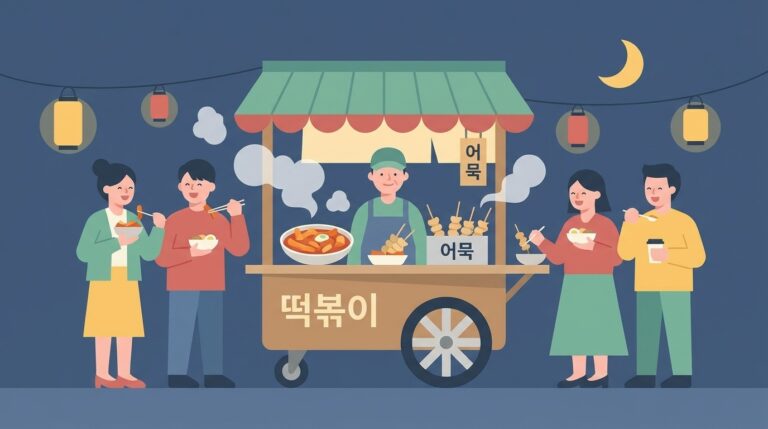
Picture this: It is a brisk autumn evening in Seoul. You turn the corner into a bustling alleyway, and a thick cloud of fragrant, savory steam wraps around you. You hear the bubbling sizzle of fiery red tteokbokki (spicy rice cakes) and see people huddled shoulder-to-shoulder under the striped vinyl awning of a street food cart (pojangmacha). Everyone is holding a warm paper cup of broth, chatting excitedly, and munching on skewers while standing up.
You want to jump right in, just like your favorite characters in K-dramas, but suddenly a wave of panic hits you: “Do I just walk up and grab food? Do I have to ask to stand here? Is the broth free? How on earth do I order without bumping into people or sounding rude?”
You are not alone! Over the past decade coaching foreign learners in Korea, nearly every student has confessed that their first street food experience felt like an unplanned exam in Korean social etiquette. But once you master just a handful of authentic phrases and learn the unspoken rhythm of street stalls, standing and eating becomes the most thrilling, delicious, and heartwarming memory of your entire trip. Let’s dive into the essential language and culture you need to eat like a true local!
Phase 2: 3 Core Expressions Deep-Dive
1. 서서 먹고 가도 돼요? (Seoseo meoggo gado dwaeyo?)
- Pronunciation: [Seo-seo meok-go ga-do dwae-yo?] (Think: “Suh-suh muck-go gah-doh dway-yo”)
- Meaning: Literal: “May I eat standing and then go?” / Real Nuance: “Can I eat right here at the stall?”
- K-Culture Moment: In K-dramas, whenever friends or lovers want a quick late-night snack on the way home, they duck under the vinyl flap of a food stall and casually say this to the vendor while rubbing their hands for warmth.
- Editor’s Insight: Street vendors often juggle takeout orders (pojang) and dine-in customers. Asking this confirms that you want to stand right at the counter. The combination of 서서 (standing) and 먹고 가다 (eat and leave) sounds exceptionally natural to native ears.
- Situation Spectrum: Casual (Friends/Young vendors): ⚠️ | Semi-formal (Polite stall owners): ✅ | Formal: 🚫
- 🤔 Think About It: In many Western cultures, standing while eating can be seen as rushed or bad table manners. In Korea, what does the warm acceptance of standing shoulder-to-shoulder reveal about communal boundaries and casual dining?
2. 국물 좀 더 마셔도 돼요? (Gungmul jom deo masyeodo dwaeyo?)
- Pronunciation: [Gung-mool jom deo ma-syeo-do dwae-yo?] (Think: “Goong-mool jom duh mah-shyuh-doh dway-yo”)
- Meaning: Literal: “May I drink a bit more broth?” / Real Nuance: “Do you mind if I pour myself another cup of fish cake soup?”
- K-Culture Moment: Seen in endless variety shows—celebrities standing in freezing winter weather, taking a sip of steaming odeng (fish cake) broth from a paper cup and sighing in pure comfort: “Kiah~!”
- Editor’s Insight: At street carts with fish cake skewers, the broth is complimentary! While you often serve yourself using the plastic ladle provided, asking politely before your second or third cup shows wonderful consideration (nunchi).
- Situation Spectrum: Casual: ⚠️ | Semi-formal: ✅ | Formal: 🚫
- 🤔 Think About It: Why do Korean street vendors offer unlimited, piping-hot broth without charging extra? How does the concept of Jeong (deep affection and hospitality) shape everyday business transactions?
3. 떡볶이 1인분하고 튀김 섞어주세요. (Tteokbokki irinbunhago twigim seokkeojuseyo.)
- Pronunciation: [Tteok-bok-kki ee-reen-boon-ha-go twee-geem seok-keo-joo-se-yo.] (Think: “Ttok-bok-key eel-in-boon hah-go twee-gim suk-kuh joo-say-yo”)
- Meaning: Literal: “Please mix 1 serving of tteokbokki and fried snacks.” / Real Nuance: “I’d like one order of tteokbokki, and please pour the spicy sauce over my assorted fried snacks!”
- K-Culture Moment: In high school K-dramas, students pool their pocket money after class and ask the stall Imo-nim (auntie) to coat their crispy fried sweet potato and seaweed rolls in thick tteokbokki gravy.
- Editor’s Insight: 섞다 (to mix) or 버무리다 (to coat in sauce) is the secret code of street food connoisseurs. If you prefer your fried snacks crispy, you can ask for them separately, but dipping or mixing them in tteokbokki sauce is the authentic Seoul style!
- Situation Spectrum: Casual: ⚠️ | Semi-formal: ✅ | Formal: 🚫
- 🤔 Think About It: Notice the counter word 인분 (in-bun) for portions. How does Korean food language reflect shared plate dining compared to individual menu items in other cuisines?
Phase 3: Textbook Korean vs. Real Korean
Situation 1: Asking if you can have the fish cake soup
- 📖 교과서 한국어 (Textbook): 이 어묵 국물을 마셔도 됩니까? (I eomuk gungmureul masyeodo doemnikka? – May I drink this fish cake broth?)
- 🗣️ 진짜 한국어 (Real-life): 사장님, 국물 종이컵에 떠 마셔도 돼요? (Sajangnim, gungmul jong-ikeobe tteo masyeodo dwaeyo? – Boss, can I ladle some broth into a paper cup?)
- 💡 왜 다를까? (Why the difference?): The textbook sentence uses rigid formal military style (-bnikka), which creates an awkward distance at a cozy street stall. Real Koreans address the owner as 사장님 (boss/owner) and use the action verb 떠 마시다 (to scoop and drink) with casual polite endings.
Situation 2: Paying after eating skewers standing up
- 📖 교과서 한국어 (Textbook): 계산서를 주십시오. (Gyesanseoreul jusipsio. – Please give me the bill.)
- 🗣️ 진짜 한국어 (Real-life): 이모님, 꼬치 세 개 먹었는데 얼마예요? (Imo-nim, kkochi se gae meogeonneunde eolmayeyo? – Auntie, I ate three skewers, how much is it?)
- 💡 왜 다를까? (Why the difference?): Street food stalls don’t have paper bills! The owner calculates your total by counting the wooden skewers left in your hand or the plate in front of you. Declaring what you ate directly is the standard, honest way to settle the tab.
Phase 4: K-Culture Deep Dive & Non-Verbal Manners
4-1. 눈치 (Nunchi) & Street Cart Gestures
Standing at a street stall is a miniature masterclass in spatial awareness (nunchi):
* The Skewer Shield: When eating fish cake skewers dipped in soy sauce, hold your paper cup directly beneath the skewer as you move it to your mouth. This prevents drops of soy sauce or soup from splashing onto the communal counter or your clothes.
* The Counter Skewers Rule: Never toss wooden skewers into the communal trash while eating! Keep them gathered in front of your plate. The owner counts them at the end to calculate your bill.
* The Gentle Step-Back: Space is tight. If a newcomer squeezes in during rush hour, tuck your elbows slightly and take half a step sideways. This silent solidarity is street food camaraderie at its finest.
4-2. Cultural Code: The Romance of 길먹 (Street Eating)
In Korean, eating on the street is colloquially termed 길먹 (Gilmuk). While Korea historically valued formal sit-down meals, modern street food culture evolved as an oasis for busy workers and students. During the chilly winter months, stepping inside a clear plastic tent stall (pojangmacha) feels like entering a warm sanctuary where social hierarchy dissolves. Whether you are a corporate manager in an expensive suit or a university student with 3,000 won in your pocket, everyone stands equal before the bubbling pot of tteokbokki.
Phase 5: Real-Life Roleplay Scenario
Setting: A vibrant, steamy street food cart outside Jongno 3-ga Station at 8:30 PM. The tantalizing smell of fried dumplings and simmering radish fills the air.
Characters: You (a hungry traveler) and the energetic stall owner (Imo-nim, sporting a bright floral visor).
- You: 안녕하세요! 사장님, 서서 먹고 가도 돼요? (Annyeonghaseyo! Sajangnim, seoseo meoggo gado dwaeyo? – Hello! Boss, can I stand and eat here?)
🎭 Smiling warmly while peeking under the cart awning. - Imo-nim: 어서 와요! 자리 있으니까 이쪽으로 들어와요. (Eoseo wayo! Jari isseunikka ijjogeuro deureowayo. – Welcome! There’s room, come right in this way.)
🎭 Wiping a clean spot on the stainless-steel counter with a cloth. - You: 떡볶이 1인분하고 튀김 섞어서 주세요. (Tteokbokki irinbunhago twigim seokkeoseo juseyo. – One serving of tteokbokki mixed with fried snacks, please.)
🎭 Pointing gently with an open palm toward the fried display. - Imo-nim: 순대도 있는데, 순대도 좀 섞어줄까? (Sundaedo inneunde, sundaedo jom seokkeojulkka? – We have blood sausage too; should I toss in some of that?)
🎭 Holding tongs ready over the steaming cutting board. - You: 아니요, 오늘은 튀김만 할게요! 혹시 어묵 국물 좀 마셔도 될까요? (Aniyo, oneureun twigimman halgeyo! Hoksi eomuk gungmul jom masyeodo doelkkayo? – No thanks, just fried snacks today! By any way, may I drink some fish cake broth?)
🎭 Reaching for a clean paper cup stacked near the counter. - Imo-nim: 아이구, 당연하지! 저기 파 띄워서 맘껏 떠 마셔요. (Aigu, dangyeonhaji! Jeogi pa ttiwoseo mamkkeot tteo masyeoyo. – Goodness, of course! Sprinkle some chopped green onions from over there and help yourself.)
🎭 Handing over a steaming plate coated in bright red sauce. - You: 와, 진짜 맛있어 보여요! 잘 먹겠습니다. (Wa, jinjja masisseo boyeoyo! Jal meokgetseumnida. – Wow, this looks incredible! Thank you for the meal.)
🎭 Holding the broth cup with two hands, taking a satisfying first sip. - Imo-nim: 뜨거우니까 조심해서 먹어요! (Tteugeounikka josimhaeseo meogeoyo! – It’s hot, so take your time and be careful!)
🎭 Giving you a motherly, proud smile.
🔀 Interactive Branch: What would you say when finished?
- Choice A: “이모님, 꼬치 두 개랑 떡볶이 계산해 주세요! 계좌이체 되나요?” (Imo-nim, please calculate two skewers and tteokbokki! Can I do a bank transfer?)
- Choice B: “여기요, 영수증이랑 카드 받으세요.” (Hey here, take the receipt and card.)
- Choice C: Just drop 5,000 won on the counter without saying anything and wave goodbye.
Feedback:
* Choice A (Best! 🌟): Flawless native communication! You accurately reported your skewer count and politely asked about mobile bank transfer (gyejwa-iche), which street vendors love.
* Choice B (Risk! ⚠️): Stalls rarely print paper receipts automatically, and calling out “여기요” while handing a card can sound demanding to older vendors.
* Choice C (Bad! ❌): Very risky! The vendor might not notice your cash on the crowded counter, causing an awkward misunderstanding before you leave.
Phase 6: 10-Second Emotion Shadowing Drill
Practice these natural rhythm pauses (/) and emotional expressions aloud:
[😊 설레고 공손하게 - Excited and Polite]- 사장님, / 떡볶이 1인분하고 / 순대 섞어주세요!
- (Sajangnim, / tteokbokki irinbunhago / sundae seokkeojuseyo!)
[🥺 쌀쌀한 날씨에 따뜻함을 기대하며 - Anticipating warmth in the cold]- 국물이 진짜 따뜻해요… / 종이컵에 / 한 번 더 떠 마셔도 돼요?
- (Gungmuri jinjja ttatteuthaeyo… / jong-ikeobe / han beon deo tteo masyeodo dwaeyo?)
[😄 개운하고 감사한 마음으로 - Cheerful and Grateful]- 이모님! / 꼬치 세 개 먹었어요. / 현금으로 계산할게요!
- (Imo-nim! / kkochi se gae meogeosseoyo. / hyeongeumeuro gyesanhalgeyo!)
Phase 7: K-Culture Mini Dictionary
- 분식 (Bunsik) [Boon-sik]: Originally referring to flour-based food, it now encompasses all casual comfort staples—tteokbokki, kimbap, ramyeon, and sundae.
- 길먹 (Gilmuk) [Geel-meok]: A trendy portmanteau of 길 (street) + 먹방 (eating). Refers to the fun lifestyle of snacking on your feet while exploring alleys.
- 포장마차 (Pojangmacha) [Poh-jang-mah-cha]: Literally “covered wagon.” Tarpaulin-tented street carts selling street food by day and soju with late-night bar bites by night.
- 덤 (Deom) [Duhm]: An extra complimentary treat given out of goodwill (e.g., when a vendor tosses an extra fried dumpling into your bowl for free).
Phase 8: Survival Kit for Travelers
TOP 3 Survival Phrases
- 국물 좀 담아주세요. (Gungmul jom damajuseyo.)
- Pronunciation: [Goong-mool jom dah-mah-joo-say-yo]
- Pro Tip: If the broth pot is out of reach or bubbling dangerously hot, say this and the owner will happily scoop it for you.
- 덜 맵게 해주실 수 있어요? (Deol maepge haejusil su isseoyo?)
- Pronunciation: [Deol maep-geh hae-joo-seel soo eess-uh-yo]
- Pro Tip: Crucial for sensitive palates! While tteokbokki sauce is pre-simmered, some vendors can balance it with fish cake soup or milder side condiments.
- 카드 결제 돼요? (Kadeu gyeolje dwaeyo?)
- Pronunciation: [Kah-deu gyul-jeh dway-yo]
- Pro Tip: While many popular tourist stalls accept cards today, smaller independent carts in residential neighborhoods are cash or bank-transfer only.
Editor’s Travel Note
- Navigation Guide: Google Maps often lags with local footpaths. We strongly recommend downloading the [Naver Map app for street food stalls] to pinpoint traditional markets like Gwangjang Market or Mangwon Market with accurate operating hours.
- Payment Wisdom: Always carry around 10,000 to 20,000 KRW in crisp cash. If you run out of cash, vendors display their bank account numbers on yellow signboards for mobile bank transfer via Korean banking apps.
Phase 9: “한 발 더 깊이” (A Step Deeper)
In a bustling metropolis like Seoul where personal space is fiercely guarded in subways and cafes, the street food stall acts as an emotional equalizer. Standing arm-to-arm under a vinyl tarp with absolute strangers, dipping food into communal saucepots, and sharing the steam of the same broth pot represents 정 (Jeong)—Korea’s unique fabric of collective empathy and warmth. Here, dining is not merely fuel; it is a brief, shared refuge from life’s fast pace.
💬 Your Turn: Have you ever experienced standing street dining in Korea or your home country? What is the one street dish you are dying to order in Korean? Tell us in the comments below!
Phase 10: FAQ & Avoiding Misunderstandings
Q: Is the fish cake broth really free at street carts?
A: Yes! When you purchase food at the stall (even just one skewer or an order of tteokbokki), you can freely drink the broth. Simply pick up a disposable paper cup and scoop it from the designated pot section using the ladle provided.
Q: Can I double-dip my fish cake skewer into the communal soy sauce dish?
A: Absolutely not! Double-dipping (침 묻히기) is a major social taboo. Instead, use the small basting brush provided to paint soy sauce onto your fish cake skewer, or spoon a small amount into your own paper cup plate before taking a bite.
Q: How do I know how much to pay if there are no price tags on skewers?
A: Skewers usually have color-coded bands at the tip or different stick shapes. Check the cart sign for prices (e.g., standard straight skewer = 1,000 won, twisted or colored skewer = 1,500 won). When in doubt, hold up the skewer and ask: “이거 얼마예요?” (Igeo eolmayeyo? – How much is this?)
🚨 Common Mistakes (흔한 실수)
- Throwing away skewers immediately: Keep all your empty wooden sticks on your tray or in your hand. If you discard them in the bin, the vendor cannot count your total.
- Blocking the broth pot: Do not linger right over the boiling soup section after grabbing your cup; step back slightly so others can reach in safely.
- Looking for seats: Remember that many stalls are strictly standing-only (스탠딩 분식). Asking repeatedly for chairs might fluster the busy owner.
Phase 11: Action Mission & Engagement
- 🥉 Bronze Mission (Solo Practice): Practice the shadowing drill in Phase 6 three times while looking in the mirror, focusing on smiling naturally while saying “서서 먹고 가도 돼요?”
- 🥈 Silver Mission (Social Share): Snap a photo of your next street snack (or favorite K-drama street scene) and post it on Instagram with the caption: “떡볶이 1인분하고 튀김 섞어주세요! #DailyHangul #Gilmuk”
- 🥇 Gold Mission (Real-life Execution): Visit a local Korean food stall or market, order while standing up, drink a cup of broth, and count your skewers out loud in Korean when paying!
- 🎮 K-Culture Mission: Watch Episode 1 of Weightlifting Fairy Kim Bok-joo or Business Proposal, spot the street food cart scene, and note whether the actors dipped their fried snacks in tteokbokki sauce!
Phase 12: Interactive Quiz Challenge
Q1. Situational Judgment:
You step into a crowded pojangmacha and want to eat right there. Which sentence is the most natural to ask the owner?
* 1) 여기서 앉아서 자도 돼요?
* 2) 서서 먹고 가도 돼요?
* 3) 빨리 계산서를 가져오세요.
👉 Click here for the Answer & Explanation
Correct Answer: 2) 서서 먹고 가도 돼요?
* Explanation: Option 1 means “Can I sit and sleep here?” while Option 3 rudely demands “Bring the bill quickly.” Option 2 is the perfectly polite way to ask if you can stand and eat.
Q2. Fill in the Blank:
When you want the vendor to pour tteokbokki sauce over your fried snacks, you say:
“떡볶이 1인분하고 튀김 ________ 주세요!”
👉 Click here for the Answer & Explanation
Correct Answer: 섞어서 (seokkeoseo)
* Explanation: 섞어서 comes from 섞다 (to mix). It signals the vendor to blend the fried snacks into the sauce.
Q3. True or False:
It is acceptable manners to dip your bitten fish cake skewer directly into the communal soy sauce container as long as you eat quickly.
👉 Click here for the Answer & Explanation
Correct Answer: False (거짓)
* Explanation: Double-dipping into communal sauce is strictly forbidden for hygiene reasons. Always brush the soy sauce on before biting, or spoon it onto a paper dish.







