

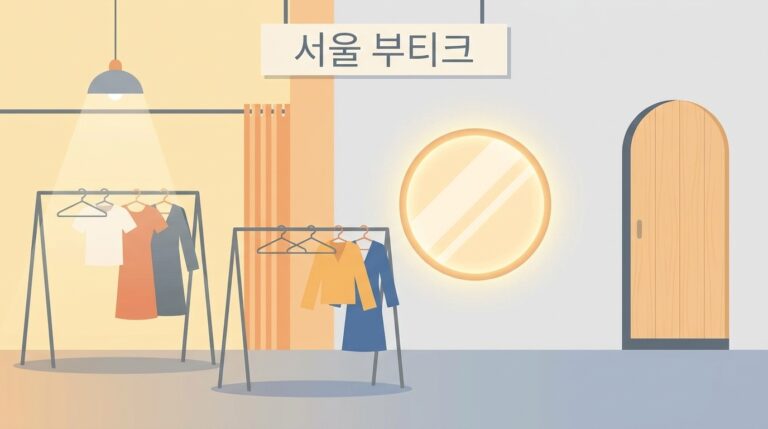
Finding the Fitting Room in Korea: Shop Clothes Like a Local
Phase 1: Empathy & Story Opening
안녕하세요! 매일한글 에디터입니다. Welcome back to Daily Hangul, your cozy corner for mastering real-life Korean!
Picture this: You are wandering through the ultra-stylish streets of Hongdae or exploring an aesthetic boutique in Seongsu-dong. Indie synth-pop is playing softly, racks of gorgeous oversized trench coats and pastel knit sweaters surround you, and you finally spot it—the absolute perfect jacket that looks like it came straight out of your favorite K-drama. Your heart does a little happy dance. You grab the hanger, turn around eager to try it on, and suddenly freeze. Where on earth is the fitting room?
You scan the minimalist walls, but there are no obvious dressing cubicles in sight. The trendy shop clerk is busily steaming clothes at the counter. You clutch the jacket tighter, hesitation kicking in: “Do they even allow customers to try this on? Can I just walk into that curtained area in the back? What if I accidentally do something rude?” That familiar wave of foreign-shopper anxiety washes over you, and for a second, you contemplate putting the jacket back and leaving empty-handed.
Take a deep breath—we have all been there! Over the past decade of coaching foreign travelers and K-culture enthusiasts, finding the fitting room and asking to try on clothes consistently tops the list of nerve-wracking shopping dilemmas. But here is the secret: Korean shopping etiquette is warm, welcoming, and delightfully straightforward once you know the exact words native speakers use. By the end of this guide, you will breeze through any clothing boutique in Seoul with total confidence, flawless manners, and your dream K-fashion haul in tow.
Phase 2: Core 3 Expressions Deep Dive
Let’s unpack the three golden phrases you will use in almost every clothing store across Korea.
1. 탈의실 어디에 있어요? (Tal-ui-sil eodi-e isseoyo?)
- Pronunciation: [Tal-ui-sil eo-di-e it-seo-yo?] (Pronunciation tip: “Tal” rhymes with “pal”, “ui” glides like “we”, and “eodi” sounds like “uh-dee” with a soft tap.)
- Meaning: Literal: “Where is the clothes-changing room located?” | Real Nuance: “Excuse me, where is the fitting room?” (Polite, clear, and universally understood across all generations).
- K-Culture Moment: In department store makeover scenes in dramas like Crash Landing on You or Business Proposal, you will hear this respectful phrasing used when characters navigate upscale retail floors.
- Editor’s Insight: “탈의실 (tal-ui-sil)” is a traditional Sino-Korean compound meaning “room to take off clothes.” While slightly formal, pairing it with the polite ending “-어디에 있어요? (-eodi-e isseoyo?)” makes it the safest, most respectful question to ask any clerk.
- Situation Spectrum: Casual: ⚠️ | Semi-formal: ✅ | Formal: ✅
- 🤔 Think About It: In English, we often look for the dressing room independently without greeting staff first. In Korean stores, verbalizing this question serves as a polite heads-up to the staff. How does this reflect Korea’s emphasis on attentive retail service?
2. 이거 입어봐도 돼요? (Igeo ib-eobwado dwaeyo?)
- Pronunciation: [Ee-geo ee-beo-bwa-do dwae-yo?] (Pronunciation tip: “Igeo” sounds like “eagle” without the ‘l’, and “dwaeyo” blends like “dweh-yo”.)
- Meaning: Literal: “Even if I wear this, is it okay?” | Real Nuance: “May I try this on?”
- K-Culture Moment: Watch any YouTube shopping vlog by K-pop idols exploring vintage markets in Dongdaemun or street stalls in Sinchon. Before entering a booth, they make warm eye contact with the shopkeeper, hold up the hanger, and ask this exact line.
- Editor’s Insight: In Korea, many shops restrict trying on delicate items like tight knitwear, white t-shirts, or silk tops to prevent makeup smears. Asking permission first demonstrates top-tier social awareness (nunchi).
- Situation Spectrum: Casual: ✅ | Semi-formal: ✅ | Formal: ⚠️
- 🤔 Think About It: Notice the grammatical ending “-아/어도 돼요? (-a/eodo dwaeyo?)” used to request permission. Why do you think asking permission before trying on clothes is considered basic retail courtesy in Korea?
3. 피팅룸이 어디예요? (Piting-rum-i eodi-yeyo?)
- Pronunciation: [Pee-ting-room-ee eo-dee-ye-yo?] (Pronunciation tip: Sounds just like the English loanword “Fitting room” followed by “ee-eo-dee-ye-yo”.)
- Meaning: Literal: “Where is the fitting room?” | Real Nuance: “Where’s the fitting stall?” (Trendy, casual, and ubiquitous among young Koreans).
- K-Culture Moment: If you step into flagship stores in Hongdae or Seongsu—such as Musinsa Standard, Ader Error, or SPAO—overhead signs will literally say “FITTING ROOM” or “피팅룸”. Shoppers in their teens, 20s, and 30s use this term daily.
- Editor’s Insight: If the traditional word “탈의실” feels tongue-twisting, this loanword is your ultimate lifesaver. It rolls naturally off the tongue while keeping the polite, friendly “-어디예요? (-eodi-yeyo?)” ending.
- Situation Spectrum: Casual: ✅ | Semi-formal: ✅ | Formal: ⚠️
- 🤔 Think About It: Why do you think modern Korean street fashion heavily embraces English loanwords like “피팅룸” over Sino-Korean terms like “탈의실”?
Phase 3: Textbook Korean vs. Real Korean
Let’s compare robotic grammar-book lines with what you will actually hear inside trendy Seoul shops.
Situation 1: Locating the changing stall
- 📖 교과서 한국어 (Textbook): 탈의실이 어느 쪽에 위치합니까? (Tal-ui-sil-i eoneu jjok-e wichi-habnikka? – In which direction is the dressing room located?)
- 🗣️ 진짜 한국어 (Real-World): 피팅룸 어디예요? (Piting-rum eodi-yeyo? – Where’s the fitting room?)
- 💡 왜 다를까? (Why is it different?): Textbook phrasing uses heavy administrative vocabulary (“위치합니까”). Real Koreans keep retail interactions light, quick, and conversational with the simple question ending “-어디예요?”.
Situation 2: Asking if you can try on an item
- 📖 교과서 한국어 (Textbook): 이 의복을 착용해 보아도 되겠습니까? (I uibok-eul chak-yong-hae boado doegessseubnikka? – Would it be permissible for me to wear this garment?)
- 🗣️ 진짜 한국어 (Real-World): 이거 입어봐도 돼요? (Igeo ib-eobwado dwaeyo? – Can I try this on?)
- 💡 왜 다를까? (Why is it different?): The word “의복 (uibok)” belongs in history textbooks or formal industry reports. In day-to-day shopping, pointing to the piece and saying “이거 (igeo – this)” combined with “입어보다 (ib-eoboda – to try on)” is infinitely more natural.
Phase 4: K-Culture Deep Dive & Non-Verbal Manners
4-1. 눈치 (Nunchi) & Essential Gestures
Shopping in Korea comes with a few unique unspoken physical codes:
1. The Face Cover (페이스 커버) Ritual: When trying on tops in women’s clothing stores, the clerk will often hand you a thin, non-woven fabric hood. This is a “face cover.” You slip it over your head before pulling clothes on so your foundation, sunscreen, or lip tint doesn’t stain the garment collar. Accept it with two hands, give a slight head nod, and use it diligently—it shows exceptional manners!
2. Look Down Before Entering: Check the threshold of the fitting room. If there is a raised wooden step or house slippers placed on a rug, take off your street shoes before stepping inside the booth. Stepping onto a pristine fitting-room floor with outdoor sneakers is a major social faux pas.
3. Holding the Clothes: Avoid letting long dresses or pants drag on the store floor while waiting. Keep them draped neatly over your forearm.
4-2. Cultural Code: Boutique Curations vs. Underground Markets
In Korea’s sprawling underground shopping arcades (like the Express Bus Terminal’s Goto Mall or Gangnam Station), prices are rock-bottom, but shop stalls are tiny. Many underground stalls have strict “피팅 불가 (No trying on)” policies, especially for white tops or clearance items. Conversely, flagship boutiques in Seongsu-dong or Hannam-dong treat fitting rooms like futuristic private studios equipped with selfie mirrors and customizable mood lighting. Checking the store vibe beforehand will save you from unexpected surprises!
Phase 5: Real-Life Roleplay Scenario
- Setting: “Studio Blank”, a minimalist indie fashion concept store in Yeonnam-dong filled with curated denim, oversized blazers, and indie lo-fi beats.
- Character: Min-jun (민준), a friendly, fashionable shop assistant wearing tailored trousers and glasses.
Turn 1 (Shopper):
저기요, 이거 입어봐도 돼요?
(Jeogiyo, igeo ib-eobwado dwaeyo? / Excuse me, may I try this on?)
🎭 Holding up a cream-colored wool sweater with both hands and catching Min-jun’s eye.
Turn 2 (Min-jun):
네, 고객님! 밝은 색 니트라서 페이스 커버 착용 부탁드려요.
(Ne, gogaeknim! Balg-eun saek niteu-raseo peiseu keobeo chak-yong butakdeuryeoyo. / Yes, customer! Since it’s a light-colored knit, please wear a face cover.)
🎭 Smiling warmly and handing you a disposable non-woven face cover.
Turn 3 (Shopper):
아, 네! 탈의실 어디에 있어요?
(A, ne! Tal-ui-sil eodi-e isseoyo? / Ah, understood! Where is the fitting room?)
🎭 Receiving the face cover with two hands and nodding gratefully.
Turn 4 (Min-jun):
피팅룸은 저쪽 전신 거울 안쪽에 있습니다.
(Piting-rum-eun jeojjok jeonsin geo-ul anjjog-e itseubnida. / The fitting rooms are inside, right behind that full-length mirror.)
🎭 Guiding your direction with an open palm.
Turn 5 (Shopper):
신발은 벗고 들어가나요?
(Sinbal-eun beotgo deureoganayo? / Do I take off my shoes to go in?)
🎭 Glancing down at the raised wooden platform outside the curtain.
Turn 6 (Min-jun):
네, 신발 벗으시고 슬리퍼로 갈아 신으시면 돼요.
(Ne, sinbal beoteusigo seullipeo-ro gara sineusimyeon dwaeyo. / Yes, please remove your shoes and switch into the slippers.)
🎭 Tidying the slippers neatly for you.
Turn 7 (Shopper):
감사합니다! 금방 입어볼게요.
(Gamsahamnida! Geumbang ib-eobolgeyo. / Thank you! I will try it on quickly.)
🎭 Stepping onto the platform and smiling.
Turn 8 (Min-jun):
네, 천천히 편하게 입어보세요!
(Ne, cheoncheonhi pyeonhage ib-eoboseyo! / Sure, take your time and try it on comfortably!)
🎭 Drawing the curtain back for you with a slight bow.
🔀 Interactive Decision Point
You try on the sweater, but you notice the shoulders are slightly too tight. You step out of the curtain. What do you say to Min-jun?
- Choice A: “저기요, 이거 더 큰 사이즈 있어요?” (Jeogiyo, igeo deo keun sa-i-jeu isseoyo?)
- Choice B: “이거 너무 작아서 싫어요.” (Igeo neomu jag-aseo silh-eoyo.)
- Choice C: “다른 거 주세요.” (Dareun geo juseyo.)
Feedback:
* Choice A is [BEST]: Natural, polite, and directly asks if a larger size is in stock. Min-jun will immediately check the inventory for you!
* Choice B is [BAD]: Saying “싫어요 (I hate/dislike it)” sounds overly critical and childish. Keep opinions constructive in retail settings.
* Choice C is [RISK]: “Give me another one” is vague. The clerk won’t know if you want a different color, size, or an entirely different style.
Phase 6: 10-Second Emotional Shadowing Drill
Train your muscle memory with these rhythmic shadowing lines! Mimic the emotional cue and observe the pause slashes (/).
[😊 Polite & Inquiring]
저기요, / 이거 / 입어봐도 돼요? ↗
(Jeogiyo, / igeo / ib-eobwado dwaeyo?)
Lift your pitch gently at the end of “돼요?” like asking a sweet favor.-
[👀 Curious & Expectant]
피팅룸이 / 안쪽에 / 어디예요? ↗
(Piting-rum-i / anjjog-e / eodi-yeyo?)
Keep the rhythm light and bounce off “어디예요?” with a soft upward glide. -
[🙏 Grateful & Bright]
네, / 감사합니다! / 금방 입어볼게요. ↘
(Ne, / gamsahamnida! / geumbang ib-eobolgeyo.)
End with a confident, downward-pitch cadence to express polite appreciation.
Phase 7: K-Culture Mini Dictionary
- 탈의실 (Tal-ui-sil) / 피팅룸 (Piting-rum): Dressing room / Fitting room. The former is classic Korean; the latter is the trendy loanword preferred in modern youth shopping districts.
- 페이스 커버 (Peiseu-keobeo): Disposable non-woven makeup protector hood provided by boutique staff to prevent makeup from rubbing onto apparel.
- 프리사이즈 (Peuri-saijeu): “Free Size” (One-size-fits-all). Extremely common across Korean boutique fashion, usually calibrated around Korean sizes 55-66 (roughly US Small/Medium).
- 입어보다 (Ib-eoboda): A compound verb combining “입다 (to wear)” and “보다 (to see/try)”, meaning “to try on clothes.”
Phase 8: Survival Kit for Travelers
Survival TOP 3 Phrases
- 이거 입어봐도 돼요? (Igeo ib-eobwado dwaeyo?)
- Pro Tip: Hold up the clothing hanger while making eye contact so the clerk knows exactly which piece you are asking about.
- 탈의실 어디에 있어요? (Tal-ui-sil eodi-e isseoyo?)
- Pro Tip: If you see multiple doors, say this while looking around; staff will happily point you toward the changing stall.
- 다른 사이즈 있어요? (Dareun sa-i-jeu isseoyo?)
- Pro Tip: Need a small or large? Point to the tag and say: “스몰 (seumol – Small)” or “라지 (raji – Large) 있어요?”.
Editor’s Travel Note
- Navigation: Google Maps often lags behind fast-changing storefronts in Seoul. Make sure to download the Naver Map application to search for trending indie boutiques in Seongsu, Hannam, and Yeonnam.
- Payments & Tax Refunds: Most shopping districts gladly accept international credit cards. For purchases over 15,000 KRW at tax-free participating stores, carry your passport to receive an instant on-the-spot tax refund at the register!
Phase 9: “One Step Deeper” (Reflective Question)
In many Western department stores, retail interactions are largely solitary: you grab armfuls of clothes, locate the fitting area on your own, and try them on at your own pace. In Korea, however, retail spaces are deeply interpersonal. Asking “입어봐도 돼요?” before touching a door curtain is not just about rules—it acknowledges that you are entering a curated space maintained with pride by the shop owner. In return, the clerk provides thoughtful amenities like face covers and sanitized slippers. It is a quiet, harmonious micro-exchange of mutual respect.
💬 Your Turn: Have you ever experienced a funny or surprising shopping moment while traveling abroad—like stepping into a fitting room with your shoes on? Tell me your story in the comments below!
Phase 10: FAQ & Avoiding Misunderstandings
Q: Can I try on white shirts or graphic t-shirts in Korean clothing shops?
A: In many independent boutiques and underground shopping malls, trying on pure white tops, light knitwear, or delicate silk blouses is strictly prohibited to prevent makeup stains or garment stretching. If an item says “착용 불가 (No trying on)”, respect the rule. When in doubt, always ask: “이거 입어봐도 돼요?”.
Q: How many items can I bring into the fitting room at once?
A: At fast-fashion retail chains like Zara, Musinsa Standard, or SPAO, the typical limit is between 3 to 4 items per visit. An attendant stationed at the fitting room entrance will count your garments and hand you a numbered plastic token.
Q: What should I do with the clothes if they don’t fit?
A: Never leave discarded garments dumped on the floor or hangers tangled inside the stall. Bring the clothes back out to the attendant or the front counter, hand them over gently, and say: “이건 안 맞아서요, 감사합니다 (Igeon an maj-aseoyo, gamsahamnida – This didn’t fit, thank you).”
🚨 Common Mistakes Warning Board
- Mistake: Marching straight into a changing stall without making eye contact with staff.
- Correct Action: Make eye contact, raise the garment slightly, and ask “탈의실 어디예요?” or “입어봐도 돼요?”.
- Mistake: Walking onto the fitting stall floor with muddy outdoor sneakers.
- Correct Action: Look for a raised floor or slippers. Step out of your shoes at the entrance before drawing the curtain closed.
- Mistake: Throwing away or ignoring the face cover given by the attendant.
- Correct Action: Place the face cover over your face before pulling shirts or sweaters over your head.
Phase 11: Action Mission & Engagement
- 🥉 Bronze Mission (Solo Practice): Stand in front of your bedroom mirror, hold up your favorite jacket, and repeat “저기요, 탈의실 어디에 있어요?” three times with bright, natural intonation.
- 🥈 Silver Mission (Community Share): Snap a photo of your outfit of the day (OOTD) and post it to Instagram or X with the caption: “오늘 이거 입어봐도 돼요? (Can I try this on today?)” and tag @DailyHangul!
- 🥇 Gold Mission (Real-World Test): Next time you step into a Korean clothing boutique or an Asian specialty shop, locate the dressing room entirely in Korean using our Phase 5 roleplay phrases!
- 🎮 K-Culture Mission: Tune into an episode of a fashion-forward K-drama (like Queen of Tears or Celebrity) or a K-pop idol street-vlog. Spot whether the sign in the background says “탈의실” or “피팅룸”!
Phase 12: Interactive Quiz Challenge
Test your new skills! Read each question, choose your answer, and open the toggle below to check your score.
Question 1 (Scenario Judgment)
You are at a trendy boutique in Hongdae holding a stylish cream knit sweater. The clerk hands you a small square white non-woven cloth. What should you do?
* A) Use it to wipe dust off your shoes.
* B) Say thank you, put it over your head while trying on the sweater to protect it from makeup.
* C) Hand it back saying you do not need a shopping napkin.
Question 2 (Fill-in-the-Blank)
Complete the phrase to ask where the fitting room is located:
“저기요, 피팅룸이 __________?” (Excuse me, where is the fitting room?)
* A) 얼마예요 (eolmayeyo)
* B) 어디예요 (eodi-yeyo)
* C) 있어요 (isseoyo)
Question 3 (True or False Cultural Quiz)
In Korea, it is completely acceptable to walk into any boutique fitting room with your outdoor shoes on, regardless of raised mats or slippers.
* [True / False]
👉 Click to Reveal Answers and Explanations!
- Question 1 Answer: B
- Explanation: That small non-woven cloth is a “face cover (페이스 커버)”! Wearing it over your face prevents cosmetics from marking light-colored clothes.
- Question 2 Answer: B (어디예요)
- Explanation: “어디예요? (eodi-yeyo?)” means “Where is it?”. “얼마예요?” means “How much is it?”, which asks for price.
- Question 3 Answer: False
- Explanation: Many Korean boutique dressing rooms feature raised wooden platforms or tatami mats where shoes must be removed before entering.
- Explanation: Many Korean boutique dressing rooms feature raised wooden platforms or tatami mats where shoes must be removed before entering.







