

Master Your Daily Seoul Commute: Talk Transportation in Korean Like a Native
Phase 1: 공감 (Story-Driven Opening)
안녕하세요! 매일한글 에디터입니다. (Hello! This is your Daily Hangul editor.)
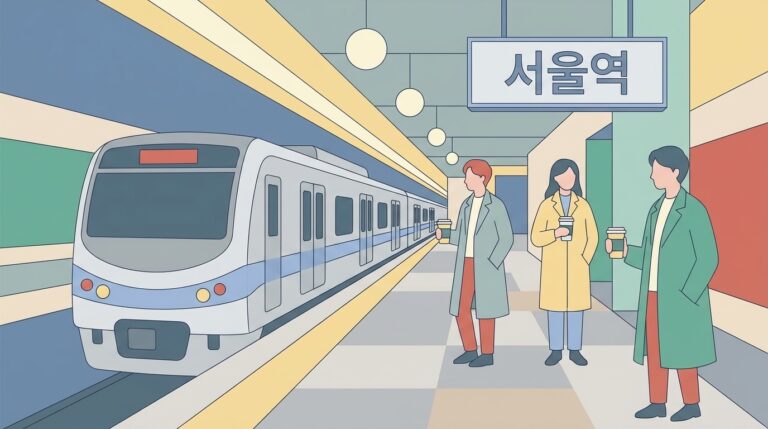
Picture this: It is 8:15 AM on a Monday at Sindorim Station in Seoul. You are standing among a sea of sleek black coats, bustling commuters gripping iced Americanos like lifelines, and digital displays chiming melodically as Line 2 trains roll in every two minutes. If you have watched K-dramas like Misaeng (미생) or My Liberation Notes (나의 해방일지), you already know the vibe—intense, synchronized, and deeply human. Suddenly, your Korean colleague spots you on the platform and asks with a warm smile: “회사에 어떻게 와요?” (Hoesa-e eotteoke wayo? / How do you get to work?)
Do you freeze up trying to remember the verb for “ride” versus “walk”? Or do you get tangled up trying to explain that you take a bus, transfer to a subway, and walk five minutes? You are not alone! In our Daily Hangul tutoring sessions, over 70% of A2 learners tell us that talking about transit makes them hesitate because textbook formulas feel too stiff. Today, we are breaking down the exact natural phrases everyday Koreans use on their daily commute so you can chat with your coworkers, friends, or host families effortlessly.
Phase 2: 핵심 표현 3선 심층 분석 (Top 3 Commuting Expressions)
Here are the three must-know expressions to describe your daily transit in natural Korean.
1. 지하철 타고 출근해요.
- Pronunciation: [Ji-ha-cheol ta-go chul-geun-hae-yo] (Sound analogy: Think of “Jee-ha-chul tah-go chool-geun-hay-yo”)
- Meaning: Literal: “I ride the subway and go to work.” / Real Nuance: “I take the subway to work.”
- K-Culture Moment: In the K-drama Something in the Rain, office workers routinely chat about catching the green Line 2 train or dodging the crowds on their morning commute.
- Editor’s Insight: In Korean, you do not just say “I go by subway.” You use the connecting structure -고 (and): “take (ride) and go” -> 타고 가요 (tago gayo) or 타고 출근해요 (tago chulgeunhaeyo). It makes your sentence flow like a native speaker’s!
- Situation Spectrum:
- Casual (반말): 지하철 타고 출근해. (✅)
- Semi-formal (해요체): 지하철 타고 출근해요. (✅ – Most recommended!)
- Formal (하십시오체): 지하철을 타고 출근합니다. (✅ – Interviews & official meetings)
- 🤔 Think About It: In English, we say “I take the subway,” but in Korean, you literally “ride and go.” Why do you think Korean combines the action of boarding with moving forward?
2. 버스로 갈아타야 돼요.
- Pronunciation: [Beo-seu-ro gar-a-ta-ya dwae-yo] (Sound analogy: Sounds like “Buh-seu-ro gahl-ah-tah-yah dway-yo”)
- Meaning: Literal: “Must change-ride by bus.” / Real Nuance: “I have to transfer to a bus.”
- K-Culture Moment: You will hear this everywhere inside Seoul Metro stations when automated announcements say: “…갈아타실 고객께서는…” (…passengers transferring should…).
- Editor’s Insight: The magic verb here is 갈아타다 (gar-a-ta-da), combining 갈다 (to switch/change) and 타다 (to ride). Add -아/어야 돼요 to mean “have to / need to.”
- Situation Spectrum:
- Casual: 버스로 갈아타야 돼. (✅)
- Semi-formal: 버스로 갈아타야 돼요. (✅)
- Formal: 버스로 환승해야 합니다. (✅ – Using Sino-Korean ‘환승’ for formal contexts)
- 🤔 Think About It: How convenient is transferring in your home city compared to Korea’s seamless tap-and-transfer discount system?
3. 걸어서 10분 정도 걸려요.
- Pronunciation: [Geol-eo-seo sip-bun jeong-do geol-lyeo-yo] (Sound analogy: “Gul-uh-suh sheep-boon jung-doh gul-lyuh-yo”)
- Meaning: Literal: “Walking, about 10 minutes takes.” / Real Nuance: “It takes about 10 minutes on foot.”
- K-Culture Moment: When real estate agents in K-dramas pitch officetels near Gangnam station, they always claim: “역에서 걸어서 3분이에요!” (It is 3 minutes on foot from the station!).
- Editor’s Insight: Notice that 걸어서 (geol-eo-seo) means “by foot / walking.” Never say “다리로 가요” (going by leg)! Pair it with 걸려요 (geol-lyeo-yo), which means “it takes time.”
- Situation Spectrum:
- Casual: 걸어서 10분 걸려. (✅)
- Semi-formal: 걸어서 10분 정도 걸려요. (✅)
- Formal: 도보로 약 10분 소요됩니다. (✅ – Official real estate or map navigation voice)
- 🤔 Think About It: Why do you think Koreans almost always add 정도 (jeong-do – about/approximately) when giving travel times?
Phase 3: 교과서 한국어 vs 진짜 한국어 (Textbook vs. Real-Life Korean)
Let us elevate your Korean from robotic textbook lines to warm, natural conversation!
Situation 1: Asking someone how they get to work
- 📖 교과서 한국어: 어떤 교통수단을 이용하여 출근하십니까? (Eotteon gyotongsudaneul iyonghayeo chulgeunhasimnikka? / Which means of transportation do you utilize to commute?)
- 🗣️ 진짜 한국어: 회사 어떻게 와요? (Hoesa eotteoke wayo? / How do you get to work?)
- 💡 왜 다를까?: Native speakers avoid heavy Sino-Korean nouns like 교통수단 (means of transit) in friendly small talk. Asking “How do you come?” already covers everything naturally.
Situation 2: Saying you are heading home from work
- 📖 교과서 한국어: 저는 이제 퇴근하여 집으로 돌아가겠습니다. (Jeoneun ije toegeunhayeo jibeuro doragagessseumnida. / I will now leave work and return to my house.)
- 🗣️ 진짜 한국어: 저 먼저 퇴근해 볼게요! (Jeo meonjeo toegeunhae bolgeyo! / I will get going first / Have a good evening!)
- 💡 왜 다를까?: Korean workplace culture uses softening phrases like -해 볼게요 (I will try to / let me) to sound considerate and polite when leaving before others.
Phase 4: K-Culture 딥다이브 & 비언어적 매너 (Culture Deep Dive & Non-Verbal Manners)
4-1. 눈치 (Nunchi) & Metro Manners
When navigating the packed Seoul subway (especially Lines 2 and 9 during rush hours):
* The Backpack Hug (배려 배낭): Never wear your backpack on your back inside a packed train. Shift it to your front or place it between your feet. It is an unwritten rule of respect (배려, baeryeo).
* Eye Contact & Silence: Commuters avoid direct eye contact to give each other psychological space in tight quarters. Phone calls should be kept to an absolute whisper or answered via text.
4-2. Cultural Code: 지옥철 (Ji-ok-cheol) and 퇴근길 (Toe-geun-gil)
Koreans affectionately nickname peak transit 지옥철 (Hell Subway), merging 지옥 (hell) and 지하철 (subway). Yet, the evening commute (퇴근길) is celebrated as a daily emotional threshold. You will see people buying hot street snacks or popping open a can of sparkling barley tea from the convenience store to mark the transition from work mode back to personal life.
Phase 5: 실전 롤플레이 시나리오 (Real-Life Roleplay Scenario)
Setting: The sun-drenched pantry of a tech startup in Seongsu-dong at 9:05 AM. The scent of roasted drip coffee fills the air.
Characters: Min-ji (민지 – your upbeat Korean coworker) and You (Alex, rookie intern).
- 민지: 알렉스 씨, 좋은 아침! 오늘 출근길 안 힘들었어요?
(Alex ssii, joeun achim! Oneul chulgeungil an himdeureosseoyo?)
“Good morning, Alex! How was your commute today? Not too exhausting?”
🎭 Hands you a paper cup of warm tea with a gentle nod. -
Alex: 괜찮았어요! 저는 지하철 타고 와요.
(Gwaenchanasseoyo! Jeoneun jihacheol tago wayo.)
“It was fine! I come by subway.”
🎭 Smiles gratefully while accepting the cup. -
민지: 아, 몇 호선 타요? 2호선은 아침에 진짜 지옥철인데!
(A, myeot hoseon tayo? Ihoseoneun achime jinjja jiokcheorinde!)
“Ah, which line do you ride? Line 2 is absolute hell in the morning!”
🎭 Widens her eyes with humorous sympathy. -
Alex: 네, 맞아요. 2호선 타고 가다가 중간에 버스로 갈아타요.
(Ne, majayo. Ihoseon tago gadaga junggan-e beoseuro garatayo.)
“Yes, exactly. I ride Line 2 and transfer to a bus halfway.”
🎭 Makes a subtle hand motion showing a transfer. -
민지: 와, 버스까지 갈아타요? 집에서 회사까지 얼마나 걸려요?
(Wa, beoseukkaji garatayo? Jib-eseo hoesa-kkaji eolmana geollyeoyo?)
“Whoa, you transfer to a bus too? How long does it take from home to work?”
🎭 Leans in with genuine curiosity. -
Alex: 걸어서 역까지 가는 시간 포함해서 40분 정도 걸려요.
(Geol-eo-seo yeok-kkaji ganeun sigan pohamhaeseo sasip-bun jeong-do geol-lyeo-yo.)
“Including the walk to the station, it takes about 40 minutes.”
🎭 Speaks clearly with relaxed confidence. -
민지: 40분이면 생각보다 괜찮네요! 성수역 3번 출구로 나오면 카페도 많아요.
(Sasip-bun-imyeon saenggakboda gwaenchanneyo! Seongsu-yeok sambeon chulgu-ro naomyeon kapedo manayo.)
“40 minutes is better than I thought! If you come out Exit 3 of Seongsu Station, there are lots of great cafes.”
🎭 Points in the direction of the station exit. -
Alex: 오, 좋은 팁 감사해요! 내일은 3번 출구로 나와 볼게요.
(O, joeun tip gamsahaeyo! Naeireun sambeon chulgu-ro nawa bolgeyo.)
“Oh, thanks for the great tip! I will try coming out Exit 3 tomorrow.”
🎭 Chuckles and bows politely.
🔀 Interactive Decision Point: What would you answer if Min-ji asks: “퇴근하고 뭐 타고 가요?” (How are you getting home after work?)
- Choice A:
퇴근할 때도 버스 타고 지하철 갈아타요.(Toegeunhal ttaedo beoseu tago jihacheol garatayo. / When leaving work, I also take a bus and transfer to the subway.)- Feedback: ⭐ BEST! Natural grammar, correct commute terminology, and effortless flow.
- Choice B:
저는 자전거를 이용하여 집으로 출발합니다.(Jeoneun jajeon-geo-reul iyonghayeo jibeuro chulbalhamnida. / I utilize a bicycle and depart for home.)- Feedback: ⚠️ RISK! Grammatically correct, but sounds like a GPS robot. Overly formal for casual pantry talk.
- Choice C:
다리로 1시간 걸어요.(Dari-ro han-sigan georeoyo. / I walk 1 hour by leg.)- Feedback: 🚫 BAD! Direct English translation error. Koreans use 걸어서 1시간 걸려요 (It takes 1 hour on foot).
Phase 6: 10초 감정 섀도잉 드릴 (10-Second Emotional Shadowing Drill)
Practice these lines out loud with the emotional markers and rhythm breaks (/)!
[😴 졸리고 피곤하지만 담담하게 / Sleepy and tired, but calm]
아침마다 / 지하철 타고 / 1시간 출근해요.
(Achimmada / jihacheol tago / han-sigan chulgeunhaeyo.)-
[🏃 급하고 서두르며 / Hurried and slightly breathless]
빨리 가야 돼요! / 지금 버스 / 갈아타야 돼요.
(Ppalli gaya dwaeyo! / Jigeum beoseu / garatayah dwaeyo.) -
[✨ 뿌듯하고 가볍게 / Proud and cheerful]
날씨가 좋아서 / 역에서 회사까지 / 걸어왔어요!
(Nalssiga joaseo / yeogeseo hoesakkaji / georeowasseoyo!)
Phase 7: K-Culture 미니 사전 (Mini Commuter Dictionary)
-
지옥철 (Ji-ok-cheol)
- Translation: Hell Subway
- Everyday Usage: Used playfully by locals to describe suffocating rush-hour train cars. “오늘 아침 9호선 완전 지옥철이었어요!” (Line 9 was pure hell subway this morning!)
- 환승 (Hwan-seung)
- Translation: Transfer (Transit or Dating!)
- Everyday Usage: On transit maps, it means changing lines. In dating pop culture, 환승연애 (Transit Love) is a mega-hit reality show where exes transition to new partners!
- 막차 (Mak-cha)
- Translation: The Last Train / Last Bus
- Everyday Usage: The ultimate party deadline during Korean dining gatherings (회식). “우리 막차 시간 확인해요!” (Let’s check the last train time!).
- 뚜벅이 (Ttu-beok-i)
- Translation: A Walker / Pedestrian (Non-car owner)
- Everyday Usage: An affectionate term for folks who navigate the city purely on foot and public transit. “저는 뚜벅이라 지하철이 편해요.” (I’m a walker, so the subway suits me best.)
Phase 8: 여행자를 위한 생존 키트 (Traveler’s Survival Kit)
Top 3 Survival Phrases for Commuters
- 어디서 갈아타요? (Eodiseo garatayo? / Where do I transfer?)
- Pro Tip: Use this when navigating multi-level transfer stations like Seoul Station or Dongdaemun.
- 몇 번 출구로 나가야 해요? (Myeot beon chul-gu-ro nagaya haeyo? / Which exit should I take?)
- Pro Tip: Seoul subway exits have unique numbers. Always know your exit number!
- 카드 찍고 타세요. (Kadeu jjikgo taseyo. / Please tap your card before boarding.)
- Pro Tip: You will hear bus drivers say this if your card fails to register on the sensor.
Editor’s Travel Note: The Transit Navigator
- Forget Google Maps in South Korea—it does not offer accurate walking or real-time transit routes due to local mapping regulations. Download and use the 네이버 지도 앱 다운로드 (Naver Map) or KakaoMap. Both apps show real-time bus arrivals down to the second, crowdedness levels per car, and exact subway exit numbers.
- Remember: Korean transit grants a free transfer discount (환승할인) if you tap off your bus or train and board the next one within 30 minutes!
Phase 9: “한 발 더 깊이” (Thinking Deeper)
In Western cultures, commuting is often viewed as dead time or an individual chore done alone in a private automobile. In Korean society, however, the commute has its own collective rhythm captured in the words 출근길 (the journey to work) and 퇴근길 (the journey home). Notice that the word 길 (road/path) transforms transit into a shared life experience. When coworkers ask how you get to work, they are not prying into your logistics; they are showing empathy for the emotional stamina required to navigate Seoul’s hyper-efficient urban landscape.
💬 Your Turn: How do you commute in your hometown? Drop a comment below using the pattern: “[교통수단] 타고 [출근/등교]해요!” (e.g., 버스 타고 출근해요!). I will personally check your sentence and reply!
Phase 10: FAQ & 오해 방지 (FAQ Schema)
Q: What is the difference between 출근 (chulgeun) and 퇴근 (toegeun)?
A: 출근 (Chul-geun) means heading into work in the morning, while 퇴근 (Toe-geun) means finishing work and heading home. Together, they are called 출퇴근 (Chul-toe-geun)—the daily commute!
Q: Can I say “걸어서 출근해요” if I walk to work?
A: Yes, absolutely! 걸어서 출근해요 (Geol-eo-seo chul-geun-hae-yo) is the most natural way to say “I commute on foot.” You can also say 걸어서 다녀요 (I attend/commute by walking).
Q: Why do drivers shout “하차 태그 하세요” on buses?
A: 하차 태그 (Ha-cha tae-geu) means “tap your card when getting off.” If you do not tap off upon leaving a Korean bus, you will lose your transfer discount and get charged a penalty fare on your next trip!
🚨 Common Mistakes Alert (흔한 실수 TOP 3)
- Saying “다리로 가요” instead of “걸어서 가요”:
- Wrong: 다리로 회사에 가요.
- Correct Action: Say 걸어서 가요 (I go on foot).
- Confusing ‘타다’ (to ride) with ‘가다’ (to go):
- Wrong: 지하철 가요.
- Correct Action: Say 지하철 타고 가요 (I ride the subway and go).
- Mixing up ‘몇 번 버스’ and ‘몇 번 출구’:
- Remember: 몇 번 버스 = which bus route number (e.g., Bus #421), while 몇 번 출구 = which station exit number (e.g., Exit 2).
Phase 11: 액션 미션 & 참여 유도 (Action Missions)
- 🥉 Bronze Mission (Solo Shadowing): Stand in front of your mirror and practice saying:
"저는 지하철 타고 출근해요. 걸어서 10분 걸려요!"three times smoothly in 10 seconds. - 🥈 Silver Mission (Social Connection): Open your Instagram or KakaoTalk story, post a picture of your commute view, and caption it in Korean:
오늘의 퇴근길! (Today's commute home!). - 🥇 Gold Mission (Real Life Application): Next time you meet a Korean speaker or tutor, ask them:
"회사에 어떻게 와요?"and understand their answer! - 🎮 K-Culture Mission: Watch Episode 1 of the drama My Liberation Notes (나의 해방일지). Notice how the main siblings discuss their brutal commute from Gyeonggi-do to Seoul!
Phase 12: 인터랙티브 퀴즈 챌린지 (Interactive Quiz Challenge)
Q1. (Situational Choice) Your coworker asks: “집에서 회사까지 멀어요?” (Is it far from home to the office?). How do you naturally say: “No, it takes about 15 minutes by bus”?
– A) 아니요, 버스로 15분 정도 걸려요.
– B) 아니요, 다리로 15분 이용해요.
– C) 아니요, 버스를 환승하지 마세요.
Q2. (Fill in the Blank) Complete the sentence for transferring lines:
“중간에 2호선으로 ______ 돼요.” (I have to transfer to Line 2 midway.)
Q3. (True or False Cultural Quiz) On the Korean subway, it is considered polite to keep your backpack on your back in crowded trains during rush hour.
– [ ] True
– [ ] False
👉 Click here for Answers & Explanations!
Q1 Answer: A) 아니요, 버스로 15분 정도 걸려요.
* Explanation: We use transportation + 로/으로 followed by duration and 걸려요 (it takes).
Q2 Answer: 갈아타야 (or 환승해야)
* Explanation: 갈아타야 돼요 is the natural conversational verb form for “must transfer.”
Q3 Answer: False!
* Explanation: During busy commutes, carrying your backpack in front or setting it down prevents hitting people behind you.







