

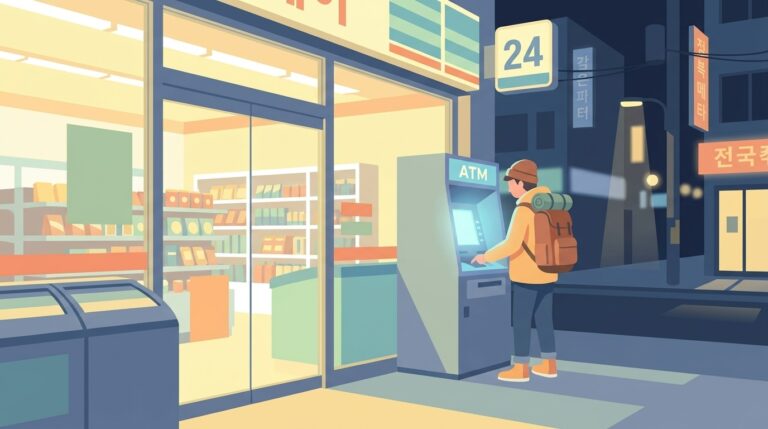
Using Convenience Store ATMs in Korea: The Ultimate Survival Guide
Phase 1: 공감 (Story-Immersive Opening)
안녕하세요! 매일한글 에디터입니다.
Picture this: It is 11:30 PM in the neon-lit alleyways of Hongdae. The intoxicating aroma of sizzling hotteok (sweet pancakes) and spicy tteokbokki pulls you toward a buzzing pojangmacha (street food cart). You order with excitement, only to notice the cardboard sign: “현금 결제 부탁드립니다” (Cash only, please). Panic strikes! You frantically search your pockets—zero won in cash. Luckily, across the street shines the comforting green-and-blue sign of a 24-hour convenience store. You rush inside toward the ATM in the corner, slide your foreign debit card into the slot, and suddenly the machine beeps loudly, flashing high-speed Korean menus at you before spitting your card right back out. Your heart sinks.
Navigating Korean convenience store ATMs (often called CD machines or 현금 인출기) is hands down one of the top three real-life hurdles foreign visitors and exchange students report to us. But once you unlock the exact conversational keys and screen vocabulary, these machines become your best late-night travel companions. This guide was built straight from our students’ real-life ATM emergencies and tested in actual Korean neighborhoods. Let’s make sure you never stand frozen in front of an ATM again!
Phase 2: 핵심 표현 3선 심층 분석 (Deep Dive: 3 Key Expressions)
1. 여기서 현금 뽑을 수 있어요? (Yeogiseo hyeongeum ppobeul su isseoyo?)
- Pronunciation: [Yeo-gi-seo hyeon-geum ppo-beul su i-sseo-yo?] (Think: “yaw-gee-suh hyun-gum poh-beul soo ee-ssuh-yo”)
- Meaning: Literal: “Can I pull out cash here?” / Actual Nuance: “Can I withdraw cash from the ATM here?”
- K-Culture Moment: In slice-of-life K-dramas, when university friends need split cash for a round of late-night chicken and beer, you will hear them casually ask the store clerk or each other, “여기 돈 뽑는 데 있어?”
- Editor’s Insight: While textbooks prioritize the formal verb 인출하다 (to withdraw), real native speakers overwhelmingly prefer the tactile verb 뽑다 (to pull out / pluck). Using 뽑다 instantly bridges the gap between sounding like an automated voice manual and sounding like a natural resident.
- Situation Spectrum: Casual: ✅ | Semi-formal: ✅ | Formal: ⚠️
- 🤔 Think About It: Why do you think Korean uses physical, action-packed verbs like “pulling out” (뽑다) cash rather than abstract banking terms in everyday conversation?
2. 해외 카드로 출금돼요? (Hae-oe kadeuro chulgeumdwaeyo?)
- Pronunciation: [Hae-oe ka-deu-ro chul-geum-dwae-yo?] (Think: “hay-way kah-doo-ro chool-gum-dway-yo”)
- Meaning: Literal: “With an overseas card, does withdrawal work?” / Actual Nuance: “Does this ATM accept international cards?”
- K-Culture Moment: Often seen in travel vlogs when international backpackers visit Jeju or rural Korea and check whether a neighborhood mini-mart’s terminal handles foreign payment networks.
- Editor’s Insight: Convenience stores house two types of machines: domestic-only cash dispensers and multi-bank “Global ATMs”. If you see the “Global ATM” logo on the machine, you are golden; if not, asking this question to the part-timer (알바생) saves you from awkward locked-card moments.
- Situation Spectrum: Casual: ⚠️ | Semi-formal: ✅ | Formal: ✅
- 🤔 Think About It: In your home country, is banking infrastructure universally international, or do foreign cards regularly face special terminal restrictions?
3. 수수료 얼마 나와요? (Susuryo eolma nawayo?)
- Pronunciation: [Su-su-ryo eol-ma na-wa-yo?] (Think: “soo-soo-ryoh ull-mah nah-wah-yo”)
- Meaning: Literal: “How much fee comes out?” / Actual Nuance: “What is the transaction fee for this withdrawal?”
- K-Culture Moment: Common in sitcom scenes where frugal characters grimace at the midnight surcharge of convenience store ATMs compared to daytime commercial bank branches.
- Editor’s Insight: Notice the verb 나오다 (to come out). Koreans frequently use 나오다 whenever prices, bills, or fees are automatically generated by a system or meter.
- Situation Spectrum: Casual: ✅ | Semi-formal: ✅ | Formal: ✅
- 🤔 Think About It: How comfortable are people in your culture discussing service surcharges openly with staff or acquaintances?
Phase 3: 교과서 한국어 vs 진짜 한국어 (Textbook vs. Real Korean)
Situation 1: Telling the clerk you need to withdraw cash
- 📖 교과서 한국어: 현금을 인출하려고 합니다. (Hyeongeumeul inchulharyeogo hamnida.) – “I intend to perform a cash withdrawal.”
- 🗣️ 진짜 한국어: 돈 좀 뽑으려고요. (Don jom ppobeuryeogoyo.) – “Just looking to pull out some cash.”
- 💡 왜 다를까?: In daily Korean life, formal Sino-Korean vocabulary like 인출 (inchul) feels excessively bureaucratic. Native speakers soften their statements with the filler 좀 (a little/just) and the punchy native verb 뽑다 (to pull).
Situation 2: Asking if a foreign credit card is accepted by the machine
- 📖 교과서 한국어: 본 기기에서 외국 신용카드를 취급합니까? (Bon gigieseo oeguk sinyongkadeureul chwigeuphamnikka?) – “Does this apparatus handle foreign credit instruments?”
- 🗣️ 진짜 한국어: 이거 외국 카드도 돼요? (Igeo oeguk kadeudo dwaeyo?) – “Does this work with foreign cards too?”
- 💡 왜 다를까?: The magic multi-tool verb 되다 (to work/be feasible) completely replaces complex business terms like 취급하다 (to handle/process) in 95% of spoken exchanges.
Phase 4: K-Culture 딥다이브 & 비언어적 매너 (Culture & Body Language)
4-1. 눈치 (Nunchi) & ATM Etiquette
When queuing for an ATM inside a cozy Korean convenience store, personal space is deeply tied to Nunchi (situational awareness). Stand at least two large paces back from the person using the screen. Looking directly toward their hands or screen is considered a major privacy violation. Furthermore, whenever taking cash or receipts from the machine’s tray or handing your card to the clerk, always collect or present items using both hands (양손) or by resting your left hand lightly on your right forearm as a sign of courteous respect.
4-2. Cultural Code Analysis: The Paradox of Korea’s Cashless Society
South Korea is celebrated worldwide as one of the most cashless societies on Earth—you can buy an apartment deposit, a taxi ride, or a 1,000-won pack of gum with Samsung Pay or a contactless card. Yet, an authentic slice of Korean culture remains proudly cash-dependent: seasonal street carts selling bungeoppang (carp bread), traditional market elders selling fresh strawberries, coin karaoke booths (코인노래방), and photo booth machines (인생네컷) when system networks stutter. Knowing how to grab quick won notes at a convenience store keeps you completely independent.
Phase 5: 실전 롤플레이 시나리오 (Interactive Role-Play)
Setting: A brightly lit GS25 store near Hongik University Station on a rainy Friday night.
Characters:
* Min-woo (민우): A friendly 23-year-old college student working the graveyard shift behind the counter.
* You (Traveler): Eager customer craving street food, holding an overseas Visa debit card.
Turn 1
You: 저기요, 실례지만 매장 안에 현금 인출기 있어요?
(Jeogiyo, sillyejiman maejang ane hyeongeum inchulgi isseoyo?)
“Excuse me, but is there a cash machine inside the store?”
🎭 [Wipe your wet umbrella and bow your head slightly]
Turn 2
Min-woo: 네! 저기 삼각김밥 매대 바로 옆 구석에 있어요.
(Ne! Jeogi samgakgimbap maedae baro yeop guseoge isseoyo.)
“Yes! It’s right over there in the corner next to the triangle kimbap shelf.”
🎭 [Points politely with an open hand toward the back]
Turn 3
You: 혹시 이 기계 해외 카드도 출금 돼요?
(Hoksi i gigye hae-oe kadedo chulgeum dwaeyo?)
“By any chance, does this machine allow foreign card withdrawals?”
🎭 [Show your card gently with both hands]
Turn 4
Min-woo: 화면 오른쪽 위에 ‘Global Service’ 버튼 누르시면 해외 카드도 잘 돼요.
(Hwamyeon oreunjjok wie ‘Global Service’ beoteun nureusimyeon hae-oe kadedo jal dwaeyo.)
“If you press the ‘Global Service’ button at the top right of the screen, foreign cards work fine.”
Turn 5
You: 다행이네요! 보통 수수료는 얼마나 나와요?
(Dahaeng-ineyo! Botong susuryoneun eolmana nawayo?)
“What a relief! How much is the fee usually?”
🎭 [Smile with a slight sigh of relief]
Turn 6
Min-woo: 카드사마다 다른데 보통 천 원에서 삼천 원 정도 나올 거예요.
(Kadeusamada dareunde botong cheon woneseo samcheon won jeongdo naol geoyeyo.)
“It depends on your card company, but usually around 1,000 to 3,000 won.”
Turn 7
You: 아, 알겠습니다. 친절하게 알려주셔서 감사해요!
(A, algesseumnida. Chinjeolhage allyeojusyeoseo gamsahaeyo!)
“Ah, I understand. Thank you for guiding me so kindly!”
🎭 [Give a warm 30-degree nod of gratitude]
Turn 8
Min-woo: 별말씀을요. 천천히 뽑으세요!
(Byeolmalsseumeullyo. Cheoncheonhi ppobeuseyo!)
“Don’t mention it. Take your time withdrawing!”
🔀 Interactive Decision Branch
The screen suddenly displays: “거래를 계속하시겠습니까? (수수료 1,300원 부과)”. What do you do?
- Option A: Press “취소” (Cancel) because you think the machine is trying to scam you.
- Feedback [Risk]: You cancel the entire transaction and leave empty-handed. In Korea, convenience store private ATMs always charge a standard independent service fee (1,000–3,500 won). This is standard operational procedure, not a scam.
- Option B: Press “확인” (Confirm) to proceed with the transaction.
- Feedback [Best]: Perfect! The ATM will dispense your cash neatly into the tray with a pleasant chime, followed by your card. Mission accomplished!
- Option C: Tap your card loudly against the touch screen repeatedly.
- Feedback [Bad]: The machine’s optical sensor may time out, locking your session or triggering a warning buzz. Always interact via the on-screen buttons or keypad.
Phase 6: 10초 감정 섀도잉 드릴 (10-Second Emotion Shadowing Drill)
Practice reading these out loud by matching the emotional tone and following the breath pauses (/):
[😅 다급하고 조심스럽게 - Panicked yet polite]
저기요… / 해외 카드 출금도 / 여기서 가능한가요?
(Jeogiyo… / hae-oe kadeu chulgeumdo / yeogiseo ganeunghangayo?)-
[😊 안도하고 밝게 - Relieved and upbeat]
다행이다! / 영어 안내 버튼이 / 화면에 있었네요.
(Dahaeng-ida! / yeongeo annae beoteuni / hwamyeone isseonneyo.) -
[🙏 정중하고 감사한 태도로 - Sincere and appreciative]
영수증은 됐습니다, / 정말 감사합니다!
(Yeongsujeungeun dwaesseumnida, / jeongmal gamsahamnida!)
Phase 7: K-Culture 미니 사전 (Mini Dictionary)
- 출금 (Chulgeum) | Withdrawal
Usage: The most crucial button on any ATM screen. Paired with 입금 (Ipgeum – Deposit). - 수수료 (Susuryo) | Service/Transaction Fee
Usage: Appears before the final payout screen. In Korean convenience stores, fees usually fluctuate between 1,100 KRW and 3,500 KRW depending on the time of day. - 명세서 (Myeongseseo) | Transaction Slip / Receipt
Usage: Synonymous with 영수증 (Yeongsujeung). The machine screen will always prompt: “명세서를 출력하시겠습니까?” (Would you like a receipt printed?). - 잔액 조회 (Janaek Johwe) | Balance Inquiry
Usage: Useful when you want to verify your account balance before purchasing tickets or travel souvenirs.
Phase 8: 여행자를 위한 생존 키트 (Traveler Survival Kit)
Survival Expressions TOP 3
- 영어 화면으로 바꿔주세요. (Yeongeo hwamyeoneuro bakkwojuseyo.)
“Please change it to the English screen.”
Pro Tip: If you are stuck, ask the clerk to assist you with this phrase—they will tap the globe icon for you. - 카드가 기계에 걸렸어요! (Kadeuga gigyee geollyeosseoyo!)
“My card is stuck in the machine!”
Pro Tip: If an ATM swallows your card, alert the store staff immediately; every machine has an emergency dispatch sticker with a telephone number. - 만원짜리로 바꿔주실 수 있나요? (Man-won-jjariro bakkwojusil su innayo?)
“Could you break this into 10,000-won bills?”
Pro Tip: If the ATM only dispenses 50,000-won bills (신사임당 / Shin Saimdang notes) and you need smaller bills for street carts, buy a small 1,000-won drink at the register to get exact change.
Editor’s Travel Note
Before stepping onto Korean streets, make sure to complete your 네이버 지도 앱 다운로드 (Naver Map app download). Once installed, simply type “글로벌 ATM” into the search bar to locate verified multi-currency machines. Also note: Many street vendors and night markets now accept quick foreign bank transfers via tourist card services like WOWPASS or Namane Card, which you can conveniently recharge at convenience store kiosks!
Phase 9: “한 발 더 깊이” (Cultural Essay)
Have you ever noticed how relaxed Koreans are when withdrawing thousands of dollars of cash at 2:00 AM in a glass-walled convenience store? South Korea consistently ranks among the safest public environments in the world, backed by an omnipresent network of CCTV cameras and a strong communal sense of public accountability. Leaving your wallet on a table while using the ATM is common practice here. This creates an atmosphere where late-night financial services are built on mutual public safety rather than fortified barriers.
💬 Your Turn: What surprised you the most about public security or money transactions during your travels? Share your stories in the comments below!
Phase 10: FAQ & 흔한 실수 (FAQ & Common Mistakes)
Q: Why did the convenience store ATM reject my Visa or Mastercard?
A: Most neighborhood convenience stores in Korea utilize domestic CD (Cash Dispenser) terminals designed solely for Korean domestic bank cards. Look specifically for machines with a “Global Service” or “Foreign Cards Welcome” label, or visit major chains (CU, GS25, 7-Eleven) located near subway stations and tourist districts.
Q: Can I deposit cash into my international account using a Korean convenience store ATM?
A: No. Overseas cards only support the withdrawal (출금) and balance inquiry (잔액 조회) functions on Korean ATMs. Cash deposits are strictly limited to domestic Korean bank accounts.
Q: What should I do if the ATM takes my cash fee but does not dispense the money?
A: Do not leave the machine. Look at the top corner of the machine casing for the yellow or silver emergency sticker labeled 고객센터 (Customer Center). Ask the store clerk for help by saying: “기계에 문제가 생겼어요” (There is a problem with the machine).
🚨 흔한 실수 (Common Mistakes) TOP 3
- Forgetting your card inside the slot
Correction: Korean ATMs dispense your cash first, and then your card second (or vice versa depending on the model). The machine sounds a high-pitched alarm chime until you pull your card out. Never walk away while it is chiming! - Confusing ‘신용카드’ (Credit) with ‘체크카드’ (Debit)
Correction: When the English menu prompts you to select account type, foreign multi-currency cards (Wise, Revolut) usually process smoothly when selecting “Checking / Savings Account” rather than Credit. - Entering a 6-digit PIN when your home PIN is 4 digits
Correction: If the machine prompts for a 6-digit PIN, try typing your standard 4-digit PIN followed by 00. If that fails, do not attempt more than twice to prevent your card from being locked.
Phase 11: 액션 미션 & 참여 유도 (Action Missions)
- 🥉 Bronze Mission: Stand in front of your mirror and practice saying: “여기서 현금 뽑을 수 있어요?” with natural rhythm 5 times in 30 seconds.
- 🥈 Silver Mission: Find a photo of a Korean convenience store ATM online or on social media and pinpoint the words “출금”, “입금”, and “확인”. Post your discovery on Instagram stories and tag
@DailyHangul! - 🥇 Gold Mission: Next time you are in Korea, step into a local CU or GS25, locate the machine, switch the UI to Korean, and withdraw 10,000 KRW entirely in Korean!
🎮 K-Culture Mission: Watch an episode of a recent slice-of-life drama (like Hospital Playlist or Our Blues) and spot the classic green or blue convenience store backdrop. Listen closely when the characters discuss splitting bills or finding an ATM!
Phase 12: 인터랙티브 퀴즈 챌린지 (Quiz Challenge)
1. Situation Decision Quiz
You want to withdraw cash from a convenience store ATM, but the machine shows only two main buttons: [출금] and [입금]. Which button should you press?
* A) [입금]
* B) [출금]
* C) [취소]
2. Fill-in-the-blank Quiz
Fill in the blank with the natural conversational verb:
“편의점에서 돈 좀 _______ 왔어요.” (I came to pull out some money at the convenience store.)
* A) 던지러
* B) 뽑으러
* C) 보내러
3. True or False Culture Quiz
True or False: In Korea, it is considered polite to peer closely over someone’s shoulder at an ATM to help them read the Korean screen.
👉 Click to reveal answers & explanations!
-
Answer: B) [출금]
Explanation: 출금 (Chulgeum) means withdrawal. 입금 (Ipgeum) means deposit, and 취소 (Chwiso) means cancel. -
Answer: B) 뽑으러
Explanation: ‘돈을 뽑다’ is the quintessential Korean spoken idiom for withdrawing cash. The grammatical ending -(으)러 denotes purpose (“in order to pull out”). -
Answer: False
Explanation: Korean etiquette demands strong Nunchi and physical space around financial transactions. Peering over someone’s shoulder is considered intrusive and rude; always maintain a polite distance.







