

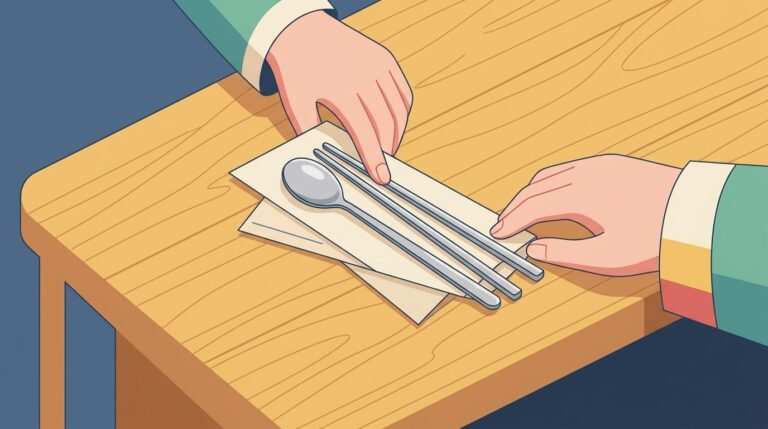
The 10-Second Table Sprint: Master Korean Dining Etiquette Before the Food Arrives
Phase 1: Empathy & Immersive Opening
안녕하세요! 매일한글 에디터입니다. (Hello! I’m your Daily Hangul editor.)
Picture this: You step into a bustling Korean restaurant in downtown Seoul during the lunch rush. The room is echoing with the rhythmic clatter of metal bowls, the sizzle of grilled meats, and the energetic shouts of “이모님!” (Auntie!). You slide into your chair, take off your jacket, and exhale, thinking you have a relaxing ten minutes to browse the menu. But before you even settle your elbows on the table, your Korean friend or colleague has already located a hidden drawer beneath the table edge, pulled out paper napkins, and arranged spoons and metal chopsticks for every single person at the table with the speed of an Olympic pit crew. Within fifteen seconds, the water cups are filled, the utensils are lined up neatly, and you are left sitting there with empty hands, wondering: Wait, did I just commit a massive cultural faux pas by doing nothing?
If you have ever felt that flash of social paralysis at a Korean dining table, you are certainly not alone. Welcome to the heart of 빨리빨리 (Pali-Pali: Hurry-Hurry) dining culture. Over my ten years of guiding foreign professionals and students in Seoul, this very moment—setting the table before the meal (음식 나오기 전 수저 세팅)—ranks as one of the most common situations where learners feel self-conscious. But here is the good news: mastering this 10-second ritual is the fastest shortcut to demonstrating peak social awareness (눈치, nunchi) and winning the admiration of Korean colleagues and friends. Let’s break down the exact phrases, cultural codes, and non-verbal nuances you need to own the Korean dining table with confidence!
Phase 2: Core Expressions Deep Dive
Here are three B2-level phrases that will immediately elevate your Korean from “tourist with a phrasebook” to “cultured, considerate dining partner.”
1. 제가 세팅할게요. (Jega setinghalgeyo.)
- Pronunciation: [Je-ga se-ting-hal-ge-yo] (Sounds like: Jay-gah seh-ting-hal-geh-yo)
- Meaning: Literal: “I will do the setting.” vs. Actual Nuance: “Allow me to handle the utensils and napkins; relax and get comfortable.”
- K-Culture Moment: Seen in almost every workplace K-Drama (like Misaeng or Business Proposal), where a proactive junior team member dashes forward to set the spoons and water before the team manager sits down.
- Editor’s Insight: The loanword 세팅 (seting) combined with the volunteer verb ending -할게요 (-halgeyo) strikes the perfect intermediate balance: polite, dynamic, and showing initiative without sounding stiff.
- Situation Spectrum: Casual ✅ | Semi-formal ✅ | Formal ⚠️ (In very formal business state dinners, staff sets the table, so volunteering might be unnecessary)
- 🤔 Think About It: In many Western dining contexts, grabbing utensils for other adults might feel intrusive. Why does Korean culture interpret this proactive gesture as deep consideration rather than an overstep?
2. 수저 놓을 휴지 한 장만 주세요. (Sujeo noheul hyuji han jangman juseyo.)
- Pronunciation: [Su-jeo no-eul hyu-ji han jang-man ju-se-yo] (Sounds like: Soo-juh noh-eul hyoo-jee hahn jahng-mahn joo-seh-yoh)
- Meaning: Literal: “Please give me just one sheet of tissue to place the cutlery on.” vs. Actual Nuance: “Could you hand me a napkin so I can lay down the hygiene base for our utensils?”
- K-Culture Moment: You are sitting at a bustling street tent bar (pocha) or a barbecue joint where the wooden tabletop might look slightly sticky. Someone immediately asks for a napkin to create an improvised paper coaster for the cutlery.
- Editor’s Insight: Notice the use of the relative clause 수저 놓을 (sujeo noheul – to place the cutlery on). This is textbook B2 grammar used in a natural, native cadence. Adding 한 장만 (just one sheet) softens the request.
- Situation Spectrum: Casual ✅ | Semi-formal ✅ | Formal ✅
- 🤔 Think About It: While food safety experts debate whether restaurant napkins are truly sterile, the act of laying a napkin down functions primarily as a psychological signal of mutual hygiene and care. Does your culture have similar symbolic dining habits?
3. 물부터 먼저 따를게요. (Mulbuteo meonjeo ttareulgeyo.)
- Pronunciation: [Mul-bu-teo meon-jeo tta-reul-ge-yo] (Sounds like: Mool-boo-tuh mun-juh ddah-reul-geh-yoh)
- Meaning: Literal: “I will pour water starting from first.” vs. Actual Nuance: “I’ll get everyone’s water poured while we wait for the side dishes.”
- K-Culture Moment: A dinner scene in Hospital Playlist, where the five doctor friends divide table tasks seamlessly—one grabs the side drawer, another passes water cups, and the third pours cold water from the stainless steel jug.
- Editor’s Insight: Combining -부터 (starting from) with 먼저 (first) creates a rhythmic sense of Pali-Pali efficiency. It shows you know the sequence of a Korean table setup.
- Situation Spectrum: Casual ✅ | Semi-formal ✅ | Formal ✅
- 🤔 Think About It: In Korea, serving others before filling your own cup is standard courtesy. How does this communal approach compare to self-service customs in your hometown?
Phase 3: Textbook Korean vs. Real-World Korean
Situation 1: Offering to prepare the utensils for the table
- 📖 교과서 한국어 (Textbook Korean):
“숟가락과 젓가락을 식탁 위에 놓겠습니다.”
(Sutgarak-gwa jeotgarak-eul siktak wie nokkess-eumnida. / “I will place the spoon and chopsticks on the dining table.”) - 🗣️ 진짜 한국어 (Real-world Korean):
“수저 챙겨 드릴게요!”
(Sujeo chaeng-gyeo deurilgeyo! / “Let me grab the cutlery for everyone!”) - 💡 왜 다를까? (Why is it different?):
Native speakers rarely say “숟가락과 젓가락” separately in casual speech; they almost always use the compound portmanteau 수저 (sujeo). Furthermore, replacing the stiff “놓겠습니다” with the warm, service-oriented verb 챙기다 (to look after / fetch) makes you sound instantly fluent and genuinely caring.
Situation 2: Asking your dining partner to spot the utensil box
- 📖 교과서 한국어 (Textbook Korean):
“식탁 옆 서랍에 수저가 들어 있습니까?”
(Siktak yeop seorabe sujeoga deureo itseumnikka? / “Is the cutlery contained in the drawer next to the table?”) - 🗣️ 진짜 한국어 (Real-world Korean):
“여기 옆에 수저통 열렸어요?” or “여기 옆 서랍 열어볼게요!”
(Yeogi yeope sujeotong yeollyeosseoyo? / Yeogi yeop seorap yeoreobolgeyo! / “Is the cutlery box open on your side?” or “I’ll open the side drawer right here!”) - 💡 왜 다를까? (Why is it different?):
Korean restaurant tables almost exclusively use built-in side-drawers today. Native speakers use conversational shortcuts like 수저통 (cutlery container/tray) and announce their proactive search rather than asking passive questions.
Phase 4: K-Culture Deep Dive & Non-Verbal Etiquette
4-1. 눈치 (Nunchi) & The Physical Choreography
Setting the table in Korea is a dynamic dance that requires sharp sensory awareness. Here is your step-by-step physical playbook:
1. The Drawer Sweep: As soon as your knees slide under the table, casually run your hand along the rim or underneath the tabletop. 90% of modern Korean dining tables have a slide-out drawer containing napkins, spoons, chopsticks, and wet wipes. Finding it quickly shows top-tier table savvy.
2. The Napkin Foundation: Pull out clean sheets of paper napkins. Fold each one neatly or lay it flat horizontally in front of each seat.
3. Proper Sujeo Positioning: Rest the spoon and chopsticks side-by-side on top of the napkin.
* Rule of Thumb: Spoon on the left, chopsticks on the right. The handles should always point toward the diner so they can easily pick them up with their dominant hand.
4. The Water Cup Two-Hand Rule: When pouring water for seniors or colleagues, hold the heavy stainless pitcher with your right hand and lightly touch your right wrist or forearm with your left fingertips—an understated sign of deep respect.
4-2. The Cultural Code: Pali-Pali as Communal Teamwork
Foreigners often mistake Korea’s 빨리빨리 (Pali-Pali) culture for sheer impatience or stress. In the context of dining, however, Pali-Pali is an expression of 공동체 의식 (communal mindset) and hospitality. Korean restaurant food often arrives astonishingly fast—sometimes within 3 to 5 minutes for soups like Kimchi Jjigae or Gukbap. If you wait until the scalding hot clay pots land on the table to start hunting for spoons, the meal rhythm is disrupted. Preparing the utensils in advance is your way of telling your companions: “I respect your time, I care about your comfort, and we are ready to share this meal together seamlessly.”
Phase 5: Real-World Roleplay Scenario
Setting: A vibrant, crowded Kalguksu (knife-cut noodle) restaurant in Jongno, Seoul, during peak 12:30 PM lunch hour.
Characters:
* Minho (민호): Your approachable Korean colleague who thrives on efficient teamwork.
* Alex (알렉스): You, an intermediate Korean learner ready to put proactive table etiquette into practice.
- Turn 1 (Minho):
와, 점심시간이라 사람 진짜 많네요. 알렉스 씨, 안쪽에 편하게 앉으세요!
(Wa, jeomsimsigan-ira saram jinjja manneyo. Alex ssi, anjjoge pyeonhage anjeuseyo!)
“Wow, there are so many people since it’s lunchtime. Alex, please sit comfortably on the inside!”
🎭 Minho gestures warmly toward the inner booth seat while slipping off his coat. -
Turn 2 (Alex):
감사해요, 민호 씨. 제가 수저 세팅할게요. 수저통이 어디 있죠?
(Gamsahaeyo, Minho ssi. Jega sujeo setinghalgeyo. Sujeotong-i eodi itjyo?)
“Thank you, Minho. I’ll set up the cutlery. Where is the utensil box?”
🎭 Alex slides into the seat and immediately inspects the side of the table. -
Turn 3 (Minho):
아, 알렉스 씨 쪽 테이블 아래 서랍 한번 당겨보실래요?
(A, Alex ssi jjok teibeul arae seorap hanbeon dang-gyeobosillaeyo?)
“Ah, could you try pulling the drawer underneath the table on your side?”
🎭 Minho points discreetly under Alex's side of the tabletop. -
Turn 4 (Alex):
찾았어요! 휴지 깔고 수저 올려드릴게요.
(Chajasseoyo! Hyuji kkalgo sujeo ollyeodeurilgeyo.)
“Found it! I’ll lay down the napkins and place the utensils for you.”
🎭 Alex pulls the drawer open smoothly and extracts two napkins. -
Turn 5 (Minho):
오, 알렉스 씨 완전 한국 사람 다 됐네요! 센스 최고예요.
(O, Alex ssi wanjeon hanguk saram da dwaenneyo! Senseu choegoyeyo.)
“Oh, Alex, you’ve become completely Korean! Your social sense is top-notch.”
🎭 Minho smiles broadly, visibly impressed by the initiative. -
Turn 6 (Alex):
민호 씨한테 배운 거죠! 물부터 먼저 따를까요?
(Minho ssihante baeun geojyo! Mulbuteo meonjeo ttareulkkayo?)
“I learned it all from you, Minho! Shall I pour the water first?”
🎭 Alex reaches for the stainless steel water pitcher. -
Turn 7 (Minho):
네, 부탁해요! 저기 칼국수 벌써 나오는 것 같아요.
(Ne, butakhaeyo! Jeogi kalguksu beolsseonaoneun geot gatayo.)
“Yes, please! It looks like our Kalguksu is already coming over there.”
🎭 Minho points toward the server wheeling a steaming cart. -
Turn 8 (Alex):
타이밍 딱 맞췄네요. 맛있게 먹어요!
(Taiming ttak matchwotneyo. Mas-itge meogeoyo!)
“Our timing was spot on. Let’s enjoy our meal!”
🎭 Both smile as the hot noodles land right on their perfectly prepared table.
🔀 Interactive Decision Point
Suppose you open the side drawer, and you realize the drawer is completely out of paper napkins! What do you do?
- Choice A: Say nothing, take the metal chopsticks and spoon out directly, and place them straight onto the bare tabletop.
- Choice B: Ask Minho: “민호 씨, 휴지가 없는데 직원분께 ‘휴지 좀 더 주세요’ 할까요?” (Minho, there are no napkins—shall I ask the staff for more napkins?)
- Choice C: Look around the restaurant, stand up abruptly mid-conversation, and walk into the kitchen to find paper towels yourself.
🔍 Click to reveal the outcome analysis
- Choice A (Risk / Awkward): While some younger Koreans skip napkins nowadays due to hygiene debates, placing bare cutlery on an unfamiliar restaurant table can make your companion feel slightly uncomfortable about cleanliness.
- Choice B (Best / Culturally Brilliant!): Perfect! It shows you care about the ritual and communicates smoothly with your dining partner before calling the server. High emotional intelligence (센스, sense).
- Choice C (Bad / Cultural Faux Pas): Walking into a commercial Korean kitchen is unsafe and considered very intrusive! Always call the staff using the table bell or by making polite eye contact with “저기요~”.
Phase 6: 10-Second Emotional Shadowing Drill
Practice these lines out loud with the designated rhythm markers (/) and emotional tone cues:
[⚡ 신속하고 센스 있게 / Quick and proactive]
제가 / 수저 세팅할게요. / 편하게 계세요!
(Jega / sujeo setinghalgeyo. / Pyeonhage gyeseyo!)
“I’ll / set up the cutlery. / Just make yourself comfortable!”-
[🤝 다정하고 배려 깊게 / Warm and considerate]
수저 놓을 휴지 / 여기 깔아 드릴게요.
(Sujeo noheul hyuji / yeogi kkara deurilgeyo.)
“I’ll lay down the napkin / right here for your cutlery.” -
[😊 유쾌하고 활기차게 / Cheerful and upbeat]
음식 나오기 전에 / 시원한 물부터 / 따를게요!
(Eumsik naogi jeone / siwonhan mulbuteo / ttareulgeyo!)
“Before the food arrives / I’ll pour some refreshing water / first!”
Phase 7: K-Culture Mini Dictionary
-
수저통 (Sujeo-tong)
Translation: Cutlery box / Utensil holder
Real-World Usage: Refers either to the stainless steel cylinder standing on older restaurant tables or the slide-out wooden drawer beneath modern tables. Used constantly when coordinating seating: “수저통 그쪽 밑에 있어요?” (Is the utensil drawer under your side?) -
눈치 (Nunchi)
Translation: Situational tact, perceptual awareness
Real-World Usage: The ultimate Korean social superpower. Having 빠른 눈치 (quick nunchi) at the dinner table means noticing when someone’s glass is empty or who needs utensils before being asked. -
테이블 세팅 (Teibeul Seting)
Translation: Table setting
Real-World Usage: While “상차림” refers to the restaurant arranging side dishes, Koreans use “세팅하다” for the personal task of arranging napkins, cutlery, and water cups for dining partners. -
밑반찬 (Mitbanchan)
Translation: Basic complementary side dishes
Real-World Usage: The array of kimchi, seasoned bean sprouts, and pickled radishes brought out right after or during your table-setting sprint. Readying your utensils ensures you can dive into these immediately.
Phase 8: Traveler’s Survival Kit
Survival Expressions TOP 3
- 서랍 여기 있어요! (Seorap yeogi isseoyo!)
Romanization: [Seo-rap yeo-gi i-sseo-yo!]
Pro Tip: Tell your friends where the hidden drawer is located so nobody searches in vain. - 물 좀 더 주실 수 있나요? (Mul jom deo jusil su innayo?)
Romanization: [Mul jom deo ju-sil su in-na-yo?]
Pro Tip: Use this polite ending when the small stainless water pitcher runs dry. - 앞접시 두 개만 부탁드려요. (Ap-jeopsi du gaeman butakdeuryeoyo.)
Romanization: [Ap-jeop-si du gae-man bu-tak-deu-ryeo-yo.]
Pro Tip: 앞접시 (ap-jeopsi) are individual sharing plates. Essential when splitting stews or noodle dishes.
Editor’s Travel Note
- Locating Tables & Hidden Drawers: If you are exploring hidden foodie alleys in Euljiro or Seongsu, check out our detailed Naver Map app installation and navigation guide to find highly-rated local spots where traditional table setups are the norm.
- The Magic Call Button: Look closely at the corner of your table. If there is a small round button (호출벨, hochul-bel), press it once instead of shouting across the room. It chimes the table number in the kitchen, exemplifying the Pali-Pali service speed!
Phase 9: “One Step Deeper” (Reflective Thought)
In Western individualist dining cultures, dining implements are treated as strictly personal space—you wouldn’t reach across a colleague’s bread plate to fold their napkin or unpack their fork. However, in Korean society, the table is fundamentally 공동 (gongdong – communal). The 10-second scramble to set napkins and cutlery is a tangible manifestation of 정 (Jeong)—the unspoken warmth, mutual obligation, and bonding that ties communities together. By laying out someone’s spoon, you are quietly affirming: “We are sharing this table as a team, not just as isolated diners.”
💬 Your Turn: In your home culture, what small, unspoken ritual signals that you are ready to bond over food? Do you have an equivalent to the Korean “napkin and spoon sprint”? Drop your story in the comments below!
Phase 10: FAQ & Avoiding Misunderstandings
Q: Isn’t putting cutlery on a paper napkin actually unhygienic according to hygiene reports?
A: You are technically right! Several Korean media reports have highlighted that paper napkins contain trace bleaching agents and dust, making them no cleaner than a wiped tabletop. However, culture often trumps micro-biology. The napkin serves as a symbolic gesture of care and cleanliness. Today, some upscale or modern diners place utensils on clean ceramic chopstick rests (수저받침) or directly on the clean tablecloth, but folding a napkin remains the overwhelming daily standard across local restaurants.
Q: Do I have to set the table if I am dining with someone much older or higher in status?
A: Yes, absolutely! In fact, that is the primary scenario where the tradition shines. If you are having lunch with a senior colleague, boss, or professor, taking the initiative to set their napkin, spoon, chopsticks, and water demonstrates exceptional manners and attentiveness (눈치).
Q: What if the restaurant has no side drawer and no cutlery on the table?
A: Don’t panic! In certain specialized restaurants (like traditional Korean banquets or raw fish spots), the utensils arrive wrapped in individual paper sleeves along with the food, or inside a sterilized hot-water container brought directly by the staff.
🚨 Common Mistakes Alert (TOP 3)
- Sticking Chopsticks Vertically in Rice (🚫 금기 – Absolute Taboo): Never spear your chopsticks upright into a bowl of steamed rice. This mimics incense burned for ancestral memorial ceremonies (제사, jesa) and represents bad luck and death. Always rest them horizontally on the napkin or side plate.
- Only Setting Your Own Utensils: Pulling out a spoon and chopsticks exclusively for yourself while your dining partners sit empty-handed looks selfish. If you open the drawer, prepare for the whole table!
- Placing Utensils Facing the Wrong Way: Always orient the handles toward the diner sitting in front of that spot, with the spoon on the left and chopsticks on the right.
Phase 11: Action Missions & Community Challenge
- 🥉 Bronze Mission (Solo Practice): The next time you eat at home or order Korean takeout, practice laying down a napkin, setting the spoon on the left and chopsticks on the right, and saying out loud: “제가 세팅할게요!” (Jega setinghalgeyo!)
- 🥈 Silver Mission (Social Share): Snap a photo of a neatly arranged Korean table setup—complete with napkins and cold barley tea—and post it on Instagram or Threads with the tag
#DailyHangulPaliPali. - 🥇 Gold Mission (Real-Life Mastery): During your next meal at a Korean restaurant or with Korean friends, beat everyone to the punch! Find the drawer, lay out the napkins, and fill the water cups within 15 seconds.
🎮 K-Culture Media Mission: Watch Episode 1 or 2 of any workplace K-drama (such as Misaeng or Agency). Spot the exact moment the junior employee opens the table drawer during a team lunch. Notice how the others react!
Phase 12: Interactive Quiz Challenge
Test your real-world cultural readiness!
1. Situational Judgment
You are sitting down at a barbecue restaurant with your Korean team leader. What is the most culturally savvy sequence of actions?
* A) Wait until the beef arrives, then ask the team leader to pass you a fork.
* B) Open the side drawer, pull out napkins, set the spoon and chopsticks with handles toward everyone, and pour water for your team leader using two hands.
* C) Pull out only your own chopsticks and start eating the complimentary side dishes immediately.
2. Fill in the Blank
Complete the sentence to politely tell your companion that you will handle the cutlery:
* “테이블 ____ 제가 ______! 편하게 앉으세요.”
(Hint: “Table setting, I will do it!”)
3. Cultural True or False
- Statement: In Korea, placing the chopsticks to the left of the spoon is the standard traditional dining arrangement. (True / False)
💡 Click here to check the Answers and Explanations!
- Situational Judgment Answer: B
Explanation: Taking the initiative to set up napkins, cutlery, and water for your senior colleague demonstrates top-tier Korean dining etiquette and respect. - Fill in the Blank Answer: 세팅은 / 할게요 (or 세팅 / 할게요)
Full sentence: “테이블 세팅은 제가 할게요! 편하게 앉으세요.” (I’ll handle the table setting! Please sit comfortably.) - Cultural True or False Answer: False
Explanation: The spoon is always placed on the left, and the chopsticks are placed on the right. Reversing this order is traditionally associated with ceremonial memorial tables for the deceased.







