

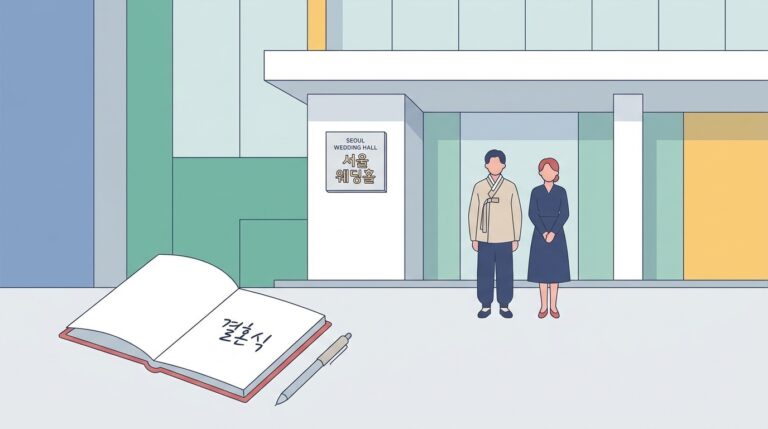
Phase 1: 공감 (Story-Immersive Opening)
안녕하세요! 매일한글 에디터입니다.
Picture this: You just received a crisp, beautifully designed 청첩장 (cheongcheopjang)—a wedding invitation—from your Korean colleague or close friend. You feel genuinely excited to celebrate their special day! But the moment you stand in front of your open closet, cold panic creeps in. You reach for that crisp, elegant white lace dress, and suddenly a voice whispers a warning you once heard on a K-drama: “Never wear white to a Korean wedding unless you want to be villainized for life!” You pivot toward your comfy jeans and blazer, only to wonder, “Is denim way too casual for a Seoul hotel wedding?”
If you have ever felt completely paralyzed trying to figure out what to wear as a wedding guest in Korea, take a deep breath. You are definitely not alone. In my ten years guiding international students and expats through the nuances of Korean social etiquette, outfit anxiety for weddings ranks right at the top. In Korea, dressing for someone’s nuptials is not just about personal style; it is an unspoken social code called 하객 룩 (hagaek-look)—the “wedding guest look.”
By mastering the phrases and cultural instincts in this unit, you will save yourself from embarrassing fashion missteps, grasp how modern Koreans balance respect with personal aesthetics, and walk into any wedding hall looking polished, culturally savvy, and effortlessly chic. Let’s make sure you arrive feeling like the most thoughtful guest in the room!
Phase 2: 핵심 표현 3선 심층 분석 (Core Expressions In-Depth)
1. 민폐 하객 되지 않게 단정하게 입어야 해요.
- Pronunciation: Minpye hagaek doeji anke danjeonghage ibeoya haeyo. (Think of ‘minpye’ sounding a bit like ‘mean-pyeh’ and ‘danjeong’ like ‘dahn-jeong’.)
- Meaning: “I need to dress neatly so I don’t become a nuisance guest.”
- K-Culture Moment: You will often hear this phrase in lifestyle YouTube vlogs or romantic comedy K-dramas when a character spends hours agonizing in a fitting room before their friend’s wedding.
- Editor’s Insight: 민폐 (minpye) means causing an inconvenience or burden to others. A 민폐 하객 (minpye hagaek) is someone who ruins photos or steals attention from the couple—most notably by wearing bridal white, revealing outfits, or overly bizarre fashion. Using 단정하게 (danjeonghage) highlights the core principle of Korean ceremonial dressing: neat, tidy, and composed.
- Situation Spectrum: Casual (⚠️ slightly dramatic) | Semi-formal (✅ perfect) | Formal (✅ ideal)
- 🤔 Think About It: In many Western weddings, guests wear bright, expressive colors to celebrate joy. Why do you think Korean society prioritizes collective modesty over individual flair at milestone life events?
2. 흰색 옷은 피하는 게 예의예요.
- Pronunciation: Huinsaek oseun pihaneun ge yeuiyeyo. (Say ‘huin-saek’ softly like ‘hween-sack’, and ‘ye-ui’ like ‘yay-wee’.)
- Meaning: Literal: “Avoiding white clothes is good manners.” → Actual nuance: “It’s standard courtesy not to wear white, out of respect for the bride.”
- K-Culture Moment: In K-drama Marry My Husband, extreme character conflicts are intentionally signaled when someone deliberately wears a pure white gown to someone else’s wedding ceremony!
- Editor’s Insight: The grammar pattern -는 게 예의예요 (-neun ge yeuiyeyo) is one of the most useful intermediate (B1) structures for offering gentle, culturally sound advice without sounding bossy. White, cream, and bright ivory are reserved exclusively for the bride. Even a light beige jacket can sometimes trigger side-eye if it looks white under bright camera flashes.
- Situation Spectrum: Casual (✅) | Semi-formal (✅) | Formal (✅)
- 🤔 Think About It: Does your home culture have a color that is strictly off-limits for guests? How does the emotional meaning of color differ across borders?
3. 너무 튀지 않고 깔끔한 스타일로 골라볼게요.
- Pronunciation: Neomu twiji anko kkalkkeumhan seutail-lo golla-bolgeyo. (‘Twiji’ sounds like a sharp ‘twee-jee’, popping off your tongue.)
- Meaning: Literal: “I’ll choose a clean style that doesn’t stand out too much.” → Actual nuance: “I’ll pick something chic, subtle, and understated.”
- K-Culture Moment: Used constantly among Korean 20-somethings and 30-somethings browsing shopping apps like Musinsa, 29CM, or Zigzag while shopping for wedding season (결혼식 시즌).
- Editor’s Insight: The verb 튀다 (twida) literally means to bounce or splatter, but idiomatically it means “to stand out noticeably.” In guest fashion, 안 튀는 것 (not standing out) is considered the ultimate virtue. Pairing it with 깔끔하다 (kkalkkeumhada)—meaning clean-cut and sharp—creates the gold standard of Korean guest fashion: navy blazers, tailored trousers, muted pastel blouses, or charcoal midi dresses.
- Situation Spectrum: Casual (✅) | Semi-formal (✅) | Formal (✅)
- 🤔 Think About It: Is “not standing out” seen as a compliment or a negative trait in your own country’s fashion culture?
Phase 3: 교과서 한국어 vs 진짜 한국어 (Textbook vs. Real Korean)
Situation 1: Asking what to wear to an upcoming wedding
- 📖 교과서 한국어: “결혼식에 무슨 옷을 입을까요?” (Gyeolhonsige museun oseul ibeulkkayo? – “What clothes shall I wear to the wedding?”)
- 🗣️ 진짜 한국어: “이번 결혼식 하객 룩 어떻게 입지?” (Ibeon gyeolhonsik hagaek ruk eotteoke ipji? – “How should I style my guest look for this wedding?”)
- 💡 왜 다를까? While the textbook sentence is grammatically flawless, modern Koreans almost universally use the trendy loanword compound 하객 룩 (hagaek-look) to describe wedding guest styling as a specific fashion genre.
Situation 2: Emphasizing the need to tone down flashy colors
- 📖 교과서 한국어: “화려한 옷을 입지 마십시오.” (Hwaryeohan oseul ipji masipsio. – “Do not wear flashy clothes.”)
- 🗣️ 진짜 한국어: “민폐 하객 되면 안 되니까 무조건 톤 다운해야 해.” (Minpye hagaek doemyeon an doenikka mujogeon ton daunhaeya hae. – “We can’t be nuisance guests, so we definitely need to tone down the colors.”)
- 💡 왜 다를까? Real conversations utilize dynamic cultural buzzwords like 민폐 하객 paired with the Konglish fashion term 톤 다운 (tone-down) to describe choosing muted shades like navy, muted charcoal, or deep olive.
Phase 4: K-Culture 딥다이브 & 비언어적 매너 (Deep Dive & Non-Verbal Manners)
4-1. 눈치 (Nunchi) & Gestures at Korean Wedding Halls
- The Two-Handed Envelope Handover: When arriving at the wedding reception desk, you will hand over your 축의금 (chug-uigeum – congratulatory money envelope). Always present the envelope with both hands (or your right hand supported at the wrist by your left) while bowing your head slightly. Handing it over with one hand feels dismissive.
- The Photo Shoot Positioning: Toward the end of the ceremony, friends gather around the newlyweds on the altar for the group photo (하객 단체 사진). Notice the subtle 눈치 (nunchi) game: if you are dressed in a slightly bright tone, discreetly stand toward the second or third row on the sides. Standing directly adjacent to the bride in a light-colored outfit will make the photographer uncomfortable!
4-2. Cultural Code: The 60-Minute Ceremony Phenomenon
Unlike marathon wedding events in many Western or South Asian cultures that stretch over several days or all night, urban Korean weddings held in commercial wedding halls (예식장) are famously fast-paced—often wrapping up in just 60 to 90 minutes! Guests arrive 30 minutes early, deliver their money envelope, quickly take a photo with the bride in the bridal waiting room (신부 대기실), watch a streamlined ceremony, pose for the group photo, and immediately head down to the buffet dining hall (피로연장). Because you will be constantly walking, standing in photo lines, and sitting at dining tables, the ideal 하객 룩 is not just modest—it must be comfortably tailored.
Phase 5: 실전 롤플레이 시나리오 (Interactive Roleplay Scenario)
Setting: You are shopping at a boutique in Gangnam with your Korean coworker, Minji (민지), looking for an outfit for your team manager’s weekend wedding.
- 민지: 이번 주말 부장님 결혼식 때 뭐 입을지 정했어요?
(Ibeon jumal bujangnim gyeolhonsik ttae mwo ibeulji jeonghaesseoyo?)
“Have you decided what to wear to Manager Park’s wedding this weekend?”
🎭 Looking through a rack of dresses with an eager expression -
You: 아직 못 골랐어요. 한국 결혼식은 처음이라 너무 고민돼요.
(Ajik mot gollasseoyo. Hanguk gyeolhonsigeun cheoeum-ira neomu gomindwaeyo.)
“Not yet. It’s my first Korean wedding, so I’m really agonizing over it.”
🎭 Sighing softly and touching your chin -
민지: 이 아이보리색 트위드 원피스 어때요? 디자인은 진짜 예쁜데!
(I aiborisaek teuwideu wonpiseu eottaeyo? Dijaineun jinjja yeppeunde!)
“How about this ivory tweed dress? The design is so pretty!”
🎭 Pulling out a bright ivory one-piece with pearl buttons -
You: 예쁘긴 한데… 흰색 옷은 피하는 게 예의잖아요.
(Yeppeugin hande… Huinsaek oseun pihaneun ge yeuijanhayo.)
“It is pretty, but… isn’t avoiding white clothes standard etiquette?”
🎭 Shaking your head gently with a cautious smile -
민지: 맞다! 플래시 터지면 사진에서 하얗게 나와서 민폐 하객 될 뻔했네요.
(Matda! Peullaesi teojimyeon sajineseo hayake nawaseo minpye hagaek doel ppeonhaenneyo.)
“You’re so right! If the camera flash goes off, it looks white in photos and you’d risk being a nuisance guest.” -
You: 그럼 이 네이비색 슬랙스에 단정한 블라우스 입는 건 어때요?
(Geureom i neibisaek seullaekseue danjeonghan beulla-useu ibneun geon eottaeyo?)
“Then what about wearing these navy slacks with a neat blouse?”
🎭 Holding up a sleek navy pant and beige chiffon top -
민지: 완전 센스 있다! 너무 튀지 않고 깔끔해서 딱 하객 룩 정석이에요.
(Wanjeon senseu itda! Neomu twiji anko kkalkkeumhaeseo ttak hagaek ruk jeongseog-ieyo.)
“You have great taste! It doesn’t stand out too much and looks so clean—the absolute textbook guest look!”
🎭 Giving a supportive thumbs up -
You: 다행이네요. 축의금 봉투 쓰는 법도 이따 알려줄 수 있어요?
(Dahaeng-ineyyo. Chug-uigeum bongtu sseuneun beopdo itta allyeojul su isseoyo?)
“What a relief. Can you show me how to write on the cash gift envelope later?”
🎭 Chuckling with genuine appreciation
🔀 인터랙티브 분기점 (Choose Your Response)
Minji asks: “What shoes are you planning to pair with this outfit?”
- Option A: “새빨간 12cm 하이힐을 신어서 포인트를 줄까 봐요!” (I think I’ll wear bright red 12cm high heels to give a pop of color!)
- 🚫 Bad: Too flashy. High-saturation red accessories will draw attention directly to your feet in the group photo.
- Option B: “결혼식이니까 편하게 슬리퍼나 크록스 신을래요.” (Since it’s a wedding, I’ll just wear slides or Crocs comfortably.)
- ⚠️ Risk: Extremely disrespectful. Casual footwear like slides or distressed sneakers is a major social faux pas in Korean wedding halls.
- Option C: “단정한 검은색 로퍼나 무난한 펌프스를 신을게요.” (I’ll wear neat black loafers or simple pumps.)
- ✅ Best: Perfect! Simple loafers or modest low-heel pumps balance professionalism, comfort, and respect.
Phase 6: 10초 감정 섀도잉 드릴 (10-Second Emotion Shadowing)
Practice reading these out loud at native speed. Pay close attention to pauses (/) and emotional tone!
[🤔 진지하게 고민하며 - Thoughtful and serious]
신부보다 / 너무 화려하게 입으면 / 민폐 하객 되잖아요.
(Sinbuboda / neomu hwaryeohage ibeumyeon / minpye hagaek doejanhayo.)
“If you dress / flashier than the bride, / you become a nuisance guest, you know.”-
[💡 확신을 주며 - Reassuring with confidence]
네이비 재킷에 / 슬랙스 조합이면 / 실패할 일 없어요!
(Neibi jaekise / seullaekseu johab-imyeon / silpaehal il eopseoyo!)
“A navy jacket / paired with tailored slacks / will never fail!” -
[😊 안도하며 환하게 - Bright and relieved]
너무 튀지 않고 / 깔끔해서 / 마음에 쏙 들어요.
(Neomu twiji anko / kkalkkeumhaeseo / maeume ssok deureoyo.)
“It doesn’t stand out too much / and looks so clean / that I absolutely love it.”
Phase 7: K-Culture 미니 사전 (Mini Dictionary)
-
하객룩 (Hagaek-look)
Literal translation: Wedding guest look.
Real-world usage: A massive fashion category in Korean online stores and department stores every spring and autumn. Refers to sophisticated, non-flashy, semi-formal wear. -
민폐 하객 (Minpye hagaek)
Literal translation: Nuisance guest.
Real-world usage: Used playfully or critically to describe anyone who dresses inappropriately (pure white dresses, overly sporty sweatpants, neon club attire) at a wedding. -
축의금 (Chug-uigeum)
Literal translation: Congratulatory money.
Real-world usage: The cash gift given in a white envelope at the reception desk. Common baseline amounts are 50,000 KRW, 100,000 KRW, or 150,000 KRW (odd numbers or round hundred-thousands). -
피로연 (Piroyeon)
Literal translation: Wedding banquet / reception.
Real-world usage: Usually held in a buffet hall within the building where guests eat immediately after or during the ceremony using the meal ticket (식권) received at the reception desk.
Phase 8: 여행자를 위한 생존 키트 (Survival Kit for Visitors)
Top 3 Emergency Wedding Phrases
-
봉투에 이름은 어디에 써요?
(Bongtue ireumeun eodie sseoyo?)
“Where do I write my name on the envelope?”
Pro Tip: Write your full name vertically on the left side of the back of the envelope, along with your affiliation (e.g., 회사 동료 / Company colleague). -
식권은 어디서 받나요?
(Sikkweoneun eodiseo bannayo?)
“Where do I get the meal voucher?”
Pro Tip: The reception table hands you a meal coupon when you submit your cash gift envelope. -
신부 대기실이 몇 층이에요?
(Sinbu daegisiri myeot cheung-ieyo?)
“Which floor is the bridal waiting room on?”
Pro Tip: Arrive 20–30 minutes before the ceremony starts so you can visit the bride and take a quick souvenir photo.
Editor’s Travel Note
Need to assemble an emergency guest outfit in Seoul without spending a fortune? Skip tourist souvenir shops and explore local stores. You can browse affordable tailored blazers and smart knitwear on the 무신사 스토어 앱 다운로드 or stop by SPA brands like 8Seconds and Spao in Hongdae or Myeongdong. On the wedding day, hail a ride directly to the venue using the 카카오 T 택시 앱 다운로드 to ensure you arrive without sweat or wrinkled clothes!
Phase 9: “한 발 더 깊이” (A Step Deeper)
In Western contexts, dressing up often celebrates individual self-expression—showing your unique personality through vibrant color and bold silhouettes. In contrast, Korean ceremonial dress reflects 조화 (johwa), or communal harmony. At a wedding, the bride and groom are the designated sole protagonists. By deliberately muting your own color palette, you show deference, ensuring the spotlight shines exclusively on the couple. Restraint in Korean culture is not boring; it is an active, loving form of consideration.
💬 Your Turn: How does wedding guest etiquette in your home country compare? Would wearing a plain dark suit or navy slacks be considered too solemn, or is it seen as respectful? Let us know in the comments below!
Phase 10: FAQ & 흔한 실수 (FAQ & Common Mistakes)
Q: Is wearing all-black okay, or is it associated with funerals in Korea?
A: Wearing all-black is actually very common and completely acceptable at Korean weddings! However, to avoid looking too austere or mournful, modern Koreans usually pair a black jacket with a beige blouse, subtle pearl accessories, or neat loafers to add a touch of warmth.
Q: Can men wear smart sneakers with a suit to a Korean wedding?
A: Clean, minimalist leather sneakers (black, dark brown, or subdued navy) paired with a sharp cropped suit are now widely embraced among younger Koreans. However, running shoes, brightly colored trainers, or gym shoes are still frowned upon.
Q: Are floral patterns or bright pastel dresses allowed for female guests?
A: Soft, muted pastels (dusty rose, sage green, sky blue, lavender) are very popular in spring and summer. Small floral prints are fine as long as the background base color is not pure white or ivory.
🚨 흔한 실수 (Common Mistakes) Checklist
- ❌ Wearing pure white, ecru, or cream lace: You will clash with the bride in official group photos.
👉 Correct Action: Choose beige, taupe, soft gray, or deep navy instead. - ❌ Showing up in denim jeans or workout athleisure: Even trendy designer jeans look overly casual at Korean hotel or hall weddings.
👉 Correct Action: Stick to tailored slacks, chinos, or pleated skirts. - ❌ Handing loose cash bills to the desk: Handing bare banknotes is seen as clumsy and rude.
👉 Correct Action: Always place clean, crisp bills into a white 축의금 envelope provided at the entrance desk before handing it over.
Phase 11: 액션 미션 & 참여 유도 (Action Mission)
- 🥉 Bronze Mission (Solo Drill): Look at three outfits in your wardrobe right now. Pick one that meets the 깔끔하고 단정한 standard and practice saying: “너무 튀지 않고 깔끔한 스타일로 골라봤어요.”
- 🥈 Silver Mission (Social Challenge): Take a mirror selfie of your chosen outfit and post it on your Instagram Story or Korean study account with the caption: “나의 주말 하객 룩 완성! 민폐 하객 탈출 ✨”
- 🥇 Gold Mission (Real-World Test): Next time you watch a modern K-drama wedding scene, spot what the guests in the crowd are wearing. Write down three color words in Korean describing their outfits (e.g., 남색, 베이지색, 회색).
🎮 K-Culture Mission: Watch an episode of a drama like King the Land or Crash Landing on You. Can you spot how background characters at formal gatherings dress? Notice how few people wear loud, saturated colors compared to Western shows!
Phase 12: 인터랙티브 퀴즈 챌린지 (Interactive Quiz Challenge)
1. Situational Judgment:
You are invited to your Korean language partner’s wedding. Which outfit choice demonstrates the best 하객 룩 etiquette?
(A) A knee-length pure white lace cocktail dress
(B) A crisp charcoal grey suit with a muted sky-blue inner shirt
(C) Distressed ripped blue jeans and an oversized band hoodie
2. Fill-in-the-Blank:
“결혼식에서는 신부가 돋보여야 하니까, 흰색 옷은 ______________ 예의예요.”
3. True or False:
In modern Korea, handing your cash gift envelope over with only one hand while holding your smartphone with the other is considered polite and casual. (T/F)
👉 Click to reveal answers & explanations!
-
Answer: (B)
Explanation: Charcoal grey paired with a muted shirt is polite, clean (단정하다), and avoids competing with the bride’s white gown. (A) is a classic 민폐 하객 choice, and (C) is far too casual. -
Answer: 피하는 게 (pihaneun ge)
Explanation: The full sentence is “흰색 옷은 피하는 게 예의예요” (Avoiding white clothes is good manners). -
Answer: False
Explanation: Etiquette strictly requires presenting the congratulatory money envelope (축의금 봉투) using both hands along with a slight bow of respect.







