

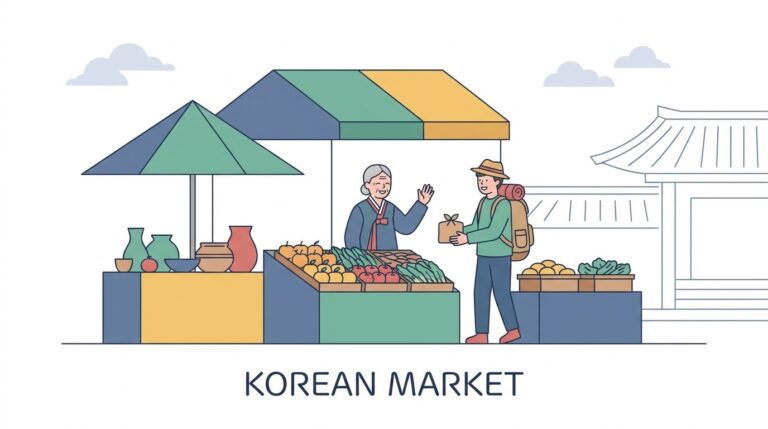
Phase 1: Empathy (A Story-Driven Awakening)
안녕하세요! 매일한글 에디터입니다! (Hello! This is your Daily Hangul editor!)
Picture this: You step into the bustling sensory explosion of Mangwon Market or Gwangjang Market on a crisp autumn afternoon. The rhythmic clanking of spatulas, the sizzle of mung bean pancakes (bindaetteok), and vibrant pyramids of crisp persimmons draw you in. You muster up the courage to buy fresh seasonal fruit from a spirited vendor—an imoni (auntie) whose sharp eyes have sized up customers for thirty years. You remember the textbook line you memorized three years ago: “깎아주세요” (Kkak-a-juseyo / “Please give me a discount”).
You utter it with stiff formality. The vendor blinks, her warm smile turns faintly rigid, and she replies flatly, “남는 거 없어요, 학생” (Namneun geo eopseoyo, haksaeng / “There’s no margin left, student”). An awkward chill descends. You pay full price, clutch your plastic bag, and walk away wondering: Didn’t every K-drama make bargaining look like an affectionate, musical game?
Here is the insider truth: Korean traditional markets operate on a relational frequency known as jeong (정, emotional bonding), not ruthless price slashing. Bargaining in Korea isn’t a zero-sum economic battle; it is an improvisational dance where both parties playfully pretend to concede while affirming mutual goodwill. For a C1-level communicator, relying on rigid textbook imperatives can sound transactional and blunt. Based on real-world field workshops with our advanced learners, this guide unpacks the art of conversational fencing, pragmatic linguistic devices, and the revered phenomenon of deom (덤, generous bonus goods). Let’s elevate your Korean from merely functional to culturally magnetic.
Phase 2: Core Expressions In-Depth
1. 사장님, 기분 좋게 에누리 좀 해 주세요
- Pronunciation: Sajangnim, gibun joke enuri jom hae juseyo (Sounds like: Sah-jahng-neem, gee-boon joe-kay eh-noo-ree johm hae joo-seh-yoh — think of ‘enuri’ rolling off the tongue smoothly, not stressed).
- Meaning: Literally: “Boss, please do a bit of price-trimming with good cheer.” Practical nuance: A sophisticated, charming request for an amicable adjustment that frames the seller’s discount as an act of magnanimity.
- K-Culture Moment: Commonly heard in slice-of-life dramas like When the Camellia Blooms (Dongbaekkkot Pil Muryeop), where experienced market-goers charm vendors by appealing to their mood rather than their wallet.
- Editor’s Insight: Notice the word 에누리 (enuri) instead of 할인 (harin) or 깎다 (kkakda). While kkakda literally means “to peel/slash,” enuri is an intrinsically warm, traditional market term for accommodating price adjustments. Paired with 기분 좋게 (“in good spirits”), you shift the interaction from a tense tug-of-war into a shared joyful moment.
- Situation Spectrum: Casual ✅ | Semi-formal ✅ | Formal ⚠️
- 🤔 Think About It: In your native culture, does haggling focus on product flaws or seller sympathy? Why does the Korean approach highlight the seller’s positive emotional state (gibun)?
2. 덤으로 하나만 더 얹어 주시면 안 돼요?
- Pronunciation: Deomeuro hanaman deo eonjeo jusimyeon an dwaeyo? (Sounds like: Dum-oo-roh ha-nah-mahn duh un-juh joo-see-myun ahn dway-yoh? — soft cadence, ending with a lilting upward inflection).
- Meaning: Literally: “Couldn’t you place just one more on top as a ‘deom’?” Practical nuance: A sly, endearing way to negotiate added value instead of subtracting cash.
- K-Culture Moment: Evokes nostalgic scenes in Reply 1988 (Eungdaphora 1988) where alleyway neighbors exchange goods, always adding a little extra to honor the invisible bond between them.
- Editor’s Insight: In Korean market psychology, asking a vendor to lower cash value directly insults their profit margin. Conversely, asking for 덤 (deom)—an extra scoop of side dishes, a surplus tangerine, or a bundle of scallions—allows the vendor to showcase 인심 (insim, generous spirit) at negligible wholesale cost. The verb 얹다 (eonjda, to lay atop) creates a vivid visual of abundance.
- Situation Spectrum: Casual ✅ | Semi-formal ✅ | Formal 🚫
- 🤔 Think About It: Why does receiving a physical freebie feel emotionally warmer in collectivist cultures than getting a monetary rebate?
3. 자주 올 테니까 단골 삼아 잘해 주세요
- Pronunciation: Jaju ol tenikka dangol sama jalhae juseyo (Sounds like: Jah-joo ohl teh-nee-kkah dahn-gohl sah-mah jahl-hae joo-seh-yoh).
- Meaning: Literally: “I’ll come often, so please treat me well by considering me a regular customer.” Practical nuance: Offering future loyalty in exchange for immediate hospitality.
- K-Culture Moment: The classic line delivered by charismatic foodie protagonists across Korean reality variety shows such as Sixth Sense or Delicious Rendezvous when befriending market stalwarts.
- Editor’s Insight: 단골 (dangol) represents one of Korea’s most cherished consumer relationships: the lifelong patron. By declaring your intention to become a dangol, you elevate the transaction from a one-time encounter into a sustained human connection. It triggers the vendor’s instinctive pride in nurturing loyal patrons.
- Situation Spectrum: Casual ✅ | Semi-formal ✅ | Formal ⚠️
- 🤔 Think About It: Contrast the Western concept of brand loyalty points with the Korean concept of dangol, which is built entirely on interpersonal trust and rapport.
Phase 3: Textbook Korean vs. Real Korean
Scenario 1: Rounding down an awkward total
- 📖 교과서 한국어 (Textbook): “총액에서 2,000원을 빼 주실 수 있습니까?” (Chongaegeseo icheon-woneul ppae jusil su isseumnikka? / Can you subtract 2,000 won from the total amount?)
- 🗣️ 진짜 한국어 (Real Korean): “사장님, 끝자리 떼고 딱 3만 원에 맞춰 주세요!” (Sajangnim, kkeutjari ttego ttak samman-wone matchwo juseyo! / Boss, just drop the spare change and round it out to an even 30,000 won!)
- 💡 왜 다를까? (Why the difference?): Traditional vendors dislike doing arithmetic on margins. Asking to “cut off the tail end” (끝자리 떼다) sounds decisive, playful, and mathematically clean without diminishing the bulk price.
Scenario 2: Asking for a complimentary extra item
- 📖 교과서 한국어 (Textbook): “무료 사은품을 제공해 줄 수 있나요?” (Muryo saeunpumeul jegonghae jul su innayo? / Are you able to provide a free complimentary gift?)
- 🗣️ 진짜 한국어 (Real Korean): “이모님, 인심 한 번 크게 쓰셔서 덤 하나만 쓱 찔러주세요~” (Imonim, insim han beon keuge sseusyeoseo deom hanaman sseuk jjilleojuseyo~ / Auntie, show your big generous heart and slip in a little extra something for me~)
- 💡 왜 다를까? (Why the difference?): “무료 사은품” is corporate retail jargon used in department stores. Market vendors trade on 인심 (insim). Using expressive mimetic words like 쓱 (sseuk, smoothly/effortlessly) transforms your request into a delightful, theatrical banter.
Phase 4: K-Culture Deep Dive & Non-Verbal Manners
4-1. 눈치 (Nunchi) & Body Language in the Market
Bargaining is 30% linguistic and 70% situational timing. To master this, exercise acute 눈치 (nunchi, situational speed-reading):
* The Golden Time Rule: Never haggle with the day’s first customer (maesu, 마수). Korean merchants believe that losing money on the opening sale curses their trade for the entire day. Strike between 2:00 PM and 5:00 PM, when the midday rush ebbs and merchants have time for chat.
* The Spatial Pivot: Never lean over the counter or touch delicate produce without permission. Instead, adopt an open posture, smile warmly with eye contact, and gently tilt your head while using conversational softeners like “아이고~” (Aigo~).
* The Cash Climax: Flash cash discreetly. Announcing “현금으로 계산할게요!” (Hyeongeumeuro gyesanhalgeyo! / “I’ll pay in cash!”) justifies your request for a discount or an extra scoop of goods without putting the vendor on the spot regarding card processing commissions.
4-2. The Cultural Architecture of Jeong (정) and Deom (덤)
In Western economic theory, every good possesses an immutable price tag. In a Korean traditional market, price is dynamic because it is co-constructed through human interaction. Deom emerged historically during periods of scarcity when agrarian communities shared surplus harvest. It signifies that “you are not just a customer taking my food; you are a guest in my culinary house.” When an elderly vendor drops three extra hot sweet potatoes (gun-goguma) into your pouch, refusing it is an insult. Accept with both hands, bow slightly, and exclaim delight!
Phase 5: Live Role-Play Scenario
Setting: A lively vegetable and banchan stall at Mangwon Market. Crates of gleaming red chili peppers and tubs of fresh geotjeori kimchi surround you.
Characters: You (a food enthusiast) and 이모님 (Imonim), a veteran market merchant with a stern expression that melts when someone speaks with warmth.
Turn 1
* You: 이모님, 이 제철 총각김치 진짜 맛깔나 보이네요! 한 통에 얼마예요?
(Imonim, i jecheol chonggakkimchi jinjja matkkallana boineyo! Han tonge eolmayeyo?)
“Auntie, this seasonal ponytail radish kimchi looks absolutely delectable! How much for a container?”
🎭 [Approach with an appreciative look, sniffing the aroma with wide eyes]
Turn 2
* 이모님: 오늘 아침에 갓 버무린 거야. 한 통에 만 오천 원!
(Oneul achime gat beomurin geoya. Han tonge man ocheon-won!)
“Freshly tossed just this morning. Fifteen thousand won for a tub!”
🎭 [Wipes hands on her floral apron and looks up proudly]
Turn 3
* You: 와, 갓 버무려서 그런지 빛깔이 장난 아니네요. 두 통 사면 조금 에누리 돼요?
(Wa, gat beomuryeoseo geureonji bitkkari jangnan anineyo. Du tong samyeon jogeum enuri dwaeyo?)
“Wow, because it’s freshly mixed, the color is out of this world. If I take two tubs, could you shave off a little?”
🎭 [Points to the kimchi while nodding respectfully]
Turn 4
* 이모님: 아이고, 총각무 값이 금값이라 남는 것도 없어~ 두 통 해봤자 3만 원이야!
(Aigo, chonggangmu gapsi geumgapsira namneun geotdo eopseo~ Du tong haebwatja samman-won-iya!)
“Goodness, radish prices are as high as gold right now, I’m barely making anything! Two tubs is still thirty thousand won!”
🎭 [Waves her hand dismissively, playing the expected part in the negotiation]
Turn 5
* You: 아이, 이모님~ 제가 망원동 살면서 단골 하려고 일부러 여기까지 찾아왔죠! 현금으로 싹 뽑아왔는데 기분 좋게 2만 8천 원에 맞춰주세요!
(Ai, imonim~ Jega Mangwon-dong salmyeonseo dangol haryeogo ilbureo yeogikkaji chajawatchyo! Hyeongeumeuro ssak ppobawatneunde gibun joke iman palcheon-wone matchwojuseyo!)
“Oh come on, Auntie~ I live nearby and came all this way specifically to become your regular! I even brought crisp cash, so let’s round it off at 28,000 won in good spirits!”
🎭 [Shows crisp bills discreetly, flashing a charming, persuasive grin]
Turn 6
* 이모님: 아이 참, 말이나 못하면! 학생 인상이 너무 좋아서 내가 이번만 특별히 손해 보고 주는 거야.
(Ai cham, marina mothamyeon! Haksaeng insangi neomu joaseo naega ibeonman teukbyeolhi sonhae bogo juneun geoya.)
“Oh dear, you really have a silver tongue! You have such a pleasant face, I’m taking a loss just this once for you.”
🎭 [Chuckles, packing the tubs with energetic precision]
Turn 7
* You: 역시 우리 이모님 인심 최고! 다음엔 깻잎장아찌도 사러 올게요. 덤으로 깻잎 몇 장만 얹어주시면 안 돼요?
(Yeoksi uri imonim insim choego! Daeumen kkaennipjang-ajchido sareo olgeyo. Deomeuro kkaennip myeot jangman eonjeojusimyeon an dwaeyo?)
“I knew our Auntie had the biggest heart! I’ll come back for the pickled perilla leaves next time. Couldn’t you slip in a couple of leaves as deom?”
🎭 [Claps hands softly in gratitude while peering playfully at the perilla tray]
Turn 8
* 이모님: 못 말려, 정말! 자, 여기 깻잎 넉넉하게 담았어. 밥 맛있게 먹고 또 와!
(Mot mallyeo, jeongmal! Ja, yeogi kkaennip neokneokhage damasseo. Bap masitge meokgo tto wa!)
“You’re impossible! Here, I packed plenty of perilla leaves. Enjoy your meal and come back again!”
🎭 [Pours a generous portion of perilla into a side pouch with a big toothy grin]
🔀 Interactive Branching Decision
Right after Turn 4, when the auntie declared radishes are “gold price,” what is your tactical response?
- Option A: “다른 가게는 2만 5천 원에 주던데요. 안 깎아주시면 그냥 갈게요.” (Dareun gageneun iman ocheon-wone judeondeyo. An kkak-ajusimyeon geunyang galgeyo. / Other stalls offered it for 25,000. If you won’t discount it, I’ll just leave.)
👉 Feedback [BAD]: Immediate stall breakdown! Comparing vendors directly or threatening to leave breaks market rapport and attacks the vendor’s professional pride. She will gladly watch you walk away. - Option B: “아, 그러세요? 그럼 정가대로 3만 원 다 드릴 테니까, 대신 저기 파김치 맛보기로 덤 좀 넉넉히 얹어주세요!” (A, geureoseyo? Geureom jeonggadaero samman-won da deuril tenikka, daesin jeogi pakimchi matbogiro deom jom neokneokhi eonjeojuseyo! / Ah, is that so? Then I’ll pay the full 30,000 won, but could you top it off with a generous taste of that green onion kimchi instead?)
👉 Feedback [BEST]: Supreme C1 pragmatic mastery! You validate her price point while securing an expensive side-dish bonus without conflict. The vendor feels respected and will over-deliver on the deom. - Option C: “사장님, 만 원만 깎아주시면 제가 친구 열 명 데리고 올게요.” (Sajangnim, man-wonman kkak-ajusimyeon jega chingu yeol myeong derigo olgeyo. / Boss, if you cut off 10,000 won, I’ll bring ten friends.)
👉 Feedback [RISK]: Asking for a 33% discount is considered disrespectful, and empty promises about “bringing friends” sound insincere to seasoned merchants.
Phase 6: 10-Second Emotion Shadowing Drill
Master the subtle pauses (/) and musical cadences of market negotiation. Mimic the emotional directives aloud:
[😊 능청스럽고 상냥하게 / Smooth, playful, and warm]
“사장님~ / 남는 거 없으신 건 알지만 / 끝자리만 살짝 / 떼어주시면 안 돼요?”
(Sajangnim~ / namneun geo eopseusin geon aljiman / kkeutjariman saljjak / tteeojusimyeon an dwaeyo?)
“Boss~ / I know there’s no profit margin / but could you gently / drop the spare digits?”-
[🥺 애교 섞인 부탁조로 / Charming, endearing, and humble]
“이모님 손맛에 반해서 / 멀리서 왔는데 / 덤 좀 팍팍 / 얹어주세요~!”
(Imonim sonmase banhaeseo / meolliseo watneunde / deom jom pakpak / eonjeojuseyo~!)
“I fell in love with your cooking hands / and traveled from afar / so please pile on the deom / generously~!” -
[🤝 든든하고 신뢰감 넘치게 / Dependable, resonant, and sincere]
“오늘 서비스 잘해주시면 / 다음 주에 / 직장 동료들 데리고 / 무조건 또 올게요!”
(Oneul seobiseu jalhaejusimyeon / daeum jue / jikjang dongryodeul derigo / mujogeon tto olgeyo!)
“If you take good care of me today / next week / with my coworkers / I will definitely return!”
Phase 7: K-Culture Mini Dictionary
- 에누리 (Enuri): Traditional term for a reciprocal price compromise. Unlike sterile corporate discounts, enuri implies mutual concession and interpersonal warmth.
- 덤 (Deom): Extra complementary goods handed out by vendors. It is the tangible embodiment of jeong (affectionate bonding) in commerce.
- 단골 (Dangol): A loyal, regular customer. Being someone’s dangol entitles you to unprompted bonus treats, secret seasonal cuts of meat, and genuine family-like inquiries.
- 마수걸이 (Masu-geori / Masu): The very first sale or transaction of the business day. In Korean commercial folklore, a smooth masu guarantees prosperous trade for the day; conversely, intense haggling on a masu brings bad luck.
Phase 8: Traveler’s Survival Kit
Survival Expressions TOP 3
- “현금 결제할 테니 조금만 봐주세요!”
(Hyeongeum gyeoljehal teni jogeumman bwajuseyo!)
Pro Tip: Translates to “I’ll pay cash, so please cut me a little slack!” Use this when purchasing bulk street snacks or clothing. - “이모님, 뭐가 제일 싱싱해요? 추천해 주세요!”
(Imonim, mwoga jeil singsinghaeyo? Chucheonhae juseyo!)
Pro Tip: Flatters the vendor’s integrity before initiating negotiations. They will often select prime stock for you. - “포장 깔끔하게 해 주셔서 정말 감사해요!”
(Pojang kkalkkeumhage hae jusyeoseo jeongmal gamsahaeyo!)
Pro Tip: High-level gratitude. Complimenting their packing craft prompts them to toss in an extra piece before tying the knot!
Editor’s Travel Note
- Essential Navigation: When wandering maze-like traditional markets, international apps often lag. We strongly suggest 네이버 지도 앱 다운로드 (Naver Map app download) to locate specific market gate numbers, stall alleys, and hidden restrooms.
- Payment Logistics: While credit cards and Samsung/Apple Pay are legally accepted, traditional stall vendors operating produce carts trade primarily in small cash notes. Keep 1,000, 5,000, and 10,000 KRW bills ready in your pocket—pulling out a 50,000 KRW note right after asking for a discount weakens your bargaining stance.
Phase 9: “한 발 더 깊이” (One Step Deeper)
In Western economic rationality, value is standardized and transactions are finalized upon monetary settlement. In a Korean traditional market, however, the purchase of goods is merely the medium through which an ongoing emotional debt of 정 (jeong) is initiated. When an elder vendor hands you an oversized bunch of herbs and says, “먹고 건강해” (Eat and stay healthy), the interaction transcends mercantile capital. You are no longer anonymous consumer #402; you are an acknowledged living presence within the neighborhood tapestry.
💬 Your Turn: Have you ever encountered a vendor who treated you like family rather than just a customer? How does market culture in your home country compare to Korea’s deom dynamic? Share your stories below!
Phase 10: FAQ & Avoiding Misunderstandings
Q: Can I bargain anywhere in Korea, such as department stores or franchise cafes?
A: Absolutely not! Haggling in department stores, convenience stores, franchise coffee chains, or retail outlets with fixed electronic barcode registers (jeonggaje, 정가제) is considered eccentric and inappropriate. Save your bargaining skills exclusively for traditional open-air markets, flea markets (like Dongmyo), and wholesale seafood/fish complexes (like Noryangjin).
Q: What should I do if a vendor flatly rejects my request for a discount?
A: Never push back or display irritation. If they say “안 돼요, 남는 거 없어” (I can’t, there is no margin), instantly pivot with an energetic smile: “아, 그렇군요! 물건이 너무 좋아서 욕심났나 봐요. 그냥 주세요!” (Ah, I see! The quality is so great I got greedy. I’ll take it as is!). Validating their product dissolves any friction instantly.
Q: Is receiving ‘deom’ guaranteed if I buy multiple items?
A: Deom is an act of discretionary benevolence, not an entitlement. Expecting it as a legal right ruins its charm. If the vendor does not offer deom, accept your purchase cheerfully. Respecting their margins is part of maintaining good nunchi.
🚨 Common Mistakes Alert (외국인 학습자의 흔한 실수 TOP 3)
- Aggressive Low-balling: Offering half price (common in some Southeast Asian tourist bazaars) is seen as deeply offensive in Korea. Target reasonable amounts—shaving off 1,000 to 2,000 KRW or asking for rounding down.
- Ignoring Morning Taboos: Engaging in lengthy bargaining early in the morning during maesu hours will trigger sharp rebukes. Browse quietly in the morning; negotiate in the afternoon.
- Cold, Monotone Delivery: Saying “깎아주세요” with a flat face sounds like an order rather than banter. Infuse your voice with warmth, humor, and melodic lilt.
Phase 11: Action Missions
- 🥉 Bronze Mission (Solo Practice): Stand before a mirror and practice Turn 5 from Phase 5 three times. Focus on your facial expression: smooth, smiling, and using melodic upward inflection on “~맞춰주세요!”
- 🥈 Silver Mission (Community Share): Head to your favorite Korean food subreddit, language exchange group, or Instagram story. Share your favorite Korean seasonal market food and write one full sentence negotiating for deom in natural Korean.
- 🥇 Gold Mission (Real-World Execution): Visit a local Korean traditional market (or a mom-and-pop Korean grocery store abroad). Buy two items using cash, compliment the vendor’s goods with “빛깔이 참 좋네요”, and successfully ask for an even round-off using “끝자리만 떼어주세요”!
- 🎮 K-Culture Mission: Watch an episode of tvN’s variety show Amazing Saturday (Nolto) or KBS’s 6 O’Clock My Hometown (6시 내고향). Identify three instances where the market hosts use compliments and eye contact before asking for extra portions!
Phase 12: Interactive Quiz Challenge
Test your situational mastery and cultural intuition below!
1. Situational Judgment
You visit a traditional fish market at 2:30 PM. You want to buy a box of king crabs. Which approach demonstrates the highest C1 pragmatic fluency?
* (A) “너무 비싸요. 5만 원 깎아주시면 현금 낼게요.”
* (B) “사장님, 오늘 게가 진짜 실하네요! 현금으로 쿨하게 결제할 테니 기분 좋게 끝자리 좀 깎아주시고, 가리비 덤으로 몇 개만 얹어주세요~”
* (C) “영수증 필요 없으니까 카드 수수료 빼고 반값에 주세요.”
🔍 Check Answer & Explanation
Correct Answer: (B)
Explanation: (B) compliments the freshness of the crab (실하네요), promises immediate cash payment, asks for a clean numeric adjustment (끝자리), and playfully seeks added value (가리비 덤) without demeaning the seller. (A) is too blunt and demands an excessive cut. (C) inappropriately demands an illegal tax/card fee discount.
2. Fill-in-the-Blank
Complete the following sentence to ask the vendor to drop the odd hundred-won digits:
“사장님, 잔돈 번거로우니까 ________ 떼고 깔끔하게 만 오천 원에 해주세요!”
🔍 Check Answer & Explanation
Correct Answer: 끝자리 (Kkeutjari)
Explanation: 끝자리 refers to the trailing numbers or loose change at the end of a total sum. Using “끝자리 떼고” is the definitive natural idiom for asking to round down.
3. Cultural True or False
Statement: In Korean traditional markets, haggling aggressively on the day’s first transaction (maesu) is encouraged as a sign of business dynamism.
🔍 Check Answer & Explanation
Correct Answer: False
Explanation: The first transaction of the day (maesu-geori, 마수걸이) holds sacred symbolic value for merchants. Haggling down or canceling a maesu sale is believed to bring poor fortune for the entire business day. Always pay full price without complaint if you are the day’s first patron!







