

Phase 1: 공감 (Story-Driven Opening)
안녕하세요! 매일한글 에디터입니다.
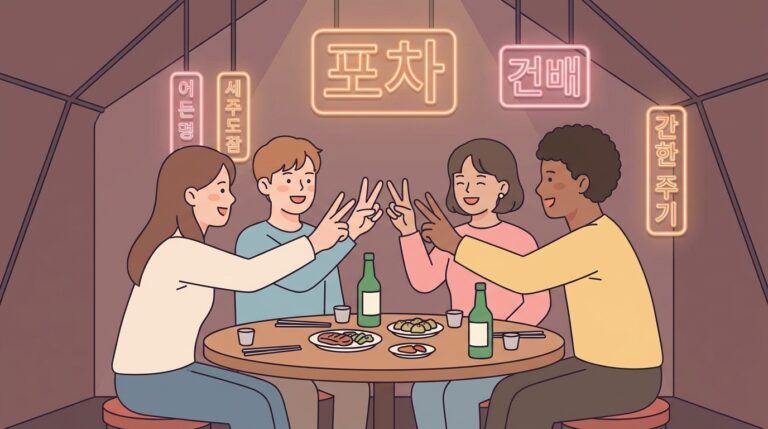
Picture this: You are sitting at a bustling pocha (street pub) in Hongdae. Neon signs hum above, plates of steaming spicy rice cakes and grilled pork sit between frosty green bottles, and laughter roars across the room. Suddenly, someone bangs on the table in rhythm and yells: “손병호 게임! 손병호 게임!” (Son Byung-ho game!). Within three seconds, everyone raises one open hand into the air, five fingers extended like antennas. Eyes dart across the table. Mischievous smirks appear. Someone calls out a condition, people start folding fingers one by one, and before you know it, all eyes lock on your hand. You have one finger left standing—and you have zero idea what anyone just said or why you are suddenly being handed a full glass of beer.
Does this scenario give you a sudden spike of social anxiety? You are definitely not alone. For intermediate Korean learners, Korean drinking games are the ultimate test of conversational reflexes, listening comprehension, and cultural radar (nunchi). The Image Game (most famously played as the “Son Byung-ho Game”) is the undisputed king of Korean icebreakers. It is witty, fast-paced, and inherently social.
Over the past ten years coaching expatriates and language students in Seoul, I have heard countless stories of learners freezing up during this exact moment. But here is the secret: once you crack the formula behind this game, it becomes your greatest superpower to make lifelong Korean friends. This guide is built directly on real feedback from international learners who went from awkward outsiders to the life of the party. Let’s make sure that next time fingers go up, you play like a local!
Phase 2: 핵심 표현 3선 심층 분석 (Top 3 Core Expressions)
1. ~한 사람 접어! (~-han saram jeobeo!)
- Pronunciation: [~han sa-ram jeo-beo!] (Sounds like: han sah-rahm jaw-buh)
- Meaning: Literal: “Person who is ~, fold!” | Actual Nuance: “Put a finger down if you…!”
- K-Culture Moment: You will see this in almost every Korean variety show—from Running Man to Going Seventeen. An idol or comedian will look around, spot someone wearing yellow socks, and yell: “노란 양말 신은 사람 접어!” (Anyone wearing yellow socks, fold!).
- Editor’s Insight: The verb 접다 (jeopda) means “to fold.” In this context, it specifically commands players to fold down one extended finger. It is usually spoken in casual imperative (banmal) because drinking games automatically establish a casual, equal playing field among peers.
- Situation Spectrum: Casual ✅ | Semi-formal ⚠️ (Only among close coworkers during team dinners) | Formal 🚫
- 🤔 Think About It: In English, we say “Put a finger down.” In Korean, the focus is on “folding” (접어), implying an active contraction of your barrier. How does phrasing rules as collective commands shape group dynamics in Korea?
2. 완전 저격이잖아! (Wanjeon jeogyeog-ijana!)
- Pronunciation: [Wan-jeon jeo-gyeok-i-ja-na!] (Sounds like: wan-juhn jaw-gyuck-ee-jah-nah)
- Meaning: Literal: “That is completely sniper-shooting!” | Actual Nuance: “Hey, you are totally targeting me!”
- K-Culture Moment: In K-Dramas like Hospital Playlist or Work Later, Drink Now, whenever a character makes a rule clearly designed to eliminate someone specific (e.g., “Anyone who texted their ex this week, fold!”), the victim immediately shouts this line with dramatic disbelief.
- Editor’s Insight: 저격 (jeogyeok) means “sniping” or “targeted attack.” In social gaming, it refers to playfully crafting a prompt so specific that only one person at the table qualifies. It is the hallmark of affectionate teasing in Korean youth culture.
- Situation Spectrum: Casual ✅ | Semi-formal ⚠️ | Formal 🚫
- 🤔 Think About It: Why does Korean gaming culture celebrate playful “targeting” rather than finding it offensive? Where is the line between good-natured ribbing and crossing a boundary?
3. 나 자폭했어! (Na japoghaesseo!)
- Pronunciation: [Na ja-pok-haet-seo!] (Sounds like: nah jah-pohk-haet-suh)
- Meaning: Literal: “I self-detonated!” | Actual Nuance: “I totally played myself! / I committed social suicide!”
- K-Culture Moment: Popularized across variety YouTube channels like Workman or No Prepare. A player tries to target someone else by saying, “Anyone who woke up after 1 PM today, fold!”—only to realize five seconds later that they themselves woke up at 2 PM and have to fold their own last finger.
- Editor’s Insight: 자폭 (japok) literally translates to “self-explosion.” It captures the hilarious, accidental blunders where your own attack ricochets back onto you. Koreans love when someone “self-detonates” because it shows humility and creates instant comedic relief.
- Situation Spectrum: Casual ✅ | Semi-formal ⚠️ | Formal 🚫
- 🤔 Think About It: Self-deprecating humor (자폭 개그) is a powerful bonding mechanism in Korea. How does laughing at your own tactical error ease tension in your own culture?
Phase 3: 교과서 한국어 vs 진짜 한국어 (Textbook vs. Real-World Korean)
Situation 1: Calling out someone’s physical trait during the game
- 📖 교과서 한국어 (Textbook Korean): 안경을 쓴 사람은 손가락을 접으세요. (An-gyeong-eul sseun saram-eun son-ga-rag-eul jeob-eu-se-yo. – “Please fold your finger if you wear glasses.”)
- 🗣️ 진짜 한국어 (Real Native Korean): 오늘 안경 낀 사람 접어! (Oneul an-gyeong kkin saram jeobeo! – “Anyone rocking glasses today, fold!”)
- 💡 왜 다를까? (Why is it different?): Textbook Korean overuses formal markers (-세요) and the standard verb 쓰다 (to wear). In real drinking games, speed is everything. Natives swap to casual imperative (접어), use conversational verb pairings like 안경 끼다, and frame the sentence with punchy rhythm.
Situation 2: Accusing a friend of cheating or making up excuses
- 📖 교과서 한국어 (Textbook Korean): 그것은 규칙에 어긋나는 행동입니다. (Geugeos-eun gyuchig-e eogeunnaneun haengdong-imnida. – “That action is contrary to the rules.”)
- 🗣️ 진짜 한국어 (Real Native Korean): 야, 밑장빼기 하지 마! 손가락 다 보여! (Ya, mitjang-ppaegi haji ma! Son-ga-rak da boyeo! – “Hey, don’t try to cheat! I can see your fingers clear as day!”)
- 💡 왜 다를까? (Why is it different?): Textbook phrasing sounds like an arbitration court statement. In reality, young Koreans drop slang references like 밑장빼기 (originally from card-shark slang in the film Tazza, meaning sneaky underhanded tricks) to call out half-folded fingers playfully.
Phase 4: K-Culture 딥다이브 & 비언어적 매너 (Cultural Deep-Dive & Non-Verbal Manners)
4-1. 눈치 (Nunchi) & Gestures: The Art of the Fold
- The Finger Display: When the game begins, raise your dominant hand at shoulder height, palm facing outward toward the center of the table. Do not hide your hand under the table or curl your fingers into a ball—this is considered bad manners (매너 없다). Everyone must clearly see your finger count.
- The Dramatic Fold: When folding a finger, do not do it silently. Koreans love exaggerated drama! Grip your folding finger with your other hand, pull it down with a sharp sigh, or look at the caller with faux betrayal. This non-verbal commitment shows you are fully immersed in the group dynamic.
- The Table Rhythm: Pay attention to the beat. Often, players chant: “손~병호! 손~병호!” while tapping their glasses or the table. Jumping into this collective rhythm before speaking signals high nunchi (social intuition).
4-2. Cultural Code: The Evolution of “Son Byung-ho Game”
Why is it named after a veteran actor? Back in the late 2000s on KBS’s hit talk show Happy Together Season 3, actor Son Byung-ho introduced this variation of the classic “Never Have I Ever” / “Image Game” using five fingers. It was so remarkably simple, hilarious, and competitive that it swept the entire nation overnight. Unlike Western “Never Have I Ever” which often skews heavily into intimate or taboo topics early on, the Son Byung-ho game in Korea usually begins with visible, observational humor (clothing, hair, habits) before moving into playful social roasts. It reflects the Korean communal desire for shared intimacy without alienating anyone too aggressively.
Phase 5: 실전 롤플레이 시나리오 (Interactive Roleplay Scenario)
Setting: 11:30 PM at a bustling pocha in Sinchon. Empty soju bottles line the table. Your Korean university friends Minho (the mischievous mood maker) and Sujin (the quick-witted master of games) are hyping up the table for one final round.
Characters:
* Minho: Highly competitive, loves targeting friends.
* Sujin: Sharp observational skills, protective of you.
* You: Intermediate Korean learner holding up five fingers.
- Turn 1 (Minho): [🎭 Slapping the table in rhythm with a wide grin] 자, 손바닥 다 펴! 손병호 게임 간다! 딴짓하기 없기! (Ja, sonbadak da pyeo! Son Byung-ho geim ganda! Ttanjithagi eopgi! – “Alright, palms up everyone! Son Byung-ho game starts now! No zoning out!”)
- Turn 2 (You): [🎭 Laughing, raising your right hand confidently] 준비 완료! 이번엔 진짜 안 마실 거야. (Junbi wallyo! Ibeonen jinjja an masil geoya. – “Ready! I’m seriously not drinking this round.”)
- Turn 3 (Sujin): [🎭 Glancing at Minho’s loud neon shirt] 나부터 할게. 오늘 옷 색깔 너무 튀는 사람 접어! (Nabuteo halge. Oneul ot saekkkal neomu twineun saram jeobeo! – “I’ll start. Anyone wearing overly flashy clothes today, fold!”)
- Turn 4 (Minho): [🎭 Clutching his chest in fake shock, bending his thumb] 야, 시작부터 완전 저격이잖아! 형광 주황색이 뭐가 어때서! (Ya, sijakbuteo wanjeon jeogyeog-ijana! Hyeonggwang juhangsaeg-i mwoga eottaeseo! – “Hey, pure sniper attack right from the start! What’s wrong with fluorescent orange!”)
- Turn 5 (You): [🎭 Checking your plain black hoodie and smiling] 휴, 난 무난해서 살았다! 민호 이제 네 개 남았네? (Hyu, nan munanhaeseo saratda! Minho ije ne gae namanne? – “Phew, I’m plain so I survived! Minho, you have four fingers left, huh?”)
- Turn 6 (Minho): [🎭 Squinting his eyes mischievously, leaning toward you] 좋아, 내 차례지? 여기서 한국 온 지 1년 안 된 사람 접어! (Joa, nae charyeji? Yeogiseo hanguk on ji il-nyeon an doen saram jeobeo! – “Fine, my turn right? Anyone here who arrived in Korea less than a year ago, fold!”)
- Turn 7 (Sujin): [🎭 Swatting Minho’s arm playfully] 야! 그건 너무 치사하지! 우리 외국인 친구한테 왜 그래? (Ya! Geugeon neomu chisahaji! Uri oeguk-in chingu-hante wae geurae? – “Hey! That’s totally cheap! Why pick on our international friend like that?”)
- Turn 8 (You): [🎭 Folding your first finger with an exaggerated theatrical sigh] 괜찮아, 인정! 근데 민호 너… 다음 내 차례 기대해라? (Gwaenchana, injeong! Geunde Minho neo… daeum nae charye gidaehaera? – “It’s cool, fair game! But Minho… just you wait for my turn.”)
🔀 Interactive Branching Point: It’s your turn to call out a prompt!
How will you phrase your attack against Minho without ruining the fun vibe?
- Option A: “지금 테이블에서 형광색 옷 입고 제일 시끄러운 사람 접어!” (Jigeum teibeul-eseo hyeonggwang-saek ot ipgo jeil sikkeureoun saram jeobeo! – “Fold if you are wearing neon and being the loudest person at this table!”)
- Option B: “여기서 통장에 돈 천만 원도 없는 사람 다 접어!” (Yeogiseo tongjang-e don cheonman-won-do eomneun saram da jeobeo! – “Fold if you don’t even have 10 million won in your bank account!”)
- Option C: “오늘 머리 안 감고 모자 쓴 사람 접어!” (Oneul meori an gamgo moja sseun saram jeobeo! – “Fold if you didn’t wash your hair today and wore a cap!”)
Branch Feedback:
- Option A (Best – Instant Legend): Spot-on banter! You turned Minho’s teasing back on him using humor and clear visual evidence. The table will erupt in cheers, and Minho will gladly fold with a laugh.
- Option B (Bad – Mood Killer): Extreme Risk! In Korean social settings, personal financial questions or serious private metrics cross an uncomfortable boundary, instantly chilling the cheerful room.
- Option C (Risk – Double-Edged Sword): High comedy, but risky! Check if someone else at the table is secretly wearing a cap for that reason. If Sujin also folds, you might make an unintended victim! Great among ultra-close friends, risky for new acquaintances.
Phase 6: 10초 감정 섀도잉 드릴 (10-Second Emotion Shadowing Drill)
Read these aloud while matching the emotion tags and pausing at every / slash mark:
- [😏 장난기 가득하고 능글맞게 / Playful & Cheeky]
“오늘 마음에 드는 사람 / 옆에 앉은 사람 / 손가락 접어!”
(Oneul maeum-e deuneun saram / yeop-e anjeun saram / son-ga-rak jeobeo!
“Anyone who… has a crush on the person sitting next to them… fold your finger!”) -
[😱 억울하고 과장되게 / Dramatic & Indignant]
“야! / 이건 대놓고 저격이잖아! / 나 죽이려고 작정했지?”
(Ya! / Igeon daenoko jeogyeog-ijana! / Na jugiryeogo jakjeonghaetji?
“Hey! / This is an outright sniper shot! / Are you determined to kill me off?”) -
[🤣 어이없고 폭소하며 / Bewildered & Bursting into Laughter]
“잠깐만, / 나 방금 자폭했어! / 나 왜 내가 말하고 내가 접냐?”
(Jamkkanman, / na banggeum japoghaesseo! / Na wae naega malhago naega jeobnya?
“Wait a second, / I just self-detonated! / Why am I folding to my own rule?”)
Phase 7: K-Culture 미니 사전 (Mini Dictionary)
- 저격 (Jeogyeok) | Targeting / Sniping
- Everyday/Drinking Use: Singling out one specific person at the gathering through playful questions or teasing comments during games.
- 흑기사 / 흑장미 (Heukgisa / Heukjangmi) | Black Knight (Male) / Black Rose (Female)
- Everyday/Drinking Use: A hero who volunteers to drink your penalty shot on your behalf. Tradition dictates the rescuer earns one wish (소원) from you in return!
- 벌주 (Beolju) | Penalty Drink
- Everyday/Drinking Use: The drink poured for the loser of a drinking game round. It is frequently mixed (폭탄주) or filled right to the brim.
- 자폭 (Japok) | Self-Destruction
- Everyday/Drinking Use: When someone sets a trap in conversation or gaming that ends up backfiring onto themselves, resulting in hearty shared laughter.
Phase 8: 여행자를 위한 생존 키트 (Traveler’s Survival Kit)
Top 3 Drinking Survival Phrases
- 1. “저 이번 판 쉬어갈게요!” (Jeo ibeon pan swieogalgeyo!)
- Pronunciation: [Jeo i-beon pan swi-eo-gal-ge-yo!]
- Pro Tip: Use this when you are on the verge of your alcohol limit. It politely and firmly exempts you from the upcoming round without killing the vibe.
- 2. “벌주 양 너무 많은 거 아니에요?” (Beolju yang neomu maneun geo anieyo?)
- Pronunciation: [Beol-ju yang neo-mu ma-neun geo a-ni-e-yo?]
- Pro Tip: Said with a smile when someone pours a terrifyingly full glass. It invites bystanders to step in and chant for moderation.
- 3. “물 한 잔만 더 부탁드려요!” (Mul han jan-man deo butakdeuryeoyo!)
- Pronunciation: [Mul han jan-man deo bu-tak-deu-ryeo-yo!]
- Pro Tip: In Korean pubs, water is always free (무료). Keep yourself hydrated between game penalties.
Editor’s Travel Note: Night Out Logistics
Seoul nightlife runs late, but subway lines typically shut down around midnight to 12:30 AM. Do not get stranded without a game plan! Make sure to install the Kakao T taxi booking app on your phone beforehand to hail late-night taxis easily without needing to speak fluent Korean to the driver. Also, bookmark your hostel or hotel on the Naver Map navigation app for accurate real-time bus schedules, as night buses (올빼미 버스) run across major nightlife hubs like Hongdae, Gangnam, and Itaewon until dawn.
Phase 9: “한 발 더 깊이” (Reflective Cultural Essay)
Drinking games in Korea are often misinterpreted by outsiders as purely competitive drinking contests. In reality, games like the Son Byung-ho Image Game function as an emotional pressure-release valve for a society steeped in hierarchical speech levels and rigorous etiquette. Under the unspoken social contract of a pocha table, rigid honorific hierarchies temporarily soften. When you fold a finger and laugh at being “sniped,” you are participating in a ritual of collective vulnerability. You allow yourself to be seen, gently roasted, and embraced by the group. It transforms an assemblage of separate individuals into an authentic “우리” (we/us).
💬 Your Turn: What is an observational question you would dare to call out during a game with your friends in Korea? Share your creative Korean prompt in the comments below!
Phase 10: FAQ & 오해 방지 (FAQ & Common Mistakes)
Q: Do I have to drink real alcohol if I lose the Son Byung-ho game?
A: Absolutely not! Korea’s drinking culture has evolved significantly over recent years. You can replace penalty drinks with cider (Sprite), water, or zero-calorie soda. Simply declare “저 오늘 술 못 마셔요, 사이다로 벌주 할게요!” (I can’t drink alcohol today, I will do penalty drinks with soda!) before the game starts. True friends will happily respect this.
Q: Can I play this game with older Koreans or supervisors at a company dinner (Hoesik)?
A: Tread very carefully. While the game can break the ice at an informal team dinner, you should only initiate it if senior colleagues suggest playing games first. Furthermore, never ask personal or sensitive questions to your boss. Stick to universally safe observations like “Anyone wearing black socks, fold!”
Q: What is the difference between “Image Game” and “Son Byung-ho Game”?
A: In the classic “Image Game,” players count to three and point their finger at the person at the table who matches a specific vibe (e.g., “Who seems most likely to survive a zombie apocalypse?”). The “Son Byung-ho Game” is a specific 5-finger elimination format where players state conditions to eliminate opponents one by one.
🚨 흔한 실수 (Common Mistakes) 경고판
- Mistake: Hiding your fingers or refusing to fold when you clearly match the rule.
- Correct Action: Honesty is prized above winning! If you get caught lying about a condition, the group will playfully make you drink a double penalty (원샷).
- Mistake: Asking deeply private questions about romantic exes, salary, or plastic surgery.
- Correct Action: Keep topics grounded in observable traits, daily habits, or common student/worker experiences (e.g., “Anyone who checked Instagram in the last 10 minutes”).
- Mistake: Speaking rigid textbook honorifics (존댓말) while yelling game commands.
- Correct Action: Drop into short, punchy casual verbs for the chant itself: “~한 사람 접어!” not “~한 사람은 손가락을 접어 주시기 바랍니다.”
Phase 11: 액션 미션 & 참여 유도 (Action Missions)
- 🥉 Bronze Mission (Solo Mastery): Record a 10-second voice memo saying: “오늘 아침에 커피 마신 사람 접어!” (Oneul achim-e keopi masin saram jeobeo!) with confident rhythm and correct pronunciation.
- 🥈 Silver Mission (Social Challenge): Teach the five-finger Son Byung-ho game to a friend or study buddy this week and play a lightning round of 3 questions in Korean.
- 🥇 Gold Mission (Real-World Test): Next time you are at a Korean restaurant or gathering, break awkward silence by raising your hand and chanting: “손병호 게임 할 사람?” (Son Byung-ho geim hal saram? – Who wants to play Son Byung-ho game?).
- 🎮 K-Culture Mission: Watch an episode of a Korean variety show (such as Running Man or Going Seventeen), spot the moment they play this game, and write down two prompts the cast members used!
Phase 12: 인터랙티브 퀴즈 챌린지 (Interactive Quiz Challenge)
Quiz 1. 상황 판단 (Situational Judgment)
You have two fingers left. It is your turn to call out a rule. Minho has only one finger standing, and he is wearing glasses. What is the most natural, punchy way to target him?
* A) 안경을 착용하신 분은 지금 손가락을 접으세요.
* B) 지금 안경 낀 사람 접어!
* C) 안경을 안 쓴 사람만 손가락을 펴세요.
🔍 정답 및 해설 확인 (Click to View Answer)
정답: B
해설: Option B (지금 안경 낀 사람 접어!) is the exact native casual phrasing used in high-energy drinking games. Option A is overly formal textbook speech that halts the game rhythm, and Option C is an awkwardly inverted sentence structure that causes confusion.
Quiz 2. 빈칸 채우기 (Fill in the Blank)
Complete the sentence when someone attacks you with a hyper-specific prompt:
“야, 그건 나한테 대놓고 한 완전 [ ______ ]이잖아!”
* A) 자폭
* B) 흑기사
* C) 저격
🔍 정답 및 해설 확인 (Click to View Answer)
정답: C (저격)
해설: “저격” (sniping/targeting) completes the phrase 완전 저격이잖아! (You are totally sniping me!). 자폭 means self-destruction, and 흑기사 means a knight who drinks on your behalf.
Quiz 3. True / False 문화 퀴즈
Statement: In the Son Byung-ho game, keeping your hand tucked under the table where opponents cannot see your remaining fingers is considered smart strategy.
* True
* False
🔍 정답 및 해설 확인 (Click to View Answer)
정답: False
해설: In Korean gaming culture, transparency and visible hands held up at shoulder level are basic non-verbal table manners. Hiding your hand is seen as poor sportsmanship (반칙 or 매너 꽝).







