

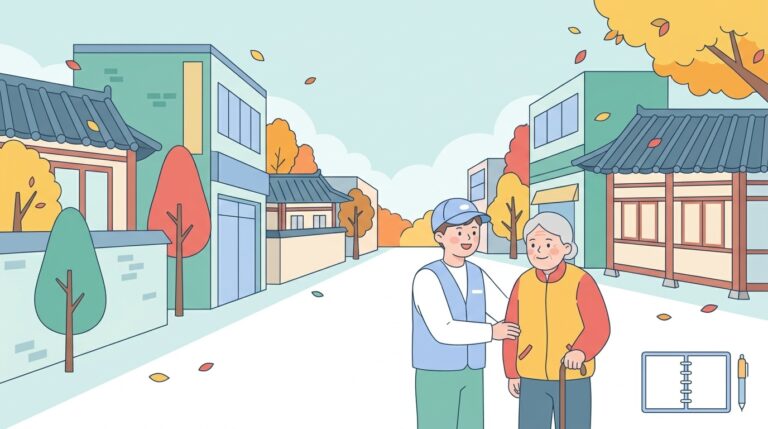
The Words Behind the Silence: How to Talk About Korean Welfare Blind Spots Like an Insider
Phase 1: Empathy (Story Immersion Opening)
안녕하세요! 매일한글 에디터입니다.
If you have watched the critically acclaimed K-drama My Mister (나의 아저씨) or Bong Joon-ho’s Parasite (기생충), you probably noticed an undercurrent of Korean society that rarely makes it into glossy travel brochures: the quiet, precarious lives lingering behind frosted glass in basement apartments (banjiha) and quiet semi-isolated alleyways. Many of our advanced learners tell us: “I can discuss business strategies and K-pop trends in Korean, but the moment a discussion turns to social safety nets or vulnerable neighbors, I feel like my vocabulary hits a brick wall.”
Addressing social inequality and welfare isn’t just about quoting cold government statistics. In Korea, speaking about those falling through the cracks requires a deeply nuanced balance of respect, discretion (nunchi), and genuine civic solidarity. When you master these C1-level expressions, you unlock the ability to discuss complex social issues with emotional intelligence, cultural sophistication, and dignity. This guide is crafted from real-world discussions with social workers and community activists across Seoul, giving you the real, living language needed to advocate, empathize, and comprehend the societal heartbeat of modern Korea.
Phase 2: Top 3 Core Expressions Deep-Dive
1. 복지 사각지대 (Bokji sagakjidae)
- Pronunciation: [Bok-ji sa-gak-ji-dae] (Think of ‘Bok’ like ‘Bawk’ in chicken, ‘ji’ like ‘jeep’, ‘sa-gak’ sounding like the start of ‘sarcasm’ + ‘gack’, and ‘ji-dae’ sounding like ‘jee-day’.)
- Meaning: Literally “Welfare Blind Spot.” It refers specifically to those vulnerable individuals or households who are desperately in need of social aid but are disqualified or overlooked by bureaucratic criteria.
- K-Culture Moment: Commonly featured on KBS or SBS investigative news specials highlighting isolated elderly citizens or single-parent families who fail official poverty thresholds by mere pennies.
- Editor’s Insight: Sagakjidae (사각지대) is an optical metaphor for the angle outside a vehicle’s mirrors. In welfare discourse, it highlights that the failure is systemic—the government’s radar simply missed them, not that they chose to be hidden.
- Situation Spectrum: Casual ⚠️ | Semi-formal ✅ | Formal ✅
- 🤔 Think About It: Does your native language view falling through the cracks as an individual slip or a systemic “blind spot” of the state?
2. 위기가구를 발굴하다 (Wigi-gagureul balgulhada)
- Pronunciation: [Wi-gi-ga-gu-reul bal-gul-ha-da] (Pronounce ‘Wi-gi’ like ‘wee-gee board’, ‘ga-gu’ like ‘gah-goo’, and ‘bal-gul’ like ‘bal’ in ballet + ‘ghoul’.)
- Meaning: Literally “To excavate/unearth households in crisis.” In practice, it means proactively searching for and identifying hidden individuals at high risk before tragedy strikes.
- K-Culture Moment: In public service campaigns by community welfare centers (Haengbok Bokji Center), where local milk-delivery workers or gas meter readers are trained to spot signs of crisis.
- Editor’s Insight: Notice the verb balgulhada (발굴하다), which usually means to excavate historical relics. Using it here conveys that vulnerable citizens are deeply buried beneath social isolation, requiring painstaking effort to uncover.
- Situation Spectrum: Casual 🚫 | Semi-formal ✅ | Formal ✅
- 🤔 Think About It: Why does Korean administrative language use an archaeological verb for community social work?
3. 온정의 손길을 내밀다 (Onjeong-ui son-gireul naemilda)
- Pronunciation: [On-jeong-ui son-gi-reul nae-mil-da] (Sounds like ‘On’ + ‘jeong’ rhyming with ‘sung’ + ‘son-gil’ like ‘son-gear’ + ‘nae-mil-da’.)
- Meaning: Literally “To extend the touch of warmhearted affection.” It describes extending practical, empathetic solidarity and financial/emotional support to someone in despair.
- K-Culture Moment: Used by community leaders and charity foundations during winter briquette-sharing (yeontan nanum) campaigns.
- Editor’s Insight: Onjeong (온정) is more intimate than mere institutional aid (jiwon). It combines emotional warmth (on) with affection (jeong), removing sterile bureaucracy and replacing it with human care.
- Situation Spectrum: Casual ⚠️ | Semi-formal ✅ | Formal ✅
- 🤔 Think About It: In your culture, does accepting help carry a social stigma, or is it framed as shared human warmth?
Phase 3: Textbook Korean vs. Real Korean
Situation 1: Reporting an isolated neighbor showing signs of distress
- 📖 교과서 한국어: 가난한 이웃이 있으니 정부가 도와주어야 합니다. (Gananhan iusi isseuni jeongbuga dowajueoya hamnida. / “There is a poor neighbor, so the government must help them.”)
- 🗣️ 진짜 한국어: 혼자 계신 어르신 댁에 며칠째 인기척이 없어서요, 복지 사각지대는 아닌지 지자체 확인이 시급해 보여요. (Honja gyesin eoreusin daege myeochiljae ingicheogi eopseoseoyo, bokji sagakjidaeneun aninji jijache hwagini sigeubhae boyeoyo. / “There hasn’t been any sign of life from the elderly neighbor living alone for days; it looks urgent for the local district to verify if they’ve fallen into a welfare blind spot.”)
- 💡 왜 다를까? Advanced native speakers avoid blunt and potentially patronizing terms like gananhan (poor). Instead, they describe observable physical realities (ingicheogi eopda – no signs of presence) and evoke administrative mechanisms politely.
Situation 2: Advocating for community-led outreach programs
- 📖 교과서 한국어: 우리는 도움이 필요한 사람을 많이 찾아야 합니다. (Urineun doumi piryohan sarameul mani chajaya hamnida. / “We need to find many people who need help.”)
- 🗣️ 진짜 한국어: 주민센터 행정력만으로는 한계가 있으니, 이웃 간의 촘촘한 연결망으로 위기가구를 조기에 발굴해야 합니다. (Juminssenteo haengjeongnyeongmaneuroneun hangyega isseuni, iut gane chomchomhan yeongyeolmangeuro wigigagureul jogie balgulhaeya hamnida. / “Since the administrative capacity of the community center has its limits, we must identify households in crisis early through a tight-knit network between neighbors.”)
- 💡 왜 다를까? C1 Korean utilizes systemic policy terminology like chomchomhan yeongyeolmang (dense/tightly-knit safety network) and jogi balgul (early identification) to articulate structured civic solutions.
Phase 4: K-Culture Deep Dive & Non-Verbal Etiquette
4-1. 눈치 (Nunchi) & Gestures: Respecting the Jajonsim (Pride)
When engaging with welfare topics or visiting low-income neighborhoods in Korea (such as hillside daldongne or rooming houses called jjokbangchon), non-verbal etiquette is critical:
* Lower Your Gaze and Avoid Gawking: Never stare at entryways, meters, or domestic clutter. Direct staring infringes upon a person’s dignity (jajonsim).
* The Two-Handed Handover: If delivering supplies or assisting a social worker, always hand over boxes, brochures, or items with both hands, accompanied by a modest bow (around 15 to 30 degrees).
* Circumspect Inquiries: Avoid asking directly, “Are you living on basic livelihood assistance?” (기초수급자이세요?). Instead, ask softly: “혹시 생활하시면서 행정적인 지원이나 도움이 필요하신 부분은 없으신지요?” (Hoksi saenghwalhasimyeonseo haengjeongjeogin jiwonina doumi piryohasin bubuneun eopseusinjiyeo? / “By any chance, as you manage daily life, might there be areas where administrative support or assistance is needed?”).
4-2. Cultural Code Analysis: The “Yakult Lady” and Gas Inspector Safety Net
In modern Korea, combating welfare blind spots has evolved beyond government desks into hyper-local community partnerships. For example, local districts contract Yakult Ladies (Hy fresh managers) and urban gas meter inspectors. Because these workers visit door-to-door regularly, they notice when milk bottles pile up or mail overflows. This mirrors the enduring traditional ethos of Sangbusangjo (상부상조, mutual aid) transposed onto modern urban logistics, turning delivery workers into front-line guardians of social welfare.
Phase 5: Real-Life Roleplay Scenario
Setting: Inside a quiet, busy neighborhood Community Service Center (Haengbok Bokji Center). Sunlight filters through window blinds covered in community welfare flyers.
Characters:
* Park Min-woo (30s): An earnest, empathetic community social worker carrying a clipboard.
* You: A vigilant resident advocating on behalf of an isolated elderly neighbor.
- Park Min-woo: 🎭 Adjusts his glasses and looks up with a warm, attentive posture.
어떤 용무로 찾아오셨습니까? 편하게 말씀해 주세요.
(Eotteon yongmuro chajaosyeotseumnikka? Pyeonhage malsseumhae juseyo.)
“What brings you in today? Please, feel free to speak comfortably.” -
You: 🎭 Speaking with quiet, deliberate concern.
저희 다세대주택 아랫집 어르신 일로 상담을 좀 드리고 싶어서요.
(Jeohui dasedaejutaek araetjip eoreusin illo sangdameul jom deurigo sipeoseoyo.)
“I’d like to consult with you regarding the elderly person living downstairs in our multi-family building.” -
Park Min-woo: 🎭 Leaning forward, his expression turning serious.
네, 혹시 어르신 신변에 어떤 우려되는 점이라도 발견하셨나요?
(Ne, hoksi eoreusin sinbyeone eotteon uryo-doeneun jeomirado balgyeonhasyeonnayo?)
“Yes, have you observed any points of concern regarding their well-being?” -
You: 🎭 Lowering your tone respectfully.
우편함에 독촉장이 쌓이고 며칠째 식사도 제대로 못 챙기시는 것 같아 복지 사각지대에 놓이신 게 아닌가 걱정됩니다.
(Upyeonhame dokchokjangi ssahigo myeochiljae sikdado jedaero mot chaenggisineun geot gata bokji sagakjidaee noisin ge aninga geokjeongdoemnida.)
“Payment demands are piling up in the mailbox and it seems they haven’t eaten properly for days; I’m deeply worried they might be caught in a welfare blind spot.” -
Park Min-woo: 🎭 Nods earnestly while taking notes on his case sheet.
이웃분께서 세심하게 살펴주셨군요. 혹시 가족분들과의 왕래는 전혀 없으신가요?
(Iutbunkkeseo sesimhage salpyeojusyeotgunyo. Hoksi gajokbundeulgwaui wangraeneun jeonhyeo eopseosingayo?)
“You have observed your neighbor very meticulously. Is there any contact with family members at all?” -
You: 🎭 Shaking your head gently.
단절된 지 오래된 것 같습니다. 공적 지원을 받으실 수 있도록 현장 방문을 부탁드려도 될까요?
(Danjeoldoen ji oraedoen geot gatseumnida. Gongjeok jiwoneul badeusil su itdorok hyeonjang bangmuneul butakdeuryeodo doelkkayo?)
“It seems contact was severed long ago. May I request an on-site home visit so they might receive official public support?” -
Park Min-woo: 🎭 Stands up and taps the paper decisively.
알려주셔서 진심으로 감사드립니다. 긴급복지지원 대상이 될 수 있으니 오늘 오후에 즉시 찾아뵙겠습니다.
(Allyeojusyeoseo jinsimeuro gamsadeurimnida. Gingeupbokjijiwon daesangi doel su isseuni oneul ohue jeuksi chaja-boepgetseumnida.)
“Thank you sincerely for letting us know. They may qualify for emergency welfare support, so I will visit them this afternoon immediately.” -
You: 🎭 Bowing slightly with gratitude.
바쁘신 와중에도 신속하게 신경 써 주셔서 정말 마음이 놓입니다.
(Bappeusin wajung-edo sinsokhage singyeong sseo jusyeoseo jeongmal maeumi noimnida.)
“I feel so relieved that you are looking into this promptly despite your busy schedule.”
🔀 Interactive Branching Point
How would you respond if the official tells you the neighbor technically exceeds the legal asset threshold for welfare assistance?
- Option A: “법적으로 안 되면 어쩔 수 없죠. 신경 쓰지 않겠습니다.” (Beopjeogeuro an doemyeon eojjeol su eopjyo. Singyeong sseuji anketseumnida. / “If it’s illegal, nothing can be done. I won’t bother.”)
- Feedback (Bad): Abruptly abandons the neighbor and reflects an apathetic attitude toward civic advocacy.
- Option B: “왜 법이 그 모양입니까? 당장 공무원들이 돈을 모아서 도와줘야 하는 거 아닙니까?” (Wae beobi geu moyang-imnikka? Dangjang gongmuwondeuri doneul moaseo dowajwoya haneun geo animnikka? / “Why is the law like that? Shouldn’t civil servants pool money right now to help?”)
- Feedback (Risk): Overly aggressive, displays misunderstanding of civil service roles, and halts productive collaboration.
- Option C: “서류상 기준에 부합하지 않더라도, 민간 후원 연계나 긴급 구호 바우처 같은 대안적 지원책이 있을까요?” (Seoryusang gijune buhap-haji anteorado, mingan huwon yeongyena gingeup guho baucheo gateun daeanjeok jiwonchaegi isseulkkayo? / “Even if they do not meet the paper criteria, might there be alternative support measures such as private sponsor connections or emergency relief vouchers?”)
- Feedback (Best!): Highly sophisticated C1 strategic response that works within the system to locate alternative remedies without causing conflict.
Phase 6: 10-Second Emotional Shadowing Drill
Read the following sentences aloud. Pay strict attention to the emotional tags and pauses marked by /.
[🥺 따뜻하고 조심스럽게]
우편물이 / 오랫동안 쌓여 있어서 / 혹시 무슨 일이라도 생기신 건 아닌지 / 걱정스러워 찾아왔습니다.
(Upyeonmuri / oraedong-an ssahyeo isseoseo / hoksi museun irirado saenggisin geon aninji / geokjeongseoreowo chajawasseumnida.)
“Mail has been piling up for a while / so I stopped by out of concern / wondering if something might have happened.”-
[🤝 단호하고 진정성 있게]
제도적 기준만 따질 것이 아니라 / 실질적인 위기 상황에 처한 분들에게 / 온정의 손길이 먼저 닿아야 합니다.
(Jedojeok gijunman ttajil geosi anira / siljiljeogin wigi sanghwang-e cheohan bundeurege / onjeong-ui son-giri meonjeo dahaya hamnida.)
“Rather than solely weighing bureaucratic criteria / to those facing genuine crises / a warm helping hand must reach them first.”
Phase 7: K-Culture Mini Dictionary
- 고독사 (Godoksa) | Solitary Death
- The tragedy of a person dying alone and unobserved, often discovered days or weeks later. A major focus of modern Korean urban welfare policies.
- 취약계층 (Chwiyak-gyecheung) | Vulnerable Social Groups
- Encompasses low-income households, disabled individuals, isolated seniors, and youths who lack sufficient social or financial buffers.
- 긴급복지지원 (Gingeup bokji jiwon) | Emergency Welfare Support System
- A fast-track national mechanism designed to inject living, medical, or housing subsidies prior to detailed audits when sudden crisis (illness, death, fire) hits.
- 촘촘한 사회 안전망 (Chomchomhan sahoe anjeonmang) | Dense Social Safety Net
- An evocative public policy term describing an airtight community network that prevents vulnerable individuals from slipping through bureaucratic cracks.
Phase 8: Traveler’s Survival Kit
Survival Expressions TOP 3
- 도움이 필요해 보입니다. (Doumi piryohae boimnida.)
- Pro Tip: Use this to notify a train attendant or police officer if you encounter someone collapsed or unresponsive in public spaces.
- 복지 상담을 받고 싶습니다. (Bokji sangdameul batgo sipeoseumnida.)
- Pro Tip: Use this at any local Eup/Myeon/Dong Community Welfare Center counter to ask for welfare advisory services.
- 긴급 지원 문의는 어디로 하나요? (Gingeup jiwon munuineun eodiro hanayo?)
- Pro Tip: Ideal when directing someone facing imminent eviction or starvation to the proper department.
Editor’s Travel Note
- Essential Helpline Numbers: Dial 129 (Ministry of Health and Welfare Call Center) or 120 (Dasan Call Center in Seoul, multi-language support available) for emergency social support.
- Digital Tool: You can install and explore the Download Bokjiro Official App on Google Play to examine how the Korean government categorizes hundreds of customized welfare services.
Phase 9: “One Step Deeper” (Reflective Essay)
In classical agrarian Korea, survival relied on Dure (두레, communal labor pooling) and Pumasi (품앗이, reciprocal labor exchange). If a neighbor’s roof collapsed, the village repaired it without asking for an invoice; to leave a neighbor helpless brought collective shame upon the village (maeul). Today, as rapid urbanization transforms traditional neighborhoods into high-rise apartment complexes, that instinctive safety net faces fragmentation. The contemporary struggle over bokji sagakjidae is essentially modern Korea’s legal and emotional effort to codify the ancient warmth of Jeong (정) into municipal codes.
💬 Your Turn: In your home country, how are isolated neighbors noticed? Does community action precede government policy, or is it the other way around? Leave a comment below and share your perspective!
Phase 10: FAQ & Avoiding Misunderstandings
Q: Can foreign residents in Korea apply for or report welfare blind spot support?
A: Yes. While certain long-term livelihood grants require Korean citizenship or permanent residency (F-5) / marriage immigration status (F-6), foreign nationals residing in Korea can be eligible for emergency medical treatment and humanitarian aid through district offices. Anyone, regardless of visa status, can report an endangered neighbor.
Q: What is the exact difference between 기초수급자 and 차상위계층?
A: Gicho sugeupja (기초생활수급자) refers to Basic Livelihood Security recipients who fall below 30–50% of the median income and receive direct state subsidies. Chasangwi-gyecheung (차상위계층) refers to the near-poverty bracket (just above the baseline, up to 50% of median income); they do not receive direct cash payouts but qualify for reductions in health insurance, utilities, and school fees.
Q: Is it considered offensive to report a neighbor to the Community Welfare Center?
A: Not if done discreetly. It is considered an act of civic responsibility (simin uisik). Community centers investigate gently under the guise of regular neighborhood wellness checks so the resident does not feel publicly shamed.
🚨 Common Mistakes Alert
- Mistake: Using “가난한 사람” (poor person) to refer to someone facing hardship.
- Correct Action: Use respectful sociological terms like “취약계층” (vulnerable demographic) or “어려움을 겪고 계신 이웃” (neighbors experiencing hardship).
- Mistake: Saying “신고하다” (report/inform on someone) when requesting welfare assistance.
- Correct Action: Singo implies reporting a crime. Use “제보하다” (provide information), “연계하다” (connect with resources), or “도움을 요청하다” (request assistance).
- Mistake: Pushing cash directly into an elderly neighbor’s hand on the street.
- Correct Action: This can wound personal dignity. Channel support through local food banks, community centers, or by offering pre-packaged food politely.
Phase 11: Action Mission & Engagement
- 🥉 Bronze Mission (Solo Mastery): Practice saying the Phase 6 Shadowing Drill 3 times aloud, maintaining an earnest and respectful intonation.
- 🥈 Silver Mission (Social Sharing): Write a 2-sentence post on your social media or language exchange app about a social issue in your city using the term 복지 사각지대.
- 🥇 Gold Mission (Real Application): Search the Korean portal Naver News for the search term “복지 사각지대 발굴” and read one editorial, noting three institutional words used.
- 🎮 K-Culture Mission: Watch Episode 1 or 2 of the drama Move to Heaven (무브 투 헤븐: 나는 유품정리사입니다) on Netflix and identify how the drama portrays forgotten social lives.
Phase 12: Interactive Quiz Challenge
1. Situational Judgment
You notice an elderly resident in your villa who has had water utility cutoff notices pasted on their door for two months. Which Korean phrase is most appropriate when contacting the local Haengbok Bokji Center?
* A) 아랫집에 돈 없는 사람이 있으니 돈 좀 주세요.
* B) 이웃집에 단수 고지서가 붙어 있어 위기가구로 우려되니, 복지 상담 연계를 부탁드립니다.
* C) 주민이 규칙을 안 지켰으니 단속해 주십시오.
2. Fill-in-the-Blank
“제도권 밖에서 고통받는 이웃들을 위해 우리 사회의 촘촘한 사회 ( )(이)가 절실합니다.”
3. True / False Cultural Check
In Korea, reporting a struggling neighbor to local authorities without their prior consent is considered illegal under privacy laws. (True / False)
👉 Click to reveal Quiz Answers & Explanations!
- Answer: B
- Explanation: Choice B employs dignified, systemic vocabulary (wigi-gagu, bokji sangdam yeon-gye) without humiliating the resident or using crude language.
- Answer: 안전망 (Anjeonmang – Safety Net)
- Explanation: The combination chomchomhan sahoe anjeonmang (촘촘한 사회 안전망) is the standard high-level idiom for a dense, protective social safety net.
- Answer: False
- Explanation: Reporting an at-risk neighbor to municipal welfare authorities is legally protected and encouraged under the “Act on the Identification and Support of Crisis Households” to prevent solitary deaths.
- Explanation: Reporting an at-risk neighbor to municipal welfare authorities is legally protected and encouraged under the “Act on the Identification and Support of Crisis Households” to prevent solitary deaths.







