

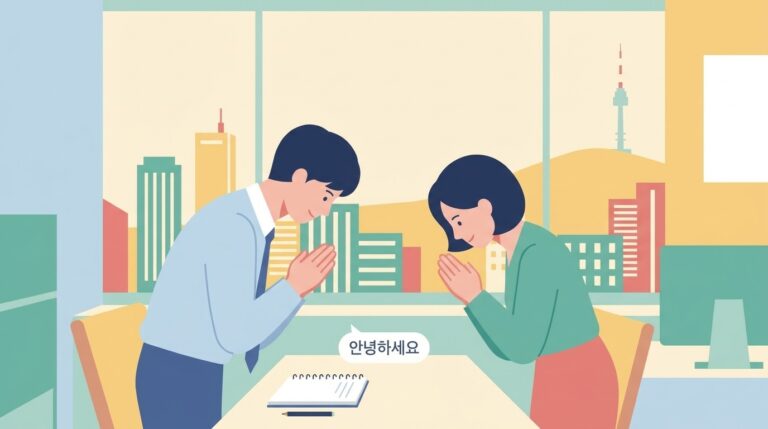
Phase 1: Empathy (Relatable K-Culture Opening)
안녕하세요! 매일한글 에디터입니다. (Hello! This is your Daily Hangul editor.)
Picture this: You are working at a trendy marketing agency in Seongsu-dong, or perhaps you just forgot an important dinner plan with your close Korean friend in Hongdae. You freeze, your heart drops, and you quickly mutter, “죄송합니다 (Joesonghamnida / I am sorry).” But then, an awkward silence settles in. In K-dramas like Misaeng or Start-Up, have you noticed what happens when a rookie makes a mistake? A simple apology is never the final line of the conversation. The supervisor or friend subtly tilts their head, waiting for that one crucial follow-up: What are you going to do to ensure this never happens again?
Many intermediate Korean learners hit a wall here. You know how to apologize, but you feel tongue-tied when trying to express genuine determination not to repeat the blunder. Saying only “I’m sorry” can unintentionally sound like you are dodging responsibility or merely waiting for the scolding to end. Today, based on real experiences from our learners and cultural insights from Seoul office life, we are unlocking the exact phrases and non-verbal nuances that turn an embarrassing mistake into a powerful moment of trust and connection. Let’s master the art of the sincere Korean comeback!
Phase 2: Top 3 Core Expressions in Depth
Here are three essential expressions tailored for different social dynamics when you need to promise, “I won’t let this happen again.”
1. 다음부터는 정말 조심하겠습니다
- Pronunciation: [Daeum-buteoneun jeongmal josim-hagesseumnida] (Sounds like: Dah-eum boo-tuh-noon jung-mahl jo-sheem-hah-gehk-seum-nee-dah)
- Meaning: Literally: “From next time, I will truly be careful.” | Real Nuance: “I take this mistake seriously, and I will ensure extra caution moving forward.”
- K-Culture Moment: The quintessential K-drama workplace line. Think of a young associate in Hospital Playlist or Agency receiving constructive criticism from a mentor and standing upright with a respectful, resolute demeanor.
- Editor’s Insight: The marker -부터는 (-buteoneun) emphasizes a clear boundary: the past mistake ends here, and starting from the next instance, your behavior changes.
- Situation Spectrum: Casual: 🚫 | Semi-formal: ⚠️ | Formal: ✅
- 🤔 Think About It: In Korean workplace culture, does acknowledging caution openly show vulnerability, or does it signal professional maturity and teachability?
2. 두 번 다시 이런 일 없도록 할게요
- Pronunciation: [Du beon dasi ireon il eopdorok halgeyo] (Sounds like: Doo buhn dah-shee ee-ruhn eel up-doh-rohk hal-geh-yo)
- Meaning: Literally: “I will make sure there is no such event a second time.” | Real Nuance: “I promise you this will never happen again.”
- K-Culture Moment: Frequently heard in friendship reconciliations or romance dramas (Twenty-Five Twenty-One) after breaking a promise or causing worry to someone dear.
- Editor’s Insight: The phrase 두 번 다시 (du beon dasi) translates directly to “a second time again,” functioning just like “never again” with heightened emotional weight.
- Situation Spectrum: Casual: ⚠️ (change to 할게) | Semi-formal: ✅ | Formal: ⚠️
- 🤔 Think About It: Notice how “두 번” (twice) sets a quantitative limit on failure—what does this reveal about the value placed on learning quickly from initial errors?
3. 내가 앞으로 진짜 더 잘할게
- Pronunciation: [Naega apeuro jinjja deo jalhalge] (Sounds like: Neh-gah ah-peu-roh jeen-jjah duh jal-hal-geh)
- Meaning: Literally: “I will do truly better forward.” | Real Nuance: “I messed up, but I promise to do so much better from now on.”
- K-Culture Moment: An intimate, heartfelt scene between best friends or dating partners sharing late-night pojangmacha street food, looking directly into each other’s eyes.
- Editor’s Insight: 앞으로 (apeuro) means “into the future.” It softens tension and transforms a moment of guilt into proactive affection.
- Situation Spectrum: Casual: ✅ | Semi-formal: 🚫 | Formal: 🚫
- 🤔 Think About It: Why does casual Korean prioritize personal commitment (“내가 더 잘할게”) over strict legalistic promises between close companions?
Phase 3: Textbook Korean vs. Real-World Korean
Situation 1: At Work After Missing a Project Detail
- 📖 교과서 한국어 (Textbook Korean): 저는 같은 실수를 반복하지 않겠습니다. (Jeoneun gateun silseureul banbokhaji ankkesseumnida. – “I shall not repeat identical mistakes.”)
- 🗣️ 진짜 한국어 (Real-World Korean): 다음에는 미리 두 번 세 번 체크해서 이런 일 없게 하겠습니다. (Daeumeneun miri du beon se beon chekeuhaeseo ireon il eopge hagesseumnida. – “Next time, I’ll double and triple-check in advance so this doesn’t happen.”)
- 💡 왜 다를까? (Why the Difference?): Textbook phrasing sounds like an automated legal disclaimer. Real Korean superiors want to hear your concrete action plan (checking 2–3 times) rather than abstract philosophical promises.
Situation 2: Forgetting a Meetup with a Close Friend
- 📖 교과서 한국어 (Textbook Korean): 다시는 약속을 잊지 않겠다고 맹세합니다. (Dasineun yaksogeul itji ankketdago maengsehapnida. – “I swear that I shall never forget an appointment again.”)
- 🗣️ 진짜 한국어 (Real-World Korean): 헐, 내가 진짜 정신이 나갔었나 봐. 다음부턴 알람 맞춰둘게, 진짜 미안해! (Heol, naega jinjja jeongsini nagasseonna bwa. Daeumbuteon allam matchwodulge, jinjja mianhae! – “Omg, I must have lost my mind. I’ll set an alarm from now on, I’m so sorry!”)
- 💡 왜 다를까? (Why the Difference?): Saying “I swear” (맹세합니다) among friends sounds comically archaic and dramatic. Koreans express remorse to peers by acknowledging their momentary lapse (“정신이 나갔었나 봐”) and offering an instant, practical fix.
Phase 4: K-Culture Deep Dive & Non-Verbal Manners
4-1. 눈치 (Nunchi) & Body Language
When delivering a promise to improve, your physical stance speaks louder than your grammar:
* The 15-Degree Head Tilt: Never stare dead into the eyes of a Korean superior while promising not to repeat a mistake; it can be perceived as defiant. Lower your chin slightly, maintain your gaze toward their neck or chest area, and nod conscientiously.
* Two-Handed Posture: Keep both hands folded neatly in front of your lower torso (공수 자세, gongsu jase). Fidgeting with sleeves or having hands in pockets instantly destroys sincerity.
* Timing Your Response: Wait until the other person finishes their entire critique before speaking. Cutting them off with an immediate “I know, I won’t do it again” shows a lack of nunchi (situational awareness).
4-2. Cultural Code: The Philosophy of 반성 (Banseong – Self-Reflection)
In Korean society, making an error is often viewed not merely as an isolated technical glitch, but as an opportunity to demonstrate your commitment to the collective group (jeong and teamwork). When you say you will not repeat a mistake, you are assuring the other person that their time spent guiding you was meaningful. In both corporate settings and interpersonal bonds, a person who accepts feedback gracefully and shows banseong is often trusted far more than someone who never makes mistakes at all.
Phase 5: Real-Life Roleplay Scenario
Setting: A design studio in Gangnam. Minho (an intermediate foreign team member) accidentally sent the unapproved draft to the client. Manager Park (박 팀장님), known for being meticulous but supportive, calls Minho to the conference table.
- Turn 1 (Manager Park): 민호 씨, 아까 거래처에 보낸 시안 확인해 봤어요? 아직 승인 안 난 파일이던데요.
(Minho-ssi, akka georaecheoe bonaen sian hwaginhae bwasseoyo? Ajik seung-in an nan pairideondeyo.)
“Minho, did you check the draft you sent to the client earlier? It was an unapproved file.”
🎭 Manager Park points calmly to the tablet screen with a furrowed brow. -
Turn 2 (Minho): 앗, 정말 죄송합니다! 제가 최종 버전을 헷갈렸습니다.
(At, jeongmal joesonghamnida! Jega choejong beojeoneul hetgallyeosseumnida.)
“Oh, I am truly sorry! I mixed up the final version.”
🎭 Minho immediately sets his coffee down, lowers his shoulders, and bows his head slightly. -
Turn 3 (Manager Park): 거래처에서 바로 연락 와서 당황했잖아요. 중요한 프로젝트인데 이런 실수가 나오면 곤란해요.
(Georaecheo-eseo baro yeollak waseo danghwanghaetjanayo. Jungyohan peurojekteu-inde ireon silsuga naomyeon gonranhaeyo.)
“The client called right away, so I was quite flustered. This is an important project, so errors like this are problematic.”
🎭 Manager Park sighs gently, crossing his arms. -
Turn 4 (Minho): 네, 팀장님 말씀이 맞습니다. 제 불찰입니다.
(Ne, timjangnim malsseumi matseumnida. Je bulchal-imnida.)
“Yes, you are completely right, Team Leader. It was my carelessness.”
🎭 Minho keeps both hands clasped neatly together. -
Turn 5 (Manager Park): 그래도 클라이언트 쪽에 수정 메일은 바로 보냈으니까 수습은 됐어요.
(Geuraedo keullai-eonteu jjoge sujeong meireun baro bonaesseunikka suseubeun dwaesseoyo.)
“Still, we sent the corrected email right away, so the damage is managed.”
🎭 Manager Park's tone softens slightly as he looks up. -
Turn 6 (Minho): 빠르게 수습해 주셔서 감사합니다. 다음부터는 파일 발송 전에 체크리스트를 꼭 재확인하겠습니다.
(Ppareuge suseubhae jusyeoseo gamsahamnida. Daeumbuteoneun pail balsong jeone chekeuriseuteureul kkok jaehwaginhagesseumnida.)
“Thank you for resolving it so quickly. From next time, I will make sure to double-check the checklist before sending any files.”
🎭 Minho speaks in a firm, sincere, and respectful tone. -
Turn 7 (Manager Park): 그래요. 실수할 수도 있죠. 같은 일만 반복되지 않게 신경 써 줘요.
(Geuraeyo. Silsuhal sudo itjyo. Gateun ilman banbokdoeji anke singyeong sseo jwoyo.)
“Right. Anyone can make a mistake. Just be mindful so the same issue isn’t repeated.”
🎭 Manager Park gives a reassuring nod. -
Turn 8 (Minho): 네! 두 번 다시 이런 일 없도록 각별히 주의하겠습니다.
(Ne! Du beon dasi ireon il eopdorok gakbyeolhi ju-uihagesseumnida.)
“Yes! I will take extraordinary care so that this never happens a second time.”
🎭 Minho performs a polite 30-degree bow before returning to his desk.
🔀 Interactive Choice Point
Imagine Manager Park pauses at Turn 3 and says, “What happened here?” What is your best response?
- Option A: “죄송해요. 그런데 메일 시스템 파일 이름이 너무 비슷해서 헷갈릴 수밖에 없었어요.” (I’m sorry. But the file names in the mail system were so similar that anyone would mix them up.)
- Option B: “죄송합니다, 팀장님! 제 불찰입니다. 다음부터는 발송 전에 파일명을 두 번 대조해서 이런 일 절대 없도록 하겠습니다.” (I apologize, Team Leader! It was my carelessness. From now on, I will cross-reference the file names twice before sending so this never happens.)
- Option C: “네, 알겠습니다. 이제 다시는 실수 안 해요.” (Yes, understood. I won’t make mistakes anymore now.)
Feedback:
* Option A (Bad): Making excuses (핑계, ping-gye) before fully accepting accountability ruins your professional credibility instantly.
* Option B (Best!): Perfect balance! You own the error, offer a direct procedural solution, and commit to zero reoccurrence.
* Option C (Risk): Overly blunt and grammatically informal. It sounds robotic and dismissive rather than sincerely penitent.
Phase 6: 10-Second Emotion Shadowing Drill
Practice these lines aloud! Follow the / pause markers and match the emotional guide.
- [🥺 진심 어린 반성과 다짐 / Sincere & Remorseful]
“다음부터는 / 정말 꼼꼼하게 확인하겠습니다. / 죄송합니다.”
(Daeumbuteoneun / jeongmal kkomkkomhage hwaginhagesseumnida. / Joesonghamnida.)
Focus: Drop pitch slightly at “죄송합니다” to convey authentic gravity. -
[🤝 단호하고 든든한 태도 / Resolute & Trustworthy]
“두 번 다시 / 이런 일 없도록 / 각별히 주의할게요!”
(Du beon dasi / ireon il eopdorok / gakbyeolhi ju-uihalgeyo!)
Focus: Emphasize “두 번 다시” with crisp pronunciation, ending “주의할게요” smoothly. -
[❤️ 따뜻하고 애정 어린 사과 / Warm & Affectionate Among Close Friends]
“내가 진짜 깜빡했어… / 다음엔 꼭 기억할게, / 앞으로 더 잘할게!”
(Naega jinjja kkamppakhaesseo… / Daeumen kkok gieokhalge, / apeuro deo jalhalge!)
Focus: Soften your breath on “깜빡했어” to express vulnerability.
Phase 7: K-Culture Mini Dictionary
- 각별히 (Gakbyeolhi) | Adverb: Especially / Exceptionally
Usage: Used in formal and business apologies to express heightened vigilance (e.g., “각별히 신경 쓰겠습니다” = “I will pay extraordinary attention”). - 재발 방지 (Jaebal Bangji) | Noun: Prevention of Recurrence
Usage: A standard corporate term in Korea when discussing measures taken so an error does not happen again. - 불찰 (Bulchal) | Noun: Carelessness / Oversight / Fault
Usage: A mature, highly respectful humble noun (e.g., “제 불찰입니다”) that elevates your professionalism instantly when admitting an error. - 수습하다 (Suseubhada) | Verb: To clean up / Resolve a mess
Usage: Commonly used in offices and daily life when dealing with the aftermath of an unintended error.
Phase 8: Traveler’s Survival Kit
When exploring Korea, small errors happen—like boarding the subway in the wrong direction or misunderstanding automated self-service kiosks at busy restaurants!
Survival Expressions TOP 3
- “제가 몰라서 실수했습니다. 다음부턴 조심할게요!”
(Jega mollaseo silsuhaesseumnida. Daeumbuteon josimhalgeyo!)
Pro Tip: Perfect when you accidentally tap the wrong transit card or breach etiquette in public places. - “제가 착각했어요, 다시 주문할게요.”
(Jega chakgakhaesseoyo, dasi jumunhalgeyo.)
Pro Tip: Use this at cafes if you accidentally ordered a hot beverage instead of iced (아이스). - “불편을 드려 죄송합니다.”
(Bulpyeoneul deuryeo joesonghamnida.)
Pro Tip: The golden polite line if you block someone’s way with heavy luggage on the escalator.
Editor’s Travel Note
If you find yourself lost or taking the wrong line on the Seoul subway, do not panic! You can immediately verify routes and exit information using the official Subway Korea application navigation guide. When asking station staff for help after passing through the wrong turnstile, politely say: “반대 방향으로 잘못 찍었어요. 도와주실 수 있나요?” (I tapped in the opposite direction. Could you assist me?) Staff are remarkably accommodating when you acknowledge the simple mix-up with a polite bow!
Phase 9: “한 발 더 깊이” (One Step Deeper)
In Western contexts, an apology often focuses on individual intent: “I didn’t mean to do it.” However, in Korean society, which values communal harmony and shared relational space (uri culture), personal intention matters far less than the disruption experienced by the other person. When you declare that you will never repeat the mistake, you are not merely engaging in self-flagellation; you are restoring emotional stability to the relationship. You are signaling: “Your peace of mind matters to me, and I will actively safeguard it in our next chapter.”
💬 Your Turn: Have you ever made a communication blunder in Korea or with Korean friends? Which expression would have saved your day? Drop your story in the comments below!
Phase 10: FAQ & Common Mistakes
Q: Can I use “두 번 다시 이런 일 없도록 할게요” with my university professor or CEO?
A: It is slightly casual for top executives or senior professors. For extremely formal figures, upgrade the verb ending to the highest honorific: “두 번 다시 이런 일이 발생하지 않도록 각별히 유념하겠습니다” (Du beon dasi ireon iri balsaenghaji antorok gakbyeolhi yunyeomhagesseumnida).
Q: What is the difference between “조심하겠습니다” and “주의하겠습니다”?
A: Both mean to be careful! However, 조심하다 (josimhada) is a native Korean word suitable for physical caution and general daily work, while 주의하다 (ju-uihada) is Hanja-based (注意) and sounds more technical, analytical, and formal in written reports or structured corporate reviews.
Q: Does saying “앞으로 잘할게” sound romantic?
A: It can be! While friends use it casually, it is also a classic romantic line after a couple’s quarrel, expressing affectionate dedication to the relationship’s longevity.
🚨 Common Mistakes (흔한 실수) Warning Board
- Mistake: Saying “미안해요 (Mianhaeyo)” to your boss or senior team leader.
Correct Action: Always use “죄송합니다 (Joesonghamnida)”. Mianhaeyo sounds disrespectful in hierarchical contexts. - Mistake: Offering excuses before stating your intention not to repeat the mistake.
Correct Action: Apologize and state your future precaution first; explain context only if explicitly asked “왜 그렇게 됐어요?”. - Mistake: Smiling awkwardly to lighten the mood during a serious apology.
Correct Action: Keep your facial expression serene and composed. In Korea, nervous smiling during apologies is easily misinterpreted as insincere.
Phase 11: Action Mission & Community Engagement
- 🥉 Bronze Mission: Stand in front of your mirror and practice saying “다음부터는 각별히 조심하겠습니다” with the 15-degree head tilt 5 times.
- 🥈 Silver Mission: Write a one-sentence Korean promise in the comments below about a habit you want to break this year (e.g., “다음부터는 늦잠 자지 않겠습니다!”).
- 🥇 Gold Mission: The next time a Korean colleague, teacher, or language exchange partner corrects your pronunciation, respond with: “지적해 주셔서 감사합니다. 다음부터는 신경 써서 발음할게요!”
- 🎮 K-Culture Media Mission: Watch one episode of an office K-drama (like Misaeng or King the Land) and see if you can spot characters uttering “조심하겠습니다” or “신경 쓰겠습니다”!
Phase 12: Interactive Quiz Challenge
Test what you have absorbed today! Click each section to reveal the answers and detailed cultural insights.
Quiz 1. Situation Judgment
You forgot to bring the contract to an important client lunch with your director. Which sentence best demonstrates your resolve not to repeat this mistake without sounding impolite?
1. “어쩔 수 없네요. 다음엔 가져올게요.”
2. “제 불찰입니다. 다음부터는 출발 전 체크리스트를 확인해 두 번 다시 이런 일 없도록 하겠습니다.”
3. “다시는 안 잊어버린다고 맹세할게!”
👉 Click to view Answer & Explanation
Correct Answer: 2
Explanation: Option 2 demonstrates humility (제 불찰입니다), gives a preventative measure (체크리스트 확인), and concludes with high-level professional resolve. Option 1 is dismissive, and Option 3 uses low-level casual speech (반말) inappropriate for a director.
Quiz 2. Fill-in-the-Blank
Complete the sentence to mean: “I will take exceptional care so there won’t be such an issue moving forward.”
* “앞으로 이런 일 없도록 _______ 주의하겠습니다.”
👉 Click to view Answer & Explanation
Correct Answer: 각별히 (gakbyeolhi)
Explanation: The adverb 각별히 perfectly collogates with 주의하겠습니다 or 신경 쓰겠습니다 in intermediate-advanced formal apologies.
Quiz 3. True or False Cultural Insight
“When apologizing to a supervisor in Korea, holding direct eye contact throughout the entire conversation signals absolute honesty and confidence.” (True / False)
👉 Click to view Answer & Explanation
Correct Answer: False
Explanation: In Korean non-verbal etiquette, unblinking direct eye contact during an apology can be perceived as confrontational or lacking remorse. Lowering your gaze slightly conveys respect and modest reflection (반성).







