

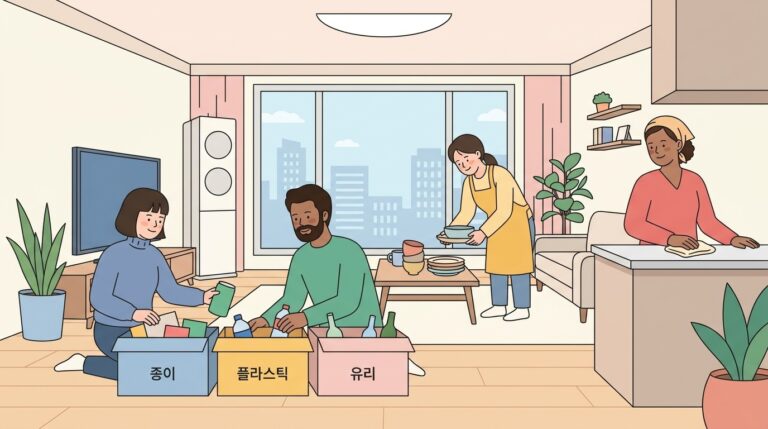
Master the Art of Helping Clean Up at a Korean Housewarming
Phase 1: Empathy (Real-World Story)
안녕하세요! 매일한글 에디터입니다. (Hello! This is your Daily Hangul editor.)
Picture this classic scene from an everyday K-drama: You are sitting on a cozy floor rug around a low table packed with bossam (boiled pork slices), fried chicken, and side dishes. You just spent two delightful hours celebrating your Korean friend’s new apartment for their 집들이 (Jip-deu-ri, housewarming party). Everyone is full, laughing, and satisfied.
Then, the atmosphere subtly shifts. Your host stands up and begins stacking paper cups, takeout lids, and bowls, walking back and forth to the tiny kitchen sink. You freeze. A wave of social panic washes over you:
Should I jump up and grab a sponge? What if they think I am intruding into their private kitchen? But if I just sit here looking at my phone, will I look like an inconsiderate, entitled guest?
If you have ever experienced this exact dilemma, take a deep breath. You are not alone! Over the past ten years coaching international learners in Korea, I have seen dozens of sweet, polite students freeze in this very moment. When you try to offer help, your host almost certainly waves their hands and says, “아니에요! 그냥 앉아 계세요!” (No, really! Just sit and relax!). Navigating this delicate social dance is one of the ultimate tests of Korean friendship.
By mastering the exact phrases and etiquette in this guide, you will transform from an awkward onlooker into an attentive, beloved friend who understands the subtle art of Korean hospitality.
Phase 2: Core Expressions Deep Dive
Here are the three golden phrases you need to offer help smoothly without making your host uncomfortable.
1. 제가 치우는 거 도와드릴게요! (Je-ga chi-u-neun geo do-wa-deu-ril-ge-yo!)
- Pronunciation: [Je-ga chi-u-neun geo do-wa-deu-ril-ge-yo] (Sounds like: “Je-gah chee-oo-neun guh doh-wah-deu-reel-geh-yo” — say ‘geo’ softly like the first syllable of ‘gullible’.)
- Meaning: Literal: “I will help with the clearing/cleaning!” | Real Nuance: “Here, let me give you a hand clearing things up!”
- K-Culture Moment: You will hear this constantly on lifestyle reality shows like I Live Alone (나 혼자 산다) whenever castmates visit a member’s studio flat.
- Editor’s Insight: Using ~드릴게요 (~deu-ril-ge-yo) shows humble politeness while showing active initiative. It is warm, polite, and doesn’t sound pushy.
- Situation Spectrum: Casual: ⚠️ (too formal for childhood buddies) | Semi-formal: ✅ (Perfect for peers, colleagues, friends) | Formal: ✅
- 🤔 Think About It: In English, “Do you need help?” invites a yes/no answer. Why does stating your intention affirmatively (“I will help you”) feel more caring in Korean collectivist culture?
2. 이건 어디에 둘까요? (I-geon eo-di-e dul-kka-yo?)
- Pronunciation: [I-geon eo-di-e dul-kka-yo] (Sounds like: “Ee-gun uh-dee-eh dool-kkah-yoh” — ‘dul’ rhymes with ‘bull’.)
- Meaning: Literal: “Where shall I place this?” | Real Nuance: “Where should I put this plate / trash?”
- K-Culture Moment: Seen in family weekend dramas whenever in-laws or guests bring dirty dishes to the kitchen counter without overstepping into the host’s organized cupboards.
- Editor’s Insight: A guest should never blindly put items away into unfamiliar cabinets. Asking this phrase shows respect for the host’s private domestic organization.
- Situation Spectrum: Casual: ⚠️ (use ‘어디에 둘까?’) | Semi-formal: ✅ | Formal: ✅
- 🤔 Think About It: How does asking where an object belongs protect both the host’s personal boundaries and the guest’s desire to help?
3. 분리수거는 제가 할게요! (Bun-ri-su-geo-neun je-ga hal-ge-yo!)
- Pronunciation: [Bun-ri-su-geo-neun je-ga hal-ge-yo] (Sounds like: “Boon-nee-soo-guh-neun jeh-gah hal-geh-yoh” — note: ‘bun-ri’ assimilates into ‘bun-ni’.)
- Meaning: Literal: “As for recycling, I will do it!” | Real Nuance: “Let me take care of sorting the recyclables!”
- K-Culture Moment: In food travel vlogs and campus dorm reality shows, whoever offers to carry out the recycling bags is instantly crowned the most popular roommate.
- Editor’s Insight: Korean recycling is remarkably strict. Sorting plastic cups, aluminum cans, and delivery boxes is a heavy chore; volunteering for this specific task makes you an instant hero.
- Situation Spectrum: Casual: ✅ (just change to ‘내가 할게’) | Semi-formal: ✅ | Formal: ✅
- 🤔 Think About It: Why is sharing tedious communal labor considered a deeper expression of friendship in Korea than giving lavish material gifts?
Phase 3: Textbook Korean vs. Real Korean
Let us compare stiff classroom phrases with the natural language locals actually use.
Situation 1: Offering to carry plates from the table to the sink
- 📖 교과서 한국어 (Textbook): 식기 세척을 돕겠습니다. (Sik-gi se-cheog-eul dop-get-seum-ni-da.) — “I shall assist with the ware-washing.”
- 🗣️ 진짜 한국어 (Real-life): 그릇 싱크대로 옮겨 드릴게요! (Geu-reut sing-keu-dae-ro om-gyeo deu-ril-ge-yo!) — “I’ll move the dishes to the sink for you!”
- 💡 왜 다를까? (Why is it different?): Textbook phrasing sounds like an industrial hotel banquet contract. Native speakers name specific, modest tasks (like moving plates) so the host does not feel burdened.
Situation 2: Asking if an empty cardboard container can be thrown away
- 📖 교과서 한국어 (Textbook): 이것을 폐기 처분해도 됩니까? (I-geos-eul pye-gi cheo-bun-hae-do doep-ni-kka?) — “Is it permissible to scrap/dispose of this item?”
- 🗣️ 진짜 한국어 (Real-life): 이거 그냥 버리면 돼요? (I-geo geu-nyang beo-ri-myeon dwae-yo?) — “Can I just toss this out?”
- 💡 왜 다를까? (Why is it different?): The term 폐기 (pye-gi) belongs in municipal waste management reports. Everyday conversations rely on the simple, clear verb 버리다 (beo-ri-da, to throw away).
Phase 4: K-Culture Deep Dive & Non-Verbal Manners
4-1. The Art of 눈치 (Nunchi) & The 2-Step Refusal Dance
When you offer to clean up, a Korean host will almost certainly say:
“괜찮아요! 손님인데 그냥 편하게 계세요!” (It’s totally fine! You are a guest, just relax!)”
Do not take this first refusal literally! This is the cultural ritual of 사양 (Sa-yang, polite refusal). If you immediately sit back down on the sofa, you may seem cold. Here is the local formula:
1. The First Decline: The host insists you rest.
2. The Counter-Offer: Stand up, pick up one or two empty bottles or cups, smile, and say: “에이, 같이 하면 금방 끝나요!” (Come on, it will finish in a flash if we do it together!).
3. The Boundary Line: If the host gently blocks the sink and refuses three times, step back and say “그럼 분리수거만 모아둘게요” (Then I’ll just gather the recycling). Never rummage through private kitchen drawers without explicit permission!
4-2. Cultural Code: The High-Stakes World of 분리수거 (Recycling)
South Korea has one of the world’s most detailed residential waste separation systems. After a housewarming party with delivery food, you will encounter:
* 일반 쓰레기 (Il-ban sseu-re-gi): General trash (dirty napkins, wooden chopsticks).
* 플라스틱 / 캔 / 종이 (Plastic / Cans / Paper): Clean recyclables (must be rinsed free of food sauce).
* 음식물 쓰레기 (Eum-sing-mul sseu-re-gi): Food waste (animal-edible organic food only; chicken bones and clam shells go into general trash!).
Offering to rinse out the takeout containers before stacking them shows elite-level cultural literacy!
Phase 5: Real-World Roleplay Scenario
Setting: Minji’s newly rented studio apartment in Mapo-gu, Seoul. Dinner is finished, and empty containers sit on the floor table.
Characters:
* Alex (A2 Korean Learner): A considerate friend.
* Minji (Host): Proud of her new home, trying to be a generous host.
- Turn 1 (Minji): 휴, 배부르다! 다들 맛있게 먹었어요?
(Hyu, bae-bu-reu-da! Da-deul mat-it-ge meog-eot-seo-yo?)
“Phew, I’m stuffed! Did everyone enjoy the meal?”
🎭 Patting her stomach happily. -
Turn 2 (Alex): 네, 정말 맛있었어요! 잘 먹었습니다.
(Ne, jeong-mal mat-it-eot-seo-yo! Jal meog-eot-seum-ni-da.)
“Yes, it was delicious! Thank you for the wonderful meal.”
🎭 Clapping hands together politely. -
Turn 3 (Minji): 다행이에요. 제가 치울 테니까 편하게 TV 보고 계세요!
(Da-haeng-i-e-yo. Je-ga chi-ul te-ni-kka pyeon-ha-ge TV bo-go gye-se-yo!)
“What a relief. I will clean this up, so please relax and watch TV!”
🎭 Standing up and gathering plastic containers. -
Turn 4 (Alex): 에이, 아니에요! 제가 치우는 거 도와드릴게요.
(E-i, a-ni-e-yo! Je-ga chi-u-neun geo do-wa-deu-ril-ge-yo.)
“Oh, no way! Let me help you clear this up.”
🎭 Standing up alongside Minji and grabbing empty beverage cans. -
Turn 5 (Minji): 진짜 괜찮은데… 손님이잖아요!
(Jin-jja gwaen-chan-eun-de… son-nim-i-jan-a-yo!)
“Really, you don’t have to… you are my guest!”
🎭 Waving her hands with a shy smile. -
Turn 6 (Alex): 같이 하면 금방 끝나요. 이건 어디에 둘까요?
(Ga-chi ha-myeon geum-bang kkeut-na-yo. I-geon eo-di-e dul-kka-yo?)
“It finishes fast if we do it together. Where should I put these?”
🎭 Holding up the empty paper delivery bags neatly folded. -
Turn 7 (Minji): 고마워요, 알렉스! 그 종이백은 현관 문 앞에 놓아주세요.
(Go-ma-wo-yo, Al-rek-seu! Geu jong-i-baeg-eun hyeon-gwan mun ap-e noh-a-ju-se-yo.)
“Thank you so much, Alex! Please set those paper bags by the front door entrance.”
🎭 Pointing warmly toward the hallway. -
Turn 8 (Alex): 네, 알겠습니다! 분리수거는 제가 정리할게요.
(Ne, al-get-seum-ni-da! Bun-ri-su-geo-neun je-ga jeong-ri-hal-ge-yo.)
“Got it! I will organize the recyclables right here.”
🎭 Giving an energetic nod and lining up the bottles.
🔀 Interactive Decision Point
Minji steps toward the kitchen sink with a pile of greasy ramen pots. What do you do?
- Option A: Sit back down on the sofa, pull out your smartphone, and start scrolling social media in silence.
- Option B: Push past Minji, grab the kitchen sponge, open her cupboards to search for dish soap, and start washing her pots vigorously.
- Option C: Stand by the kitchen counter, neatly scrape table scraps into one designated food container, and wipe the dining table with a wet tissue.
Feedback:
* Option A (Bad): While Minji said she would handle it, totally disengaging after a home meal leaves an impression of indifference.
* Option B (Risk): Overstepping boundaries! In Korean homes, private cabinets and personal sink setups are considered intimate personal space. Digging through storage can make hosts uncomfortable.
* Option C (Best!): Perfect cultural balance! Clearing the communal table surface and organizing trash assists the host tremendously without intruding into private kitchen fixtures.
Phase 6: 10-Second Emotional Shadowing Drill
Read these sentences aloud. Pay attention to the pause slashes (/) and adopt the suggested emotion tags!
[🤝 Warm and insisting]
에이, / 아니에요! / 제가 치우는 거 / 도와드릴게요!
(E-i, / a-ni-e-yo! / Je-ga chi-u-neun geo / do-wa-deu-ril-ge-yo!)-
[😊 Cheerful and cooperative]
같이 하면 / 금방 끝나요! / 이건 / 어디에 둘까요?
(Ga-chi ha-myeon / geum-bang kkeut-na-yo! / I-geon / eo-di-e dul-kka-yo?) -
[💪 Confident and reassuring]
분리수거는 / 저한테 맡기세요, / 제가 다 할게요!
(Bun-ri-su-geo-neun / jeo-han-te mat-gi-se-yo, / je-ga da hal-ge-yo!)
Phase 7: K-Culture Mini Dictionary
-
집들이 (Jip-deu-ri) | Housewarming Party
Literally “entering the home.” Traditionally celebrated by gifting toilet paper (wishing wealth unravels smoothly) or laundry detergent (wishing prosperity bubbles up). -
분리수거 (Bun-ri-su-geo) | Waste Sorting / Recycling
The categorized separation of household garbage. One of the primary shared household responsibilities in Korean neighborhood associations. -
설거지 (Seol-geo-ji) | Dishwashing
Washing pots, pans, and cutlery. While hosts often insist on doing this alone, offering to rinse glasses is considered very thoughtful. -
눈치 (Nun-chi) | Social Intuition / Tact
The rapid situational awareness required to read body language and mood, allowing you to know when to push an offer to help and when to step back gracefully.
Phase 8: Traveler’s & Resident’s Survival Kit
Top 3 On-the-Spot Expressions
- 행주 어디 있어요? (Haeng-ju eo-di it-seo-yo?)
Pronunciation: [Haeng-ju eo-di it-seo-yo]
Pro Tip: Use this to ask for the table dishcloth so you can wipe down the dining table yourself. - 음식물 쓰레기는 어디에 버려요? (Eum-sing-mul sseu-re-gi-neun eo-di-e beo-ryeo-yo?)
Pronunciation: [Eum-sing-mul sseu-re-gi-neun eo-di-e beo-ryeo-yo]
Pro Tip: Essential when scraping leftover bones and sauces into the designated food waste bag. - 오늘 초대해 주셔서 정말 감사해요! (O-neul cho-dae-hae ju-syeo-seo jeong-mal gam-sa-hae-yo!)
Pronunciation: [O-neul cho-dae-hae ju-syeo-seo jeong-mal gam-sa-hae-yo]
Pro Tip: Say this right as you gather your coat before walking toward the door.
Editor’s Travel Note
- If you need to bring a gift before showing up, find the nearest supermarket using the Naver Map app navigation guide. Classic housewarming gifts include quality wet tissues, decorative diffusers, or premium fruit gift boxes.
- If you are staying at an Airbnb or visiting local friends in Seoul, download the Smart Seoul Waste sorting guide to understand color-coded trash bags (종량제 봉투 – Jong-ryang-je bong-tu).
Phase 9: “One Step Deeper” (Reflective Cultural Essay)
In many Western settings, boundary etiquette dictates that if someone’s host says, “Please, don’t worry about it,” repeating the offer might feel like questioning their capability or violating their privacy. But in Korean culture, human relationships flourish on 정 (Jeong, relational warmth and bonding).
Offering help after a home meal is not merely about sanitation; it is an unspoken recognition of your host’s emotional and physical labor. When you insist on clearing table scraps, you are telling your friend: “I see how hard you worked to feed and welcome me, and I value our bond too much to let you carry this burden alone.” It is a celebration of community over convenience.
💬 Your Turn: In your home culture, is it polite to wash dishes when invited to someone’s house, or is clearing the table considered the host’s job? Share your cultural perspective in the comments below!
Phase 10: FAQ & Avoiding Misunderstandings
Q: What if my Korean friend strictly forbids me from washing the dishes?
A: Respect their boundary immediately! Many Koreans feel protective of their kitchen space or worry their guest’s clothes will get wet or soiled. If they tell you to stay away from the sink, pivot to low-intrusive tasks: fold the delivery boxes, wipe the table, or gather empty plastic cups.
Q: Is it rude to start cleaning right after the meal ends?
A: Do not jump up while people are still chewing or drinking their last cup of tea! Wait until everyone has laid down their chopsticks, or until the host makes the first move to stand up and gather tableware.
Q: Can I throw chicken bones or eggshells into the food waste bin?
A: No! In Korea, general rule of thumb for 음식물 쓰레기 (food waste) is: “Can a farm animal digest this?” Hard bones, crustacean shells, onion skins, and tea bags belong in the 일반 쓰레기 (general trash) bag.
🚨 Common Mistakes Alert (외국인 학습자의 흔한 실수)
- Mistake: Taking the very first “아니에요, 괜찮아요!” literally and doing nothing at all.
Correct Action: Offer at least one more time with a cheerful smile and clear your own plate. - Mistake: Searching through private kitchen drawers without asking to find garbage bags.
Correct Action: Always ask “쓰레기봉투 어디에 있어요?” (Where are the trash bags?)” first. - Mistake: Throwing delivery containers with food residue straight into the plastic bin.
Correct Action: Rinse oil and chili sauce from plastic containers before setting them with recyclables.
Phase 11: Action Missions & Community Challenge
- 🥉 Bronze Level: Practice saying “제가 치우는 거 도와드릴게요!” three times in front of your mirror with an encouraging, friendly facial expression.
- 🥈 Silver Level: Find an empty Korean beverage can or instant ramen container at home and practice categorizing it into either plastic, paper, or general waste.
- 🥇 Gold Level: During your next dinner party or Korean meetup, use “이건 어디에 둘까요?” when clearing plates.
- 🎮 K-Culture Mission: Watch any housewarming episode of a variety show (such as Running Man or Omniscient Interfering View) and count how many times guests say “내가 할게!” or “도와줄게!”.
Phase 12: Interactive Quiz Challenge
1. Situational Judgment
Your friend Mina hosts a housewarming dinner. She starts picking up cups and tells you: “알렉스 씨, 손대지 마세요! 제가 다 할게요!” (Alex, don’t touch anything! I’ll do it all!) What is your best response?
* A) Say “Okay!” and lie down on the sofa to take a nap.
* B) Say “에이, 같이 해요! 이건 어디에 둘까요?” while gathering empty cans.
* C) Grab the sponge, push Mina out of the kitchen, and wash her dishes.
Click to view answer & explanation
Correct Answer: B
Explanation: Korean etiquette values the courteous back-and-forth. Gathering lightweight items while asking where to put them respects Mina’s kitchen boundaries while actively lightening her workload.
2. Fill-in-the-Blank
Complete the sentence to politely offer clearing help:
“제가 치우는 거 ________드릴게요!”
* Hint: The verb means “to help/assist.”
Click to view answer & explanation
Correct Answer: 도와 (do-wa)
Full Sentence: 제가 치우는 거 도와드릴게요! (Je-ga chi-u-neun geo do-wa-deu-ril-ge-yo!)
3. True or False Cultural Quiz
Chicken bones and shellfish shells belong in the 음식물 쓰레기 (food waste) bag because they come from food. (True / False)
Click to view answer & explanation
Correct Answer: False
Explanation: In Korea, hard animal bones, eggshells, and seafood shells cannot be processed into animal livestock feed, so they must be thrown into general trash (일반 쓰레기) bags.







