

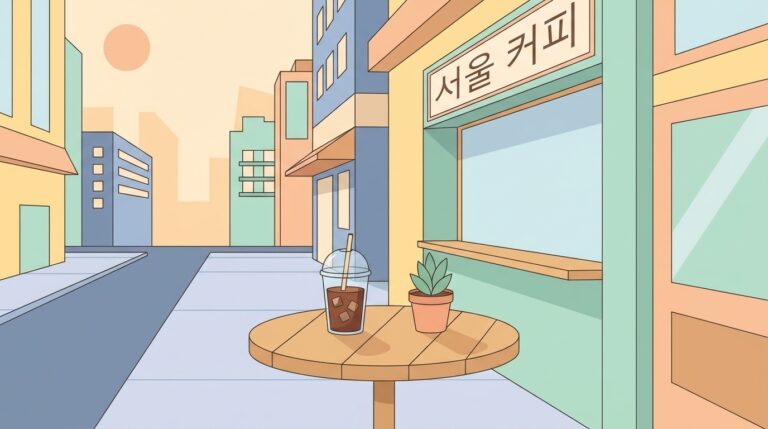
Phase 1: 공감 (Story Opening)
안녕하세요! 매일한글 에디터입니다.
Picture this: It is mid-January in downtown Seoul. The wind chill has plummeted to -10°C (14°F), your breath is freezing mid-air, and you are bundled in a massive ankle-length black padded coat (롱패딩, long-padding). You dash into a bustling cafe in Euljiro to warm your frozen fingers. But as you look around, you notice something shocking: nearly every single Korean worker standing in line is clutching a massive plastic cup brimming with ice and deep black coffee. Not a steaming latte, not a hot tea—pure, rattling ice.
Then, the office worker in front of you steps up to the busy counter, looks the barista in the eye, and simply says two syllables: “아아 하나요! (A-a hana-yo!)”
Within ten seconds, a vibrating buzzer is handed over, the card is tapped, and the interaction is complete. If you have only learned textbook Korean, you might wonder: Did they just sigh? Did they drop something? No—they just successfully ordered South Korea’s unofficial national drink: the Iced Americano.
Korean abbreviations (줄임말, jullimmal) are not just lazy slang; they are an essential cultural survival tool born from South Korea’s lightning-fast Ppali-ppali (빨리빨리, hurry-hurry) lifestyle. In this guide, tailored specifically for intermediate B1 learners, we will break down the coffee slang that will instantly transform you from a hesitant tourist into a savvy Seoulite who orders with total confidence.
Phase 2: 핵심 표현 3선 심층 분석 (Deep Dive into 3 Core Expressions)
1. 아아 (A-A)
- Pronunciation: [Ah-Ah] (Think of the sharp, double “ah” sound you make when refreshing your throat after a cold drink: “Ah-Ah!”)
- Meaning: Literal: Short for 아이스 아메리카노 (Iced Americano). Nuance: The lifeblood of modern Korea; shorthand for quick, zero-calorie caffeine fuel.
- K-Culture Moment: Seen in nearly every slice-of-life K-Drama (like Work Later, Drink Now or Misaeng), where stressed office workers enter a cafe and order “아아 세 잔 (Three Ah-Ahs)” without even looking at the menu board.
- Editor’s Insight: You can use “아아” directly at franchise cafes (Mega Coffee, Compose Coffee, Ediya, and even Starbucks) as long as you attach a polite ending like “~주세요” (juseyo) or “~하나 포장이요” (hana pojang-iyo).
- Situation Spectrum: Casual: ✅ | Semi-formal: ✅ | Formal: ⚠️ (In high-stakes business meetings, prefer the full title: 아이스 아메리카노)
- 🤔 Think About It: In English, we rarely say “Ice-Ame.” Why did Korean culture compress a four-syllable foreign loanword into a snappy two-syllable punch?
2. 얼죽아 (Eol-Juk-A)
- Pronunciation: [Eol-juk-ah] (Sounds like English “Earl” + “Jook” + “Ah”)
- Meaning: Literal: 얼어 죽어도 아이스 (Even if I freeze to death, I will drink iced drinks!). Nuance: A humorous badge of honor worn by Koreans who refuse hot drinks even during Siberian-level blizzards.
- K-Culture Moment: Idol group members on V-Live or Weverse showing off their iced drinks in sub-zero temperatures, proudly proclaiming to their fandom: “I’m a member of the Eol-juk-a club!”
- Editor’s Insight: This word became so culturally prominent that it was featured in international news outlets like Reuters to describe Korea’s unique consumer phenomenon.
- Situation Spectrum: Casual: ✅ | Semi-formal: ✅ | Formal: 🚫 (Slang term; avoid during job interviews or formal presentations!)
- 🤔 Think About It: Does your home culture have a habit or food preference that people stubbornly stick to despite extreme weather conditions?
3. 뜨아 (Tteu-A)
- Pronunciation: [Tteu-Ah] (A crisp, tense double ‘T’ sound like the ‘t’ in “stop”, followed by “Ah”)
- Meaning: Literal: 뜨거운 아메리카노 (Hot Americano). Nuance: The quiet rival to “아아.” Used primarily when you desperately need warmth, or by the minority who dislike icy coffee.
- K-Culture Moment: When a group of colleagues orders four “Ah-Ahs” and that one senior manager pauses and softly says, “I’ll take a Tteu-Ah today… I have a sore throat.”
- Editor’s Insight: While “아아” is universally accepted at 100% of counters, “뜨아” is slightly more colloquial. Some ultra-formal hotel cafe baristas might pause for a split second, but every neighborhood cafe barista knows it instantly.
- Situation Spectrum: Casual: ✅ | Semi-formal: ✅ | Formal: 🚫
- 🤔 Think About It: Notice the linguistic symmetry: “아아” (cold/bright vowel) vs. “뜨아” (tense, firm initial consonant). Korean slang loves neat acoustic pairings!
Phase 3: 교과서 한국어 vs 진짜 한국어 (Textbook vs. Real-Life Korean)
Situation 1: Ordering Coffee at a Busy Counter
- 📖 교과서 한국어 (Textbook):
- “저는 차가운 아이스 아메리카노 한 잔을 주문하고 싶습니다.”
(Jeoneun chaga-un aiseu amerika-no han janeul jumunhago sipseumnida. / I would like to order one cup of cold iced americano.)
- “저는 차가운 아이스 아메리카노 한 잔을 주문하고 싶습니다.”
- 🗣️ 진짜 한국어 (Real-Life):
- “아아 한 잔 테이크아웃으로 부탁드려요!”
(A-a han jan teikeu-a-useuro butakdeuryeoyo! / One Ah-Ah for takeout, please!)
- “아아 한 잔 테이크아웃으로 부탁드려요!”
- 💡 왜 다를까? (Why the Difference?):
Korean cafes prioritize maximum speed and clarity. Saying “차가운 (cold)” before “아이스 (iced)” is redundant, and dropping lengthy sentence stems saves precious seconds during the morning rush hour.
Situation 2: Asking a Friend/Colleague Their Coffee Preference
- 📖 교과서 한국어 (Textbook):
- “당신은 어떤 종류의 커피를 마시기를 선호합니까?”
(Dangsineun eotteon jongryu-ui keopi-reul masigireul seonhohamnikka? / Which type of coffee do you prefer to drink?)
- “당신은 어떤 종류의 커피를 마시기를 선호합니까?”
- 🗣️ 진짜 한국어 (Real-Life):
- “커피 뭐 마실래? 너도 얼죽아야?”
(Keopi mwo masillae? Neodo eol-juk-a-ya? / What coffee do you want? Are you an Eol-juk-a too?)
- “커피 뭐 마실래? 너도 얼죽아야?”
- 💡 왜 다를까? (Why the Difference?):
“당신 (Dangsin)” is almost never used in casual spoken Korean between peers. Instead, native speakers categorize preferences using fun cultural tags like “얼죽아” to build camaraderie.
Phase 4: K-Culture 딥다이브 & 비언어적 매너 (Deep Dive & Non-Verbal Etiquette)
4-1. 눈치(Nunchi) & Counter Etiquette in Korean Cafes
- The Card-Ready Stance: When standing in line at high-volume cafe franchises like Mega Coffee, Paik’s Coffee, or Compose Coffee, have your physical credit card or phone (Samsung Pay/Apple Pay) already in your hand. Fumbling in your backpack when you reach the cashier violates the collective rhythm of Korean Ppali-ppali efficiency.
- Two-Handed Exchange: Even when casually saying “아아 하나요,” always hand over your payment card and receive your buzzer (진동벨, jindong-bel) using both hands (or one hand lightly supporting your right wrist/forearm). It balances casual vocabulary with deep Korean respect.
- Clear Space Immediately: Once the order is placed, immediately step sideways away from the pickup zone (픽업대, pik-eop-dae). The space directly in front of the counter belongs to the next customer.
4-2. Cultural Code: The Office Survival Elixir
In Korean corporate life, the post-lunch coffee walk (커피 타임, coffee time) is sacred. Between 12:30 PM and 1:30 PM in districts like Yeouido or Gangnam, sidewalks become a sea of lanyards and plastic cups.
Why “아아” over other drinks? First, Koreans drink Americanos largely as an antidote to spicy, heavy lunches (like Kimchi Jjigae or KBBQ); the clean, bitter cold resets the palate. Second, it delivers immediate hydration and a sharp caffeine spike without dairy heaviness, allowing workers to survive grueling afternoon meetings. In K-Dramas, handing an iced americano to an exhausted junior colleague is the ultimate non-verbal act of empathy.
Phase 5: 실전 롤플레이 시나리오 (Real Role-Play Scenario)
- Setting: A bustling cafe in Mapo-gu near Hongik University at 12:45 PM.
- Character: Barista Min-ji (ultra-efficient, friendly, wearing a black apron with a headset).
- Barista Min-ji: “어서 오세요! 주문 도와드릴게요.” (Eoseo oseyo! Jumun dowadeurilgeyo. / Welcome! I can take your order.)
🎭 [Bracing a warm smile while fingers hover over the POS touchscreen] - Learner (You): “안녕하세요! 아아 한 잔이랑 뜨아 한 잔 주세요.” (Annyeonghaseyo! A-a han jan-irang tteu-a han jan juseyo. / Hello! One Ah-Ah and one Tteu-Ah, please.)
🎭 [Holding your credit card ready with both hands] - Barista Min-ji: “네, 아아 하나, 뜨아 하나요. 원두는 고소한 맛과 산미 있는 맛 중 어떤 걸로 하시겠어요?” (Ne, a-a hana, tteu-a hana-yo. Wonduneun gosohan mat-gwa sanmi inneun mat jung eotteon geollo hasigesseoyo? / Got it, one iced and one hot Americano. Would you prefer nutty or acidic coffee beans?)
🎭 [Pointing swiftly to two coffee bean icons on the register display] - Learner (You): “고소한 원두로 해주세요. 그리고 아아에는 샷 추가해 주세요.” (Gosohan wonduro hae-juseyo. Geurigo a-a-eneun syat chuga-hae juseyo. / Nutty beans, please. And please add an extra espresso shot to the Ah-Ah.)
🎭 [Nodding clearly with confidence] - Barista Min-ji: “네, 샷 추가 500원 추가되셨고요. 드시고 가시나요, 포장이세요?” (Ne, syat chuga obaek-won chugadoesyeotgoyo. Deusigo gasinayo, pojang-iseyo? / Okay, 500 KRW added for the extra shot. For here or to-go?)
🎭 [Looking up to confirm your destination] - Learner (You): “포장해 갈게요! 테이크아웃이요.” (Pojanghae galgeyo! Teikeu-a-ut-iyo. / To-go, please! Takeout.)
🎭 [Tapping your card lightly on the payment terminal] - Barista Min-ji: “결제 완료되셨습니다. 진동벨 울리면 오른쪽 픽업대에서 음료 받아 가세요!” (Gyeolje wanryodoesyeosseumnida. Jindongbel ullimyeon oreunjjok pik-eop-dae-eseo eumryo bada gaseyo! / Payment complete. When the buzzer vibrates, please pick up your drinks at the right-side counter!)
🎭 [Handing you the small round black buzzer with both hands] - Learner (You): “감사합니다, 수고하세요!” (Gamsahamnida, sugohaseyo! / Thank you, keep up the good work!)
🎭 [Bowing your head slightly at 15 degrees and stepping to the waiting area]
🔀 Interactive Choice Point!
The barista suddenly asks: “영수증 드릴까요? (Yeongsujeung deurilkkayo? / Would you like a receipt?)” How do you respond?
- Option A: “아니요, 버려주세요! (Aniyo, beoryeojuseyo! / No, please throw it away!)”
- 👉 Feedback [Best]: Natural, polite, and exactly what 90% of Koreans say. Saves paper and keeps things swift.
- Option B: “영수증은 나의 권리입니다. 주세요. (Yeongsujeungeun naui gwonrimnida. Juseyo. / The receipt is my legal right. Give it to me.)”
- 👉 Feedback [Bad]: Overly aggressive, bizarrely robotic, and creates instant awkward tension!
- Option C: “네, 주세요. (Ne, juseyo. / Yes, please.)”
- 👉 Feedback [Safe & Functional]: Perfectly fine if you need the paper receipt for expense reports or tax tracking.
Phase 6: 10초 감정 섀도잉 드릴 (10-Second Emotional Shadowing Drill)
Read these aloud matching the pauses (/) and the emotional cues in brackets! Repeat each sentence 3 times.
[😊 Cheerful & Briskly Efficient]- “사장님! / 아아 두 잔 / 테이크아웃이요!”
- (Sajangnim! / A-a du jan / teikeu-a-ut-iyo!)
- “Boss! Two Ah-Ahs for takeout, please!”
[🥶 Shivering Teeth, Unyielding Determination]- “영하 십 도여도… / 난 무조건… / 얼죽아야!”
- (Yeongha sip do-yeodo… / nan mujogeon… / eol-juk-a-ya!)
- “Even if it’s minus ten degrees… I am unconditionally… an Eol-juk-a!”
[☕ Gentle, Comforting & Soft]- “날씨가 쌀쌀하니까 / 오늘은 / 따뜻한 뜨아 마실래.”
- (Nalssiga ssalssalhanikka / oneureun / ttatteut-han tteu-a masillae.)
- “Since the weather is chilly, today I’ll have a warm Tteu-Ah.”
Phase 7: K-Culture 미니 사전 (Mini Dictionary)
- 얼죽아 (Eol-juk-a) | Noun
- Translation: “Iced Americano even if I freeze to death” culture.
- Real-World Use: Used among friends and coworkers during autumn and winter to boast about one’s devotion to iced caffeinated beverages.
- 샷 추가 (Syat Chu-ga) | Noun / Verb Phrase
- Translation: Extra espresso shot addition.
- Real-World Use: High-frequency phrase at counters (“샷 추가해 주세요”). Indispensable for survival during Korean overtime shifts (야근, yageun).
- 디카페인 (Di-ka-pe-in) | Noun
- Translation: Decaf.
- Real-World Use: Korean cafes historically lacked decaf options, but it has exploded in popularity. Combine it: “디카페인 아아 (Decaf Ah-Ah)”.
- 진동벨 (Jin-dong-bel) | Noun
- Translation: Cafe buzzer / pager (Vibration bell).
- Real-World Use: Handed to you after ordering. When it lights up and buzzes aggressively, bring it to the 픽업대 (pickup counter) to swap for your coffee.
Phase 8: 여행자를 위한 생존 키트 (Traveler’s Survival Kit)
TOP 3 Survival Phrases
- “아아 연하게 한 잔 주세요.” (A-a yeonhage han jan juseyo.)
- Meaning: “One light/mild Iced Americano, please.”
- Pro Tip: Korean espresso shots are famously strong. If you get caffeine jitters easily, “연하게 (yeonhage)” tells the barista to dilute it with extra water or pull a half shot.
- “텀블러 할인 되나요?” (Teombeulleo harin doenayo?)
- Meaning: “Do you offer a personal tumbler/cup discount?”
- Pro Tip: Most Korean chains (like Starbucks, Mega Coffee, Twosome Place) give between 100 to 500 KRW discounts if you bring your own insulated mug.
- “얼음 적게 넣어주세요.” (Eoreum jeokge neoeojuseyo.)
- Meaning: “Please put less ice.”
- Pro Tip: Use this if you want maximum liquid volume and don’t want your drink getting watery too quickly.
Editor’s Travel Note: Conquering the Kiosk
Nearly 80% of urban Korean takeout cafes now utilize digital touchscreen kiosks at the shop entrance.
* Switch language to English if available, but knowing Korean speeds up the queue! Look for the tab marked 커피 (Coffee) ➔ select 아메리카노 (Americano) ➔ tap ICE.
* Download the Naver Map app for finding the highest-rated local cafes around your hotel instead of Google Maps, which lacks updated interior hours and menu details in Korea.
Phase 9: “한 발 더 깊이” (One Step Deeper)
In Korean linguistic culture, abbreviating compound terms is not mere slang; it is an act of establishing in-group intimacy (정, Jeong). When a society embraces high-density urban living and ultra-fast digital connectivity, language naturally compresses to eliminate cognitive friction. Saying “아아” or identifying oneself as an “얼죽아” signals that you share the collective rhythm and bittersweet humor of daily Korean hustle. Language reflects life: fast, energetic, resilient, and unapologetically chilled.
💬 Your Turn: Are you an unapologetic 얼죽아 (Eol-juk-a) who drinks iced coffee in the snow, or do you stand with the 뜨아 (Tteu-A) team? Tell us your order in the comments below using today’s phrases!
Phase 10: FAQ & 오해 방지 (FAQ & Common Pitfalls)
Q: Can I use “아아” when ordering at high-end hotel lounges or formal business restaurants?
A: It is better to use the complete formal phrase: “아이스 아메리카노 부탁드립니다 (Aiseu amerika-no butakdeurimnida)”. While baristas everywhere understand “아아”, luxury dining staff expect standardized terminology.
Q: What is the opposite abbreviation for an Iced Cafe Latte?
A: You guessed it! Koreans call an Iced Latte “아라 (Ah-Ra)” (아이스 라떼) and a hot one “뜨라 (Tteu-Ra)” (뜨거운 라떼). However, “아라” is slightly less common than “아아”.
Q: Why do Koreans use plastic cups even in winter for Iced Americanos?
A: Korean government eco-regulations mandate paper cups for hot drinks and reusable/recyclable plastic for cold drinks. However, if you drink inside the cafe (매장 이용), you will be given a heavy glass mug by law!
🚨 Common Mistakes Warning Board
- Mistake: Saying “차가운 아메리카노 (Chaga-un americano)”.
- Correct Action: In coffee culture, always use the loanword “아이스 (Iced)” or the slang “아아”. “차가운” sounds like a poetic description rather than an order.
- Mistake: Forgetting to specify to-go before payment.
- Correct Action: Say “테이크아웃이요 (Takeout-iyo)” or “포장이요 (Pojang-iyo)” early. Korean law strictly fines cafes if customers drink from disposable single-use plastic cups inside store premises.
- Mistake: Confusing 뜨아 (Tteu-A) with “뜨거워요 (It’s hot!)”.
- Correct Action: Make sure to pronounce the “Ah” at the end clearly so the cashier knows it is an Americano, not an exclamation of being burned!
Phase 11: 액션 미션 & 참여 유도 (Action Missions)
- 🥉 Bronze Mission (Solo Practice): Stand in front of your mirror and practice ordering smoothly under 3 seconds: “사장님, 아아 하나 테이크아웃이요!” Repeat until it rolls off your tongue effortlessly.
- 🥈 Silver Mission (Social Media): Take a photo of your next coffee. Post it on Instagram or Threads with the hashtag
#얼죽아or#매일한글and write the caption: “오늘도 시원한 아아 한 잔! (Refreshing Ah-Ah again today!)”. - 🥇 Gold Mission (Real Life Execution): Step into any local Korean-owned cafe or bakery in your city, head to the counter, and order entirely in Korean using “아아” or “뜨아” without glancing at the English menu.
- 🎮 K-Culture Mission: Watch an episode of a modern office K-Drama (like King the Land or Business Proposal). Spot the scene where characters carry takeout cup trays and listen carefully for the words 아아 or 커피 타임!
Phase 12: 인터랙티브 퀴즈 챌린지 (Interactive Quiz Challenge)
Test your knowledge before you hit the Seoul cafe streets!
- Situational Judgment: You are ordering coffee in Seoul on a snowy morning at -5°C. You firmly believe that cold coffee tastes superior regardless of the freeze. What title describes you?
- (A) 롱패딩족 (Long-padding jock)
- (B) 얼죽아 (Eol-juk-a)
- (C) 뜨아러버 (Tteu-a lover)
- Fill-in-the-Blank: Complete the order naturally:
- “사장님, 시원한 ______ 한 잔 테이크아웃으로 포장해 주세요!”
- True / False: Under current Korean environmental regulations, you can freely sit inside a cafe for two hours while drinking from a single-use plastic takeout cup.
- (True / False)
👉 Click to reveal answers & explanations!
- Answer: (B) 얼죽아 (Eol-juk-a)
- Explanation: “얼어 죽어도 아이스!” You are a certified member of the freezing-cold iced drink society.
- Answer: 아아 (or 아이스 아메리카노)
- Explanation: “아아” fits the casual, modern flow perfectly.
- Answer: False
- Explanation: Korean law prohibits disposable single-use plastic cups inside cafes for seated customers to reduce waste. You must choose “매장 (for here)” with a glass cup or “포장 (takeout)” to leave the premises!
- Explanation: Korean law prohibits disposable single-use plastic cups inside cafes for seated customers to reduce waste. You must choose “매장 (for here)” with a glass cup or “포장 (takeout)” to leave the premises!







