

Phase 1: 공감 (Story-Driven Opening)
안녕하세요! 매일한글 에디터입니다.
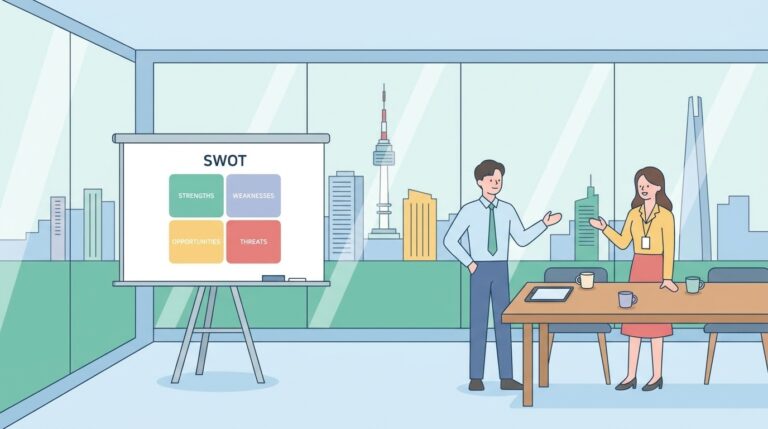
Picture this: You are sitting in a sleek glass conference room in Teheran-ro, Gangnam. The projector casts the classic four-quadrant SWOT matrix on the wall. Your team lead, Team Leader Park, swivels his chair toward you and asks, “So Alex, looking at quadrant W and T, what should our defensive strategy be?” Your mind races back to K-drama scenes from Misaeng (미생) or Start-Up (스타트업)—the intense eye contact, the rhythmic clicking of ballpoint pens, the heavy silence before someone pitches a breakthrough idea.
You want to contribute something profound. But instead, you blurt out: “우리는 약점이 많아서 위험합니다” (We have many weaknesses so it’s dangerous). Suddenly, the room temperature drops by five degrees. Why? In Korean corporate culture, SWOT analysis isn’t just about translating data points; it’s about delicate interpersonal calibration, known as wanggok-eobeop (완곡어법, indirect framing). Calling an internal flaw a flat-out “weakness” (약점) in front of colleagues can sound like an accusatory attack rather than a strategic insight. Over the past decade coaching foreign professionals in Seoul, I have seen brilliant marketers freeze because they lacked these exact diplomatic verbal filters. Master this unit, and you won’t just participate in marketing meetings—you will command the room with the tactical finesse of a seasoned Korean strategist.
Phase 2: 핵심 표현 3선 심층 분석 (Top 3 Strategic Expressions)
1. 강점으로 내세울 만합니다
- Pronunciation: [Gang-jeom-eu-ro nae-se-ul man-ham-ni-da] (Sounds like: “Gahng-jum-oo-roh neh-seh-ool mahn-hahm-nee-dah”)
- Meaning: “It is worthy of being presented/highlighted as our core strength.”
- K-Culture Moment: Think of Nam Do-san in Start-Up pitching his AI model’s accuracy to Sand Box investors without sounding boastful.
- Editor’s Insight: Instead of the blunt “이것이 우리의 강점입니다” (This is our strength), the structure
-을 만하다adds professional humility and objective weight, implying that after careful market benchmarking, this attribute truly qualifies as an edge.- Situation Spectrum: Casual: 🚫 | Semi-formal: ⚠️ | Formal: ✅
- 🤔 Think About It: In your native culture, do people state strengths directly, or do they soften their claims to maintain harmony?
2. 보완해야 할 약점으로 보입니다
- Pronunciation: [Bo-wan-hae-ya hal yak-jeom-eu-ro bo-im-ni-da] (Sounds like: “Boh-wahn-heh-yah hahl yahk-jum-oo-roh boh-eem-nee-dah”)
- Meaning: “It appears to be a vulnerability that requires complementing/improvement.”
- K-Culture Moment: When Senior Manager Oh in Misaeng spots a critical loophole in an export contract and brings it up to the executive director without triggering a blame game.
- Editor’s Insight: Pairing “보완하다” (to complement/patch up) with “-로 보입니다” (it appears to be) turns a harsh criticism into an actionable task. You never say “우리가 못합니다” (We are bad at this); you frame weaknesses as puzzle pieces waiting to be solved.
- Situation Spectrum: Casual: 🚫 | Semi-formal: ⚠️ | Formal: ✅
- 🤔 Think About It: How does shifting from “flaw” to “area for complementation” change psychological safety in your own workplace?
3. 위협 요인을 기회로 전환할 필요가 있습니다
- Pronunciation: [Wi-hyeop yo-in-eul gi-hoe-ro jeon-hwan-hal pil-yo-ga it-seum-ni-da] (Sounds like: “Wee-hyup yoh-een-ool ghee-hweh-roh jun-hwahn-hahl peel-yoh-gah eet-soom-nee-dah”)
- Meaning: “There is a necessity to pivot this threat factor into an opportunity.”
- K-Culture Moment: The climactic board meeting climax in the corporate drama Agency (대행사), where an underdog ad agency reframes market retaliation into a viral campaign hook.
- Editor’s Insight: This is the quintessential B2/C1 executive pivot sentence. In SWOT meetings, executives do not want to hear a laundry list of threats (위협 요인) unless it is immediately coupled with an actionable conversion (전환) strategy.
- Situation Spectrum: Casual: 🚫 | Semi-formal: ⚠️ | Formal: ✅
- 🤔 Think About It: Notice the passive noun structure “필요가 있습니다” (there is a need) instead of “우리가 해야 합니다” (we must do it). Why do you think Korean business language de-emphasizes the personal subject “we”?
Phase 3: 교과서 한국어 vs 진짜 한국어 (Textbook vs. Real Korean)
Situation 1: Pointing out an internal product flaw
- 📖 교과서 한국어: “우리 제품의 기능이 경쟁사보다 나쁩니다.” (Our product’s function is worse than the competitor’s.)
- 🗣️ 진짜 한국어: “기능적인 측면에서 경쟁사 대비 다소 보완이 필요해 보입니다.” (Functionally, it appears that somewhat more refinement is needed compared to competitors.)
- 💡 왜 다를까? Direct negative adjectives like “나쁘다” (bad) create defensiveness across departments. Real corporate teams rely on softening adverbs like “다소” (somewhat) and nominalizers like “-적 측면” (aspect).
Situation 2: Identifying an untapped market niche
- 📖 교과서 한국어: “이 시장은 아주 좋은 기회입니다.” (This market is a very good opportunity.)
- 🗣️ 진짜 한국어: “이 틈새시장을 선점할 만한 승산이 충분합니다.” (There is plenty of winning potential to preemptively capture this niche market.)
- 💡 왜 다를까? Natural Korean business pros prefer vivid domain nouns like “틈새시장” (niche market) and “승산” (chances of winning) over generic words like “좋다” (good).
Phase 4: K-Culture 딥다이브 & 비언어적 매너 (Non-Verbal Manners)
4-1. 눈치 (Nunchi) & Gestures in Strategy Meetings
- The Open-Palm Gesture: When pointing to the presentation slide, never point with an index finger at the ‘Weakness’ or ‘Threat’ quadrant. Extend your whole hand, palm tilted slightly upward toward the screen. Pointing with an index finger implies personal culpability.
- The Softened Gaze: When delivering critical evaluations during SWOT analysis, avoid continuous, unblinking eye contact with the team leader. Deliver your opening insight while making polite eye contact, gaze softly at your briefing document or the presentation screen while articulating the vulnerability, and reconnect your gaze when delivering the solution.
4-2. 문화 코드 분석 (Culture Code)
In Korean corporate planning, a SWOT meeting is rarely an individual arena for grandstanding; it is a collective alignment ritual (consensus-building or 품의/공감대). K-dramas like Search: WWW (검색어를 입력하세요 WWW) vividly show how strategy directors carefully weave corporate loyalty into strategic critique. A threat is framed as a shared challenge, while a strength is attributed to collective teamwork.
Phase 5: 실전 롤플레이 시나리오 (Interactive Roleplay)
- Setting: Conference Room B at a cosmetics tech brand in Pangyo Silicon Valley. The afternoon sun filters through wooden blinds. A sleek SWOT chart on bio-fermented toner is projected onto the wall.
- NPC: Team Leader Park Min-woo (박민우 팀장), an analytical, sharp-dressed marketing veteran who appreciates grounded, pragmatic realism.
- 박 팀장: “알렉스 씨, 해외 시장 진출 전략 SWOT 표 정리된 것 보고 있죠?”
(Alex-ssi, haewoe sijang jinchul jeollyak SWOT pyo jeongnidoen geot bogo itjyo?)
“Alex, you are looking at the summarized SWOT chart for our overseas market expansion, right?”
🎭 Leans forward on the conference table, tapping his tablet stylus twice. -
알렉스: “네, 팀장님. 특히 강점과 기회 요인을 중심으로 면밀히 검토했습니다.”
(Ne, timjangnim. Teukhi gangjeomgwa gihoe yoineul jungsim-euro myeonmilhi geomtohyeotseumnida.)
*”Yes, Team Leader. I have closely reviewed it, focusing especially on our strengths and opportunities.”
🎭 Sits upright, tilting body slightly toward Team Leader Park. -
박 팀장: “우리 원료의 독자성을 강점으로 내세울 만하다고 봅니까?”
(Uri wollyoui dokjaseong-eul gangjeom-euro naeseoul manhada-go bomnikka?)
“Do you believe our ingredient originality is worth putting forward as a core strength?”
🎭 Adjusts his glasses, testing Alex's conviction. -
알렉스: “네, 임상 데이터가 뒷받침되므로 충분히 강점으로 내세울 만합니다.”
(Ne, imsang de-iteoga dwitbatchim-doemeuro chungbunhi gangjeom-euro naeseoul manhamnida.)
*”Yes, since clinical trial data backs it up, it is fully worth spotlighting as our strength.”
🎭 Glances at the printout and nods calmly. -
박 팀장: “하지만 약점 부분에 기재된 높은 제조 단가가 걸리네요.”
(Hajiman yakjeom bubune gijaedoen nopeun jejo dan-gaga geollineyo.)
*”However, the high manufacturing unit cost listed in our weakness section troubles me.”
🎭 Frowns slightly, crossing his arms. -
알렉스: “초기 생산 단계에서 보완해야 할 약점으로 보입니다.”
(Chogi saengsan dangye-eseo bowanhaeya hal yakjeom-euro boimnida.)
*”It appears to be a vulnerability that we must complement during our initial production stage.”
🎭 Keeps an even, reassuring tone. -
박 팀장: “경쟁사의 유사 카피 제품 출시라는 위협 요인은 어떻게 대응할 생각입니까?”
(Gyeongjaengsayi yusa kapi jepum chulsi-raneun wihyeop yoineun eotteoke daeeunghal saenggak-imnikka?)
“How do you propose we counter the threat factor of competitor copycat launches?”
🎭 Looks directly into Alex's eyes, anticipating a concrete pivot. -
알렉스:
[Select your response below]
🔀 Your Move (Interactive Branching Point)
- Choice A: “이 위협 요인을 특허 마케팅을 통한 신뢰도 선점 기회로 전환할 필요가 있습니다.”
(I wihyeop yoineul teukheo maketing-eul tonghan sinroedo seonjeom gihoe-ro jeonhwanhal piryoga itseumnida.) - Choice B: “카피 제품이 나오면 우리는 가격을 대폭 낮춰서 싸워야 합니다.”
(Kapi jepumi naomyeon urineun gagyeog-eul daepok natchwoseo ssaw his hamnida.) - Choice C: “경쟁사 제품은 조악할 테니 무시하고 그냥 출시하면 됩니다.”
(Gyeongjaengsa jepumeun jo-akhal teni musihago geunyang chulsihamyeon doemnida.)
Feedback:
* Choice A (Best Outcome): Masterful! You reframed a grave threat into an opportunity for brand credibility (신뢰도 선점 기회). Team Leader Park smiles and jots your idea down on his strategic roadmap.
* Choice B (Risk Outcome): Dangerous move. Slashing prices (가격을 대폭 낮추다) destroys premium margins and fails to counter the manufacturing cost weakness you just conceded.
* Choice C (Bad Outcome): Flunked. Dismissing competitors (무시하다) shows market arrogance and a total breakdown of strategic risk management in a Korean corporate setting.
Phase 6: 10초 감정 섀도잉 드릴 (10-Second Emotional Shadowing)
Practice these sentences aloud. Follow the / marks for intentional pauses and internalize the emotional tags.
[💼 자신감 있고 정중하게 / Confident and respectful]
“자사 데이터에 따르면 / 강점으로 내세울 만한 요소가 / 분명히 존재합니다.”
(Jasa de-iteo-e ttareumyeon / gangjeom-euro naeseoul manhan yosoga / bunmyeonghi jonjaehamnida.)
“According to our internal data / factors worth highlighting as our core strength / clearly exist.”-
[🔍 분석적이고 조심스럽게 / Analytical and cautious]
“현 시장 점유율을 고려할 때 / 우선적으로 보완해야 할 약점으로 / 보입니다.”
(Hyeon sijang jeomyuyur-eul goryeohal ttae / useonjeog-euro bowanhaeya hal yakjeom-euro / boimnida.)
“Taking our current market share into account / it appears to be a vulnerability / that requires prioritized complementation.” -
[🚀 결단력 있고 진취적으로 / Decisive and forward-looking]
“규제 강화라는 위협 요인을 / 친환경 인증 획득의 기회로 / 전환할 필요가 있습니다.”
(Gyu-je ganghwa-raneun wihyeop yoineul / chinhwan-gyeong injeung hoekdeug-ui gihoe-ro / jeonhwanhal piryoga itseumnida.)
“The threat factor of tighter regulations / into an opportunity to obtain eco-friendly certifications / must be transformed.”
Phase 7: K-Culture 미니 사전 (Business Mini-Dictionary)
- 강점 (Gangjeom) | Core Strength / Comparative Advantage
Unlike basic “장점” (general merit), “강점” refers strictly to competitive, strategic dominance against industry rivals. - 보완점 (Bowanjeom) | Area for Improvement / Refinement Point
The polite executive substitute for “약점” (weakness). Used when providing diplomatic constructive criticism in slide decks. - 돌파구 (Dolpagu) | Breakthrough / Strategic Workaround
Literally meaning “breakthrough hole,” this term is used when the team brainstorms an escape route out of an impasse. - 리스크 관리 (Riseukeu Gwanli) | Risk Management
Widely used in SWOT reviews to emphasize mitigating threats rather than outright running away from them.
Phase 8: 여행자를 위한 생존 키트 (Professional Expat Survival Kit)
Top 3 Meeting Survival Phrases:
- “자료 화면을 공유해 드리겠습니다.”
(Jaryo hwamyeon-eul gong-yuhae deurigetseumnida.)
“I will share the slide deck on screen.”
Pro Tip: Use this polite humble phrasing before clicking ‘Share Screen’ during a Zoom or Microsoft Teams meeting. - “다시 한번 말씀해 주시겠습니까?”
(Dasi hanbeon malsseumhae jusigetseumnikka?)
“Could you please state that once more?”
Pro Tip: Never use casual “뭐라고요?” when you miss a figure in a corporate strategy meeting. - “말씀하신 취지에 전적으로 공감합니다.”
(Malsseumhasin chwiji-e jeonjeok-euro gonggamhamnida.)
“I completely empathize with the underlying intention behind your comment.”
Pro Tip: A golden phrase to bridge a disagreement before introducing your counter-strategy.
Editor’s Corporate Life Note:
If you are organizing an ad-hoc strategy session outside the office, download the SpaceCloud space booking app to reserve private meeting pods in Gangnam or Yeouido. To navigate efficiently between offices across Seoul, install the Naver Map public transit app. When entering corporate buildings, retain your physical passport or ARC card at reception desks to secure guest visitor badges.
Phase 9: “한 발 더 깊이” (Cultural Reflection Essay)
In Western business discourse, straightforward debate is often celebrated as intellectual honesty—you dissect weaknesses transparently without taking it personally. In the Korean workplace, however, your project proposal represents your team’s collective chaemyeon (체면, face) and emotional sweat. Point-blank condemnation of a strategy as an irredeemable failure damages the group’s collective morale. Mastering wanggok-eobeop (완곡어법) is not deception; it is an act of consideration (baeryeo, 배려) that safeguards interpersonal harmony while maintaining strategic precision.
💬 Your Turn: In your home culture, how do you point out a colleague’s plan flaw without causing friction? Drop your thoughts below—I would love to read your stories!
Phase 10: FAQ & 흔한 실수 (FAQ Schema & Pitfalls)
Q: Why shouldn’t I just say “우리 약점이 너무 큽니다” during a SWOT presentation?
A: Saying “우리 약점이 너무 큽니다” (Our weakness is too big) sounds fatalistic and assigns implicit blame to the department responsible for that area. Instead, say “이 부분은 향후 전략 수립 시 보완이 필요한 지점으로 판단됩니다” (This point is judged as an area requiring refinement when establishing future strategies).
Q: Can I use “-같아요” in formal SWOT meetings?
A: While “-인 것 같아요” (It seems like…) is widely used in casual conversation, relying on it in an executive SWOT meeting can make you sound uncertain or lacking rigorous data conviction. Opt for “-로 사료됩니다” (It is respectfully considered as…) or “-로 분석됩니다” (It is analyzed as…).
Q: How do I smoothly transition from discussing Weaknesses to Opportunities?
A: Use the transitional phrase: “이러한 한계점에도 불구하고, 시장 내 다음과 같은 기회 요인을 포착할 수 있습니다” (Notwithstanding these limitations, we can capture the following opportunity factors in the market).
🚨 흔한 실수 (Common Mistakes)
- Mistake 1: Translating “Threat” as “위험” instead of “위협 요인”.
Correct Action: Use the official business nomenclature 위협 요인 (Threat Factor). - Mistake 2: Using the aggressive verb “공격하다” for market expansion.
Correct Action: Use 시장 공략 (Market capture/penetration) or 선점 (Preemption). - Mistake 3: Forgetting honorific humble forms when speaking to your boss.
Correct Action: Replace “내 의견” with “제 소견” or “저희 팀 검토 의견”.
Phase 11: 액션 미션 & 참여 유도 (Action Missions)
- 🥉 Bronze Mission (Solo Mastery): Record a 15-second voice memo reciting: “이 항목은 강점으로 내세울 만하며, 해당 위협 요인은 기회로 전환할 필요가 있습니다.” Focus on crisp enunciation.
- 🥈 Silver Mission (Social Challenge): Write a 2-sentence SWOT analysis of your favorite K-pop agency (e.g., HYBE or SM) in the comments below using “보완점” and “강점으로 내세울 만합니다”.
- 🥇 Gold Mission (Real-World Test): Use “-로 사료/판단됩니다” during an actual business conversation, Korean study club presentation, or writing assignment.
- 🎮 K-Culture Mission: Watch Episode 3 of the drama Agency (대행사) and count how many times the strategic planning team utilizes diplomatic softening verbs during their client pitch preparation.
Phase 12: 인터랙티브 퀴즈 챌린지 (Interactive Quiz)
Q1. Situational Judgment
During a marketing SWOT presentation, the executive director asks what your team intends to do about a competitor’s lower price point. Which response reflects the most polished intermediate business Korean?
- A) “그 경쟁사는 사기꾼이라서 신경 쓸 필요 없습니다.”
- B) “단가 경쟁은 다소 불리하므로, 프리미엄 품질을 강점으로 내세울 만합니다.”
- C) “우리는 돈이 없어서 이 약점을 고칠 수 없습니다.”
🔍 Check Answer & Explanation
Correct Answer: B
Explanation: Option B gracefully acknowledges the unit price disadvantage (단가 경쟁은 다소 불리하므로) while pivoting proactively to brand quality as a strength (강점으로 내세울 만합니다). Option A is unprofessional and slanderous, while Option C lacks strategic resilience.
Q2. Fill-in-the-Blank
Fill in the missing strategic vocabulary:
“해외 시장 진출 시, 현지 규제라는 (____) 요인을 친환경 브랜딩의 기회로 (____)할 필요가 있습니다.”
🔍 Check Answer & Explanation
Correct Answer: 위협 / 전환
Sentence: “해외 시장 진출 시, 현지 규제라는 위협 요인을 친환경 브랜딩의 기회로 전환할 필요가 있습니다.”
Translation: When expanding abroad, we need to transform the threat factor of local regulations into an opportunity for eco-friendly branding.
Q3. True or False Cultural Quiz
True or False: In a Korean strategic corporate meeting, it is considered polite and standard etiquette to point your index finger directly at the ‘Weakness’ slide quadrant to make sure everyone sees the flaw.
🔍 Check Answer & Explanation
Correct Answer: False
Explanation: Pointing with an index finger is perceived as accusatory. Professionals always guide attention toward slides using an open palm with fingers loosely aligned, creating a respectful and collaborative atmosphere.







