

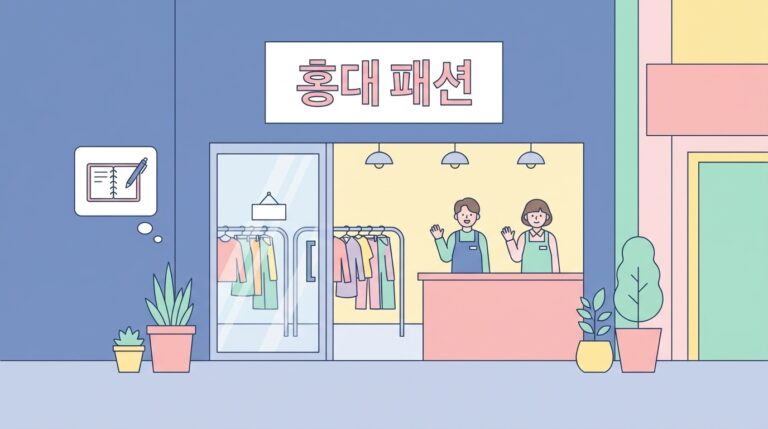
Phase 1: 공감 (Story-driven Opening)
안녕하세요! (Annyeonghaseyo!) I’m your Daily Hangul editor and your personal Korean culture navigator.
Picture this: You are strolling through the trendy, neon-lit shopping alleys of Hongdae in Seoul. Through a cozy boutique window, you spot the most gorgeous oversized knit sweater—the exact style your favorite K-drama star wore last week! Your heart skips a beat. You walk inside, slide it off the rack, but realize… it only comes in blinding neon lime green. You desperately want it in chic black or aesthetic beige.
Just then, the stylish boutique clerk approaches you with a polite bow: “도와드릴까요?” (Do you need help?)
Suddenly, your mind goes completely blank. You point awkwardly at your pants, shake your head, and mumble an apology before sheepishly walking out empty-handed.
We have all been there! Shopping for fashion in Korea should be thrilling, not terrifying. Over the years, hundreds of our beginner students have told us that clothing shops were where their conversational confidence crumbled first. Today, you are going to master the single most empowering phrase in Korean retail: asking for other colors. Let’s make sure you never miss out on your dream Seoul wardrobe again!
Phase 2: 핵심 표현 3선 심층 분석 (Top 3 Core Expressions)
1. 다른 색깔 있어요? (Dareun saekkkal isseoyo?)
- Pronunciation: [Dareun saekkkal isseoyo?] (Sounds like: “Dah-reun seck-kahl ee-ssuh-yo?”)
- Meaning: Literal: “Does another color exist?” vs Real Nuance: “Do you have this in any other colors?”
- K-Culture Moment: In modern lifestyle K-dramas, you will constantly hear shoppers browsing racks in Dongdaemun or Seongsu-dong using this exact sentence when looking for alternatives.
- Editor’s Insight: ‘다른’ (dareun) means ‘different’ or ‘other’, ‘색깔’ (saekkkal) means ‘color’, and ‘있어요?’ (isseoyo?) is the golden key verb meaning ‘do you have?’ or ‘is there?’. Memorize this trio!
- Situation Spectrum: Casual: ⚠️ | Semi-formal: ✅ | Formal: ✅
- 🤔 Think About It: In English, we ask “Do you have…?” putting focus directly on the person. In Korean, we say “Does it exist?”. Why do you think Korean softens questions by focusing on the object rather than the person?
2. 이거 검은색 있어요? (Igeo geomeunsaek isseoyo?)
- Pronunciation: [Igeo geomeunsaek isseoyo?] (Sounds like: “Ee-guh guh-meun-seck ee-ssuh-yo?”)
- Meaning: Literal: “This, black color exists?” vs Real Nuance: “Do you have this one in black?”
- K-Culture Moment: K-pop idols doing “Get Ready With Me” styling vlogs frequently ask stylists or boutique staff for minimalist monochrome items using this pattern.
- Editor’s Insight: ‘이거’ (igeo) means ‘this one’. If you want white instead, simply swap ‘검은색’ (black) with ‘흰색’ (hin-saek / white) or ‘베이지색’ (be-ijisaek / beige).
- Situation Spectrum: Casual: ⚠️ | Semi-formal: ✅ | Formal: ✅
- 🤔 Think About It: In Korean, the item being pointed at (‘이거’) comes first. How does starting with the item help the staff understand you instantly, even before you finish speaking?
3. 보여주세요 (Boyeojuseyo)
- Pronunciation: [Boyeojuseyo] (Sounds like: “Boh-yuh-joo-seh-yo”)
- Meaning: Literal: “Please show” vs Real Nuance: “Could you show it to me, please?”
- K-Culture Moment: When a boutique clerk tells a character that extra colors are stored in the back drawer, the shopper smiles and says this politely to inspect the piece.
- Editor’s Insight: This is a smooth combination of the verb ‘보이다’ (to show) and the polite request ending ‘-주세요’ (please give/do). It is respectful, light, and never feels bossy.
- Situation Spectrum: Casual: 🚫 | Semi-formal: ✅ | Formal: ✅
- 🤔 Think About It: The ending ‘-주세요’ is ubiquitous in Korea. Why is adding this suffix considered the dividing line between being charming and being rude?
Phase 3: 교과서 한국어 vs 진짜 한국어 (Textbook vs Real Korean)
Situation 1: Asking if a garment comes in other shades
- 📖 교과서 한국어: “이 옷의 다른 색상을 보유하고 계십니까?” (I osui dareun saeksangeul boyuhago gyesimnikka? / Do you possess other colors of this clothing?)
- 🗣️ 진짜 한국어: “이거 다른 색도 있어요?” (Igeo dareun saekdo isseoyo? / Does this come in other colors too?)
- 💡 왜 다를까?: Textbook Korean relies heavily on formal business vocabulary like ‘보유하다’ (to possess). Real Seoul shoppers use the casual noun ‘색’ (saek) combined with ‘-도’ (too/also) for a crisp, natural rhythm.
Situation 2: Asking what colors are available
- 📖 교과서 한국어: “어떤 색상이 매장에 구비되어 있습니까?” (Eotteon saeksangi maejange gubidoeeo itsseumnikka? / Which colors are equipped in the store?)
- 🗣️ 진짜 한국어: “어떤 색 있어요?” (Eotteon saek isseoyo? / What colors do you have?)
- 💡 왜 다를까?: Native speakers eliminate unnecessary bureaucratic verbs in favor of short, punchy questions that make retail shopping quick and pleasant.
Phase 4: K-Culture 딥다이브 & 비언어적 매너 (Deep Dive & Non-Verbal Manners)
4-1. 눈치 (Nunchi) & Gestures
- The Two-Hand Hold: When presenting an item to the staff to ask about colors, lightly hold the hanger or fabric with both hands. Pointing with a single finger can feel sharp or accusatory.
- The Polite Head Tilt: As you ask “다른 색깔 있어요?”, tilt your head slightly with a warm smile and let your tone rise at the end. This instantly triggers a helpful response.
- Staff Nunchi: If the clerk hesitates and looks down, they are exercising nunchi to break the news gently that the item is sold out. Don’t press them; a quick “괜찮아요!” (It’s okay!) will save the mood.
4-2. Culture Code: The Personal Color Craze
In South Korea right now, everyone knows their “Personal Color” (퍼스널 컬러)—whether they are a Warm Tone (웜톤) or Cool Tone (쿨톤). When boutique staff recommend a specific shade, they aren’t just selling; they are assessing what flatters your complexion! If you ask for another color, the clerk might suggest: “베이지가 더 잘 어울려요!” (Beige suits you much better!).
Phase 5: 실전 롤플레이 시나리오 (Real-World Roleplay)
Setting: “Aura Boutique” in Hongdae. Indie pop beats play softly, and minimalist racks line the concrete walls.
Character: Minji (민지), a friendly, stylish store clerk wearing an oversized tailored blazer.
- 민지 (Minji): “어서오세요! 천천히 보세요.” (Eoseo-oseyo! Cheoncheonhi boseyo. / Welcome! Please take your time looking around.)
🎭 Greets with a light 15-degree bow and a warm smile. - You: “저기요, 이거 다른 색깔 있어요?” (Jeogiyo, igeo dareun saekkkal isseoyo? / Excuse me, do you have this in other colors?)
🎭 Holding the green sweater gently with both hands. - 민지 (Minji): “네, 고객님! 그거 베이지랑 블랙도 나와요.” (Ne, gogaeknim! Geugeo be-ijirang beullaekdo nawayo. / Yes, customer! That one also comes in beige and black.)
🎭 Points toward the lower display shelf. - You: “베이지색 보여주세요.” (Be-ijisaek boyeojuseyo. / Please show me the beige one.)
🎭 Nodding with a curious, friendly smile. - 민지 (Minji): “잠시만요, 새 상품으로 찾아봐 드릴게요.” (Jamsimanyo, sae sangpumeuro chajabwa deurilgeyo. / Just a moment, I will find a fresh packaged one for you.)
🎭 Checks the storage cabinet underneath. - 민지 (Minji): “여기 베이지색 있어요. 한번 대보세요!” (Yeogi be-ijisaek isseoyo. Hanbeon daeboseyo! / Here is the beige. Hold it up against yourself!)
🎭 Hands you the neatly folded sweater. - You: “와, 너무 예뻐요! 이거 입어봐도 돼요?” (Wa, neomu yeppeoyo! Igeo ibeobwado dwaeyo? / Wow, it’s so pretty! Can I try this on?)
🎭 Holding it in front of the mirror with excitement. - 민지 (Minji): “탈의실 저쪽에 있어요. 편하게 입어보세요!” (Taruisil jeojjoge isseoyo. Pyeonhage ibeoboseyo! / The fitting room is over there. Feel free to try it on!)
🎭 Gestures toward the curtained fitting booth.
🔀 인터랙티브 분기점 (Interactive Choice)
Now imagine you also want to check if they have it in clean white. What do you say?
- Choice A: “흰색도 있어요?” (Hin-saek-do isseoyo?)
- Choice B: “흰색 줘.” (Hin-saek jwo.)
- Choice C: “다른 거 다 가져와요.” (Dareun geo da gajyeowayo.)
Feedback:
* Choice A [Best]: Spot on! Adding ‘-도’ (too/also) makes you sound polite, natural, and remarkably like a savvy local.
* Choice B [Bad]: ‘줘’ is informal speech (반말). Using this with retail staff sounds disrespectful and arrogant.
* Choice C [Risk]: This means “Bring me all the other things!”. It sounds overly demanding and will startle the clerk!
Phase 6: 10초 감정 섀도잉 드릴 (10-Second Emotion Shadowing Drill)
Practice matching the emotional pitch of native speakers! Pause briefly at each / mark:
[😊 Polite & curious]
저기요, / 이거 / 다른 색깔 있어요?
(Jeogiyo, / igeo / dareun saekkkal isseoyo? / Excuse me, do you have this in other colors?)-
[🥺 Gentle & hopeful]
검은색 / 있어요?
(Geomeunsaek / isseoyo? / Do you have black?) -
[✨ Bright & grateful]
네! / 보여주세요.
(Ne! / Boyeojuseyo. / Yes! Please show me.)
Phase 7: K-Culture 미니 사전 (Mini Dictionary)
- 색깔 (Saekkkal) | Color | The general, everyday word for color. Staff might also use the shorter term 색 (Saek) or slightly formal 색상 (Saeksang).
- 신상 (Sinsang) | New Arrival | Slang abbreviation of ‘신상품’ (new product). Look for this word on rack banners across Hongdae and Dongdaemun.
- 피팅 (Piting) / 착용 (Chagyong) | Trying on / Fitting | Commonly seen on shop signs such as “피팅 가능” (Fitting allowed) or “착용 불가” (Trying on not permitted).
- 품절 (Pumjeol) | Sold Out | The retail heartbreak word! When the specific shade or size you want is completely out of stock.
Phase 8: 여행자를 위한 생존 키트 (Traveler’s Survival Kit)
Top 3 Survival Expressions
- 얼마예요? (Eolmayeyo?) – How much is it?
Pro Tip: In South Korea, prices shown on tags almost always include the 10% VAT tax. No mental math required! - 입어봐도 돼요? (Ibeobwado dwaeyo?) – Can I try this on?
Pro Tip: White tops and delicate knits are frequently non-try-on items due to makeup risks. Always ask first! - 이걸로 주세요 (Igeollo juseyo) – I will take this one, please.
Pro Tip: Hand over your payment card using both hands while saying this for maximum cultural politeness.
Editor’s Travel Note
When hunting for underground shopping treasures in places like Express Bus Terminal (Goto Mall) or Dongdaemun, standard international map tools often struggle with indoor layouts. Make sure to check the Naver Map App navigation guide to find exact subway exits and shop zones. Also, remember to carry your physical passport—many boutique chains offer immediate tax refunds right at the cash register!
Phase 9: “한 발 더 깊이” (Reflective Question)
In Korean culture, everyday language revolves around collective harmony and mutual comfort. Notice that instead of demanding “Show me another color”, the question “다른 색깔 있어요?” simply asks whether the color exists in the world. By putting the focus on the item rather than the person, Korean allows both the shopper and the clerk to interact without confrontation or pressure.
💬 Your Turn: What color dominated your closet during your last vacation? Have you ever felt lost shopping in a foreign country? Let us know in the comments below!
Phase 10: FAQ & 오해 방지 (FAQ & Common Mistakes)
Q: Can I try on white clothes in Korean fashion stores?
A: In most independent boutiques, white t-shirts, light blouses, and delicate knit sweaters cannot be tried on. This policy prevents cosmetic and lipstick smudges. Always look for a “피팅 불가” (Fitting not allowed) tag or ask “입어봐도 돼요?” before heading to the dressing booth.
Q: How do I name specific colors like navy, beige, or khaki?
A: Great news! Modern Korean fashion heavily uses English loanwords for trendy colors. Simply attach 색 (saek) to the English word: 네이비색 (navy), 베이지색 (beige), or 카키색 (khaki). It works like magic!
Q: What should I say if the staff tells me an item is sold out?
A: If the staff shakes their hands slightly and says “품절이에요” (It’s sold out), simply respond warmly with: “아, 네! 감사합니다.” (Ah, okay! Thank you.) and feel free to continue browsing.
🚨 흔한 실수 (Common Mistakes) 경고판
- Mistake: Calling the clerk “너” (You) when asking questions (e.g., “너 다른 색 있어?”).
Correct Action: Never use “너” with strangers. Drop the subject entirely and just say: “다른 색깔 있어요?” - Mistake: Walking into fitting rooms with street shoes on.
Correct Action: Korean dressing rooms have a clean elevated step or mat. Step out of your shoes on the floor outside, then step onto the carpet in your socks. - Mistake: Pointing your index finger aggressively at a mannequin.
Correct Action: Point with an open palm or gently indicate the rack with two hands.
Phase 11: 액션 미션 & 참여 유도 (Action Missions)
- 🥉 Bronze Mission (Solo): Walk up to your wardrobe, pick out your most colorful shirt, and recite “다른 색깔 있어요?” out loud 5 times with natural rising intonation.
- 🥈 Silver Mission (Social): Record a short 5-second voice note asking for black (“검은색 있어요?”) and share it in your language study community or tag @DailyHangul.
- 🥇 Gold Mission (Real Life): Visit a Korean clothing boutique, an Asian market, or chat with a Korean friend online and use “보여주세요” in context!
- 🎮 K-Culture Mission: Watch any shopping scene in a K-drama (like True Beauty or Crash Landing on You) and listen closely for the verb “있어요?”!
Phase 12: 인터랙티브 퀴즈 챌린지 (Interactive Quiz Challenge)
Q1. [Situation Judgment]
You find a stunning jacket in a Hongdae shop, but you want to ask if they have it in black. Which sentence is the most polite and natural?
A) 검은색 줘. (Geomeunsaek jwo.)
B) 검은색 있어요? (Geomeunsaek isseoyo?)
C) 검은색 왜 없어요? (Geomeunsaek wae eopseoyo?)
Q2. [Fill in the Blank]
Complete the natural shopping phrase:
“이거 다른 ______ 있어요?” (Does this come in another color?)
Q3. [True or False Cultural Trivia]
In Korean clothing shops, it is customary to keep your dirty street sneakers on when stepping inside the curtained fitting stall. (True / False)
👉 Click to reveal answers & explanations!
- Q1 Answer: B) 검은색 있어요? (Choice A is rude informal speech, and Choice C means “Why don’t you have black?”).
- Q2 Answer: 색깔 (saekkkal) or 색 (saek). Both mean ‘color’!
- Q3 Answer: False! Always slip off your shoes before stepping onto the fitting booth’s clean platform or carpet pad.







