

Phase 1: Empathy (Story-Driven Opening)
안녕하세요! 매일한글 에디터입니다. (Annyeonghaseyo! Maeil Hangul editeo-imnida. – Hello! This is your Daily Hangul editor.)
Imagine this scenario: You finally saved up and purchased that viral, aesthetic K-lifestyle heating pad or a smart induction cooktop you fell in love with after seeing it featured on an episode of Home Alone (나 혼자 산다). It fits your apartment perfectly, boasting minimalist Seoul design. But two weeks later, while scrolling through your morning news feed, a red headline catches your eye: the Ministry of Food and Drug Safety or the Korean Agency for Technology and Standards has issued an urgent directive—your exact model has a defect prone to overheating, and the company has launched a nationwide recall (리콜).
Suddenly, your heart sinks. You visit the official brand website, but the notices are filled with heavy Sino-Korean institutional jargon: 제조물 책임법 (Product Liability Act), 결함 보상 (defect compensation), and 무상 수리 (complimentary repair). When you call customer service, basic beginner phrases like “고장 났어요” (It is broken) or “바꿔 주세요” (Please exchange it) fail to convey the gravity of a safety hazard or secure the full compensation you deserve under Korean consumer protection law.
Advocating for your safety in a second language is intimidating, especially in Korea where corporate dispute resolution follows distinct socio-cultural protocols. As a C1-level communicator, you need sophisticated, assertive, yet culturally calibrated Korean that commands immediate respect from corporate representatives. Based on actual case studies from foreign residents in Korea and consultations with consumer advocacy specialists, this guide will equip you with high-level vocabulary, strategic nunchi techniques, and practical roleplays so you can confidently assert your consumer safety rights like a native.
Phase 2: Core Expressions Deep Dive
1. 결함으로 인한 전량 리콜을 발표했습니다.
- Pronunciation: Gyeol-ham-eu-ro in-han jeon-ryang ri-kol-eul bal-pyo-haet-seum-ni-da. (Sounds like: Gyul-hahm-oo-roh in-hahn jun-ryahng ree-kohl-eul bahl-pyo-haht-seum-nee-dah)
- Meaning: “They announced a full recall due to a defect.”
- Literal: Due to a defect, an all-quantity recall was announced.
- Nuance: Used in formal or legal contexts to specify institutional responsibility rather than ordinary user error or simple damage (파손).
- K-Culture Moment: Seen in corporate crisis dramas like Queen of Tears or investigative journalism programs when a conglomerate is held accountable for manufacturing flaws.
- Editor’s Insight: Notice the noun 결함 (gyeolham). While 하자 (haja) is widely used in contract and civil law, 결함 specifically points to safety and manufacturing hazards that trigger the Product Liability Act (제조물책임법). 전량 (jeonnyang – entire volume) emphasizes that every single batch unit must be pulled from the market.
- Situation Spectrum: Casual 🚫 | Semi-formal ⚠️ | Formal ✅
- 🤔 Think About It: In your native language, how distinct is the vocabulary between an everyday “glitch” and a legally actionable “manufacturing defect”?
2. 무상 교환이나 환불 조치가 가능한가요?
- Pronunciation: Mu-sang gyo-hwan-i-na hwan-bul jo-chi-ga ga-neung-han-ga-yo? (Sounds like: Moo-sahng gyoh-hwahn-ee-nah hwahn-bool joh-chee-gah gah-neung-hahn-gah-yoh?)
- Meaning: “Is a complimentary replacement or refund process available?”
- Literal: Are complimentary exchange or refund measures possible?
- Nuance: Sophisticated consumer assertion. It frames your demand as a reasonable inquiry into corporate policy (조치) rather than an aggressive demand for money.
- K-Culture Moment: Heard at premium After-Service (A/S) centers in Gangnam or Yongsan when knowledgeable consumers cite official warranty protocols to customer care managers.
- Editor’s Insight: The word 조치 (jochi – measure/action) elevates your speech. Saying “환불해 주세요” (Refund me) can sound blunt or emotional, whereas asking for “환불 조치” (refund procedure) demonstrates that you understand institutional consumer protection processes.
- Situation Spectrum: Casual 🚫 | Semi-formal ✅ | Formal ✅
- 🤔 Think About It: Why does invoking structural policy terms often yield faster, more courteous service than displaying raw anger?
3. 소비자 안전 경보가 발령된 품목입니다.
- Pronunciation: So-bi-ja an-jeon gyeong-bo-ga bal-ryeong-doen pum-mok-im-ni-da. (Sounds like: Soh-bee-jah ahn-juhn gyung-boh-gah bahl-ryung-dwen poom-mohk-eem-nee-dah)
- Meaning: “This is an item for which a consumer safety alert has been issued.”
- Literal: It is an item where a consumer safety warning has been officially proclaimed.
- Nuance: Establishes external, government-backed authority. You are not simply complaining about personal dissatisfaction; you are referencing state consumer safety findings.
- K-Culture Moment: Quoted directly from press releases by the Korea Consumer Agency (한국소비자원) or during investigative broadcasts like Curious Stories Y (궁금한 이야기 Y).
- Editor’s Insight: 발령되다 (ballyeongdoeda) is a high-level passive verb used for legal alerts, state emergencies, or official edicts. Combining this with 소비자 안전 (consumer safety) creates an unassailable argument when dealing with reluctant merchants.
- Situation Spectrum: Casual 🚫 | Semi-formal ⚠️ | Formal ✅
- 🤔 Think About It: How does referencing a neutral third-party state agency alter the balance of power between an individual and a corporation?
Phase 3: Textbook Korean vs. Real Korean
Situation 1: Calling Customer Service to Check Recall Status
- 📖 교과서 한국어 (Textbook):
이 제품 고장 났으니까 리콜해 주세요.
(I jepum gojang nasseunicca rikolhae juseyo. – This product broke, so please recall it for me.) - 🗣️ 진짜 한국어 (Real Korean):
이번에 리콜 대상 모델로 공지되었던데, 회수 및 환불 절차를 어떻게 밟아야 하나요?
(Ibeone rikol daesang model-lo gongjidoeeotdeonde, hoesu mit hwanbul jeolchareul eotteoke balb-aya hanayo? – I noticed this was announced as an eligible recall model; what procedure should I follow for collection and refund?) - 💡 왜 다를까? (Why is it different?): An individual consumer does not tell a company to “recall” a product; a recall is an institutional decree. Educated speakers cite the public announcement (공지) and ask for the established procedural steps (절차를 밟다).
Situation 2: Following Up on Safety-Related Damages
- 📖 교과서 한국어 (Textbook):
다쳤으니까 병원비랑 위자료를 다 내놓으세요.
(Dachyeosseumnikka byeong-wonbirang wijaryoreul da naenoh-euseyo. – Because I got hurt, give me all hospital fees and consolation money.) - 🗣️ 진짜 한국어 (Real Korean):
제조물 결함에 따른 2차 피해가 발생한 상황이라, 소비자분쟁해결기준에 따른 합당한 보상안을 제시해 주시기 바랍니다.
(Jejomul gyeolhame ttareun icha pihega balsaenghan sanghwang-ira, sobijabunjaenghae-gyeol-gijune ttareun hapdanghan bosang-aneul jesihae jusigi baramnida. – Secondary damage has occurred due to a product defect, so please present a fair compensation plan based on the Consumer Dispute Resolution Standards.) - 💡 왜 다를까? (Why is it different?): Emotional demands for cash can be categorized as unreasonable complaints (블랙컨슈머 행위). Framing your claim through formal legal rubrics like 제조물 결함 (product defect) and 소비자분쟁해결기준 (Consumer Dispute Resolution Standards) forces the legal department to respond systematically.
Phase 4: K-Culture Deep Dive & Non-Verbal Manners
4-1. 눈치 (Nunchi) & Gestures: Assertive Courtesy in Dispute Resolution
When resolving a safety recall dispute in Korea, raw emotional confrontation (such as shouting or slamming counters) often backfires. Frontline Korean representatives are trained to stonewall abusive callers under strict emotional labor protection policies (감정노동자 보호법).
- The Cushion Technique (쿠션어): Always soften an unyielding demand with institutional politeness: “상담원님의 잘못이 아닌 것은 잘 알고 있습니다만…” (I know very well this is not your personal fault, counselor, but…). This disarms the representative and turns them into your advocate.
- Physical Demeanor at A/S Desks: Keep your posture upright, maintain steady yet respectful eye contact, and present the defective device with both hands while pointing out the serial number (제조번호). Keep documentation, receipts, and agency recall notices arranged neatly in a folder. Demonstrating meticulous organization signals that you are an informed consumer who cannot be dismissed.
4-2. Cultural Code: The Evolution of Public Safety in Korean Media
In K-dramas (such as corporate intrigue series like Agency or Misaeng), you frequently witness public apology press conferences (대국민 사과) where corporate executives bow at 90-degree angles to the media. This highlights the immense weight Korean society places on corporate social accountability and collective safety.
Historically, events like the humidifier disinfectant scandal deeply transformed Korean consumer consciousness. Today, safety warnings issued by the Korea Consumer Agency (KCA) or the Fair Trade Commission (공정거래위원회) trigger instant public discussions across online communities such as Blind, Mom-cafes (맘카페), and DC Inside. When dealing with Korean companies, showing that you are conscious of these collective safety standards immediately places you in a position of authority.
Phase 5: Real-World Roleplay Scenario
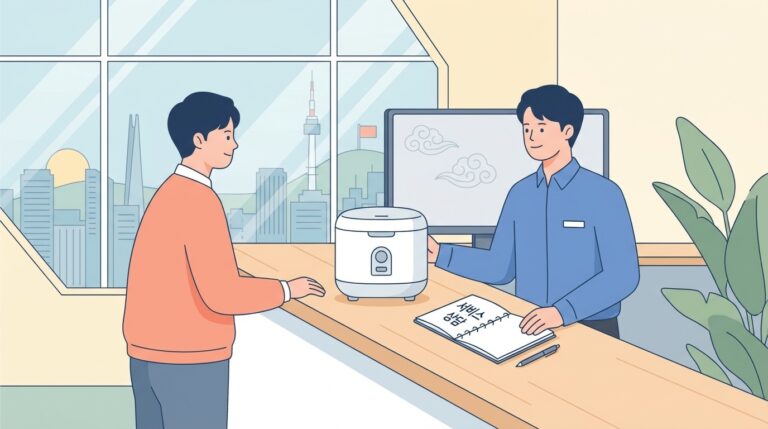
Setting: The Customer Service & A/S Center of a major tech conglomerate in Gangnam, Seoul. Sleek modern interior, quiet electronic ticket chimes, and glass partitions.
Characters:
* Alex (알렉스): Foreign tech researcher living in Seoul for 4 years; articulate and calm.
* Team Manager Park (박 팀장): Veteran customer quality assurance manager.
Turn 1
* Alex: 안녕하세요, 지난주 국가기술표준원에서 리콜 권고가 내려진 무선 충전기 건으로 방문했습니다.
(Annyeonghaseyo, jinanju gukgagisulpyojun-woneon-eseo rikol gwongoga naeryeojin museon chungjeon-gi geon-euro bangmunhaetseumnida.)
(Hello, I am visiting regarding the wireless charger model that received a recall recommendation from the Korean Agency for Technology and Standards last week.)
🎭 [Hands over the product and printout with both hands calmly]
Turn 2
* Manager Park: 아, 고객님. 해당 제품으로 심려를 끼쳐드려 대단히 죄송합니다. 제품 일련번호 확인 먼저 도와드리겠습니다.
(Ah, gogaeknim. Haedang jepum-euro simnyeoreul kkichyeodeuryeo daedanhi joesonghamnida. Jepum illyeonbeonho hwag-in meonjeo dowadeurigetseumnida.)
(Ah, valued customer. We apologize deeply for causing you concern with this product. Allow me to verify the product serial number first.)
🎭 [Bows head slightly and inputs serial code into the terminal]
Turn 3
* Alex: 네, 배터리 과열로 인한 발화 위험이 확인된 제조 라인 제품으로 알고 있습니다. 현재 자발적 리콜 대상에 포함되나요?
(Ne, baeteori gwa-yeol-lo inhan balhwa危険-i hwag-indoen jejo rain jepum-euro algo isseumnida. Hyeonjae jabaljeok rikol daesang-e pohamdoenayo?)
(Yes, I understand it belongs to the manufacturing line verified to have a combustion hazard caused by battery overheating. Is it currently included under the voluntary recall?)
🎭 [Speaks with a composed, deliberate pace without raising tone]
Turn 4
* Manager Park: 확인해 보니 리콜 대상 모델이 맞으십니다. 현재 본사 지침상 배터리 무상 교체 수리로 접수 도와드릴 수 있습니다.
(Hwag-inhae boni rikol daesang modeli majeusimnida. Hyeonjae bonsa jichimsang baeteori musang gyo-che suriro jeopsu dowadeuril su isseumnida.)
(Upon verification, it is indeed an eligible recall model. Under our head office policy, we can process it for complimentary battery replacement and repair.)
🎭 [Offers an apologetic, measured corporate smile]
Turn 5
* Alex: 제품 결함 공지를 확인했을 때는 단순 부품 교환뿐만 아니라 구매가 기준 전액 환불 조치도 선택 가능한 것으로 명시되어 있었는데요.
(Jepum gyeolham gongjireul hwag-inhaesseul ttaeneun dansun bupum gyohwanppunman anira gumaega gijun jeonaek hwanbul jochido seontaek ganeunghan geoseuro myeongsidoeeo isseotneundeyo.)
(When I reviewed the defect announcement, it explicitly stated that consumers could also choose a full refund based on the purchase price, rather than just simple parts replacement.)
🎭 [Points calmly to clause 3 on the official notice document]
Turn 6
* Manager Park: 아… 구매 영수증을 지참하셨다면 환불 접수도 가능하십니다만, 승인까지 영업일 기준 삼일 정도 소요될 수 있습니다.
(Ah… gumaeyeongsujeung-eul jichamhasyeotdamyeon hwanbul jeopsudo ganeunghasimnidaman, seung-in-kkaji yeong-eobil gijun samil jeongdo soyodoel su isseumnida.)
(Ah… If you brought the purchase receipt, refund processing is also possible, though authorization may take approximately three business days.)
🎭 [Checks the system notes and adjusts glasses thoughtfully]
Turn 7
* Alex: 네, 모바일 전자영수증과 결제 내역서 모두 출력해 왔습니다. 안전과 직결된 사안인 만큼 빠른 환불 집행 부탁드립니다.
(Ne, mobail jeonjayeongsujeunggwa gyeolje naeyeokseo modu chullyeokhae watseumnida. Anjeongwa jik-gyeoldoen saan-in mankeum ppareun hwanbul jiphaeng butakdeurimnida.)
(Yes, I brought both the mobile digital receipt and the payment statement. Since this is an issue directly tied to personal safety, I request swift refund processing.)
🎭 [Hands over the neatly stapled receipts across the desk]
Turn 8
* Manager Park: 철저히 준비해 주셔서 감사합니다. 접수증 발송해 드리고 우선 처리 부서로 이관하도록 하겠습니다.
(Cheoljeohi junbihae jusyeoseo gamsahamnida. Jeopsujeung balsonghae deurigo useon cheori buseoro igwanhadorok hagetseumnida.)
(Thank you for preparing so thoroughly. I will send your registration receipt and transfer this directly to our priority processing department.)
🎭 [Bows with genuine respect and prints confirmation ticket]
🔀 Interactive Branching Decision Point
Suppose Manager Park states: “Since you purchased this three months ago, we can only offer a repair, not a refund.” How do you respond?
- Option A: “장난해요? 본사에 전화해서 인터넷에 다 올려버릴 겁니다! 당장 팀장보다 높은 사람 나오라고 하세요!” (Are you joking? I’m going to call headquarters and post everything online! Bring someone higher than you right now!)
- Option B: “한국소비자원 분쟁해결기준상 안전 결함으로 인한 리콜 건은 구입 기간과 무관하게 환불 선택권이 보장되는 것으로 알고 있습니다. 확인 후 재안내 부탁드립니다.” (Under KCA dispute standards, I understand that recall cases caused by safety defects guarantee the right to choose a refund regardless of the purchase date. Please verify and advise again.)
- Option C: “아, 그렇군요… 그럼 어쩔 수 없네요. 그냥 무상 수리라도 맡겨야겠네요.” (Oh, I see… Nothing can be done then. I guess I’ll just leave it for complimentary repair.)
Feedback:
* Option A (Bad): Escalates conflict unnecessarily and risks being flagged for harassment (갑질/업무방해), shutting down cooperation.
* Option B (Best): Flawless C1 strategy. Citing the institutional baseline (한국소비자원 분쟁해결기준) with emotional poise leaves the manager no choice but to adhere to regulatory policy.
* Option C (Risk): Sacrifices your legal rights under Korean law and leaves you stuck with a potentially hazardous appliance.
Phase 6: 10-Second Emotion Shadowing Drill
Master the cadence of institutional assertiveness. The slash marks (/) represent brief rhythm pauses for maximum gravitas.
- [🧐 차분하고 단호하게 – Calm and resolute]
해당 제품은 / 안전 결함으로 인해 / 리콜 명령이 내려진 모델입니다.
(Haedang jepum-eun / anjeon gyeolham-euro inhae / rikol myeongnyeong-i naeryeojin model-imnida.)
(This product / due to a safety defect / is a model issued an official recall order.) -
[💼 전문적이고 정중하게 – Professional and polite]
단순 변심이 아닌 / 공공 안전 경보에 따른 사안이므로 / 규정에 따라 처리 바랍니다.
(Dansun byeonsim-i anin / gong-gong anjeon gyeongboe ttareun saan-imeuro / gyujeong-e ttara cheori baramnida.)
(As this is not a simple change of mind / but a matter concerning a public safety alert / please process it in accordance with regulations.) -
[🤝 상호존중을 담아 – Respectfully firm]
소비자 보호원 권고안에 맞춰 / 신속한 환불 절차를 진행해 주시기 바랍니다.
(Sobija boho-won gwongowane matchwo / sinsokhan hwanbul jeolchareul jinhaenghae jusigi baramnida.)
(In accordance with Consumer Protection Agency recommendations / please proceed with the expedited refund procedure.)
Phase 7: K-Culture Mini Dictionary
| Korean Term (Hanja) | Romanization & Literal | Real-World & Business Nuance |
|---|---|---|
| 1. 리콜 대상 (Recall 對象) | Rikol daesang “Recall target” |
Official designation for serial numbers or product batches that qualify for mandatory government or manufacturer returns. |
| 2. 제조물 책임법 (製造物 責任法) | Jejomul chaegim-beop “Product Liability Act” |
Commonly called the “PL Act.” The legal foundation holding manufacturers strictly liable for damages resulting from defects affecting consumer safety. |
| 3. 소비자분쟁해결기준 (消費者紛爭解決基準) | Sobijabunjaenghae-gyeol-gijun “Consumer Dispute Resolution Standards” |
Standardized government guidelines issued by the Fair Trade Commission specifying exact compensation formulas (exchanges, refunds, damages) across all product categories. |
| 4. 자발적 리콜 (自發的 Recall) | Jabaljeok rikol “Voluntary recall” |
When a corporation proactively recalls an item before a government agency issues a mandatory administrative order (강제 리콜), often used by corporations to demonstrate moral integrity and protect brand image. |
Phase 8: Traveler & Resident Survival Kit
Top 3 Immediate Survival Phrases
- 이 제품, 리콜 공지 뜬 거 맞죠?
(I jepum, rikol gongji tteun geo matjyo?)
Pro Tip: Use this at small reseller shops or electronics markets in Yongsan when you need to double-check inventory authenticity. - 안전 문제로 교환 접수하러 왔습니다.
(Anjeon munjero gyohwan jeopsuhareo watseumnida.)
Pro Tip: Clears up ambiguity immediately upon taking a ticket at any service center. - 접수증과 처리 확인서 발급해 주세요.
(Jeopsujeunggwa cheori hwag-inseo balgeubhae juseyo.)
Pro Tip: Always obtain official written proof of your request for recall resolution.
Editor’s Field Note: Essential Consumer Safety Resources
- Check Official Recall Databases: Before buying second-hand electronics on Danggeun Market (당근마켓) or Joonggonara (중고나라), search serial numbers directly on the Korea Consumer Agency Official Portal or the nationwide Happy Dream Consumer Comprehensive Support Portal.
- Emergency Hotlines: Dial 1372 (국번없이 1372) anywhere in Korea to access the government-operated Consumer Counseling Center for free dispute guidance.
Phase 9: 한 발 더 깊이 (One Step Deeper)
In Korean society, product safety is not merely a legal or technical compliance matter; it is fundamentally tied to societal trust (사회적 신뢰) and communal solidarity (공동체 의식). Korea’s rapid post-war modernization led to dense urban living environments, where a single domestic defect—such as an apartment building water heater failure or an electric scooter battery fire in an underground garage—can threaten hundreds of neighbors simultaneously.
Consequently, the Korean public responds intensely to how corporations handle defects. An earnest, rapid voluntary recall (자발적 리콜) accompanied by humble public transparency is celebrated as moral corporate behavior, whereas delaying fixes or downplaying risks (축소 은폐) can lead to swift, permanent brand cancellation (불매운동).
💬 Your Turn: Have you ever experienced a product safety issue or recall in your home country versus abroad? What cultural differences did you notice in how customer service handled your claim? Share your thoughts below!
Phase 10: FAQ & Avoiding Misunderstandings
Q: Can foreign residents file a complaint with the Korea Consumer Agency (1372)?
A: Absolutely. Foreign residents holding Alien Registration Cards (or even tourists who made qualifying retail purchases in Korea) have equal access to mediation services through the 1372 hotline and the Korea Consumer Agency portal. English interpretation support is also accessible via the Danuri Helpline or the 1345 Immigration Contact Center.
Q: Does a recall automatically entitle me to cash refund rather than repair?
A: Not always, but often yes for safety risks. Under the Fair Trade Commission’s Consumer Dispute Resolution Standards, if a defect poses a direct threat to bodily safety or property, consumers typically have the right to choose between an exchange (교환) or a full refund (환불), even if the company’s internal warranty guidelines state “repair only” (수리 우선).
Q: What should I do if the retailer refuses to help and tells me to contact the manufacturer directly?
A: Politely cite that under Korean commercial law, both the seller and manufacturer bear joint liability for safety defects. Say: “유통업체 역시 소비자 안전에 대한 공동 책임이 있으므로, 제조사로만 책임을 전가하지 마시고 접수를 도와주시기 바랍니다.” (Retailers also share joint responsibility for consumer safety; please do not defer full responsibility to the manufacturer and assist in processing my case.)
🚨 Common Mistakes Alert (흔한 실수 TOP 3)
- Mistake 1: Relying on colloquial slang like “환불각” or “망가졌어요” in formal disputes.
Correct Action: Use formal nominal phrases like 제품 하자 (product defect), 안전성 결함 (safety hazard), and 환불 조치 요망 (request for refund measure). - Mistake 2: Losing physical receipts.
Correct Action: In Korea, card approval slips (카드 매출전표) or electronic receipts from the store’s mobile app (e.g., Coupang, Naver Pay) hold the exact same legal validity as paper receipts. Save PDF copies immediately. - Mistake 3: Accepting informal verbal promises from service staff.
Correct Action: Always insist on an official record: “처리 예정 일자와 세부 조치 내용을 문자나 이메일로 발송해 주십시오.” (Please send the scheduled processing date and detailed action plan via text message or email.)
Phase 11: Action Missions
- 🥉 Bronze Mission (Solo Shadowing): Read Aloud Phase 6’s three emotion drills 5 times, matching the
/pause patterns and asserting steady pitch control. - 🥈 Silver Mission (Safety Detective): Check one household appliance or K-beauty device in your home. Find its model code (모델명) and serial number (제조번호) and look it up on the Korean Consumer Agency recall search bar.
- 🥇 Gold Mission (Real or Mock Practice): Practice the Phase 5 dialogue aloud with a Korean study partner or tutor, successfully choosing Option B and presenting simulated documentation.
- 🎮 K-Culture Mission: Watch a clip of an investigative Korean news report (search
뉴스데스크 리콜on YouTube) and note down at least two Sino-Korean nouns related to consumer safety used by the anchor.
Phase 12: Interactive Quiz Challenge
1. Situation Judgment Quiz
You discovered your electric kettle has been officially recalled due to an electrical leak hazard. The clerk says, “We can fix the switch for a 10,000 KRW parts fee.” What is the most appropriate C1-level response?
(A) “돈 없어요. 그냥 공짜로 고쳐 주세요.”
(B) “안전 결함으로 인한 정부 리콜 대상 제품이므로, 규정에 따른 전액 무상 조치를 요구합니다.”
(C) “장사 그렇게 하지 마세요. 인터넷에 올릴 거예요!”
2. Fill-in-the-Blank Quiz
제조업체가 결함을 인정하고 자체적으로 수거하는 조치를 ( ________ 리콜 )이라고 합니다.
Hint: It starts with ‘자’ (self/voluntary).
3. True or False Cultural Quiz
In Korea, shouting angrily at customer service desks is considered an effective, respected way to speed up recall compensation. (True / False)
👉 Click to reveal answers & explanations!
-
Answer: (B)
Explanation: Option (B) correctly cites the institutional ground (안전 결함 / 정부 리콜 대상) and formally demands non-chargeable remedy (무상 조치). Option (A) is too childish, and Option (C) risks legal exposure for obstruction of business. -
Answer: 자발적 (자발적 리콜 – Voluntary Recall)
Explanation: When a company undertakes a recall proactively before a state mandate, it is classified as a 자발적 리콜. -
Answer: False
Explanation: Aggressive yelling violates the Emotional Laborers Protection Act (감정노동자보호법) and usually leads to security intervention or legal warning. Professional, calm assertion grounded in official regulations is far more effective in Korea.







