

Phase 1: Empathy (Welcome & The Friction of Kagongjok)
안녕하세요! 매일한글 에디터입니다. (Hello! I’m your Daily Hangul editor.)
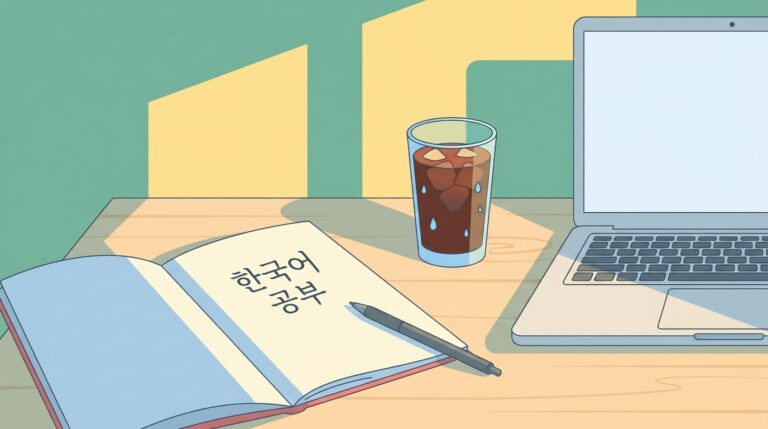
Picture this: You are tucked away in a sunlit boutique cafe in Yeonnam-dong. The lo-fi jazz is smooth, your laptop is hummed to life, and that iced Americano tastes pristine. Two hours pass in the blink of an eye. You feel inspired, productive, and completely in your element. But then, the afternoon rush begins. The tables around you fill up with office workers on their lunch break and friends sharing croffles. Suddenly, you catch the cafe owner’s gaze. They aren’t glaring, but they are wiping the empty table next to you for the third time in ten minutes with unmistakable vigor.
Welcome to one of the most intriguing cultural frontlines in modern South Korea: the delicate battle between the 카공족 (Kagongjok – people who study or work in cafes) and cafe owners fighting for 회전율 (hoejeonyul – table turnover rate).
Navigating this dynamic requires far more than basic conversational Korean. It calls for C2-level communicative competence: nuanced hedging, reading contextual social cues (눈치 – nunchi), and employing honorific softeners that protect interpersonal harmony while asserting your needs. In this masterclass, based on direct fieldwork and insights from long-term expatriates and native cafe owners, you will learn how to articulate complex social boundaries, negotiate study duration gracefully, and master the tacit codes of Korean urban cafe spaces.
Phase 2: Core Expressions Deep Dive
Here are three advanced expressions designed to navigate cafe dwell-time and table turnover with absolute sophistication.
1. 혹시 매장 이용 시간에 제한이 따로 있나요? (Hoksi maejang iyong sigane jehanni ttaro innayo?)
- Pronunciation: [Hok-shi mae-jang ee-yong shi-gan-e je-han-ee tta-ro in-na-yo?] (Think of ‘Hok-shi’ like the gentle intake of breath before asking an exploratory question: “Hoke-shee”).
- Meaning: Literal: “By any chance, is there a separate limit on store usage time?” / Nuance: A proactive, polite inquiry that signals you are aware that space comes at a cost, preemptively acknowledging the owner’s business needs.
- K-Culture Moment: You will hear this phrase in slice-of-life K-dramas whenever a graduate student settles down in an indie cafe with a massive stack of legal or medical textbooks.
- Editor’s Insight: Using the adverb 혹시 (hoksi – by any chance) at the start softens the question immensely. Pairing it with 따로 (ttaro – separately/specifically) shows you know many cafes operate under unwritten rules rather than rigid corporate policies.
- Situation Spectrum: Casual: ⚠️ | Semi-formal: ✅ | Formal: ✅
- 🤔 Think About It: In many Western cafes, occupying a table until closing time without asking is taken for granted once you buy a drip coffee. Why does Korean cafe culture require proactive checking of implicit limits?
2. 오래 앉아 있기 좀 눈치 보여서 한 잔 더 주문하려고요. (Orae anja itgi jom nunchi boyeoseo han jan deo jumunharyeogoyo.)
- Pronunciation: [Oh-rae an-ja it-gi jom noon-chi bo-yeo-seo han jan deo joo-moon-ha-ryeo-go-yo.] (The word ‘Nunchi’ rolls naturally off the tongue, rhythmic like “noon-chee”).
- Meaning: Literal: “Because it shows nunchi to sit for a long time, I’m going to order one more cup.” / Nuance: “I feel self-conscious lingering this long on one drink, so I want to be fair and buy another round.”
- K-Culture Moment: Often shared casually over the phone or to a study buddy when the cafe begins getting crowded and the staff starts switching the playlists to upbeat K-pop to accelerate table turnover.
- Editor’s Insight: 눈치 보이다 (nunchi boida) is an invaluable passive psychological construct in Korean. It denotes that you perceive the unspoken social pressure around you. Explicitly voicing this to a cafe owner or friend demonstrates peerless socio-pragmatic maturity.
- Situation Spectrum: Casual: ✅ | Semi-formal: ✅ | Formal: ⚠️
- 🤔 Think About It: How does verbalizing your own feeling of social discomfort actually ease social friction rather than escalate it in Korean collectivist spaces?
3. 손님 몰리는 시간대라 슬슬 비켜 드려야겠네요. (Sonnim mollineun sigandaera seulseul bikyeo deuryeoyagenneyo.)
- Pronunciation: [Son-nim mol-li-neun shi-gan-dae-ra seul-seul bee-kyeo deu-ryeo-ya-gen-ne-yo.] (Pronounce ‘seulseul’ softly, resembling the English sound “sool-sool”, evoking a gradual, quiet departure).
- Meaning: Literal: “Because it’s the time period when guests flock in, I should gradually make way.” / Nuance: “Peak hours have started, so out of consideration for business turnover, I’ll wrap up and leave the table free.”
- K-Culture Moment: Spoken by considerate professionals in urban business hubs like Gangnam or Yeouido as the 12:30 PM post-lunch crowd pours into neighborhood cafes.
- Editor’s Insight: The use of 슬슬 (seulseul – gently/gradually) paired with the humble benefactive verb 비켜 드리다 (bikyeo deurida – to clear way for someone’s benefit) transforms a mundane exit into an act of supreme civic courtesy.
- Situation Spectrum: Casual: ⚠️ | Semi-formal: ✅ | Formal: ✅
- 🤔 Think About It: Notice that you are framing leaving the cafe as a service offered to the proprietor (-드리다). What does this reveal about reciprocity in Korean business encounters?
Phase 3: Textbook Korean vs. Real Korean
Situation 1: Asking if it is okay to work on a laptop for several hours
- 📖 교과서 한국어 (Textbook Korean): 여기서 노트북을 사용해도 됩니까? (Yeogiseo noteubugeul sayonghaedo doebnikka? – May I use a notebook computer here?)
- 🗣️ 진짜 한국어 (Real Native Korean): 혹시 여기서 노트북 작업 좀 오래 해도 괜찮을까요? (Hoksi yeogiseo noteubuk jageop jom orae haedo gwaenchaneulkkayo? – By any chance, would it be alright if I work on my laptop here for a little while?)
- 💡 왜 다를까? (Why is it different?): Textbook Korean focuses on mechanical permission (
-해도 됩니까). Real-life native speech employs indirect softeners: 작업 (jageop – work/tasks) sounds purposeful, while 좀 (jom – a bit) and conditional interrogatives (-괜찮을까요?) preempt any blunt imposition.
Situation 2: Ordering a second drink because you plan to extend your study session
- 📖 교과서 한국어 (Textbook Korean): 시간이 지났으니 커피 한 잔을 더 주문하겠습니다. (Sigani jinasseuni keopi han janeul deo jumunhagetseumnida. – Since time has passed, I will order one more cup of coffee.)
- 🗣️ 진짜 한국어 (Real Native Korean): 제가 좀 더 머물 것 같아서, 아메리카노 한 잔 더 결제할게요! (Jega jom deo meomul geot gataseo, amerikano han jan deo gyeoljehalgeyo! – It looks like I’ll be staying a bit longer, so I’ll purchase one more Americano!)
- 💡 왜 다를까? (Why is it different?): Natives rarely state chronological obligations stiffly. Instead, they use hedging clauses like -ㄹ 것 같다 (-l geot gata – it seems that…) and take proactive financial action (결제할게요 – I will pay for…) to establish mutual goodwill.
Phase 4: K-Culture Deep Dive & Non-Verbal Etiquette
4-1. 눈치 (Nunchi) & Spatial Body Language
In a bustling Seoul cafe, table turnover is monitored through non-verbal choreography. Here is how to read the atmosphere:
1. The Audio Transition: Notice when background music shifts from subdued acoustics to upbeat, bass-heavy tracks. Cafe owners frequently adjust tempo to stimulate subconscious turnover.
2. The Periphery Sweep: If the barista starts making eye contact while tidying up condiments, trays, or the water counter, it is an unspoken indicator that floor space has reached maximum capacity.
3. Desk Footprint Management: True cafe decorum dictates that one customer occupies one seat. Spreading a backpack across a four-top table while studying solo violates collective etiquette. If couples or groups enter and look around aimlessly, gathering your chargers and moving to a one-person window counter is an elite demonstration of nunchi.
4-2. Cultural Code Analysis: The “Third Place” Paradox
Why do Koreans flock to cafes to study despite owning hyper-fast residential internet? In dense metropolitan environments like Seoul, apartments often lack private, distraction-free spatial buffers, especially for young adults living with parents or in cramped one-rooms (studio apartments). Cafes fulfill Ray Oldenburg’s classic sociological concept of the “Third Place”—a semi-public living room.
However, this cultural habit clashes with the harsh economic realities of cafe operations: high commercial rents in trendy districts, soaring electricity bills from laptop chargers, and low retail margins on single beverage orders. This friction has birthed polarized trends across Korea: specialized 스터디 카페 (Study Cafes) equipped with noise-canceling booths versus aesthetic indie cafes posting 노스터디존 (No-Study Zone) signs. Mastering this cultural nuance allows you to pick the right venue for your intentions without unintentional conflict.
Phase 5: Real-World Roleplay Scenario
Setting: A stylish, boutique cafe near Sinchon University district on a rainy Wednesday afternoon. The counter is lined with pour-over drippers.
Characters:
* Minji (민지): A considerate graduate researcher preparing a thesis proposal.
* Boss Park (박 사장): An independent cafe owner balancing artisan hospitality with commercial margins.
Turn 1: Minji
(Approaches the counter with an empty cup in hand and a warm, apologetic smile)
저기, 사장님! 커피가 너무 맛있어서 집중이 잘 되더라고요.
(Jeogi, sajangnim! Keopiga neomu masisseoseo jipjungi jal doedeoragoyo.)
“Excuse me, Boss! The coffee was so delicious that I was able to concentrate really well.”
Turn 2: Boss Park
(Polishing a mug, his tired face brightening slightly at the compliment)
아, 그래요? 입에 맞으셨다니 다행이네요. 공부하시는 분들 많죠, 오늘.
(A, geuraeyo? Ibe majeusyeoddani dahaengineyo. Gongbuhasineun bundeul manchyo, oneul.)
“Ah, really? I’m glad it suited your palate. We have quite a few people studying today, don’t we?”
Turn 3: Minji
(Glancing around at the incoming lunchtime crowd, modulating her vocal tone to sound discreet)
네, 그런데 점심시간이라 손님이 꽤 많이 들어오네요. 혹시 제가 너무 오래 자리를 차지했나요?
(Ne, geureonde jeomsimsiganira sonnimi kkwae mani deureo-oneyo. Hoksi jega neomu orae jarireul chajihaennayo?)
“Yes, but quite a few customers are coming in since it’s lunch hour. Have I monopolized the seat for too long by any chance?”
Turn 4: Boss Park
(Waving a hand dismissively, though visibly appreciating her self-awareness)
아닙니다! 아직 2인 테이블은 여유가 있어요. 그래도 점심 피크 때는 회전율이 좀 신경 쓰이긴 하죠.
(Animnida! Ajik i-in teibeureun yeoyuga isseoyo. Geuraedo jeomsim pikeu ttaeneun hoejeonyuri jom singyeong sseu-igin hajyo.)
“Not at all! There are still two-person tables available. Still, during the lunch peak, turnover is something I have to keep in mind.”
Turn 5: Minji
(Placing a pastry plate and fresh order card onto the counter tray promptly)
당연하죠! 제가 한두 시간 더 작업할 것 같아서요, 디저트랑 아메리카노 한 잔 더 주문할게요.
(Dang-yeonhajyo! Jega handu sigan deo jageophal geot gataseoyo, dijeoteurang amerikano han jan deo jumunhalgeyo.)
“Naturally! It looks like I’ll be working for another hour or two, so I’d like to order a dessert and another Americano.”
Turn 6: Boss Park
(Impressed by her consideration, offering an encouraging nod)
어휴, 매너가 너무 좋으시네요. 그럼 제가 새로 내린 원두로 정성껏 준비해 드릴게요.
(Eohyu, maeneoga neomu joeusineyo. Geureom jega saero naerin wonduro jeongseongkkeot junbihae deurilgeyo.)
“Oh, you have wonderful manners! In that case, I will prepare it meticulously with our freshly roasted beans.”
Turn 7: Minji
(Pointing toward a smaller side table near the window)
감사합니다! 4인 테이블은 다른 분들 앉으시게 안쪽 창가 1인석으로 옮겨 둘게요.
(Gamsahamnida! Sa-in teibeureun dareun bundeul anjeusige anjjok changga irinseogeuro olmgyeo dulgeyo.)
“Thank you! I’ll move over to the one-person window seat inside so groups can take this four-person table.”
Turn 8: Boss Park
(Smiling warmly and handing her the buzzer)
고마워요, 편하게 공부하다 가세요!
(Gomawoyo, pyeonhage gongbuhada gaseyo!)
“Thank you! Please make yourself comfortable and study as long as you need!”
🔀 Interactive Branching Moment
Suppose you have been sitting at a two-top table for three hours, and the owner sets down a glass of tap water at your table with a polite smile, saying:
“손님, 오늘 매장에 대기 손님이 좀 계셔서요…” (Sonnim, oneul maejange daegi sonnimi jom gyesyeoseoyo… – “Guest, we have several waiting parties in the shop today…”)
How do you respond?
- Option A: “아, 몰랐네요. 테이크아웃 잔으로 바꿔주시면 바로 일어날게요!” (Ah, I didn’t realize. If you could transfer this to a takeout cup, I’ll get going right away!)
- Option B: “저 아직 음료 남았는데요? 조금만 더 앉아 있다 갈게요.” (My drink is still left, though? I will sit here a bit longer before leaving.)
- Option C: “죄송한데, 그럼 추가 주문하면 계속 앉아 있어도 되나요?” (I’m sorry, but if I place an additional order, am I allowed to keep sitting here?)
Scenario Analysis:
- Option A (Best): Pure cultural mastery. You read the indirect cue instantly. By requesting a takeout cup, you save face for both yourself and the owner, clearing valuable turnover real estate immediately without friction.
- Option B (Bad): High interpersonal risk. Insisting on drink residue ignores the owner’s gentle face-saving intervention (체면 – chaemyeon). It labels you as an inconsiderate 진상 (jinsang – nuisance customer).
- Option C (Risk): Context-dependent. If the queue consists of larger dining groups waiting for tables, throwing money at another drink won’t solve their capacity bottleneck. However, if the owner simply needs higher revenue per seat hour, this may be acceptable—provided you ask with immense humility.
Phase 6: 10-Second Emotion Shadowing Drill
Train your intonation, breath control, and emotional nuance. Slashes (/) indicate natural breath pauses.
[😊 정중하고 조심스럽게 / Courteously & Cautiously]
저기 사장님, / 제가 좀 오래 앉아 있었죠? / 음료 한 잔 더 / 결제해 드릴게요!
(Jeogi sajangnim, / jega jom orae anja isseotjyo? / Eumnyo han jan deo / gyeoljehae deurilgeyo!)-
[💡 눈치 빠르고 산뜻하게 / Quick-Witted & Cheerful]
손님들 많이 들어오시네요! / 저는 마침 다 끝났으니까 / 슬슬 일어나겠습니다.
(Sonnimdeul mani deureo-osineyo! / Jeoneun machim da kkeutnasseunikka / seulseul ireonagetseumnida.) -
[🥺 미안함을 담아 상냥하게 / Apologetically & Amiably]
혹시 대기 생기면 / 바로 말씀해 주세요. / 노트북 정리하고 / 비켜 드릴게요!
(Hoksi daegi saenggimyeon / baro malsseumhae juseyo. / Noteubuk jeongnihago / bikyeo deurilgeyo!)
Phase 7: K-Culture Mini-Dictionary
-
카공족 (Kagongjok)
Literal translation: Cafe Study Tribe.
Contextual usage: A blend of 카페 (Cafe) and 공부하는 족 (Studying Tribe). Commonly used in cultural journalism and everyday banter to describe students and telecommuters who colonize cafe booths for prolonged intellectual work. -
회전율 (Hoejeonyul)
Literal translation: Turnover rate.
Contextual usage: Primarily a business metric (매장 회전율), but widely spoken among native urbanites when evaluating whether staying at a restaurant or cafe is socially acceptable: “여긴 회전율 빨라서 눈치 보여.” (“Turnover is so fast here, I feel pressured.”) -
1인 1음료 (Irin Il-eumnyo)
Literal translation: One drink per person rule.
Contextual usage: A standard policy across virtually all Korean specialty cafes. Splitting one pastry and one beverage between two laptop users is considered a major cultural faux pas. -
콘센트 난민 (Konsenteu Nanmin)
Literal translation: Wall outlet refugees.
Contextual usage: A humorous modern neologism describing customers who pace around cafes peering under tables and behind benches seeking an unblocked 220V electrical outlet for their devices.
Phase 8: Traveler’s Survival Kit
Top 3 On-the-Ground Phrases:
- 콘센트 있는 자리로 옮겨도 될까요? (Konsenteu inneun jariro olmgyeodo doelkkayo?)
Pro Tip: Always ask before unplugging cafe equipment or shifting heavy armchairs across the floor. - 와이파이 비밀번호 영수증에 적혀 있나요? (Wa-i-pa-i bimilbeonho yeongsujeunge jeokhyeo innayo?)
Pro Tip: In 90% of Korean cafes, the Wi-Fi credentials and restroom door passcode are printed right at the bottom of the purchase receipt. - 남은 음료 테이크아웃 잔에 담아주실 수 있나요? (Nameun eumnyo teikeu-aut jane damajusil su innayo?)
Pro Tip: Korean environmental law prohibits single-use plastic cups inside the cafe if you choose 매장 이용 (dine-in), but staff will gladly repackage your drink into paper or takeout plastic upon departure.
Editor’s Travel Note: Navigating Digital Cafe Spots
Before embarking on a work session in Seoul, download the essential local mapping utilities. Skip Google Maps for urban navigation in South Korea; instead, use this link to check out 네이버 지도 앱 다운로드 (Naver Map App Download). Type in keywords like “작업하기 좋은 카페” (Cafes great for laptop work) or “스터디 카페” (Study Cafe). Read user reviews specifically checking for “콘센트 많음” (plenty of outlets) to save yourself from awkward confrontation before you even order your beverage.
Phase 9: A Deeper Step: Spatial Etiquette and Collective Space
Language is never detached from spatial politics. In South Korea, public and semi-public spaces are traditionally governed by an implicit social contract rooted in collective mindfulness: 배려 (baeryeo – considerate accommodation). While a Western commercial exchange often defines a consumer’s space as sovereign property for the duration of the purchase, Korean social geography perceives a cafe chair as a shared civic resource momentarily loaned to you. When you voluntarily clear your table during a rush, you aren’t just giving up a seat; you are participating in the quiet preservation of communal equilibrium.
💬 Your Turn: Have you ever experienced an awkward encounter while working on a laptop in a foreign cafe? How do people in your home culture negotiate the boundary between paying customers and prolonged table occupancy? Share your perspective in the comments below!
Phase 10: FAQ & Common Pitfalls
Q: Is it truly rude to study in Korean cafes for more than two hours?
A: Not inherently! It depends entirely on the venue type. At large multi-story corporate franchises (like Starbucks, A Twosome Place, or Hollys Coffee), staying three to four hours is generally normalized and widely accepted. However, in small independent bakeries, specialized drip-coffee bars, or trendy cafes with under ten tables, staying past two hours without ordering additional refreshments is viewed as inconsiderate.
Q: Can I leave my laptop and backpack on the table while I grab a 45-minute lunch outside?
A: While Korea is internationally famous for low petty theft—meaning your laptop will almost certainly remain untouched—reserving a table with your belongings while you leave the premises to eat lunch elsewhere (자리 맡아두기) is heavily frowned upon by both owners and other patrons.
Q: What should I do if a cafe has a sign that reads “노스터디존” (No-Study Zone)?
A: Respect the policy immediately. This indicates the owner has faced turnover or ambiance issues in the past and wishes to preserve an environment strictly for conversation and relaxation. Do not attempt to negotiate laptop use in these venues; simply save your work for a nearby franchise or dedicated study lounge.
🚨 Common Mistakes Warning Board
- Mistake: Plugging in multi-plug surge protectors to charge a laptop, tablet, and smartphone simultaneously on one outlet.
Correct Action: Charge one device discreetly, or carry a high-capacity portable power bank. - Mistake: Taking business Zoom calls with unmuted vocal chatter in a tranquil cafe.
Correct Action: Keep calls strictly text-based, or step outside the cafe doorway for brief verbal exchanges. - Mistake: Assuming that paying for a single espresso grants unlimited rights to a 4-person booth.
Correct Action: Default to single-counter seating or compact two-top tables whenever you are working alone.
Phase 11: Action Missions
- 🥉 Bronze Mission (Solo Shadowing):
Stand in front of a mirror and recite Expression #2: “오래 앉아 있기 좀 눈치 보여서 한 잔 더 주문하려고요.” five times, ensuring your intonation sounds warm, natural, and rhythmically cohesive. - 🥈 Silver Mission (Community Engagement):
Share in our comments or your personal language diary your favorite Korean phrase for showing consideration (배려), explaining why the Korean concept of nunchi resonates with you. - 🥇 Gold Mission (Real-World Execution):
The next time you visit a cafe in Korea or an authentic Korean-run cafe in your hometown, order an additional beverage or pastry using the phrase: “작업이 좀 길어져서 음료 한 잔 더 주문할게요!” and observe the welcoming response from the staff! - 🎮 K-Culture Mission:
Watch an episode of an urban K-drama (such as Work Later, Drink Now or Crash Course in Romance). Spot a scene set in a cafe and analyze whether the characters are studying, chatting, or checking their surroundings for open seats.
Phase 12: Interactive Quiz Challenge
Test your situational mastery and linguistic instinct below!
1. Situational Judgment:
You have been working in a cozy indie cafe for 2.5 hours. It is 1:00 PM, and the small room is completely packed with waiting patrons standing by the counter. What is the most culturally adept action to take?
(A) Put on noise-canceling headphones and order a glass of complimentary ice water.
(B) Order three extra drinks and demand to keep the 4-person table.
(C) Politely request the staff to transfer your remaining coffee into a takeout cup and vacate the table.
👉 Click to reveal Answer & Explanation
Correct Answer: (C)
Explanation: At peak turnover moments in compact cafes, physical space is of greater value to the owner than small incremental beverage sales. Offering to take your drink to-go showcases elite C2 socio-cultural fluency.
2. Fill-in-the-Blank:
Complete the sentence using the natural hedging adverb meaning “by any chance”:
“( ) 매장 이용 시간에 제한이 따로 있나요?”
👉 Click to reveal Answer & Explanation
Correct Answer: 혹시 (Hoksi)
Explanation: 혹시 is the ultimate polite conversational buffer in Korean, transforming a potentially invasive inquiry into a soft, considerate question.
3. True or False Cultural Quiz:
True or False: In South Korea, it is considered completely acceptable to leave your laptop unattended on a cafe table for an hour while going to an adjacent building to have lunch, because public safety is high.
👉 Click to reveal Answer & Explanation
Correct Answer: False
Explanation: While theft is exceptionally rare, monopolizing a commercial seat while not physically present (자리 맡아두기) during operational hours is widely regarded as selfish and poor cafe etiquette (비매너).







