

Phase 1: 공감 (Story-Driven Opening)
안녕하세요! 매일한글 에디터입니다.
Imagine this scene straight out of a slice-of-life K-Drama: It’s 11:58 AM in a bustling Seoul office building or university hallway. Monitors begin snapping shut, chairs scrape against the floor, and a friendly wave of people moves toward the elevator. Suddenly, your Korean friend or coworker turns toward you with a bright smile and asks, “점심 먹었어요? (Jeomsim meogeosseoyo?)”
Your mind races. Wait, are they inviting me to eat right this second? Are they asking because they already had their meal? What if I already grabbed a kimbap from the convenience store—will I sound rude?
If you have ever frozen in place when dealing with daily meal invitations in Korea, take a deep breath. You are definitely not alone! Lunch in Korea is far more than just a biological refueling session during your daily routine—it is a cherished cultural ritual of empathy, bonding, and workplace survival. In this guide, tailored specifically for A1 beginners, we will break down the essential phrases you need so you can confidently accept invitations, order like a pro, and navigate lunchtime etiquette without feeling lost. Let’s dig in!
Phase 2: 핵심 표현 3선 심층 분석 (Top 3 Key Expressions)
1. 점심 먹었어요? (Jeomsim meogeosseoyo?)
- Pronunciation: Jeom-sim meo-geo-sseo-yo? (Think of the English sound: “Chum-seem mug-uh-ssuh-yo?” with a rising tone at the end)
- Meaning: Literal: “Did you eat lunch?” | Actual Nuance: “Hello, how are you doing today? I hope your day is going well!”
- K-Culture Moment: In the drama Hospital Playlist, doctors pass each other in the busy hallways and constantly greet one another with this question, showing genuine care amidst chaos.
- Editor’s Insight: Do not treat this only as a yes/no factual question. In Korea, asking about someone’s meal is one of the warmest ways to say “I care about your well-being.” If you haven’t eaten, they might immediately follow up with an invitation!
- Situation Spectrum:
- Casual (Friends): ⚠️ (Use “점심 먹었어? (Jeomsim meogeosseo?)” instead)
- Semi-formal (Coworkers/Classmates): ✅
- Formal (Clients/Elders): ✅ (Or the honorific: “식사하셨어요? (Siksahasyeosseoyo?)”)
- 🤔 Think About It: In English, we usually ask “How are you?” or comment on the weather. Why do you think Korean society developed greetings centered around eating rice and meals?
2. 같이 점심 먹어요 (Gachi jeomsim meogeoyo)
- Pronunciation: Ga-chi jeom-sim meo-geo-yo (Think of: “Gah-chee chum-seem mug-uh-yo” – remember that t-i combines into a soft “chee” sound!)
- Meaning: Literal: “Together lunch let’s eat.” | Actual Nuance: “Let’s grab lunch together!”
- K-Culture Moment: When the main leads in Business Proposal take their relationship from formal work colleagues to friendly lunch buddies, this is the magical icebreaker phrase.
- Editor’s Insight: 같이 (Gachi) means “together.” It instantly lowers social distance. If you want to make friends in a Korean workplace or school, dropping this line with a warm smile is your golden key.
- Situation Spectrum:
- Casual (Friends): ⚠️ (Say “같이 점심 먹자 (Gachi jeomsim meokja)”)
- Semi-formal (General everyday use): ✅
- Formal (Senior boss/Directors): 🚫 (Too casual; use “점심 식사 같이 하시겠습니까?”)
- 🤔 Think About It: How do you invite people to lunch in your home culture? Do you plan days ahead, or is it spontaneous like in Korea?
3. 맛있게 드세요 (Mas-itge deuseyo)
- Pronunciation: Ma-sit-ge deu-se-yo (Flows naturally as: “Mah-sheet-geh duh-seh-yo”)
- Meaning: Literal: “Eat deliciously.” | Actual Nuance: “Enjoy your meal! / Bon appétit!”
- K-Culture Moment: In any Korean reality cooking show like Jinny’s Kitchen, cast members cheerfully chime this phrase to guests right as steaming plates land on the table.
- Editor’s Insight: Before eating, you say “잘 먹겠습니다 (Jal meokkketseumnida – I will eat well)”. But to the people sitting around you or the table next to you, you say “맛있게 드세요”. It spreads good vibes instantly.
- Situation Spectrum:
- Casual (Friends): ⚠️ (Say “맛있게 먹어 (Mas-itge meogeo)”)
- Semi-formal: ✅
- Formal: ✅
- 🤔 Think About It: Isn’t it wonderful that Korean has dedicated phrases celebrating the deliciousness of the food before anyone even takes the first bite?
Phase 3: 교과서 한국어 vs 진짜 한국어 (Textbook vs. Real-Life Korean)
Situation 1: Suggesting Lunch to a Peer
- 📖 교과서 한국어 (Textbook Korean):
우리 지금 점심 식사를 하러 갑시다. (Uri jigeum jeomsim siksa-reul hareo gapsida. / Let us depart to have our luncheon now.) - 🗣️ 진짜 한국어 (Real-Life Korean):
점심 먹으러 가요! (Jeomsim meogeureo gayo! / Let’s go grab lunch!) - 💡 왜 다를까? (Why is it different?):
“식사 (Siksa)” is formal and sounds like a diplomatic schedule item. Native speakers in daily life prefer using the action verb phrase “점심 먹으러 가요” which sounds lively, natural, and inviting.
Situation 2: Asking if a Colleague has Eaten
- 📖 교과서 한국어 (Textbook Korean):
당신은 점심 식사를 완료했습니까? (Dangsin-eun jeomsim siksa-reul wallyohaetseumnikka? / Have you completed your midday dining?) - 🗣️ 진짜 한국어 (Real-Life Korean):
밥 먹었어요? (Bap meogeosseoyo? / Did you eat?) - 💡 왜 다를까? (Why is it different?):
“당신 (Dangsin)” should almost never be used with coworkers or casual acquaintances, and “완료하다 (to complete)” sounds like a factory operation! Simply saying “밥 먹었어요?” covers everything naturally.
Phase 4: K-Culture 딥다이브 & 비언어적 매너 (Culture Deep Dive & Non-Verbal Manners)
4-1. 눈치 (Nunchi) & Table Manners
When you sit down at a Korean lunch restaurant, your subtle cultural radar (눈치 – Nunchi) comes into play:
1. The Napkin & Utensil Setup: Never wait for someone else to set your table. Look for the cutlery box on the side of the table or drawer underneath. Pull out a paper napkin, place it neatly in front of your dining companions, and lay their spoon and chopsticks on top.
2. The Water Cup Courtesy: The youngest or newest member at the table usually fills everyone else’s stainless steel cup with cold water before pouring their own.
3. The First Spoon Rule: Always wait for the oldest person or senior colleague at the table to lift their spoon and take the first bite before you start digging in.
4-2. Culture Code: “밥심 (Bapsim)” & Sharing Side Dishes
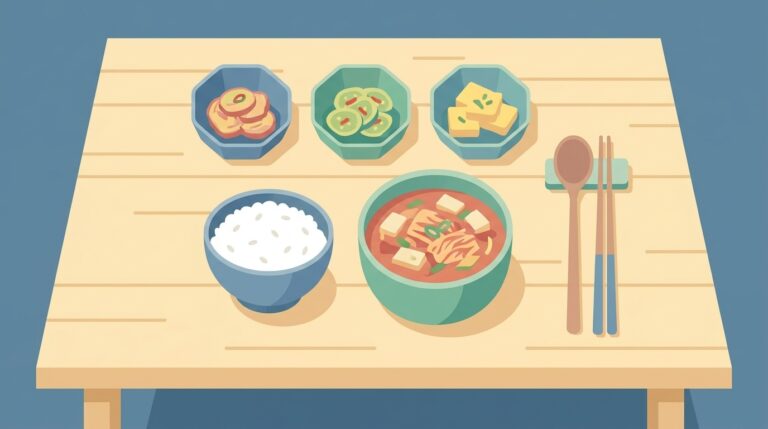
In Korea, there is a famous proverb: “한국인은 밥심으로 산다 (Koreans live on the strength of rice).” Lunch is viewed as the fuel that powers you through the afternoon. Furthermore, most lunch spots serve shared side dishes (반찬 – Banchan). Sharing these side dishes represents communal connection (정 – Jeong). Don’t hesitate to ask for refills—banchan is almost always free and limitless!
Phase 5: 실전 롤플레이 시나리오 (Real Roleplay Scenario)
Setting: It is 12:10 PM. You and your friendly Korean coworker, Minjun (민준), are sitting at a bustling Doenjang-jjigae (soybean paste stew) restaurant near your office.
- Turn 1 (Minjun):
배고파 죽겠어요. 오늘 점심 뭐 먹고 싶어요?
(Baegopa jukgesseoyo. Oneul jeomsim mwo meokgo sipeoyo?)
🎭 Rubbing his stomach with an exhausted laugh.
“I’m starving to death. What do you want to eat for lunch today?” -
Turn 2 (You):
찌개 어때요? 다 좋아요!
(Jjigae eottaeyo? Da joayo!)
🎭 Looking at the menu on the wall with bright eyes.
“How about stew? Anything is good for me!” -
Turn 3 (Minjun):
좋아요! 여기 된장찌개 2인분 주세요!
(Joayo! Yeogi doenjangjjigae i-inbun juseyo!)
🎭 Raising his hand slightly toward the bustling server.
“Great! Over here, two servings of soybean paste stew, please!” -
Turn 4 (You):
제가 물 따라 드릴게요.
(Jega mul ttara deurilgeyo.)
🎭 Grabbing the cold metal water pitcher and filling Minjun’s cup first.
“I will pour the water for you.” -
Turn 5 (Minjun):
오, 센스 만점인데요? 고마워요!
(O, senseu manjeom-indeyo? Gomawoyo!)
🎭 Nodding gratefully with both hands on the table.
“Oh, 10 out of 10 for manners! Thank you!” -
Turn 6 (Server):
음식 나왔습니다. 맛있게 드세요!
(Eumsik nawasseumnida. Mas-itge deuseyo!)
🎭 Placing bubbling stone pots and steaming bowls of rice on the table.
“Food is served. Enjoy your meal!” -
Turn 7 (You):
잘 먹겠습니다! 맛있게 드세요, 민준 씨!
(Jal meokkketseumnida! Mas-itge deuseyo, Minjun ssi!)
🎭 Clapping hands softly together and smiling at Minjun.
“Thank you for the meal! Enjoy your lunch, Minjun!” -
Turn 8 (Minjun):
네, 맛있게 먹어요!
(Ne, mas-itge meogeoyo!)
🎭 Lifting his spoon first to taste the broth.
“Yes, let’s eat delicious food!”
🔀 Interactive Choice Point
The meal is finished, and the bill of 18,000 KRW is sitting on the edge of the table. What do you do?
- Option A: Say “제가 낼게요! (Jega naelgeyo! – I will pay!)” and rush to hand your credit card to the cashier.
- Option B: Say “따로 계산해 주세요 (Ttaro gyesanhae juseyo – Separate checks, please)” directly to the cashier before discussing with Minjun.
- Option C: Pick up the receipt and politely ask Minjun, “얼마 보내드리면 될까요? (Eolma bonaedeurimyeon doelkkayo? – How much should I send you?)”.
Feedback:
* Option A [Risk]: While generous, if Minjun is senior, he might feel awkward or insist on paying instead. In Korea, junior team members aren’t expected to foot the bill.
* Option B [Bad]: In traditional Korean restaurants during peak lunch rush hours, asking for separate card swipes for small amounts can frustrate the busy staff.
* Option C [Best]: In modern Korea, one person pays at the counter and coworkers transfer their share via KakaoPay or bank transfer later! This shows top-tier social awareness.
Phase 6: 10초 감정 섀도잉 드릴 (10-Second Emotion Shadowing Drill)
Read aloud along with the emotional rhythm. Pay attention to the pauses marked with /!
[🤤 배고프고 신나게 / Starving & Eager]
배고파요! / 점심 / 먹으러 가요!
(Baegopayo! / Jeomsim / meogeureo gayo!)
“I’m hungry! Let’s go grab lunch!”-
[😊 따뜻하고 정답게 / Warm & Caring]
오늘 / 점심 / 맛있게 드셨어요?
(Oneul / jeomsim / mas-itge deusyeosseoyo?)
“Did you have a delicious lunch today?” -
[🙏 감사하고 활기차게 / Polite & Appreciative]
잘 먹겠습니다! / 맛있게 / 드세요!
(Jal meokkketseumnida! / Mas-itge / deuseyo!)
“I will eat well! Please enjoy your food!”
Phase 7: K-Culture 미니 사전 (K-Culture Mini Dictionary)
- 맛점 (Mat-jeom)
- Translation: Delicious lunch (Short for 맛있게 점심 먹기).
- Usage: Used heavily in messenger chats (KakaoTalk) around 11:30 AM: “다들 맛점하세요! (Everyone have a tasty lunch!)”.
- 더치페이 (Deochi-pei)
- Translation: Dutch pay (Splitting the bill evenly).
- Usage: When dining among peers or students: “우리 더치페이 해요 (Let’s split the bill).”
- 혼밥 (Hon-bap)
- Translation: Eating alone (Short for 혼자 밥 먹기).
- Usage: Korea used to have a strong group-dining culture, but 혼밥 restaurants with single booths are now widely loved everywhere in Seoul.
- 후식 (Hu-sik)
- Translation: Dessert / Post-meal coffee.
- Usage: Walking holding an iced Americano right after lunch is an unwritten Korean workplace ritual: “후식으로 커피 마시러 갈까요? (Shall we go grab coffee for dessert?)”.
Phase 8: 여행자를 위한 생존 키트 (Traveler’s Survival Kit)
TOP 3 Survival Phrases
- “여기 주문할게요!” (Yeogi jumunhalgeyo!)
- Meaning: “Excuse me, we’d like to order here!”
- Pro Tip: Don’t shout loudly; make gentle eye contact with the staff, raise your hand to shoulder height, and deliver this phrase clearly.
- “물은 셀프인가요?” (Mureun selpeu-ingayo?)
- Meaning: “Is water self-service?”
- Pro Tip: Look for water coolers with metal cups stacked upside down. Most casual Korean restaurants are self-serve for water!
- “계산해 주세요” (Gyesanhae juseyo)
- Meaning: “Check, please / Please calculate the bill.”
- Pro Tip: Bring the paper bill from your table directly to the counter near the exit.
Editor’s Travel Note
- Finding Great Lunch Spots: Skip Google Maps in Korea—it lacks live transit updates and localized food reviews. Instead, use the 네이버 지도 앱 다운로드 to search for “점심 맛집 (Lunch restaurants)”. Look for places packed with local office workers between 11:45 AM and 12:30 PM; that is your foolproof guarantee of authentic, delicious food!
- Card Payments: Tipping is 0% in Korea. Just tap your credit card or transit card when paying at the register.
Phase 9: “한 발 더 깊이” (Deeper Cultural Insight)
In many Western cultures, a greeting is separated from physical survival: you talk about greetings, health, or the weather. However, in Korean history—particularly during periods following the Korean War—poverty was rampant, and skipping meals was a daily reality. Asking “Have you eaten rice?” became the purest, most compassionate expression of love and solidarity: Are you surviving? Are you well?
Today, Korea is a modern powerhouse of gastronomy, yet this beautiful sentiment remains embedded in everyday vernacular. When a Korean asks you if you ate lunch, they are wrapping you in warmth and making sure your day is comfortable. It is the language of caring disguised as food.
💬 Your Turn: What is your favorite lunch comfort food when you’re having a busy day? Have you ever experienced a culture where food and daily greetings are connected? Tell us in the comments below!
Phase 10: FAQ & 오해 방지 (FAQ & Common Mistakes)
Q: Does asking “점심 먹었어요?” mean they are definitely offering to buy me food?
A: Not necessarily! About 50% of the time, it is simply a polite greeting equivalent to “How are you doing today?” If you answer “아직 안 먹었어요 (I haven’t eaten yet),” they might invite you, but do not assume it is an automatic free meal proposal.
Q: Can I sit at a table for 4 if I am eating alone (혼밥) during lunch rush hour?
A: Try to avoid this between 11:50 AM and 12:40 PM. Casual restaurants get completely slammed with office lunch crowds. If you are solo, look for single-diner bar seating or wait until 1:00 PM to sit comfortably without feeling rushed.
Q: What if I have dietary restrictions or cannot eat pork?
A: You can clearly say: “돼지고기 못 먹어요. (Dwaejigogi mot meogeoyo. / I cannot eat pork.)” or “고기 빼주세요. (Gogi bpae-juseyo. / Please exclude meat.)”.
🚨 흔한 실수 (Common Mistakes) TOP 3
- Mistake: Saying “식사 드세요” to friends.
- Correct Action: Say “맛있게 먹어! (Mas-itge meogeo!)” to friends and “맛있게 드세요! (Mas-itge deuseyo!)” to adults or colleagues.
- Mistake: Leaving chopsticks stuck vertically into your rice bowl.
- Correct Action: Rest them flat on the dish or cutlery rest. Sticking them upright resembles ancestral funeral incense offerings and is considered bad luck!
- Mistake: Picking up your rice bowl to eat near your mouth.
- Correct Action: Unlike in Japan or China, keep your rice bowl flat on the table and lift the food using your spoon.
Phase 11: 액션 미션 & 참여 유도 (Action Mission)
- 🥉 Bronze Mission: Stand in front of your mirror and practice saying “점심 먹으러 가요!” 3 times with a bright, welcoming smile.
- 🥈 Silver Mission: Next time you text a friend or Korean study partner around midday, send them “맛점하세요!” on KakaoTalk or Instagram DM.
- 🥇 Gold Mission: Step into a Korean restaurant or mart, make polite eye contact, and say “맛있게 드세요” or “잘 먹겠습니다” out loud!
- 🎮 K-Culture Mission: Watch any episode of a contemporary K-Drama this week. Listen closely during daytime workplace scenes and see if you can catch the character asking “점심 먹었어요?”!
Phase 12: 인터랙티브 퀴즈 챌린지 (Interactive Quiz Challenge)
Q1. (Situational Judgment) Your coworker arrives at their desk at 12:30 PM with a coffee in hand. You want to ask if they already had their meal. Which phrase is best?
* A) 점심 먹지 마세요! (Jeomsim meokji maseyo!)
* B) 점심 먹었어요? (Jeomsim meogeosseoyo?)
* C) 점심은 비쌉니다. (Jeomsim-eun bissamnida.)
👉 Click to Reveal Answer & Explanation
Answer: B) 점심 먹었어요?
Explanation: Option A means “Don’t eat lunch!” and Option C means “Lunch is expensive.” Option B is the natural, polite way to ask if they’ve eaten!
Q2. (Fill in the Blank) When food is placed on your table and you are ready to eat with coworkers, you say:
“잘 ________!” (I will eat well!)
👉 Click to Reveal Answer & Explanation
Answer: 먹겠습니다 (meokkketseumnida)
Explanation: “잘 먹겠습니다” literally translates to “I will eat well” and serves as the polite expression before enjoying a meal.
Q3. (True or False Cultural Trivia) In Korea, it is standard practice to split side dishes (반찬) with everyone at the table, and they can usually be refilled for free.
* True / False
👉 Click to Reveal Answer & Explanation
Answer: True!
Explanation: Banchan reflects Korea’s generous communal dining culture (Jeong). Don’t hesitate to ask the staff for more kimchi or sprouts!







