

Phase 1: 공감 (Story-Driven Opening)
안녕하세요! 매일한글 에디터입니다. (Hello! This is your Daily Hangul editor.)
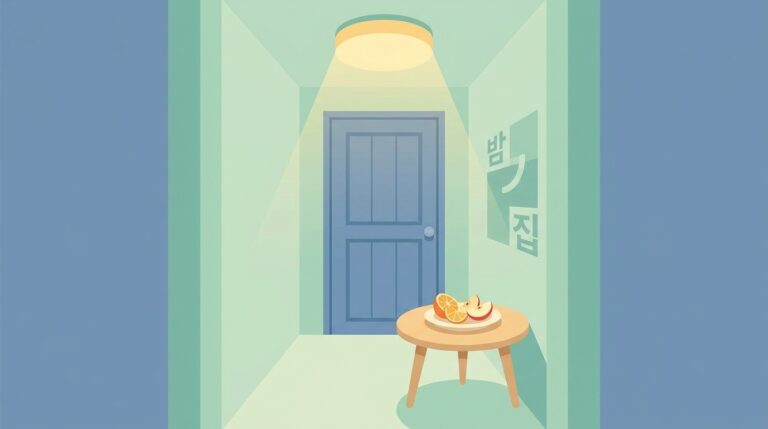
Picture this quintessential K-Drama scene: It is 10:45 PM on a drizzly Tuesday night in Daechi-dong, Seoul. The front door’s digital keypad beeps (삐-비-빅), and your fifteen-year-old child trudges in, carrying a backpack that weighs heavier than their adolescent angst. You have spent the evening anxiously rehearsing supportive words. You slice a crisp pear, arrange it carefully on a ceramic plate, and softly ask, “오늘 학원 어땠어? 밥은 챙겨 먹었어?” (How was hagwon today? Did you manage to eat?).
Instead of a warm family exchange, what do you receive? A muted, monosyllabic grunt—”어” (Yeah)—followed by the distinct, heart-sinking click of a bedroom door latching shut. The emotional drawbridge has been raised. You stand alone in the hallway, holding that cold plate of fruit, wondering when your bright, affectionate child turned into an impenetrable emotional fortress.
Parenting an adolescent navigating Sam-chun-gi (사춘기 – puberty/adolescence) in Korean culture is not merely a linguistic challenge; it is a delicate high-wire act of emotional calibration. The standard textbook phrases you learned in level-one Korean—like “무슨 일 있니?” (Is something the matter?)—often sound like an administrative interrogation to a guarded teen. In this masterclass guide, built upon real therapeutic discourse and feedback from international families living in Seoul, we are elevating your language to CEFR C2 proficiency. You will master the hyper-nuanced, non-intrusive linguistic cushions that dissolve defensiveness, bridge generational silences, and communicate unconditional presence without ever suffocating your child.
Phase 2: 핵심 표현 3선 심층 분석 (3 Core C2 Expressions)
1. 요즘 많이 버겁지? 네 속도대로 가도 돼.
- Pronunciation: [Yo-jeum ma-ni beo-geop-ji? Ne sok-do-dae-ro ga-do dwae.] (Phonetic cue: Think of ‘beo-geop’ as the heavy sensation of lifting a soggy winter coat, ending on a soft, lingering ‘ji’ sound).
- Meaning:
- Literal: Lately [it is] very heavy/beyond capacity, right? According to your own pace, going is okay.
- Pragmatic Nuance: “Things feel pretty overwhelming right now, don’t they? There is zero pressure to rush; you can move at whatever pace feels manageable to you.”
- K-Culture Moment: Think of the tender mother-daughter dynamics in Crash Course in Romance (일타스캔들) or the quiet emotional support in Reply 1988 (응답하라 1988). It is the line delivered when the child is visibly breaking under high-stakes academic or social pressure.
- Editor’s Insight: At the C2 level, note the profound semantic difference between 힘들다 (to be difficult/tired) and 버겁다 (to be physically or emotionally beyond one’s capacity to bear). 버겁다 acknowledges that the external burden is genuinely disproportionate to the child’s shoulders. By pairing it with the permissive marker -대로 (in accordance with), you dismantle the relentless Korean cultural trope of Ppalli-ppalli (hurry-hurry) and grant them sovereign autonomy.
- Situation Spectrum:
- Casual (반말): ✅ “요즘 많이 버겁지? 네 속도대로 가도 돼.”
- Semi-formal (존댓말): ⚠️ “요즘 많이 버거우시죠? 그쪽 속도대로 가셔도 돼요.” (Used for adult children or mentees)
- Formal: 🚫 (Too deeply intimate for strict business formal settings)
- 🤔 Think About It: In English, we often ask “Are you stressed?” which centers the individual’s mental reaction. In Korean, 버겁다 shifts the gaze to the sheer weight of the circumstance. How does acknowledging the weight of the circumstance rather than questioning the child’s coping stamina alter their willingness to open up?
2. 말하고 싶지 않을 땐 굳이 말 안 해도 돼. 그냥 옆에 있을게.
- Pronunciation: [Mal-ha-go sip-ji a-neul ttaen gu-ji mal an hae-do dwae. Geun-yang yeo-pe is-seul-ge.] (Phonetic cue: ‘Gu-ji’ sounds like ‘goo-jee’ with a soft, dismissive slide on the vowel).
- Meaning:
- Literal: When you don’t want to speak, you intentionally need not speak. Just, by your side, I will be.
- Pragmatic Nuance: “You don’t have to force conversation if you’re not ready. I am right here beside you, no explanations needed.”
- K-Culture Moment: Often seen in cinematic masterpieces like My Mister (나의 아저씨), where profound empathy is demonstrated not through inquisitiveness, but through shared, comfortable silence sitting on a bench or walking home together.
- Editor’s Insight: The adverb 굳이 (intentionally going out of one’s way, usually with a negative or futile implication) is a linguistic master-key in C2 Korean. By saying 굳이 말 안 해도 돼, you actively eliminate the child’s guilt for withholding details. The trailing promise 그냥 옆에 있을게 transforms physical proximity from surveillance into a secure sanctuary.
- Situation Spectrum:
- Casual (Intimate family): ✅ “말하고 싶지 않을 땐 굳이 말 안 해도 돼.”
- Polite Softening: ⚠️ “말씀하고 싶지 않으시면 굳이 안 하셔도 돼요.”
- Formal: 🚫 (Exclusively an intimate interpersonal phrase)
- 🤔 Think About It: In low-context Western dialogue, emotional processing typically requires verbal articulation (“Talk to me, tell me what happened”). Korean communicative architecture places immense value on Yeo-baek (여백 – empty margin/space). Can your presence alone serve as a complete grammatical sentence?
3. 엄마/아빠가 널 다 안다고 생각해서 미안해. 네 마음은 어때?
- Pronunciation: [Eom-ma/Ap-pa-ga neol da an-da-go saeng-gak-hae-seo mi-an-hae. Ne ma-eu-meun eo-ttae?] (Phonetic cue: Allow the ‘an-da-go’ to carry a slight drop in pitch, denoting humble self-correction).
- Meaning:
- Literal: Mom/Dad, because of thinking I know all of you, is sorry. What is your heart like?
- Pragmatic Nuance: “I’m sorry for assuming I knew everything you were going through without really asking. How does your heart actually feel?”
- K-Culture Moment: The climax of coming-of-age films like House of Hummingbird (벌새), where an adult authority figure finally relinquishes their presumed omniscience and sees the child as an independent emotional entity.
- Editor’s Insight: Confucian parenting scripts traditionally position the parent as the all-knowing guide. For a Korean parent to utter 널 다 안다고 생각해서 미안해 is a revolutionary disarming tactic. It fractures the hierarchical binary of teacher/student and shifts into peer-to-peer emotional validity. Inquiring 네 마음은 어때? rather than 생각이 어때? invites emotional introspection rather than cognitive justification.
- Situation Spectrum:
- Casual: ✅ “엄마가 널 다 안다고 넘겨짚어서 미안해. 네 마음은 어때?”
- Semi-formal: ⚠️ “제가 다 안다고 지레짐작해서 죄송해요. 심정이 어떠세요?”
- Formal: 🚫
- 🤔 Think About It: When you apologize for an epistemic assumption (“assuming I knew you”), you validate your child’s evolving identity as a separate individual. How does this challenge traditional hierarchical parenting?
Phase 3: 교과서 한국어 vs 진짜 한국어 (Textbook vs. Real Korean)
Scenario 1: Greeting your exhausted teenager after an intense day at school or Hagwon
- 📖 교과서 한국어 (Textbook):
- “오늘 학교 생활은 어떠하였습니까? 시험공부는 열심히 하였습니까?”
- (Oneul hakgyo saenghwareun eotteohayeosseumnikka? Siheomgongbuneun yeolsimhi hayeosseumnikka? / How was your school life today? Did you study hard for your examinations?)
- 🗣️ 진짜 한국어 (Real C2 Korean):
- “오늘 하루도 애썼어. 피곤하지? 말 안 걸 테니까 편하게 있어.”
- (Oneul harudo aesseosseo. Pigonhaji? Mal an geol tenikka pyeonhage isseo. / You really weathered a lot today. Exhausted, right? I won’t pester you with questions; just unwind comfortably.)
- 💡 왜 다를까? (Why is it different?): Textbook formulations mimic structured school entrance interviews. Native adolescents instantly perceive inquiry into their academic life as conditional affection. Saying 애썼어 (you poured effort into weathering life) validates their unquantifiable struggle, and preemptively offering not to initiate conversation (말 안 걸 테니까) lowers their defensive perimeter immediately.
Scenario 2: When your teen retreats, slams their bedroom door, and cuts off contact
- 📖 교과서 한국어 (Textbook):
- “방 문을 열고 나와서 부모님과 성실하게 대화하십시오.”
- (Bang muneul yeolgo nawaseo bumonimgwa seongsilhage daehwahasipsio. / Open your room door, come out, and converse sincerely with your parents.)
- 🗣️ 진짜 한국어 (Real C2 Korean):
- “문 앞에 네가 좋아하는 간식 두고 갈게. 생각 정리되면 언제든 나와.”
- (Mun ape nega johahaneun gansik dugo galge. Saenggak jeongnidwoemyeon eonjedeun nawa. / I’m leaving your favorite snack outside your door. Whenever you’ve sorted out your thoughts, come out on your own terms.)
- 💡 왜 다를까? (Why is it different?): Demanding verbal resolution inflames adolescent fight-or-flight triggers. In Korean psychological space, leaving an offering at the door creates a non-verbal emotional tether (Ggan-bu / non-invasive solidarity). It respects physical boundaries while maintaining emotional connection.
Phase 4: K-Culture 딥다이브 & 비언어적 매너 (Deep-Dive & Non-Verbal Manners)
4-1. 눈치 (Nunchi) & Spatial Dynamics
- The 90-Degree Rule (시선 분산): Never confront a distressed Korean teenager face-to-face across a dinner table with unrelenting direct eye contact. This is culturally perceived as an aggressive cross-examination (청문회 style). Instead, practice side-by-side positioning: while driving in the car, sitting at a kitchen island, or peeling fruit together. When eyes look forward rather than locked onto each other, the emotional tension dissipates.
- The Non-Verbal Language of Fruit (과일 접시): In South Korean family sociology, peeled apples, quartered pears, or halved persimmons placed silently on a study desk serve as the ultimate maternal/paternal code for “I love you, I forgive the harsh words, and I am here.” It requires no verbal acknowledgment; accepting the fruit is the teen’s way of accepting peace.
4-2. Cultural Code Analysis: Jung-i-byeong (중2병) & Hagwon Fatigue
- Korean society refers to adolescent turbulent transition as 중2병 (Jung-i-byeong / Second-year Middle School Syndrome). This stage often overlaps with the peak pressure cooker of the Korean private education curriculum (Hagwon sessions stretching until 10 PM, mock evaluations, and parental expectations).
- The adolescent’s silence is rarely malicious hostility; it is often sheer linguistic depletion. They have produced calculated, competitive verbal output for 14 continuous hours. Home must become a low-entropy zone where the child is exempt from linguistic performance.
Phase 5: 실전 롤플레이 시나리오 (Interactive Roleplay Scenario)
Setting: 11:15 PM on a rainy Thursday night. 16-year-old Ji-hoon (지훈) walks into the living room, flings his school bag onto the parquet floor, kicks off his sneakers, and heads straight toward his bedroom without making eye contact.
- Parent: 지훈아, 비 많이 맞았네? 우산 안 가져갔어?
(Jihuna, bi mani majanne? Usan an gajyeogasseo?)
🎭[Gently hands a dry hand-towel without stepping into his walking path]
“Ji-hoon, you caught quite a bit of rain? Did you not have an umbrella?” -
Ji-hoon: 됐어요.
(Dwaesseoyo.)
🎭[Mumbles with head down, shoulder turned toward his bedroom door]
“It doesn’t matter / Leave it.” -
Parent: 오늘 모의고사 때문에 속상한 일 있었지? 표정이 많이 굳어 있어서 걱정돼.
(Oneul mouigosa ttaemune soksanghan il isseotji? Pyojeongi mani gudeo isseoseo geokjeongdwae.)
🎭[Lowers voice, leaning against the kitchen counter calmly]
“Something frustrating happened with the mock exam today, didn’t it? Your face looks so tense, it makes me worry.” -
Ji-hoon: 엄마/아빠가 뭘 알아요? 어차피 시험 본 건 나인데, 맨날 등급 얘기만 하면서.
(Eomma/Appaga mwol arayo? Eochapi siheom bon geon nainde, maennal deunggeup yaegiman hamyeonseo.)
🎭[Fists clenched in hoodie pockets, voice cracking slightly with defensive anger]
“What do you even know? I’m the one who sat through the exam anyway, while all you ever talk about are percentile tiers.” -
Parent: 그러네. 지훈이 네가 감당해야 할 무게인데, 엄마/아빠가 성급하게 굴었네. 미안해.
(Geureone. Jihuni nega gamdanghaeya hal mugeinde, eomma/appaga seonggeubhage gureonne. Mianhae.)
🎭[Takes an instinctive half-step back, softening facial expression entirely]
“You’re right. It is a weight that you have to shoulder yourself, and I acted hastily. I am sorry.” -
Ji-hoon: …그냥 다 그만두고 싶어요. 숨 막혀요.
(…Geunyang da geumandugo sipeoyo. Sum makhyeoyo.)
🎭[Looks toward the floor, shoulders dropping noticeably as defensive posture breaks]
“…I just want to quit everything. I feel completely suffocated.” -
Parent: 말해줘서 고마워. 얼마나 버거웠으면 그런 마음이 들었을까. 오늘 밤엔 아무 생각 말고 푹 쉬자.
(Malhaejwoseo gomawo. Eolmana beogeowosseumyeon geureon maeumi deureosseulkka. Oneul bamen amu saenggak malgo puk swija.)
🎭[Nods slowly with deep, warm validation; makes no move to advise or fix]
“Thank you for telling me that. How terribly overwhelming it must have been for you to feel like that. Tonight, let’s put all thoughts aside and just get deep rest.” -
Ji-hoon: …배는 좀 고픈데.
(…Baeneun jom gopeunde.)
🎭[Sniffs, looking toward the kitchen with softened hostility]
“…I am a little hungry, though.”
🔀 인터랙티브 분기점 (Choose Your Response)
When Ji-hoon snaps: “엄마/아빠가 뭘 알아요? 어차피 시험 본 건 나인데!” (What do you even know? I’m the one who took the exam!), how do you respond?
- Option A: “내가 너 잘되라고 학원 보내줬지, 이런 소리 들으려고 뒷바라지한 줄 아니?” (Did I support you through Hagwons just to hear you speak to me like this?)
- Feedback [BAD]: Fatal trigger. This invalidates the teen’s emotional stress with guilt-tripping and transactional parenting. The door will slam shut for weeks.
- Option B: “시험 망친 건 알겠는데, 부모한테 그 말투는 아니지. 태도 똑바로 해.” (I know you messed up your exam, but that tone toward your parent is unacceptable. Fix your attitude.)
- Feedback [RISK]: Enforcing Confucian filial piety during an emotional flood state produces short-term silence but long-term estrangement. It addresses form while suffocating substance.
- Option C: “그러네. 그 무게를 겪어낸 건 너인데, 내가 섣불리 참견했어. 네 마음은 지금 어때?” (You’re so right. You are the one who bore that weight, and I intruded carelessly. How does your heart feel right now?)
- Feedback [BEST]: Supreme C2 mastery. It de-escalates conflict by validating reality, displays parental humility, and shifts into non-judgmental listening.
Phase 6: 10초 감정 섀도잉 드릴 (Emotional Shadowing Drill)
Practice reading these lines aloud with correct emotional prosody, pitch arcs, and rhythmic pauses (/).
[🕊️ 차분하고 나직하게 - Calming, low pitch, unconditional acceptance]
“말하고 싶지 않을 땐 / 굳이 설명 안 해도 돼. / 엄마는 / 언제든 네 편이야.”
(Malhago sipji aneul ttaen / gudi seolmyeong an haedo dwae. / Eommaneun / eonjedeun ne pyeoniya.)
Guide: Pause for half a beat after ‘땐’ and ‘돼’. Do not rush the final cadence.-
[🥺 깊은 공감과 미안함 - Deep empathy, soft cadence]
“네 속마음도 모르면서 / 다그치기만 해서 미안해. / 오늘 / 정말 수고 많았어.”
(Ne sokmaeumdo moreumyeonseo / daguechigiman haeseo mianhae. / Oneul / jeongmal sugo manasseo.)
Guide: Soften the ‘ㅁ’ and ‘ㅎ’ sounds in ‘미안해’ so it sounds restorative rather than defensive. -
[🌱 조용하지만 단단한 위로 - Quiet, reassuring warmth]
“지금 당장 / 답을 못 찾아도 괜찮아. / 네 속도대로 / 천천히 가자.”
(Jigeum dangjang / dabeul mot chajado gwaenchana. / Ne sokdodaero / cheoncheonhi gaja.)
Guide: Lengthen the vowel on ‘천천히’ (slowly) to convey emotional grounding.
Phase 7: K-Culture 미니 사전 (4 Essential Keywords)
-
속앓이 (Sog-a-ri)
Literal translation: Inside-aching.
Usage: Chronic internal emotional suffering where one swallows their grievances without externalizing them. Parents often say, “혼자 속앓이하지 말고 털어놔” (Don’t suffer internally alone; speak your mind). -
마음의 문 (Ma-eum-ui mun)
Literal translation: The door of the heart.
Usage: The metaphorical boundary an adolescent draws when overstimulated. Closing it (마음의 문을 닫다) requires patience, gentle non-verbal presence, and non-demanding gestures to re-open. -
스카 / 스터디 카페 (Seu-ka / Study Cafe)
Literal translation: Study Cafe.
Usage: The contemporary sanctuary for Korean teens. More than an academic study room, it serves as a liminal space of personal autonomy away from both institutional scrutiny at school and parental vigilance at home. -
뒷바라지 (Dwit-ba-ra-ji)
Literal translation: Caring support from behind.
Usage: The Korean cultural archetype of selfless, behind-the-scenes parental backing. True C2 parenting involves knowing when active 뒷바라지 must transform into giving psychological space.
Phase 8: 여행자를 위한 생존 키트 (Survival Kit for Living in Korea)
-
Survival TOP 3 Expressions for Parents & Families:
- “밥부터 먹자. 다 먹고살자고 하는 일이잖아.”
(Bapbuteo meokja. Da meokgosaljago haneun irijana.)
Pro Tip: The ultimate Korean domestic de-escalator. It re-anchors catastrophic worries back to basic primal nourishment. - “네가 어떤 결정을 내리든 믿고 기다려줄게.”
(Nega eotteon gyoeljeongeul naerideun mitgo gidaryeojulge.)
Pro Tip: The bedrock phrase to alleviate performance anxiety in teens undergoing high-stakes academic transitions. - “방해 안 할 테니까 쉬어.”
(Banghae an hal tenikka swieo.)
Pro Tip: Delivers immense psychological comfort upon closing their door.
- “밥부터 먹자. 다 먹고살자고 하는 일이잖아.”
- Editor’s Living & Parenting Note:
- When living with adolescents in Korea, install the KakaoTalk Emoticon Shop and utilize subtle, cute animal stickers (이모티콘) rather than wordy texts. Korean teens respond far better to a humble bear extending a cup of coffee sticker than a paragraph-long parental thesis.
- For urgent mental health or youth counseling support in South Korea, call the Korea Youth Counseling Hotline at 1388 (청소년상담1388), which provides 24/7 counseling support for parents and adolescents in crisis.
Phase 9: “한 발 더 깊이” (Philosophical Reflection)
In traditional Korean communal semantics, the self is almost always contextualized within the collective: 우리 집 (our home), 우리 학교 (our school), and 우리 아이 (our child). While this Uri (우리) orientation generates unmatched networks of protective solidarity, it often poses a profound linguistic and psychological paradox during adolescence. The teen’s developmental imperative is to carve out 나 (an autonomous ‘I’) from the suffocating embrace of 우리 (the communal ‘We’). When parents treat the teenager’s silent boundary-setting as a betrayal of filial harmony, dialogue crumbles. True linguistic maturation at the C2 level requires embracing expressions that give up complete ownership over your child’s interior world, honoring their emerging individuality while leaving the front porch light on.
💬 Your Turn: What phrase from your native culture best conveys unconditional physical presence without demanding an answer? Share your reflections in the comments below!
Phase 10: FAQ & 오해 방지 (FAQ Schema)
Q: Why does my child get more agitated when I say “우리 편하게 솔직히 다 이야기해보자” (Let’s comfortably talk about everything honestly)?
A: To an adult, this sounds open and inviting; to an adolescent experiencing sensory overload, it feels like an insurmountable project. The words 다 이야기해보자 (let’s talk about everything) implies complete exposure of their messy, undefined emotions. Instead, scale down the commitment: “딱 1분만 안아주고 끝낼게” (I’ll just hug you for one minute and leave you be) or “지금은 아무 말 안 해도 돼” (You don’t need to say a single word right now).
Q: Is it bad etiquette to communicate with my teen via text when we are in the same apartment?
A: Not at all! In modern Korean urban life, sending a KakaoTalk message from the living room to their closed bedroom is considered a sophisticated demonstration of Nunchi (tactful consideration). It allows the teenager to read, process, and regulate their hormonal reaction before formulating a response, entirely bypassing defensive voice inflections.
Q: When should I switch between 반말 (casual) and 존댓말 (polite) with my adolescent?
A: When parenting in Korean, 반말 denotes unconditional warmth and belonging. However, during serious negotiations or boundary discussions, deliberately switching to a calm, respectful tone (하오체 or gentle 해요체, such as “지훈 씨의 생각은 어떤지 존중하고 싶어요”) communicates that you are now treating them not as a misbehaving dependent, but as a young adult responsible for their choices.
🚨 흔한 실수 (Common Mistakes) TOP 3
- Mistake 1: Interrogative Flooding (“밥 먹었어? 학원은? 선생님이 뭐래? 숙제는?”)
- Correct Action: Replace serial questions with declarative care: “고생했어. 식탁에 찌개 데워뒀다.” (You worked hard. Stew is warmed on the stove.)
- Mistake 2: Weaponizing Sacrificial Narratives (“내가 널 어떻게 키웠는데…”)
- Correct Action: Acknowledge autonomy: “엄마의 불안 때문에 널 다그쳤네. 미안해.” (I pushed you out of my own anxiety. I’m sorry.)
- Mistake 3: Over-analyzing Body Language Immediately
- Correct Action: Give them a 30-minute decompression buffer upon returning home before initiating any conversational engagement.
Phase 11: 액션 미션 & 참여 유도 (Action Missions)
- 🥉 Bronze Mission (Solo Practice):
Stand in front of a mirror and practice delivering Phase 2’s expression: “요즘 많이 버겁지? 네 속도대로 가도 돼.” Focus on maintaining completely relaxed shoulders and dropping pitch at the end of the sentence. - 🥈 Silver Mission (KakaoTalk Micro-Step):
Send your child or a loved one a message today without asking a single question: “오늘 하루도 애썼어. 답장 안 해도 돼!” (You weathered a lot today. No need to reply!). - 🥇 Gold Mission (Real-Life Mastery):
When your child returns home visibly stressed, prepare their favorite fruit or a warm cup of barley tea. Place it beside them, speak one C2 validation phrase, and walk away without lingering.
🎮 K-Culture Mission: Watch an episode of Reply 1988 (응답하라 1988) or My Mister (나의 아저씨). Transcribe one scene where two characters reconcile in silence without dramatic dialogue. Notice how non-verbal cadence drives the emotional narrative!
Phase 12: 인터랙티브 퀴즈 챌린지 (Interactive Quiz Challenge)
Test your real-world cultural and linguistic mastery below!
1. [상황 판단] When your 15-year-old child slams their bedroom door and yells “다 귀찮아! 혼자 있고 싶어!” (Everything is annoying! I want to be alone!), what is the most culturally mature C2 response?
(A) “방 문 열어! 부모한테 소리 지르는 버릇 어디서 배웠어?”
(B) “알겠어. 문 앞에 과일 둘 테니까 쉬어. 마음 풀리면 언제든 나와.”
(C) “혼자 있으면 뭐가 해결되니? 나와서 속 시원하게 털어놔.”
2. [빈칸 채우기] Complete the following sentence indicating non-pressured acceptance:
“말하고 싶지 않을 땐 ( ) 말 안 해도 돼. 그냥 옆에 있을게.”
(Hint: An adverb meaning ‘deliberately’ or ‘going out of one’s way’)
3. [문화 O/X] In Korean domestic dynamics, bringing peeled fruit to a child’s study room is merely a nutritional snack and carries no implicit relational meaning. (O / X)
👉 Click here to reveal the answers and comprehensive analysis!
1. Answer: (B)
Analysis: Choice (A) instigates authoritarian conflict, triggering deeper defiance. Choice (C) invalidates their emotional capacity by demanding immediate verbalization. Choice (B) validates boundary limits, provides physical comfort (fruit), and leaves the emotional door safely ajar.
2. Answer: 굳이 (gu-ji)
Analysis: 굳이 demonstrates advanced stylistic nuance, freeing the listener from arbitrary obligation or unnecessary emotional performance.
3. Answer: X (False)
Analysis: In modern Korean cultural hermeneutics, the 과일 접시 (fruit plate) is one of the most powerful non-verbal communicative artifacts of maternal/paternal affection, reconciliation, and quiet solidarity.







